Map of France showing where the Blosser arms are recorded
The Blosser arms were recorded in Savoy, c. 1663.
Savoy was Alpine country ruled by its own house for eight hundred years. Families there held land and served in arms, and both service and landholding brought recorded shields with them.
This is where the arms were entered in the register. Families often moved to other parts of the country, so the same name can turn up in more than one region.
The body that granted and recorded arms in France in this period.
Louis XIV of France
Sovereign of the period
Louis XIV of France
1643–1715
Reigning in France when the Blosser arms are first recorded.
How Arms Worked in France
In France, a coat of arms was a mark of honor that passed down through the male line to all legitimate descendants. Families often used the same shield without changes to show their shared heritage. If a branch wanted to stand out, they could add a small mark to their shield to show their specific place in the family tree.
Granting authority
The Juge d'armes de France acted as the official authority that regulated and verified coats of arms across the country.
How they got arms
Families typically inherited their arms from ancestors, though they could also receive them through royal grants or by proving their noble status.
Where arms were recorded
Coats of arms were officially recorded in the Armorial Général de France, which began its main collection in the year 1696.
The family's standing
Recorded among the armigerous families of Savoy.
Origin & History of the Blosser Family in France
The surname Blosser is deeply rooted in the historical landscape of the Alpine regions, with significant records placing the family in the Duchy of Savoy by 1663. The name is generally understood to be of Germanic origin, likely evolving from terms describing a person who lived near a specific type of clearing or a blooming meadow. During the seventeenth century, families in this area often moved between mountain valleys to find better farmland or to escape the political instability caused by regional conflicts. As the Blosser family settled in Savoy, they became part of a complex social structure where surnames were becoming more permanent for tax and census purposes. Over time, the name spread as family members migrated across borders, carrying their heritage from the high mountain passes of the Alps into new territories.
Related Branches & Arms
Root word
Bloss
Derived from the Middle High German word for bare or naked.
This name
BlosserAn occupational or descriptive name for someone who was bald or lived on bare land.
also spelled
Belossier
Belloseer
Documented Sources
J. B. Rietstap, Armorial Général, Gouda: G. B. van Goor Zonen, 1884–87
Archives départementales de la Savoie, État civil et registres paroissiaux
Morlet, Marie-Thérèse, Dictionnaire étymologique des noms de famille, 1991
Dauzat, Albert, Dictionnaire étymologique des noms et prénoms de France, 1951
Digital archive packCoat of arms PNG, gold border print PDF, vector SVG and the certificate of authenticity. Sent to your email in minutes.


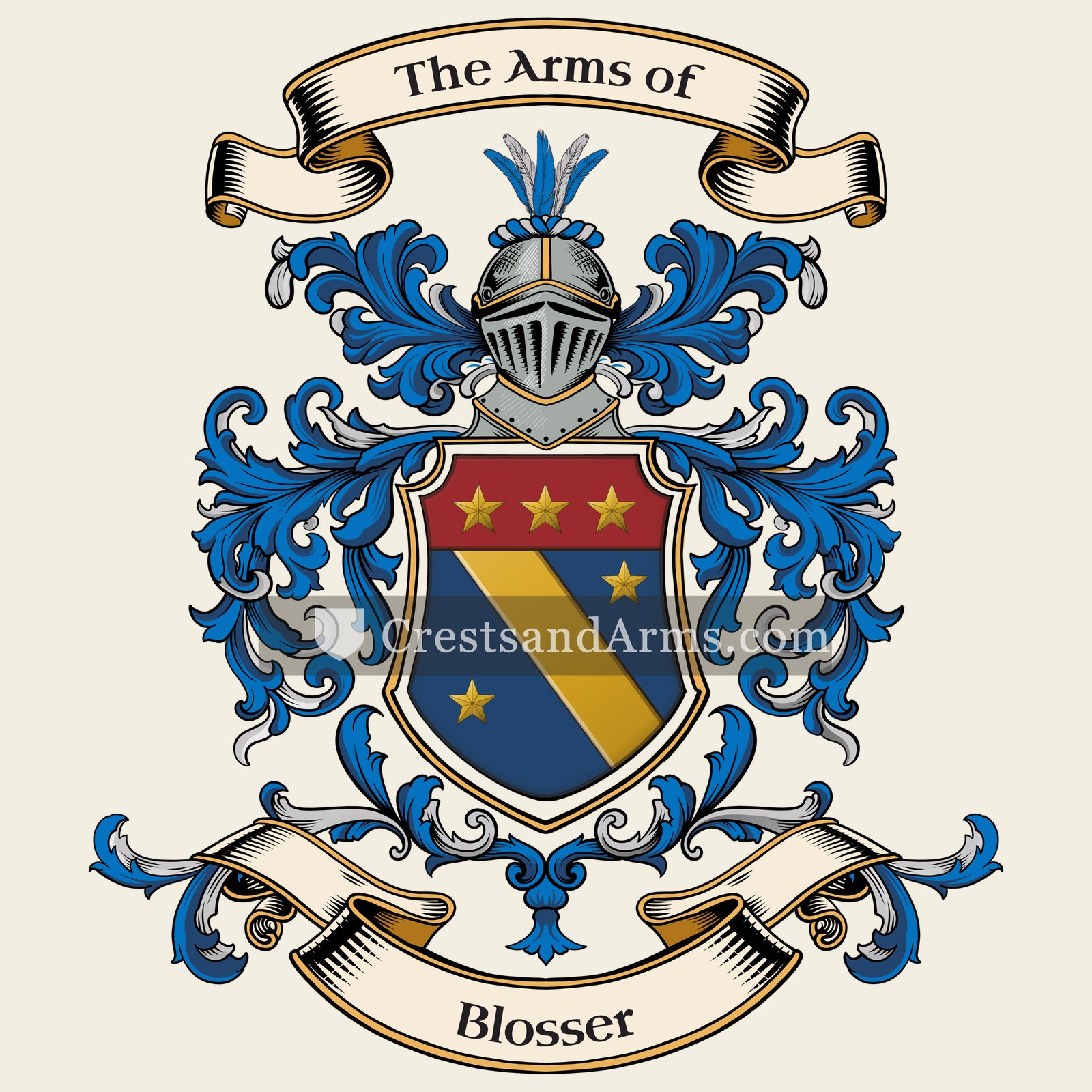
 bendDefence, and the scarf of a commander
 chiefAuthority, wisdom and dominion
 mulletThe third son, and a divine quality from above
 bendDefence, and the scarf of a commander
 chiefAuthority, wisdom and dominion
 mulletThe third son, and a divine quality from above