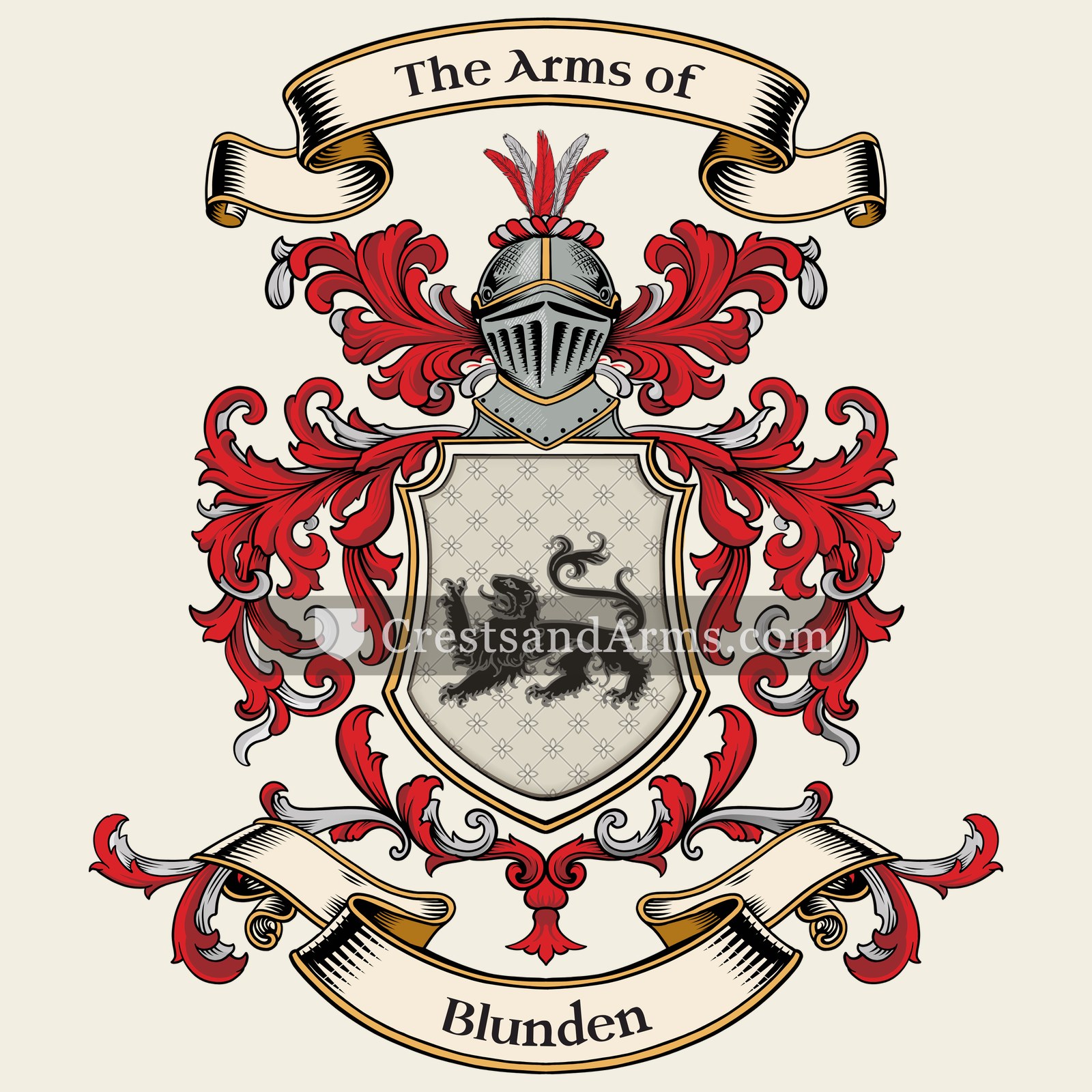
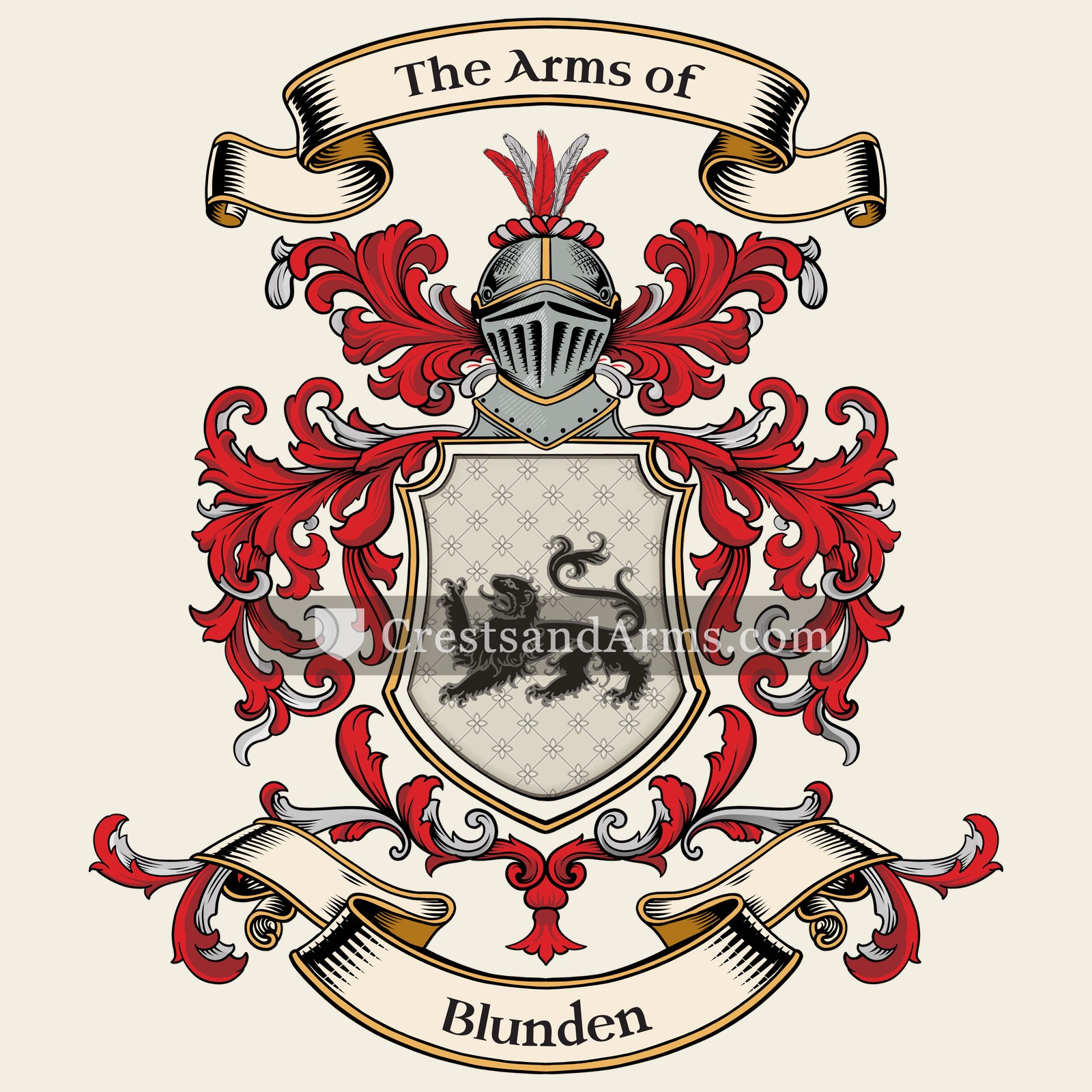
A record of documented arms, meaning and origin, researched for the Blunden family lines. Documented in 2 countries.
Reg. 8730 · English, A–C
Coat of Arms & Family Crest Details
Symbols on this shield
lionCourage, strength and royalty
Colours
Silver (Argent)Means: Peace and sincerity
Black (Sable)Means: Constancy
Historical info
Source
Sir Bernard Burke, The General Armory of England, Scotland, Ireland and Wales, London: Harrison & Sons, 1884
Blazon (the actual original written record)
“Ar. a lion pass. sa. (another, pass. guard.)”
SalopSalop, c. 1620
Where the Blunden Arms Were Recorded
Salop
Map of England showing where the Blunden arms are recorded
The Blunden arms were recorded in Salop, c. 1620.
Shropshire lay on the Welsh border, and border country needed men who could fight. Families held their land in return for service, and service in arms is what a coat of arms was originally for.
This is where the arms were entered in the register. Families often moved to other parts of the country, so the same name can turn up in more than one region.
The body that granted and recorded arms in England in this period.
James VI and I
Sovereign of the period
James VI and I
1603–1625
Reigning in England when the Blunden arms are first recorded.
How Arms Worked in England
English heraldry allowed arms to be shared by all legitimate descendants of the original owner. These symbols were treated as personal property that moved through the generations to all children. While the eldest son kept the original design, other family members could use the same shield without needing to change it or register their own unique versions.
Granting authority
The College of Arms in London has regulated the use of coats of arms throughout England and Wales since 1484.
How they got arms
Families typically obtained their coats of arms through a formal grant from the Crown or by proving their ancient right to them.
Where arms were recorded
All official coats of arms are recorded in the registers kept at the College of Arms, which date back to the fifteenth century.
The family's standing
Recorded among the armigerous families of Salop.
Origin & History of the Blunden Family in England
The surname Blunden is rooted in the landscape of medieval England, likely originating as a descriptive name for a person with a fair or pale complexion. By the early 17th century, the family had established a notable presence in the county of Shropshire, which was historically referred to as Salop. Records from 1620 confirm that members of the Blunden family were active in this region, where they integrated into the local social and economic life of the English West Midlands. During this period, families in Shropshire often held land or participated in local governance, helping to solidify the name within the community. As the family grew, they moved through various English parishes, leaving behind traces in local registers that document their daily lives, marriages, and contributions to the rural society of the time.
Coat of Arms & Family Crest Details
Symbols on this shield
lionCourage, strength and royalty
Colours
Silver (Argent)Means: Peace and sincerity
Black (Sable)Means: Constancy
Historical info
Source
Sir Bernard Burke, The General Armory of England, Scotland, Ireland and Wales, London: Harrison & Sons, 1884
Blazon (the actual original written record)
“Ar. a lion pass. sa. in the dexter paw a trefoil slipped vert”
Irelandc. 1645
Where the Blunden Arms Were Recorded
Dublin
Map of Ireland showing where the Blunden arms are recorded
The Blunden arms were recorded in Ireland, c. 1645.
Arms such as these were typically recorded in Dublin.
Dublin was the seat of government in Ireland and the place where grants were sought and recorded. Families with business at the castle or the courts settled nearby, and settling there put their arms on record.
This is where the arms were entered in the register. Families often moved to other parts of the country, so the same name can turn up in more than one region.
The body that granted and recorded arms in Ireland in this period.
Charles I of England
Sovereign of the period
Charles I of England
1625–1649
Reigning in England when the Blunden arms are first recorded.
How Arms Worked in Ireland
The Ulster King of Arms granted coats of arms to individuals who proved their social standing and good character. These symbols were typically inherited by all legitimate descendants of the original holder. If a family branch wanted a unique look, they could apply for a specific change to their design through the office to ensure their identity remained distinct.
Granting authority
The Ulster King of Arms acted as the official body that regulated and issued all coats of arms throughout Ireland.
How they got arms
Families obtained their arms through formal grants issued by the office after proving their eligibility and paying the required fees.
Where arms were recorded
All official grants were recorded in the registers held by the Ulster King of Arms starting from the year 1552.
The family's standing
Recorded among the armigerous families of Ireland.
Origin & History of the Blunden Family in Ireland
The Blunden family established a notable presence in Ireland by the mid-seventeenth century, with records confirming their residence in Dublin as early as 1645. During this period, the family became integrated into the administrative and social fabric of the city, often serving in professional or civic roles that were common for families of English origin settling in the Irish capital. As the seventeenth century progressed, members of the family expanded their influence beyond Dublin, eventually acquiring land and establishing estates in County Kilkenny. This transition from urban dwellers to landed gentry allowed the family to play a significant role in local governance and regional politics for several generations. Their history in Ireland reflects the broader patterns of migration and social mobility that characterized the era, as families moved to establish deep roots in the Irish landscape.
Related Branches & Arms
Root word
Blund
Old French term referring to someone with blonde or fair hair.
This name
BlundenA topographical or habitational name denoting a person with light-colored hair or a fair complexion.
also spelled
Blundin
Blundon
Blundyn
Documented Sources
Sir Bernard Burke, The General Armory of England, Scotland, Ireland and Wales, London: Harrison & Sons, 1884
Bardsley, Charles Wareing, A Dictionary of English and Welsh Surnames, 1901
Reaney, Percy Hide, A Dictionary of British Surnames, 1958
Shropshire Archives, Diocese of Lichfield Episcopal Visitation Records, 1620
Digital archive packCoat of arms PNG, gold border print PDF, vector SVG and the certificate of authenticity. Sent to your email in minutes.


 lionCourage, strength and royalty
 lionCourage, strength and royalty