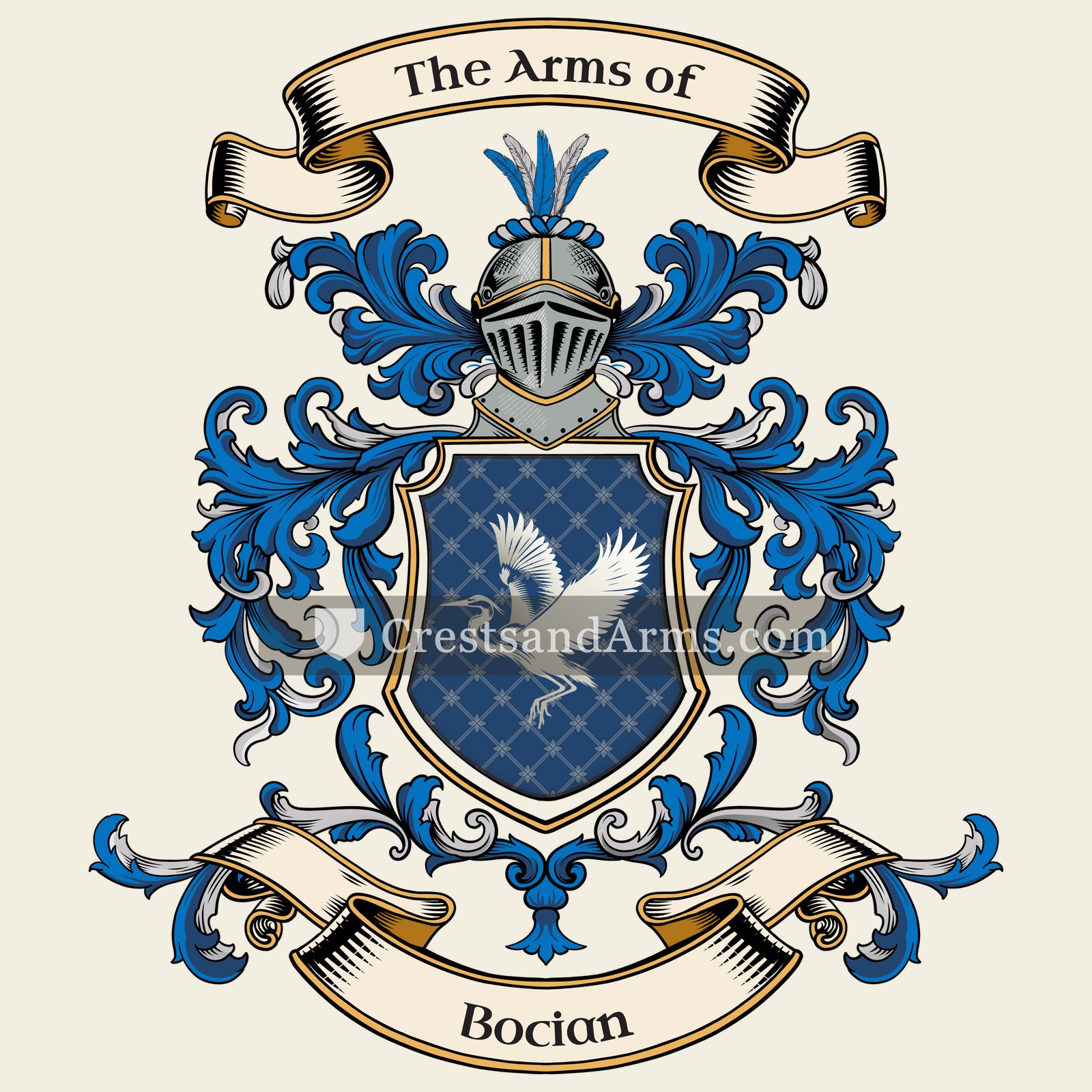
A record of documented arms, meaning and origin, researched for the Bocian family of Poland.
Reg. 9858 · Polish, A–C
Coat of Arms & Family Crest Details
Symbols on this shield
heronPatience and quiet watchfulness
Colours
Blue (Azure)Means: Loyalty and truth
Historical info
Source
J. B. Rietstap, Armorial Général, Gouda: G. B. van Goor Zonen, 1884–87
Blazon (the actual original written record)
“D'azur à une grue avec sa vigilance au nat. Cq. cour. C.: un vol de sa.”
Polandc. 1772
Where the Bocian Arms Were Recorded
Mazovia
Map of Poland showing where the Bocian arms are recorded
The Bocian arms were recorded in Poland, c. 1772.
Arms such as these were typically recorded in Mazovia.
Mazovia held Warsaw, the Polish court and the assemblies where the szlachta met. Poland's nobles were unusually numerous and every one of them bore arms, and Warsaw is where those arms were argued over and recorded.
This is where the arms were entered in the register. Families often moved to other parts of the country, so the same name can turn up in more than one region.
Region
Mazovia
First recorded
1772
Granting Authority for the Bocian Arms
Ennoblement by the Sejm
Author: Olek Remesz · CC BY-SA 3.0
The body that granted and recorded arms in Poland in this period.
Stanisław August Poniatowski
Sovereign of the period
Stanisław August Poniatowski
1764–1795
Reigning in Poland when the Bocian arms are first recorded.
How Arms Worked in Poland
Polish noble families shared a single coat of arms across many different surnames, creating large clans rather than individual designs. These symbols were held collectively by all members of the clan regardless of their specific family name. When a new family joined the nobility, they were adopted into an existing clan and began using that group's established shield.
Granting authority
The Sejm, which was the Polish parliament, held the power to grant noble status and the right to bear arms.
How they got arms
Families typically received their coat of arms through a formal act of ennoblement granted by the Sejm for distinguished service.
Where arms were recorded
These grants were officially recorded in the Crown Metrica, which served as the central archive for state documents starting in the sixteenth century.
The family's standing
Recorded among the armigerous families of Poland.
Origin & History of the Bocian Family in Poland
The surname Bocian is a descriptive name derived from the Polish word for stork, a bird deeply embedded in the cultural landscape of the Mazovia region. By 1772, families bearing this name were well-established in this central Polish province, where the flat, marshy terrain provided an ideal habitat for storks to nest near human settlements. In rural society, names often originated from nicknames or observations of the natural world, and families were frequently associated with the specific traits of the animals they lived alongside. Because the stork was viewed as a symbol of good fortune and agricultural prosperity, the name likely emerged as a respectful label for families who lived near these nesting grounds or who were known for their industrious nature. Over generations, this identifier transitioned from a simple nickname into a permanent family name, anchoring the Bocian lineage to the specific geography and traditions of the Mazovian plains.
Related Branches & Arms
Root word
bocian
A large long-legged wading bird of the stork family.
This name
BocianA topographic or nickname-based surname referring to someone associated with storks or their habitat.
also spelled
Boshian
Bokian
Documented Sources
J. B. Rietstap, Armorial Général, Gouda: G. B. van Goor Zonen, 1884–87


 heronPatience and quiet watchfulness
 heronPatience and quiet watchfulness