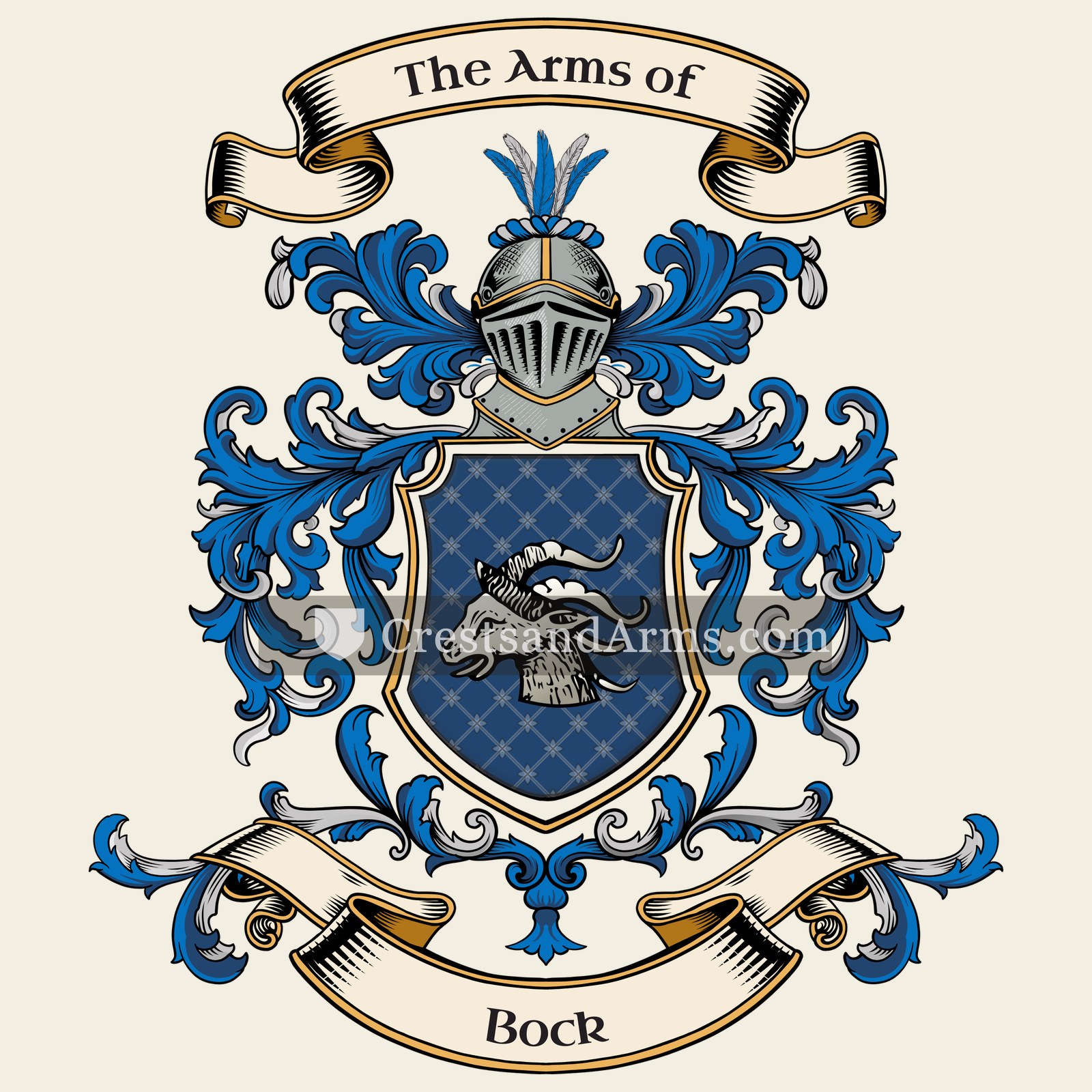
A record of documented arms, meaning and origin, researched for the Bock family lines. Documented in 3 countries.
Reg. 5651 · German, A–C
Coat of Arms & Family Crest Details
Symbols on this shield
mountThe ground held, and steadfastness upon it
wingSwiftness, and protection under a raised wing
goatOne who wins by diplomacy rather than force
griffinValour and vigilance, guarding great treasure
antelopeHarmony, polity and peace
Colours
Gold (Or)Means: Generosity
Red (Gules)Means: Military strength
Black (Sable)Means: Constancy
Green (Vert)Means: Hope
Historical info
Source
J. B. Rietstap, Armorial Général, Gouda: G. B. van Goor Zonen, 1884–87
Blazon (the actual original written record)
“Ec.: aux 1 et 4 d'or au bouc sautant de sa., soutenu d'une colline de sin., le bouc du 1 cont.; au 2 de gu. au griffon d'or, soutenu d'un tertre de sin. et tenant de ses pattes une flèche d'arg. en pal.; au 3 d'arg. à un chamois sautant et cont. au nat., soutenu d'une colline de sin. Sur le tout de sa. au vol d'or. Deux cq. cour. C.: 1° une tête et col de bouc cont. de sa., tenant entre ses dents une feuille de chène d'or; l. d'or et de sa.; 2° un vol à l'antique d'or, ch. d'une bande de gu., surch. du griffon du 2; l. d'arg. et de gu.”
BavariaBavaria, c. 1731
Digital archive packCoat of arms PNG, gold border print PDF, vector SVG and the certificate of authenticity. Sent to your email in minutes.
Map of Germany showing where the Bock arms are recorded
The Bock arms were recorded in Bavaria, c. 1731.
Bavaria was a country of old landed families and walled market towns. Estates passed down the same line for centuries, and both the landowners and the leading townsmen kept arms, which is why so many Bavarian names sit in the registers.
This is where the arms were entered in the register. Families often moved to other parts of the country, so the same name can turn up in more than one region.
The body that granted and recorded arms in Germany in this period.
Charles VI, Holy Roman Emperor
Sovereign of the period
Charles VI, Holy Roman Emperor
1711–1740
Reigning in Germany when the Bock arms are first recorded.
How Arms Worked in Germany
In the Holy Roman Empire, coats of arms were often granted to individuals by the Emperor or his representatives. These arms were then passed down through the generations to all legitimate descendants of the original holder. Younger branches of a family usually kept the same shield design without needing to change it, as the arms belonged to the entire lineage.
Granting authority
The Holy Roman Emperor held the sole power to grant new coats of arms throughout his vast imperial territories.
How they got arms
Families typically obtained their coats of arms through a formal imperial grant or by proving their noble status to the authorities.
Where arms were recorded
These grants were officially recorded in the Imperial Chancery registers, which began keeping formal records of such honors during the Middle Ages.
The family's standing
Recorded among the armigerous families of Bavaria.
Origin & History of the Bock Family in Germany
The surname Bock is a classic example of a German occupational or descriptive name that emerged during the Middle Ages. In the German language, the word *Bock* refers to a male goat or a buck, and it was often used as a nickname for a person who was perceived to be stubborn, strong, or particularly energetic. By the time records confirm the presence of the family in Bavaria in 1731, the name had been established for centuries as a common identifier across the German-speaking lands. Families bearing this name were typically part of the rural or middle-class population, often working as farmers, tradesmen, or foresters. Because the name was tied to a common animal found throughout the German countryside, it developed independently in various regions, meaning that many families named Bock share the same linguistic roots rather than a single common ancestor. By the early 18th century, the name was well-integrated into the local Bavarian community, reflecting a long history of families who lived and worked within the traditional social structures of the Holy Roman Empire.
Coat of Arms & Family Crest Details
Symbols on this shield
mountThe ground held, and steadfastness upon it
goatOne who wins by diplomacy rather than force
elephantGreat strength, wit and ambition
towerGrandeur and solidity, and a stronghold defended
applePeace, plenty and long-standing settlement
Colours
Red (Gules)Means: Military strength
Silver (Argent)Means: Peace and sincerity
Green (Vert)Means: Hope
Gold (Or)Means: Generosity
Historical info
Source
J. B. Rietstap, Armorial Général, Gouda: G. B. van Goor Zonen, 1884–87
Blazon (the actual original written record)
“Ec.: aux 1 et 4 de gu. à un bouc ramp. d'arg., accorné d'or, onglé de sa.; aux 2 et 3 d'arg. à un éléphant au nat., posé sur un tertre de sin., portant deux tours d'or essorées d'azur, avec une pomme de grenade de gu. entre ces deux tours. Deux cq. cour. C.: 1° le bouc, iss. et cont.; 2° un homme iss., hab. d'or, coiffé d'un chapeau à la matelotte de sa., tenant de sa main dextre la pomme de grenade et de sa sen. une des tours de l'éléphant. L. d'arg. et de gu.”
AlsaceAlsace, c. 1532
Digital archive packCoat of arms PNG, gold border print PDF, vector SVG and the certificate of authenticity. Sent to your email in minutes.
Map of France showing where the Bock arms are recorded
The Bock arms were recorded in Alsace, c. 1532.
Alsace lay between France and the German lands and belonged to both at different times. Its families held small estates and served whichever side ruled, and men who served in arms carried arms of their own.
This is where the arms were entered in the register. Families often moved to other parts of the country, so the same name can turn up in more than one region.
The body that granted and recorded arms in France in this period.
Francis I of France
Sovereign of the period
Francis I of France
1515–1547
Reigning in Germany when the Bock arms are first recorded.
How Arms Worked in France
In France, a coat of arms was a mark of honor that passed down through the male line to all legitimate descendants. Families often used the same shield without changes to show their shared heritage. If a branch wanted to stand out, they could add a small mark to their shield to show their specific place in the family tree.
Granting authority
The Juge d'armes de France acted as the official authority that regulated and verified coats of arms across the country.
How they got arms
Families typically inherited their arms from ancestors, though they could also receive them through royal grants or by proving their noble status.
Where arms were recorded
Coats of arms were officially recorded in the Armorial Général de France, which began its main collection in the year 1696.
The family's standing
Recorded among the armigerous families of Alsace.
Origin & History of the Bock Family in France
The family name Bock has deep roots in the Alsace region, a territory that has long served as a cultural bridge between France and Germany. By 1532, members of the Bock family were already established as residents in this area, living during a time of significant religious and social transition. The name itself is thought to be derived from the Middle High German word for a male goat, which was often used as a descriptive nickname for a person with a strong or stubborn personality. In the sixteenth century, families in Alsace often lived in small, tightly knit agricultural communities where they contributed to the local economy through farming or trade. As the region shifted between different political influences, the Bock family maintained their presence in the local records, reflecting the steady persistence of families who helped shape the unique identity of the Alsatian borderlands.
Coat of Arms & Family Crest Details
Symbols on this shield
goats headWisdom, and one who wins by policy rather than force
Colours
Blue (Azure)Means: Loyalty and truth
Silver (Argent)Means: Peace and sincerity
Historical info
Source
J. B. Rietstap, Armorial Général, Gouda: G. B. van Goor Zonen, 1884–87
Blazon (the actual original written record)
“D'azur à une tête et col de bouc (sans cornes) d'arg. C.: le meuble de l'écu, entre deux prob., coupées alt d'arg. et d'azur.”
Swedenc. 1532
Digital archive packCoat of arms PNG, gold border print PDF, vector SVG and the certificate of authenticity. Sent to your email in minutes.
Map of Sweden showing where the Bock arms are recorded
The Bock arms were recorded in Sweden, c. 1532.
Arms such as these were typically recorded in Stockholm.
Stockholm held the Swedish court and the House of Nobility, where every noble family's arms were entered and kept. Families ennobled for service registered there, which is why so many are recorded around the city.
This is where the arms were entered in the register. Families often moved to other parts of the country, so the same name can turn up in more than one region.
The body that granted and recorded arms in Sweden in this period.
Gustav I of Sweden
Sovereign of the period
Gustav I of Sweden
1523–1560
Reigning in Germany when the Bock arms are first recorded.
How Arms Worked in Sweden
In Sweden, a coat of arms belonged to a noble family as a whole rather than just one individual. These arms were passed down through the generations to all legitimate descendants. Younger branches of the family used the same shield without needing to change it. This system ensured that the entire lineage shared the same identity and status under the law.
Granting authority
The Riddarhuset, or House of Nobility, regulated all noble coats of arms in Sweden under royal authority.
How they got arms
Families received their coats of arms through royal grants of nobility which were then officially registered with the House.
Where arms were recorded
Coats of arms were officially recorded in the Swedish House of Nobility register starting in the year 1626.
The family's standing
Recorded among the armigerous families of Sweden.
Origin & History of the Bock Family in Sweden
The history of the Bock family in Sweden traces back to the early sixteenth century, with documented evidence placing members of the family in Stockholm as early as 1532. During this period, the name was often associated with individuals who held positions of responsibility within the growing urban centers of the Swedish realm. As Stockholm evolved from a medieval trading hub into a central seat of power, the Bock family integrated into the social and economic life of the city. They were part of the demographic shift that saw families transition from local merchants or minor officials into more established roles within the Swedish administration. By maintaining a presence in the capital during the reign of Gustav Vasa, the family witnessed a transformative era in Swedish history that saw the country move toward becoming a centralized modern state. This early residency in Stockholm suggests that the family was well-positioned to participate in the political and commercial developments that defined the sixteenth century.
Bock Meaning & Related Branches
Root word
bukkaz
A Proto-Germanic term referring to a male goat or buck.
This name
BockAn occupational name for a goatherd or a nickname for someone with goat-like characteristics.
also spelled
Bocke
Beck
Bek
Bok
Boke
Related arms
Bokvariant spelling
Documented Sources
J. B. Rietstap, Armorial Général, Gouda: G. B. van Goor Zonen, 1884–87
Bahlow, Hans, Deutsches Namenlexikon: Familien- und Vornamen nach Ursprung und Sinn erklärt, 1967
Heintze, Albert, Die deutschen Familien-Namen: geschichtlich, geographisch, sprachlich, 1903


 mountThe ground held, and steadfastness upon it
 wingSwiftness, and protection under a raised wing
 goatOne who wins by diplomacy rather than force
 griffinValour and vigilance, guarding great treasure
 antelopeHarmony, polity and peace
 mountThe ground held, and steadfastness upon it
 wingSwiftness, and protection under a raised wing
 goatOne who wins by diplomacy rather than force
 griffinValour and vigilance, guarding great treasure
 antelopeHarmony, polity and peace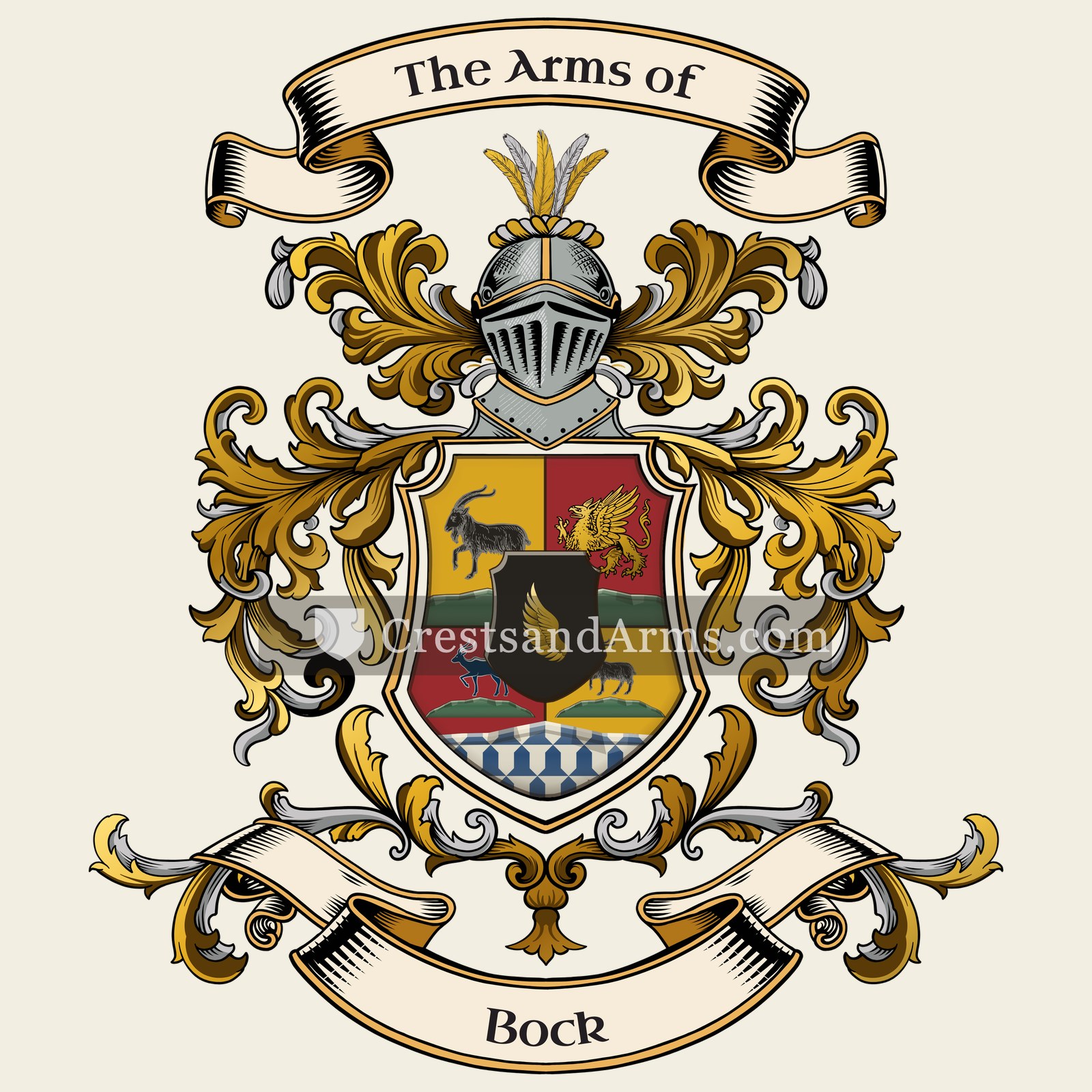


 elephantGreat strength, wit and ambition
 towerGrandeur and solidity, and a stronghold defended
 applePeace, plenty and long-standing settlement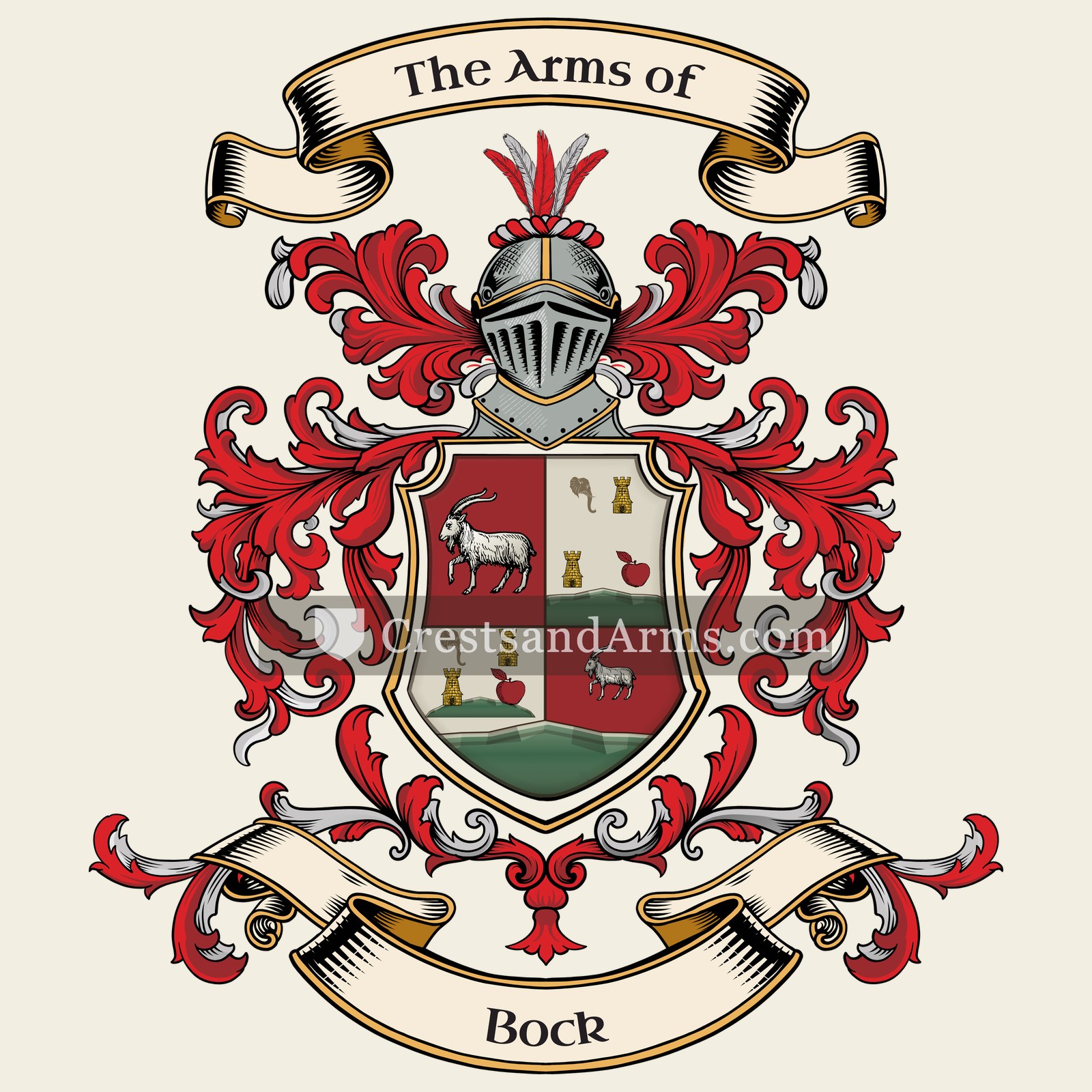


 goats headWisdom, and one who wins by policy rather than force