A record of documented arms, meaning and origin, researched for the Bode family lines. Documented in 3 countries.
Reg. 8719 · German, A–C
Coat of Arms & Family Crest Details
Symbols on this shield
mountThe ground held, and steadfastness upon it
dovePeace, love and the Holy Spirit
roseThe seventh son, and beauty with grace
Colours
Blue (Azure)Means: Loyalty and truth
Silver (Argent)Means: Peace and sincerity
Green (Vert)Means: Hope
Red (Gules)Means: Military strength
Historical info
Source
J. B. Rietstap, Armorial Général, Gouda: G. B. van Goor Zonen, 1884–87
Blazon (the actual original written record)
“Coupé: au 1 d'azur à une colombe d'arg., bq., m. et ailée de gu., posée sur un tertre de sin.; au 2 d'arg. à trois roses de gu., bout. d'or, tigées et feuillées de sin., posées sur une terrasse du même. Cq. cour. C.: un rencontre de boeuf d'arg. L.: à dextre d'arg. et d'azur, à sen. d'arg. et de gu.”
GermanyBade, c. 1707
Digital archive packCoat of arms PNG, gold border print PDF, vector SVG and the certificate of authenticity. Sent to your email in minutes.
Map of Germany showing where the Bode arms are recorded
The Bode arms were recorded in Bade, c. 1707.
This is where the arms were entered in the register. Families often moved to other parts of the country, so the same name can turn up in more than one region.
The body that granted and recorded arms in Germany in this period.
Joseph I, Holy Roman Emperor
Sovereign of the period
Joseph I, Holy Roman Emperor
1705–1711
Reigning in Germany when the Bode arms are first recorded.
How Arms Worked in Germany
In the Holy Roman Empire, coats of arms were often granted to individuals by the Emperor or his representatives. These arms were then passed down through the generations to all legitimate descendants of the original holder. Younger branches of a family usually kept the same shield design without needing to change it, as the arms belonged to the entire lineage.
Granting authority
The Holy Roman Emperor held the sole power to grant new coats of arms throughout his vast imperial territories.
How they got arms
Families typically obtained their coats of arms through a formal imperial grant or by proving their noble status to the authorities.
Where arms were recorded
These grants were officially recorded in the Imperial Chancery registers, which began keeping formal records of such honors during the Middle Ages.
The family's standing
Recorded among the armigerous families of Germany.
Origin & History of the Bode Family in Germany
The surname Bode has deep roots in the northern regions of Germany, where it likely originated as a short form of ancient Germanic names starting with the element "bod," meaning messenger or command. By the early 18th century, families carrying this name were well-established in the region of Bade. During this period, the Bode family lived in a society defined by local agricultural traditions and strict parish record-keeping. As the family grew, they became part of the backbone of rural German life, often working as skilled farmers or craftsmen within their village communities. Their presence in the historical records of 1707 reflects a time when families were deeply tied to the land and the local church, which served as the primary center for documenting births, marriages, and deaths for generations.
Coat of Arms & Family Crest Details
Symbols on this shield
martletA younger son, who must win his own land
Colours
Silver (Argent)Means: Peace and sincerity
Historical info
Source
J. B. Rietstap, Armorial Général, Gouda: G. B. van Goor Zonen, 1884–87
Blazon (the actual original written record)
“Ec.: aux 1 et 4 d'arg. à un pivert, becquetant un chicot sur lequel il est perché, le tout”
Russiac. 1784
Digital archive packCoat of arms PNG, gold border print PDF, vector SVG and the certificate of authenticity. Sent to your email in minutes.
Map of Russia showing where the Bode arms are recorded
The Bode arms were recorded in Russia, c. 1784.
Arms such as these were typically recorded in Moscow.
Moscow held the Russian court, and rank there came from service rather than land. Families who served the Tsar were entered in the registers of nobility, and that entry is where their arms are recorded.
This is where the arms were entered in the register. Families often moved to other parts of the country, so the same name can turn up in more than one region.
The body that granted and recorded arms in Russia in this period.
Catherine II of Russia
Sovereign of the period
Catherine II of Russia
1762–1796
Reigning in Germany when the Bode arms are first recorded.
How Arms Worked in Russia
Russian heraldry was strictly tied to the nobility and the state service system. Families proved their ancient status or earned new rank to receive an official grant from the Tsar. These symbols were then inherited by all legitimate children of the noble line. If a family lacked proof of their status, they were often excluded from the official records entirely.
Granting authority
The Herald Master's Office acted as the central state body that strictly regulated and verified all noble heraldic symbols.
How they got arms
Families typically received their arms through a formal state grant or by proving their noble status to the government authorities.
Where arms were recorded
All approved coats of arms were officially recorded in the General Armorial of the Noble Families of the Russian Empire starting in 1797.
The family's standing
Recorded among the armigerous families of Russia.
Origin & History of the Bode Family in Russia
The history of the Bode family in Russia began to take shape during the late eighteenth century when members of the family established a presence in Moscow by 1784. During this era, the Russian Empire actively encouraged the migration of skilled professionals and intellectuals from Western Europe to modernize its administration and cultural life. The Bodes were part of this wave of arrivals who integrated into the upper echelons of Russian society. By settling in Moscow, they positioned themselves within the heart of the nation’s social and political activity. Over the following decades, the family became deeply connected to the Russian nobility and served in various capacities within the imperial government. Their transition from foreign arrivals to established residents reflects the broader trend of European families finding new opportunities and influence within the Russian capital during the Enlightenment period.
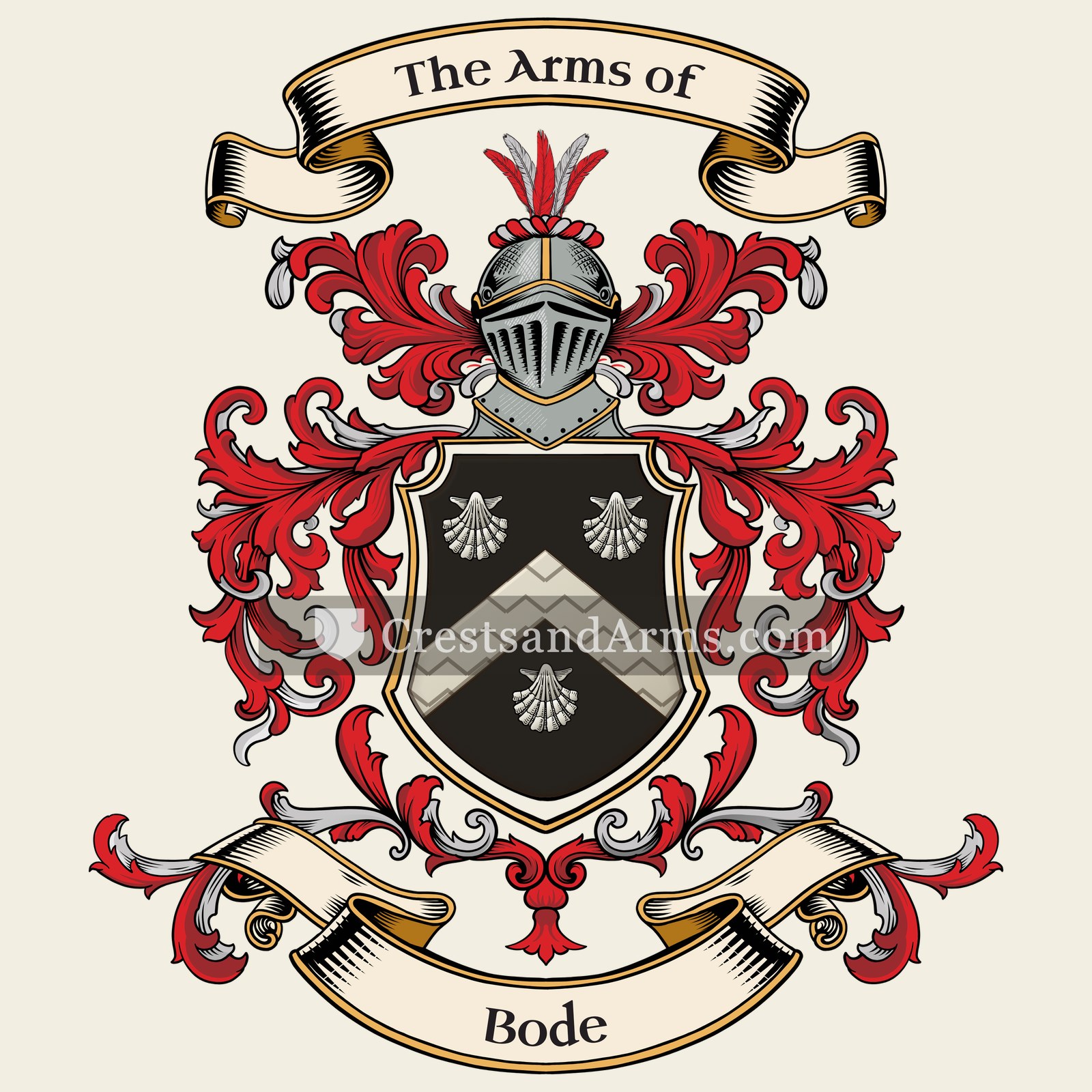
Coat of Arms & Family Crest Details
Symbols on this shield
chevronProtection, and faithful service completed
escallopThe pilgrim's shell, and a long journey made
Colours
Black (Sable)Means: Constancy
Silver (Argent)Means: Peace and sincerity
Historical info
Source
Sir Bernard Burke, The General Armory of England, Scotland, Ireland and Wales, London: Harrison & Sons, 1884
Blazon (the actual original written record)
“Sa. two chev. betw. three escallops ar”
KentFeversham · Kent, c. 1620
Digital archive packCoat of arms PNG, gold border print PDF, vector SVG and the certificate of authenticity. Sent to your email in minutes.
Map of England showing where the Bode arms are recorded
The Bode arms were recorded in Kent, c. 1620.
Kent sits between London and the short crossing to Europe, and the trade passing through made it wealthy. Merchant families bought land with that money, and it was landowners who took coats of arms.
This is where the arms were entered in the register. Families often moved to other parts of the country, so the same name can turn up in more than one region.
The body that granted and recorded arms in England in this period.
James VI and I
Sovereign of the period
James VI and I
1603–1625
Reigning in Germany when the Bode arms are first recorded.
How Arms Worked in England
English heraldry allowed arms to be shared by all legitimate descendants of the original owner. These symbols were treated as personal property that moved through the generations to all children. While the eldest son kept the original design, other family members could use the same shield without needing to change it or register their own unique versions.
Granting authority
The College of Arms in London has regulated the use of coats of arms throughout England and Wales since 1484.
How they got arms
Families typically obtained their coats of arms through a formal grant from the Crown or by proving their ancient right to them.
Where arms were recorded
All official coats of arms are recorded in the registers kept at the College of Arms, which date back to the fifteenth century.
The family's standing
Recorded among the armigerous families of Kent.
Origin & History of the Bode Family in England
The family name Bode has roots that stretch back to the medieval period, often originating as a descriptive term for a messenger or a person who acted as a representative for others. By the early 17th century, the name was firmly established in the county of Kent, where records confirm members of the family were living by 1620. During this era, Kent served as a vital hub for trade and agriculture, placing the Bode family within a region known for its strong ties to London and the continent. As the family settled into the local community, they likely engaged in the typical trades of the time, such as farming or local commerce, which were essential to the economy of southeastern England. Their presence in Kent during this period suggests they were part of the stable, land-holding population that helped shape the social fabric of the English countryside before the great migrations to the New World.
Bode Meaning & Related Branches
Root word
Bodo
Derived from the Old High German word for messenger or herald.
This name
BodeA patronymic surname indicating a descendant of a messenger or a leader.
also spelled
Boad
Boade
Related arms
Gilg de Gilgenburgsimilar arms
Koprziva de Nesselfeldsimilar arms
Pavesisimilar arms
Boadevariant spelling
Documented Sources
J. B. Rietstap, Armorial Général, Gouda: G. B. van Goor Zonen, 1884–87
Bahlow, Hans, Deutsches Namenlexikon: Familien- und Vornamen nach Ursprung und Sinn erklärt, 1967
Gottschald, Max, Deutsche Namenkunde: Unsere Familiennamen nach ihrer Entstehung und Bedeutung, 1971
Niedersächsisches Landesarchiv (Hannover), Kirchenbuchduplikate der Ämter und Städte, 1707
Digital archive packCoat of arms PNG, gold border print PDF, vector SVG and the certificate of authenticity. Sent to your email in minutes.


 mountThe ground held, and steadfastness upon it
 dovePeace, love and the Holy Spirit
 roseThe seventh son, and beauty with grace
 mountThe ground held, and steadfastness upon it
 dovePeace, love and the Holy Spirit
 roseThe seventh son, and beauty with grace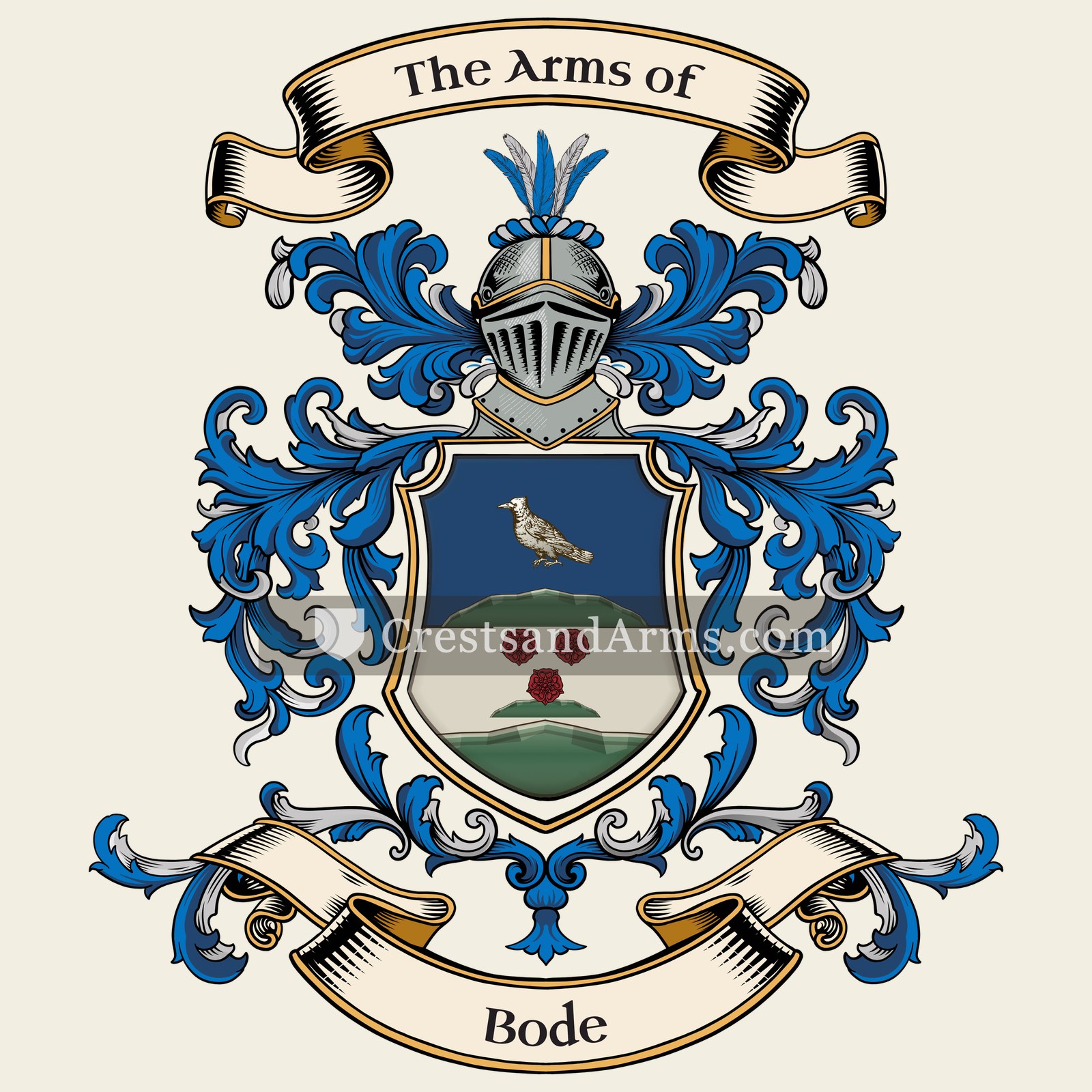


 martletA younger son, who must win his own land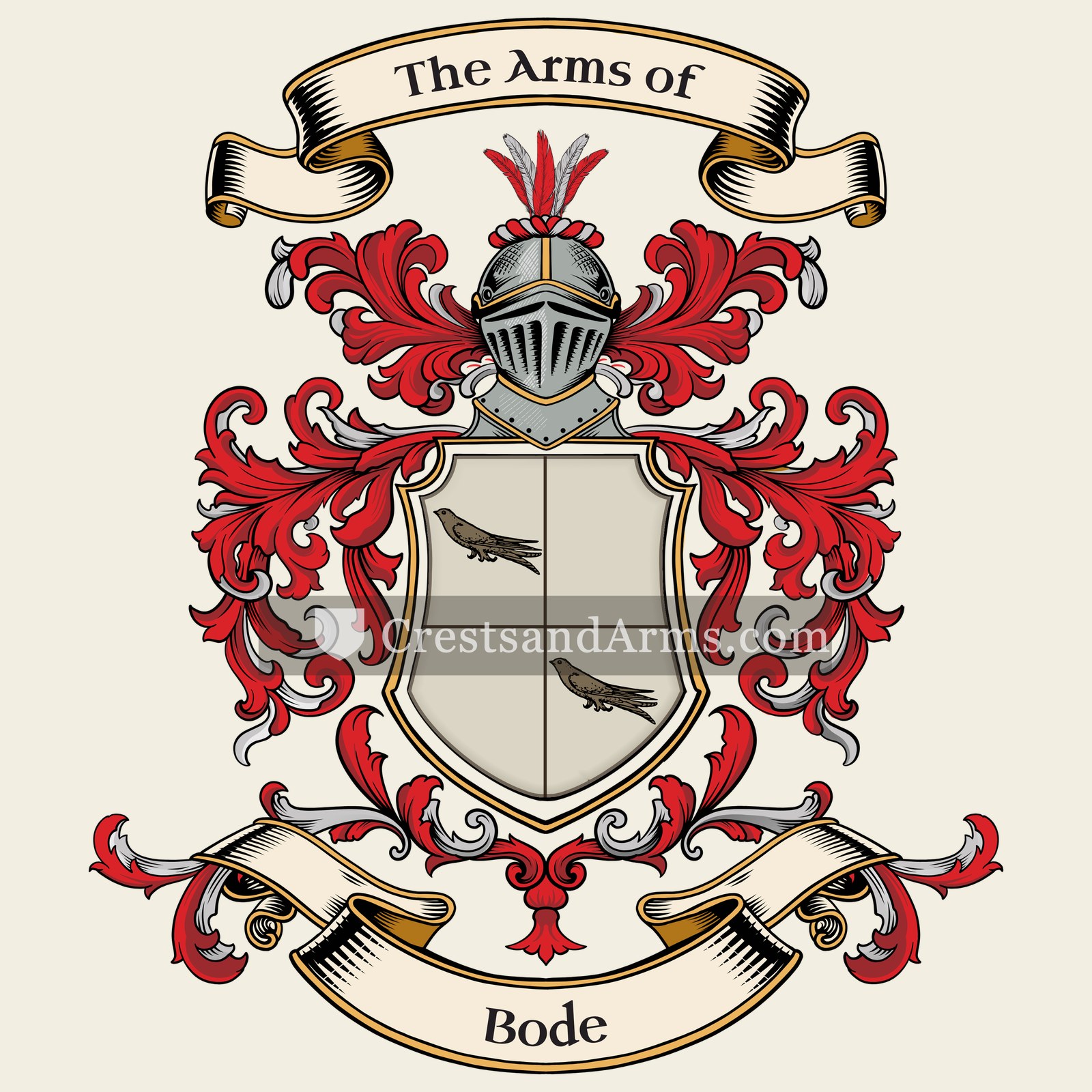


 chevronProtection, and faithful service completed
 escallopThe pilgrim's shell, and a long journey made