A record of documented arms, meaning and origin, researched for the Boden family lines. Documented in 3 countries.
Reg. 5755 · German, A–C
Coat of Arms & Family Crest Details
Symbols on this shield
mountThe ground held, and steadfastness upon it
eagleNobility, strength and a keen mind
wheatsheafPlenty, and the harvest of one's own labour
batonAuthority and office held under the crown
legStrength and swiftness
Colours
Silver (Argent)Means: Peace and sincerity
Red (Gules)Means: Military strength
Gold (Or)Means: Generosity
Green (Vert)Means: Hope
Black (Sable)Means: Constancy
Historical info
Source
J. B. Rietstap, Armorial Général, Gouda: G. B. van Goor Zonen, 1884–87
Blazon (the actual original written record)
“Ec.: au 1 d'arg. à la tête de l'aigle de Prusse; au 2 de gu. à trois épis d'or, tigés et feuillés de sin., rangés sur un tertre du même; au 3 d'azur à un messager au nat., tenant un bâton, pass. sur une terrasse de sin. soutenue d'un rocher d'arg.; au 4 d'arg. à un membre d'aigle de sa., la patte d'or. L'écu bordé d'or. C.: une étoile (8) d'or, entre un vol de l'aigle de Prusse. L.: à dextre d'or et de sa., à sen. d'or et de gu.”
Germanyc. 1739
Digital archive packCoat of arms PNG, gold border print PDF, vector SVG and the certificate of authenticity. Sent to your email in minutes.
Map of Germany showing where the Boden arms are recorded
The Boden arms were recorded in Germany, c. 1739.
Arms such as these were typically recorded in Bavaria.
Bavaria was a country of old landed families and walled market towns. Estates passed down the same line for centuries, and both the landowners and the leading townsmen kept arms, which is why so many Bavarian names sit in the registers.
This is where the arms were entered in the register. Families often moved to other parts of the country, so the same name can turn up in more than one region.
The body that granted and recorded arms in Germany in this period.
Charles VI, Holy Roman Emperor
Sovereign of the period
Charles VI, Holy Roman Emperor
1711–1740
Reigning in Germany when the Boden arms are first recorded.
How Arms Worked in Germany
In the Holy Roman Empire, coats of arms were often granted to individuals by the Emperor or his representatives. These arms were then passed down through the generations to all legitimate descendants of the original holder. Younger branches of a family usually kept the same shield design without needing to change it, as the arms belonged to the entire lineage.
Granting authority
The Holy Roman Emperor held the sole power to grant new coats of arms throughout his vast imperial territories.
How they got arms
Families typically obtained their coats of arms through a formal imperial grant or by proving their noble status to the authorities.
Where arms were recorded
These grants were officially recorded in the Imperial Chancery registers, which began keeping formal records of such honors during the Middle Ages.
The family's standing
Recorded among the armigerous families of Germany.
Origin & History of the Boden Family in Germany
The surname Boden is deeply rooted in the German language and geography, originating as a topographic name for people who lived on a stretch of flat land or a valley floor. In Middle High German, the word *boden* referred to the ground or the bottom of a valley, suggesting that the earliest ancestors to carry this name were likely farmers or settlers who worked the low-lying fields of the Bavarian region. By the time records place the family in Bavaria in 1739, the name had already become a well-established identifier for families tied to specific plots of land. During this period, Bavaria was a patchwork of agricultural communities where a family name often served as a link to the local landscape. These early generations lived through a time of significant social change, as families began to transition from being defined solely by their village to being recognized by a stable, inherited surname. This evolution reflects the broader history of German naming customs, where geographical features were frequently used to distinguish one family from another in growing rural populations.
Coat of Arms & Family Crest Details
Symbols on this shield
trefoilPerpetuity, and the Trinity
mulletThe third son, and a divine quality from above
lozengeHonour and nobility, and the arms of a woman
Colours
Silver (Argent)Means: Peace and sincerity
Blue (Azure)Means: Loyalty and truth
Green (Vert)Means: Hope
Gold (Or)Means: Generosity
Red (Gules)Means: Military strength
Historical info
Source
J. B. Rietstap, Armorial Général, Gouda: G. B. van Goor Zonen, 1884–87
Blazon (the actual original written record)
“Coupé: au 1 d'arg. à un trèfle de sin., accosté de deux étoiles (5) d'or; au 2 d'azur à trois losanges de gu. taillées à quatre facettes, rangées en fasce et touchant les bords.”
Switzerlandc. 1745
Digital archive packCoat of arms PNG, gold border print PDF, vector SVG and the certificate of authenticity. Sent to your email in minutes.
Map of Switzerland showing where the Boden arms are recorded
The Boden arms were recorded in Switzerland, c. 1745.
Arms such as these were typically recorded in Bern.
Bern was the largest of the Swiss cantons and ran itself, with its own council and its own courts. Its governing families held office for generations, and office of that kind carried a shield with it.
This is where the arms were entered in the register. Families often moved to other parts of the country, so the same name can turn up in more than one region.
The body that granted and recorded arms in Switzerland in this period.
How Arms Worked in Switzerland
In Switzerland, coats of arms were not restricted to the nobility and were often adopted by common citizens and families. These symbols were passed down through generations to show family identity. When branches of a family grew, they often changed small details of the design to distinguish their own line from the original group.
Granting authority
Cantonal and civic authorities managed the use of coats of arms within their specific regions and local jurisdictions.
How they got arms
Families typically assumed their own coats of arms based on local custom rather than receiving them from a central monarch.
Where arms were recorded
Arms were recorded in various cantonal and civic registers starting from the fourteenth century throughout the Swiss region.
The family's standing
Recorded among the armigerous families of Switzerland.
Origin & History of the Boden Family in Switzerland
The surname Boden has deep roots in the Swiss landscape, where it historically functioned as a topographic name. In the German language, the word *Boden* refers to the ground, floor, or a specific piece of land, suggesting that the earliest ancestors to carry this name were likely identified by the location of their farm or homestead. By the year 1745, records confirm that members of the Boden family were established residents of Bern. During this period, families in the region were often tied to specific parishes and local agricultural guilds, which helped maintain their social standing within the city. As these early family members navigated life in Bern, they contributed to the local economy and community structure that defined the Swiss cantons during the eighteenth century. This connection to the land remained a central part of their identity as they settled into the urban and rural environments of the Swiss Confederation.
Coat of Arms & Family Crest Details
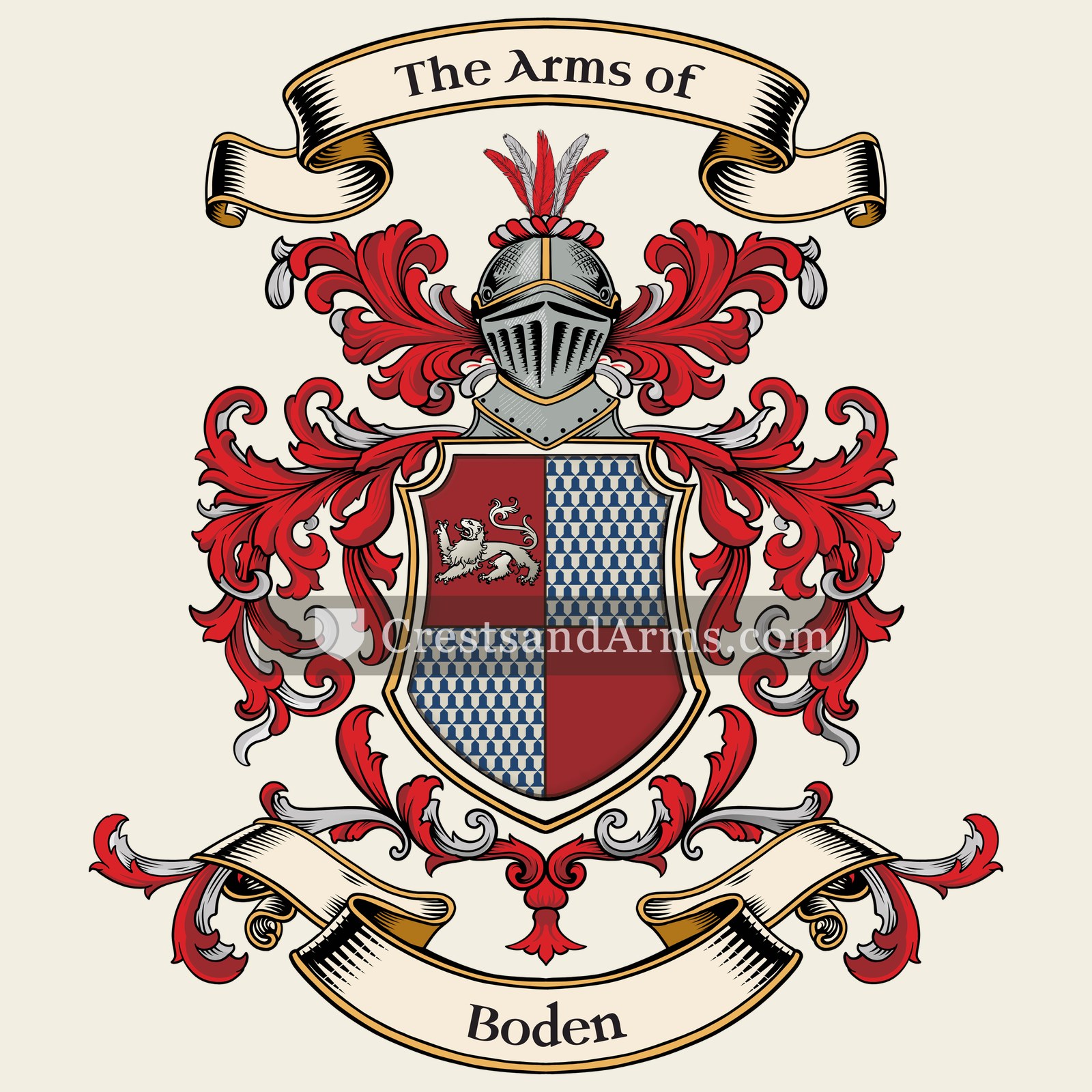
Symbols on this shield
vairProtection, and the winter fur
lionCourage, strength and royalty
Colours
Red (Gules)Means: Military strength
VairMeans: Protection
Silver (Argent)Means: Peace and sincerity
Historical info
Source
Sir Bernard Burke, The General Armory of England, Scotland, Ireland and Wales, London: Harrison & Sons, 1884
Blazon (the actual original written record)
“Quarterly gu. and vair, in the first quarter a lion pass. ar”
LancasterWorsley · Lancaster, c. 1620
Digital archive packCoat of arms PNG, gold border print PDF, vector SVG and the certificate of authenticity. Sent to your email in minutes.
Map of England showing where the Boden arms are recorded
The Boden arms were recorded in Lancaster, c. 1620.
Lancashire was divided among a great many small landed families, more than most northern counties. Estates were passed down whole rather than split up, so the same names hold the same ground for centuries in the records.
This is where the arms were entered in the register. Families often moved to other parts of the country, so the same name can turn up in more than one region.
The body that granted and recorded arms in England in this period.
James VI and I
Sovereign of the period
James VI and I
1603–1625
Reigning in Germany when the Boden arms are first recorded.
How Arms Worked in England
English heraldry allowed arms to be shared by all legitimate descendants of the original owner. These symbols were treated as personal property that moved through the generations to all children. While the eldest son kept the original design, other family members could use the same shield without needing to change it or register their own unique versions.
Granting authority
The College of Arms in London has regulated the use of coats of arms throughout England and Wales since 1484.
How they got arms
Families typically obtained their coats of arms through a formal grant from the Crown or by proving their ancient right to them.
Where arms were recorded
All official coats of arms are recorded in the registers kept at the College of Arms, which date back to the fifteenth century.
The family's standing
Recorded among the armigerous families of Lancaster.
Origin & History of the Boden Family in England
The surname Boden has deep roots in the English landscape, with historical evidence placing families of this name in the county of Lancaster as early as 1620. The name is generally considered a topographic or locational surname, likely derived from people who lived near a specific piece of land or a valley. In the seventeenth century, the region of Lancashire was a hub of agricultural and textile activity, and families like the Bodens were often deeply connected to the local parish system. These early records suggest that the family was part of the growing population of northern England, moving through generations as farmers, tradespeople, or local craftsmen. By establishing themselves in Lancaster, the early members of the Boden family became part of the long history of families who helped shape the social and economic fabric of the English countryside during the Stuart period.
Boden Meaning & Related Branches
Root word
Bodo
Derived from the Old High German word for messenger or herald.
This name
BodenA topographic name for someone who lived on a plot of land or floor.
also spelled
Boddin
Bodenh
Bodenn
Bodin
Bodyn
Documented Sources
J. B. Rietstap, Armorial Général, Gouda: G. B. van Goor Zonen, 1884–87
Bahlow, Hans, Deutsches Namenlexikon: Familien- und Vornamen nach Ursprung und Sinn erklärt, 1967
Heintze, Albert, Die deutschen Familiennamen: geschichtlich, geographisch, sprachlich, 1903


 mountThe ground held, and steadfastness upon it
 eagleNobility, strength and a keen mind
 wheatsheafPlenty, and the harvest of one's own labour
 batonAuthority and office held under the crown
 legStrength and swiftness
 mountThe ground held, and steadfastness upon it
 eagleNobility, strength and a keen mind
 wheatsheafPlenty, and the harvest of one's own labour
 batonAuthority and office held under the crown
 legStrength and swiftness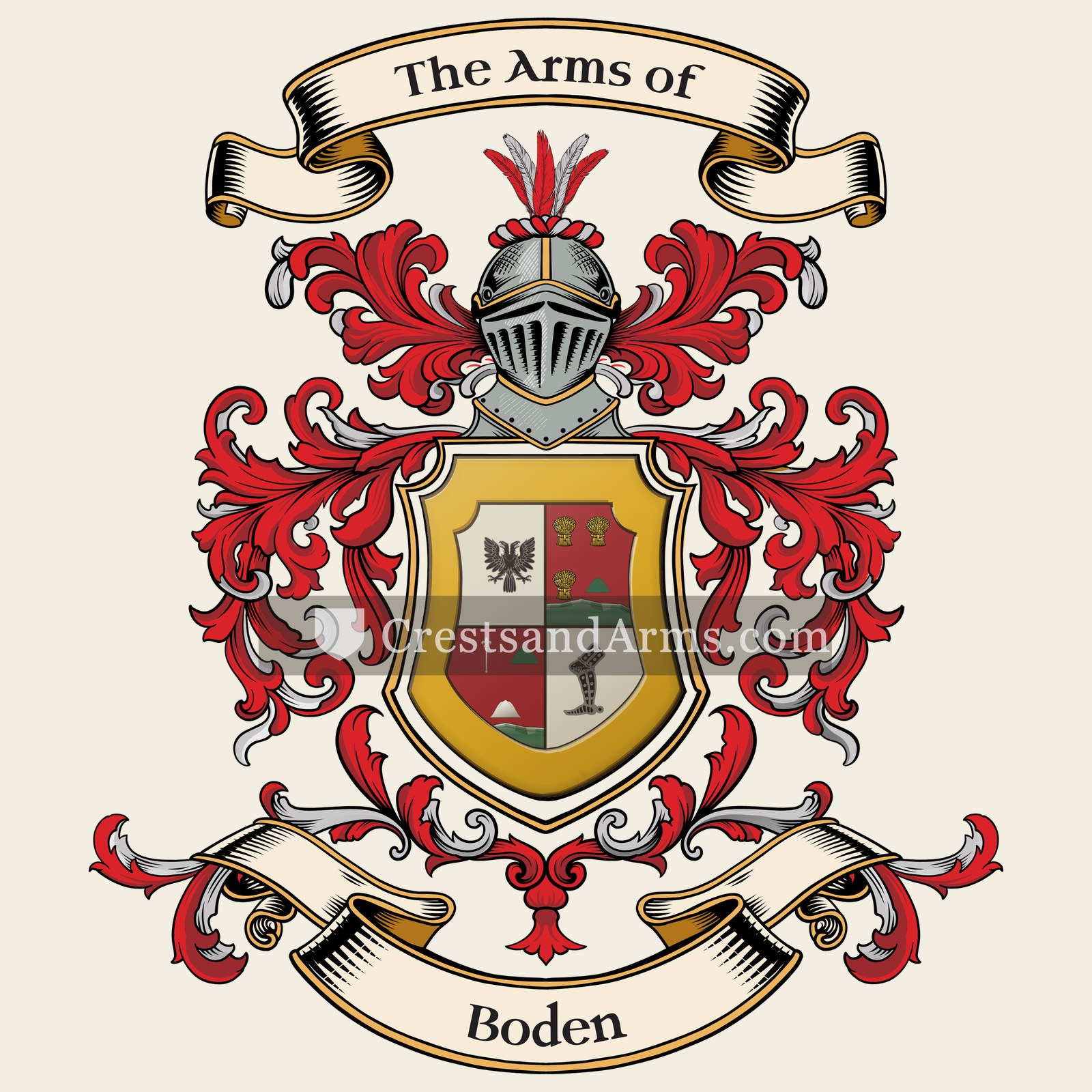


 trefoilPerpetuity, and the Trinity
 mulletThe third son, and a divine quality from above
 lozengeHonour and nobility, and the arms of a woman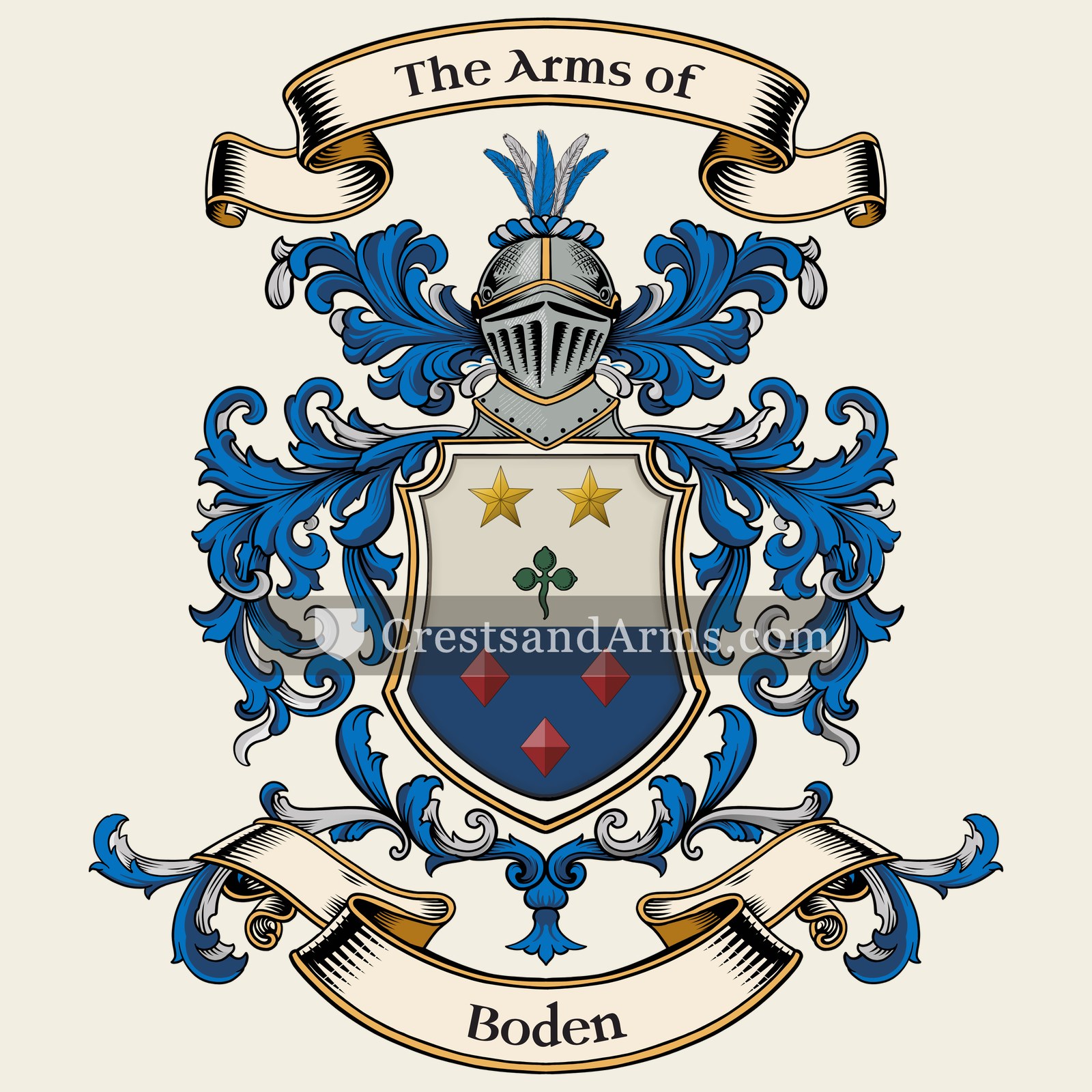

 lionCourage, strength and royalty