A record of documented arms, meaning and origin, researched for the Bodley family lines. Documented in 3 countries.
Reg. 8417 · Britain, A–C
Coat of Arms & Family Crest Details
Symbols on this shield
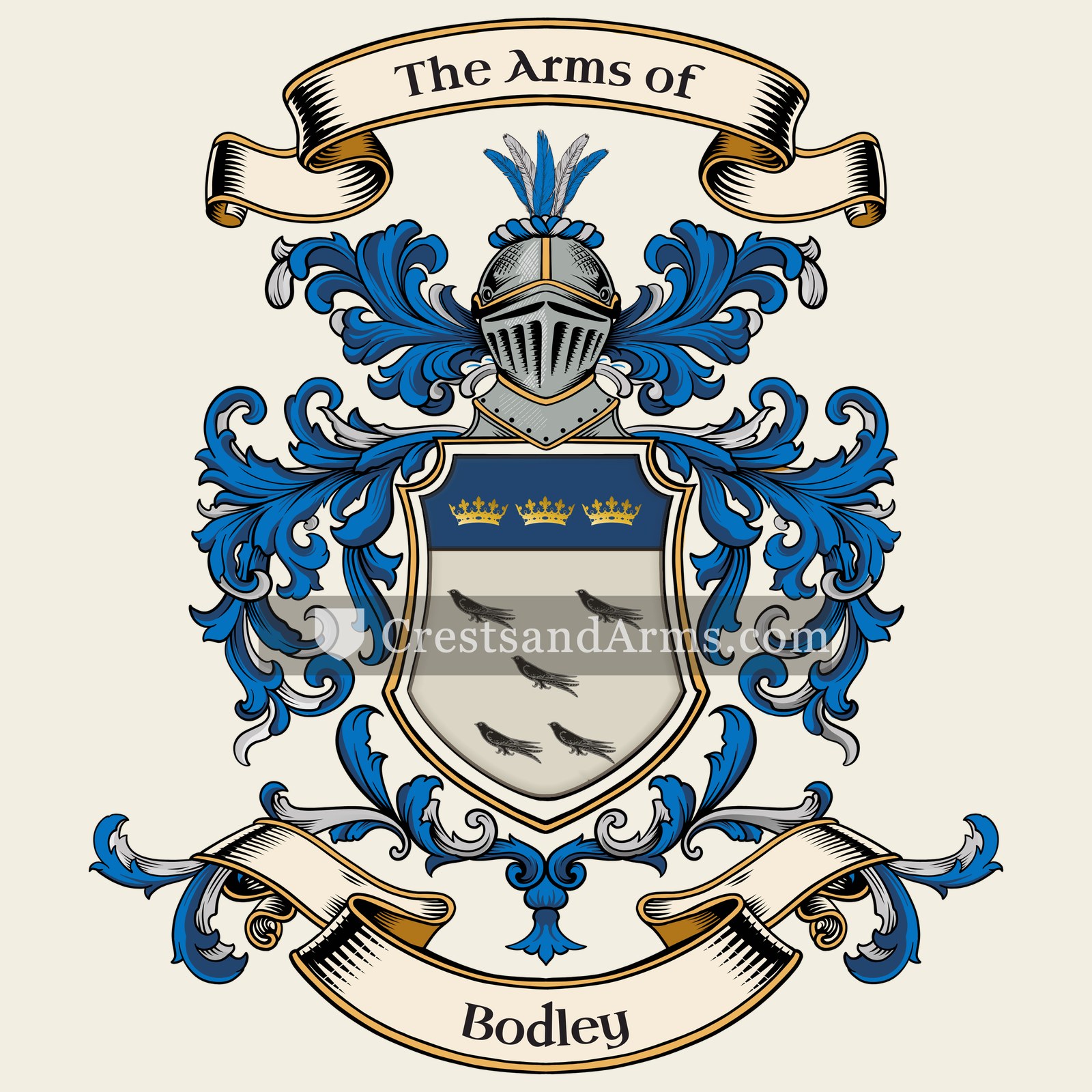
chiefAuthority, wisdom and dominion
martletA younger son, who must win his own land
crownSovereignty, authority and just reward
Colours
Silver (Argent)Means: Peace and sincerity
Blue (Azure)Means: Loyalty and truth
Black (Sable)Means: Constancy
Gold (Or)Means: Generosity
Historical info
Source
J. B. Rietstap, Armorial Général, Gouda: G. B. van Goor Zonen, 1884–87
Blazon (the actual original written record)
“D'arg. à cinq martinets de sa., 2, 1 et 2; au chef d'azur, ch. de trois couronnes d'or. C.: une couronne d'or, posée sur des nuages d'azur, rayonnantes d'or [Armes de sir Thomas Bodley, fondateur de la célèbre bibliothèque bodléienne, à Oxford.]”
Britainc. 1700
Digital archive packCoat of arms PNG, gold border print PDF, vector SVG and the certificate of authenticity. Sent to your email in minutes.
Map of Britain showing where the Bodley arms are recorded
The Bodley arms were recorded in Britain, c. 1700.
Arms such as these were typically recorded in Kent.
Kent sits between London and the short crossing to Europe, and the trade passing through made it wealthy. Merchant families bought land with that money, and it was landowners who took coats of arms.
This is where the arms were entered in the register. Families often moved to other parts of the country, so the same name can turn up in more than one region.
The body that granted and recorded arms in Britain in this period.
William III of England
Sovereign of the period
William III of England
1694–1702
Reigning in Britain when the Bodley arms are first recorded.
How Arms Worked in Britain
English heraldry allowed arms to be shared by all legitimate descendants of the original owner. These symbols were treated as personal property that moved through the generations to all children. While the eldest son kept the original design, other family members could use the same shield without needing to change it or register their own unique versions.
Granting authority
The College of Arms in London has regulated the use of coats of arms throughout England and Wales since 1484.
How they got arms
Families typically obtained their coats of arms through a formal grant from the Crown or by proving their ancient right to them.
Where arms were recorded
All official coats of arms are recorded in the registers kept at the College of Arms, which date back to the fifteenth century.
The family's standing
Recorded among the armigerous families of Britain.
Origin & History of the Bodley Family in Britain
The surname Bodley is deeply rooted in the history of southern England, with its origins likely tied to the landscape and local geography of the region. Etymologists often trace the name to Old English roots, suggesting it may have originally described someone who lived near a specific clearing or a small woodland settlement. By the turn of the 18th century, the family had established a notable presence in Kent, a county known for its rich agricultural traditions and proximity to London. During this era, families like the Bodleys were often involved in the local economy as yeoman farmers or tradespeople, helping to sustain the rural communities that defined the English countryside. Their movement through these Kentish parishes reflects the broader patterns of migration and social development that shaped British society during the early modern period.
Coat of Arms & Family Crest Details
Symbols on this shield
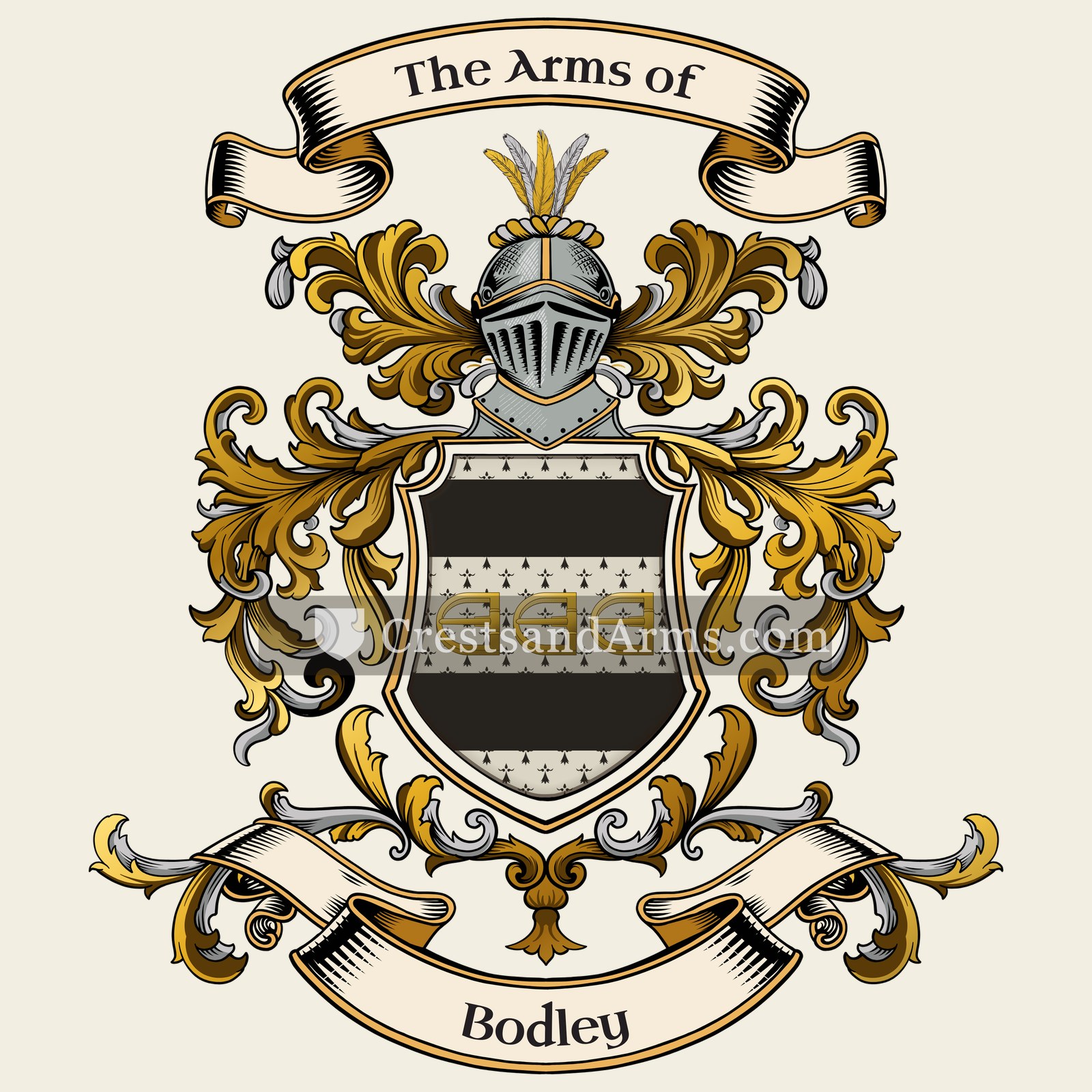
buckleFidelity, and a bond firmly held
Colours
ErmineMeans: Dignity
Black (Sable)Means: Constancy
Gold (Or)Means: Generosity
Historical info
Source
Sir Bernard Burke, The General Armory of England, Scotland, Ireland and Wales, London: Harrison & Sons, 1884
Blazon (the actual original written record)
“Erm. on two bars sa. three round buckles or, two and one”
SurreyStreatham · Surrey, c. 1609
Digital archive packCoat of arms PNG, gold border print PDF, vector SVG and the certificate of authenticity. Sent to your email in minutes.
Map of England showing where the Bodley arms are recorded
The Bodley arms were recorded in Surrey, c. 1609.
Surrey sat just south of London and filled up with families who had made money in the City. Buying an estate there was the usual next step, and an estate was the usual reason to take arms.
This is where the arms were entered in the register. Families often moved to other parts of the country, so the same name can turn up in more than one region.
The body that granted and recorded arms in England in this period.
James VI and I
Sovereign of the period
James VI and I
1603–1625
Reigning in Britain when the Bodley arms are first recorded.
How Arms Worked in England
English heraldry allowed arms to be shared by all legitimate descendants of the original owner. These symbols were treated as personal property that moved through the generations to all children. While the eldest son kept the original design, other family members could use the same shield without needing to change it or register their own unique versions.
Granting authority
The College of Arms in London has regulated the use of coats of arms throughout England and Wales since 1484.
How they got arms
Families typically obtained their coats of arms through a formal grant from the Crown or by proving their ancient right to them.
Where arms were recorded
All official coats of arms are recorded in the registers kept at the College of Arms, which date back to the fifteenth century.
The family's standing
Recorded among the armigerous families of Surrey.
Origin & History of the Bodley Family in England
The family name Bodley has deep roots in the English landscape, with its origins tied to the Old English language. The name is likely a locative surname, meaning it was originally taken from a specific place or a small settlement known as a "Bodley." By the early 17th century, the family had established a clear presence in the county of Surrey. Records from 1609 show members of the Bodley family living and working within this region during a time of significant social change in England. As the family moved through the generations, they became part of the local fabric of Surrey life, contributing to the agricultural and community development of the area. Their history reflects the broader movement of families who settled in the English countryside and helped shape the identity of their local parishes over several centuries.
Coat of Arms & Family Crest Details
Symbols on this shield
chiefAuthority, wisdom and dominion
martletA younger son, who must win his own land
crownSovereignty, authority and just reward
Colours
Silver (Argent)Means: Peace and sincerity
Blue (Azure)Means: Loyalty and truth
Black (Sable)Means: Constancy
Gold (Or)Means: Generosity
Historical info
Source
Sir Bernard Burke, The General Armory of England, Scotland, Ireland and Wales, London: Harrison & Sons, 1884
Blazon (the actual original written record)
“Ar. five martlets in saltire sa. on a chief az. three crowns or”
KildareKildare, c. 1604
Digital archive packCoat of arms PNG, gold border print PDF, vector SVG and the certificate of authenticity. Sent to your email in minutes.
Map of Ireland showing where the Bodley arms are recorded
The Bodley arms were recorded in Kildare, c. 1604.
Kildare was flat grazing country close to Dublin, taken early by Norman families. Being near the seat of government meant being near where arms were recorded, which is why so many Kildare names appear.
This is where the arms were entered in the register. Families often moved to other parts of the country, so the same name can turn up in more than one region.
The body that granted and recorded arms in Ireland in this period.
James VI and I
Sovereign of the period
James VI and I
1603–1625
Reigning in Britain when the Bodley arms are first recorded.
How Arms Worked in Ireland
The Ulster King of Arms granted coats of arms to individuals who proved their social standing and good character. These symbols were typically inherited by all legitimate descendants of the original holder. If a family branch wanted a unique look, they could apply for a specific change to their design through the office to ensure their identity remained distinct.
Granting authority
The Ulster King of Arms acted as the official body that regulated and issued all coats of arms throughout Ireland.
How they got arms
Families obtained their arms through formal grants issued by the office after proving their eligibility and paying the required fees.
Where arms were recorded
All official grants were recorded in the registers held by the Ulster King of Arms starting from the year 1552.
The family's standing
Recorded among the armigerous families of Kildare.
Origin & History of the Bodley Family in Ireland
The Bodley family established a notable presence in Ireland by the early seventeenth century, with records confirming their residence in County Kildare by 1604. The most prominent member of this era was Sir Josias Bodley, a military engineer who arrived in Ireland to oversee the construction and repair of fortifications during the Nine Years' War. His work was essential to the English administration, as he traveled extensively to map out defensive structures and improve the security of various garrisons. Because of his technical expertise, he was eventually appointed as the Director-General of Fortifications for Ireland. This role allowed the family to integrate into the administrative and social life of the region, transitioning from military service to holding land and influence within the Irish Pale. Through these official duties, the Bodley name became firmly rooted in the landscape of Kildare, marking the beginning of their long-standing connection to the area.
Bodley Meaning & Related Branches
Root word
Boda-leah
A messenger or herald's woodland clearing or meadow.
This name
BodleyDerived from Old English elements referring to a clearing associated with a messenger.
also spelled
Bodly
Bodleigh
Bodlie
Bodely
Related arms
Bodleighvariant spelling
Bowesrecorded with Bodley, same area
Hallrecorded with Bodley, same area
Documented Sources
J. B. Rietstap, Armorial Général, Gouda: G. B. van Goor Zonen, 1884–87
Reaney, P.H., A Dictionary of English Surnames, 1958
Hanks, Patrick and Hodges, Flavia, A Dictionary of Surnames, 1988
The National Archives, Prerogative Court of Canterbury and related Probate Jurisdictions: Will Registers, 1700
Kent History and Library Centre, Parish Registers of Kent, 1700
Digital archive packCoat of arms PNG, gold border print PDF, vector SVG and the certificate of authenticity. Sent to your email in minutes.


 chiefAuthority, wisdom and dominion
 martletA younger son, who must win his own land
 crownSovereignty, authority and just reward
 chiefAuthority, wisdom and dominion
 martletA younger son, who must win his own land
 crownSovereignty, authority and just reward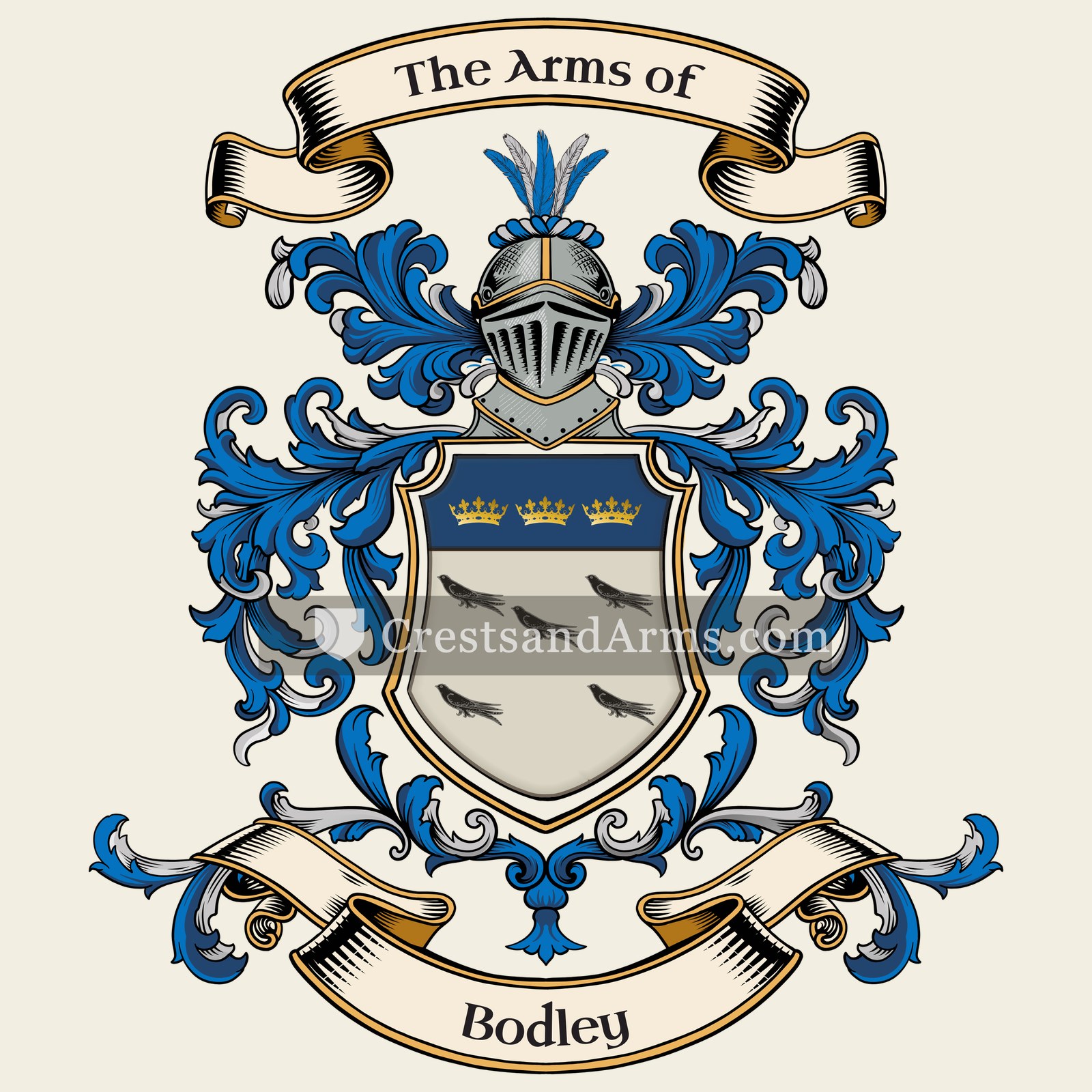


 buckleFidelity, and a bond firmly held