Map of France showing where the Bohon arms are recorded
The Bohon arms were recorded in France, c. 1663.
Arms such as these were typically recorded in Bretagne.
More families held coats of arms in Bretagne than anywhere else in France. The land was divided into many small estates rather than a few large ones, so far more households counted as gentry, and each needed a shield of its own to be told apart.
This is where the arms were entered in the register. Families often moved to other parts of the country, so the same name can turn up in more than one region.
The body that granted and recorded arms in France in this period.
Louis XIV of France
Sovereign of the period
Louis XIV of France
1643–1715
Reigning in France when the Bohon arms are first recorded.
How Arms Worked in France
In France, a coat of arms was a mark of honor that passed down through the male line to all legitimate descendants. Families often used the same shield without changes to show their shared heritage. If a branch wanted to stand out, they could add a small mark to their shield to show their specific place in the family tree.
Granting authority
The Juge d'armes de France acted as the official authority that regulated and verified coats of arms across the country.
How they got arms
Families typically inherited their arms from ancestors, though they could also receive them through royal grants or by proving their noble status.
Where arms were recorded
Coats of arms were officially recorded in the Armorial Général de France, which began its main collection in the year 1696.
The family's standing
Recorded among the armigerous families of France.
Origin & History of the Bohon Family in France
The family name Bohon finds its historical roots in the rugged landscape of northwestern France. By the year 1663, records confirm that members of the family were well-established in the region of Bretagne. During this period, the name was closely tied to the rural life and local administration of the French countryside. Families in this area often lived in small, tight-knit communities where they worked as farmers or artisans. The name itself likely evolved from local geographic markers or specific landmarks near their ancestral homes. As the family grew, they became part of the social fabric of the province, contributing to the agricultural and cultural development of the region. Their presence in Bretagne reflects the broader patterns of migration and settlement that defined French society during the seventeenth century.
Meaning of the Bohon family crest colors & symbols
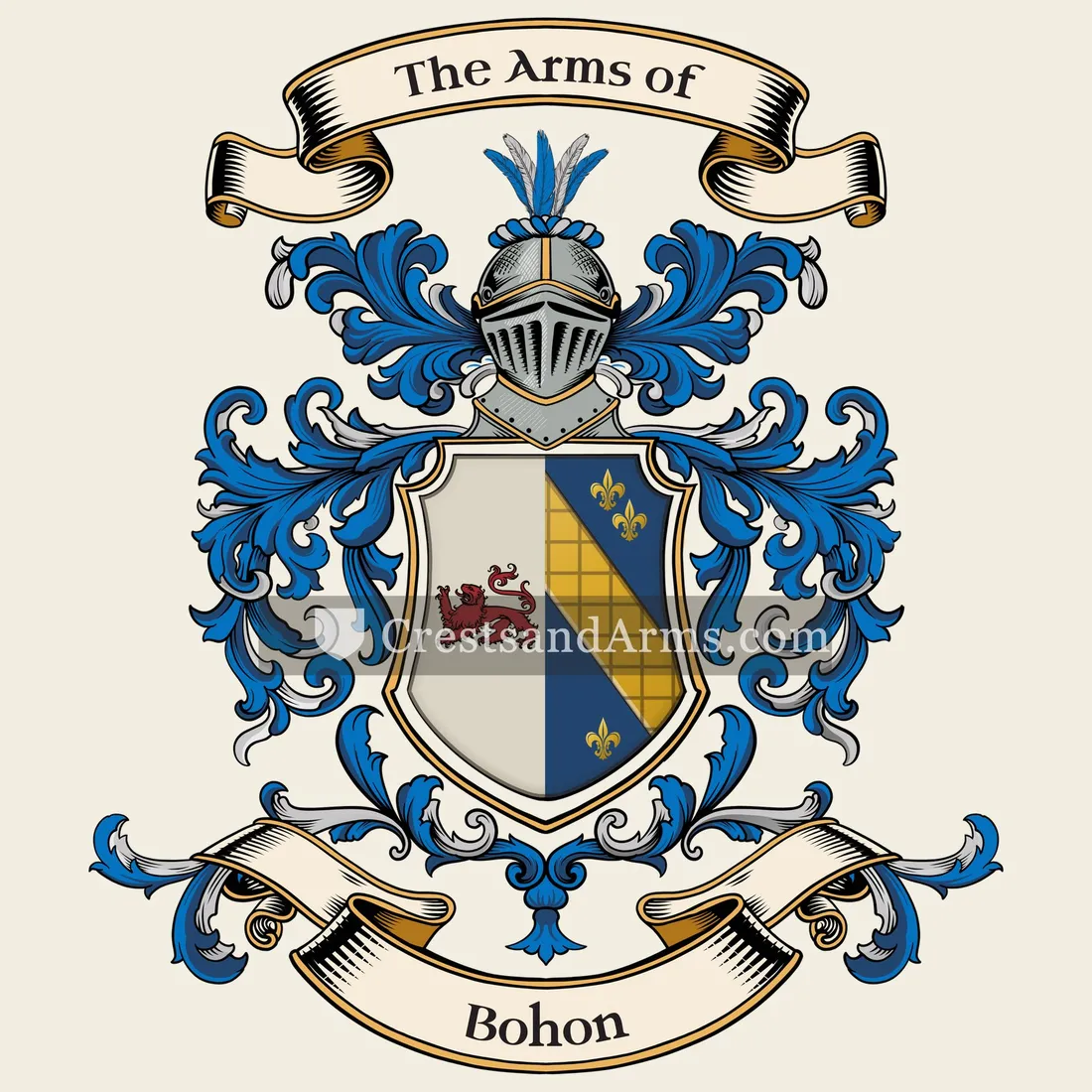
Symbols on this shield
bendDefence, and the scarf of a commander
lionCourage, strength and royalty
fleur de lisPurity, light, and the sixth son
Colours
Silver (Argent)Means: Peace and sincerity
Blue (Azure)Means: Loyalty and truth
Gold (Or)Means: Generosity
Red (Gules)Means: Military strength
Historical info
Source
J. B. Rietstap, Armorial Général, Gouda: G. B. van Goor Zonen, 1884–87
Blazon (the actual original written record)
“Parti: au 1 d'arg. au lion cont. de gu., arm. et lamp. d'or; au 2 d'azur à la bande d'or, acc. de trois fleurs-de-lis du même, 2 en chef et 1 en p. Brl. d'arg., de gu., d'arg., d'or et d'azur. C.: un lion iss. de gu., arm. et lamp. d'or.”
Belgiumc. 1745
Digital archive packCoat of arms PNG, gold border print PDF, vector SVG and the certificate of authenticity. Sent to your email in minutes.
Map of Belgium showing where the Bohon arms are recorded
The Bohon arms were recorded in Belgium, c. 1745.
Arms such as these were typically recorded in Brabant.
Brabant lay at the heart of the Low Countries, where the trade routes met. Its towns were wealthy and its landowners many, and both kinds of family kept arms, which is why the region is so heavily represented.
This is where the arms were entered in the register. Families often moved to other parts of the country, so the same name can turn up in more than one region.
The body that granted and recorded arms in Belgium in this period.
Charles VII, Holy Roman Emperor
Sovereign of the period
Charles VII, Holy Roman Emperor
1742–1745
Reigning in France when the Bohon arms are first recorded.
How Arms Worked in Belgium
In Belgium, a coat of arms is considered personal property that is passed down through the male line to legitimate descendants. Families often use the same shield design across generations to show their shared heritage. If a branch of the family wants to change the design, they must apply for an official update to their specific version of the arms.
Granting authority
The Conseil héraldique is the official body that regulates and approves all coats of arms in Belgium.
How they got arms
Families obtain their coats of arms through formal royal grants or by confirming their historical right to use existing designs.
Where arms were recorded
All approved coats of arms are officially recorded in the public registers of the Conseil héraldique since 1844.
The family's standing
Recorded among the armigerous families of Belgium.
Origin & History of the Bohon Family in Belgium
The history of the Bohon family in Belgium is deeply rooted in the historical region of Brabant, where records confirm their presence by at least 1745. During the eighteenth century, Brabant was a central hub of political and economic activity within the Austrian Netherlands. Families like the Bohons often lived in these densely populated areas, which were characterized by a mix of agricultural traditions and growing urban commerce. The name itself likely evolved from local geographic markers or regional dialects common to the borderlands between French and Dutch-speaking communities. As residents of this territory, the early Bohons were part of a society that navigated complex shifts in governance and local law. By tracing their roots to this specific time and place, we see a family that was established within a stable community long before the modern borders of Belgium were fully defined.
Bohon Meaning & Related Branches
Root word
Baudouin
Derived from Germanic elements meaning bold friend or brave protector.
This name
BohonA locative surname originating from the commune of Bohon in Normandy, France.
also spelled
Bouhone
Bouhonn
Bouhont
Buhon
Documented Sources
J. B. Rietstap, Armorial Général, Gouda: G. B. van Goor Zonen, 1884–87
Archives départementales d'Ille-et-Vilaine, Registres paroissiaux et d'état civil
Poterie, Henri, Histoire de la Bretagne, 1968
Tanguy, Bernard, Dictionnaire des noms de communes, trèves et paroisses des Côtes-d'Armor, 1992
Digital archive packCoat of arms PNG, gold border print PDF, vector SVG and the certificate of authenticity. Sent to your email in minutes.


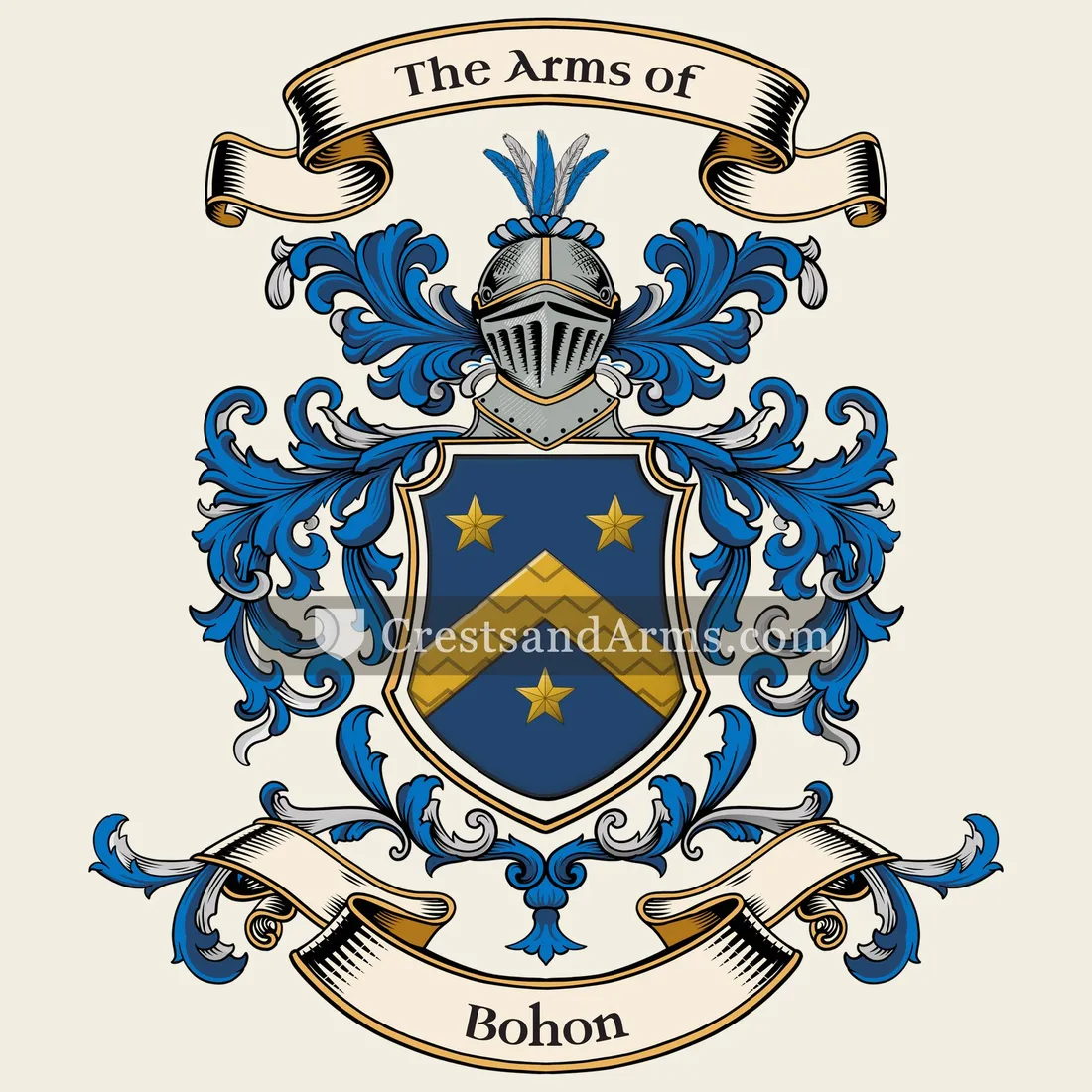
 chevronProtection, and faithful service completed
 mulletThe third son, and a divine quality from above
 chevronProtection, and faithful service completed
 mulletThe third son, and a divine quality from above


 bendDefence, and the scarf of a commander
 lionCourage, strength and royalty
 fleur de lisPurity, light, and the sixth son