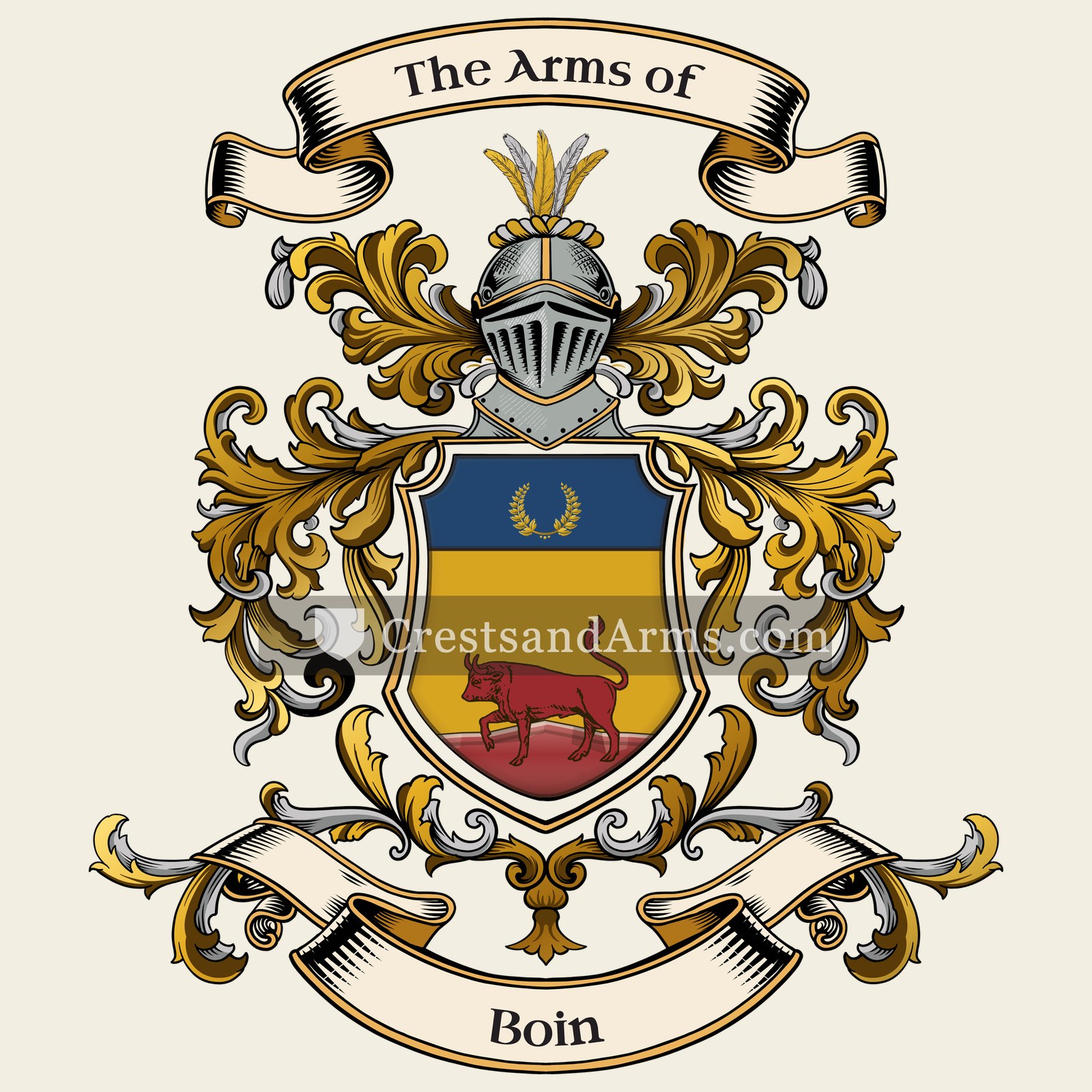
A record of documented arms, meaning and origin, researched for the Boin family of Switzerland.
Reg. 7905 · Swiss, A–C
Coat of Arms & Family Crest Details
Symbols on this shield
mountThe ground held, and steadfastness upon it
chiefAuthority, wisdom and dominion
bullValour and generosity
wreathHonour, and a victory crowned
Colours
Gold (Or)Means: Generosity
Blue (Azure)Means: Loyalty and truth
Red (Gules)Means: Military strength
Historical info
Source
J. B. Rietstap, Armorial Général, Gouda: G. B. van Goor Zonen, 1884–87
Blazon (the actual original written record)
“D'or à une vache de gu., coll. et clarinée d'arg., pass. sur une terrasse de sin.; au chef d'azur, ch. d'une olive d'or, feuillée de quatre pièces du même.”
SwitzerlandGenève, c. 1745
Digital archive packCoat of arms PNG, gold border print PDF, vector SVG and the certificate of authenticity. Sent to your email in minutes.
Map of Switzerland showing where the Boin arms are recorded
The Boin arms were recorded in Genève, c. 1745.
This is where the arms were entered in the register. Families often moved to other parts of the country, so the same name can turn up in more than one region.
The body that granted and recorded arms in Switzerland in this period.
How Arms Worked in Switzerland
In Switzerland, coats of arms were not restricted to the nobility and were often adopted by common citizens and families. These symbols were passed down through generations to show family identity. When branches of a family grew, they often changed small details of the design to distinguish their own line from the original group.
Granting authority
Cantonal and civic authorities managed the use of coats of arms within their specific regions and local jurisdictions.
How they got arms
Families typically assumed their own coats of arms based on local custom rather than receiving them from a central monarch.
Where arms were recorded
Arms were recorded in various cantonal and civic registers starting from the fourteenth century throughout the Swiss region.
The family's standing
Recorded among the armigerous families of Switzerland.
Origin & History of the Boin Family in Switzerland
The surname Boin has deep roots in the historical landscape of Geneva, where members of the family were firmly established by 1745. During this period, Geneva was a bustling center of trade and intellectual growth, and families like the Boins were often integrated into the city’s complex social and professional structures. The name itself is thought to be a variation of older French naming traditions, potentially linked to regional descriptors or occupational titles common in the French-speaking territories surrounding Lake Geneva. As residents of a city known for its strict record-keeping and civic engagement, the early Boin family likely participated in the local guilds or the merchant classes that defined the city’s economy in the eighteenth century. By maintaining a presence in Geneva during this era, the family became part of a unique cultural crossroads where Swiss tradition met French influence, helping to shape the identity of the name for generations to come.
Boin Meaning & Related Branches
Root word
Bonus
Latin term meaning good or virtuous.
This name
BoinA topographic or habitational name derived from the Latin word for good, often referring to a pleasant location or a person of good character.
also spelled
Boyn
Boine
Boinn
Bwan
Documented Sources
J. B. Rietstap, Armorial Général, Gouda: G. B. van Goor Zonen, 1884–87
Archives d'État de Genève, État civil et registres paroissiaux de Genève, 1745
Baud-Bovy, Daniel, Les anciens noms de famille genevois, 1934
Senebier, Jean, Histoire littéraire de Genève, 1786
Digital archive packCoat of arms PNG, gold border print PDF, vector SVG and the certificate of authenticity. Sent to your email in minutes.


 mountThe ground held, and steadfastness upon it
 chiefAuthority, wisdom and dominion
 bullValour and generosity
 wreathHonour, and a victory crowned
 mountThe ground held, and steadfastness upon it
 chiefAuthority, wisdom and dominion
 bullValour and generosity
 wreathHonour, and a victory crowned