Map of Norway showing where the Boldt arms are recorded
The Boldt arms were recorded in Norvège, c. 1605.
Arms such as these were typically recorded in Oslo.
Oslo held the Norwegian court and the offices that went with it. Norway's landed families were few and most held some post under the crown, and a post of that kind was what brought a shield.
This is where the arms were entered in the register. Families often moved to other parts of the country, so the same name can turn up in more than one region.
The body that granted and recorded arms in Norway in this period.
Christian IV of Denmark
Sovereign of the period
Christian IV of Denmark
1588–1648
Reigning in Norway when the Boldt arms are first recorded.
How Arms Worked in Norway
Norwegian families often assumed their own coats of arms freely without needing official permission from the crown. These symbols functioned as personal seals for merchants and farmers rather than just marks of nobility. Families passed these designs through generations as private property. When branches split, they frequently modified the original colors or shapes to create distinct versions for their own use.
Granting authority
The Norwegian royal chancery oversaw the formal recognition of noble status and the official registration of coats of arms.
How they got arms
Most families simply adopted their own unique designs to use on seals and property, though some sought royal confirmation.
Where arms were recorded
Official records of noble arms were kept in the royal chancery archives, which began documenting these grants during the union period.
The family's standing
Recorded among the armigerous families of Norway.
Origin & History of the Boldt Family in Norway
The family name Boldt has deep roots in the urban development of early modern Norway, with documented evidence placing members of the family in Oslo as early as 1605. During this period, Oslo was transitioning from a medieval town into a more structured administrative center, and the Boldt family appears to have been part of the growing class of citizens and merchants who helped shape the city. The name itself is of Low German origin, often associated with the word for bold or courageous, and it likely arrived in Norway through the active trade networks connecting the Baltic region with Scandinavian ports. By the seventeenth century, individuals bearing this name were integrated into the social fabric of the capital, participating in the civic and economic life that defined the city before the great fire of 1624 led to the relocation of Oslo to the area known as Christiania. Their presence in these early records highlights the role of immigrant families in building the professional and commercial foundations of the Norwegian capital.
Meaning of the Boldt family crest colors & symbols
Symbols on this shield
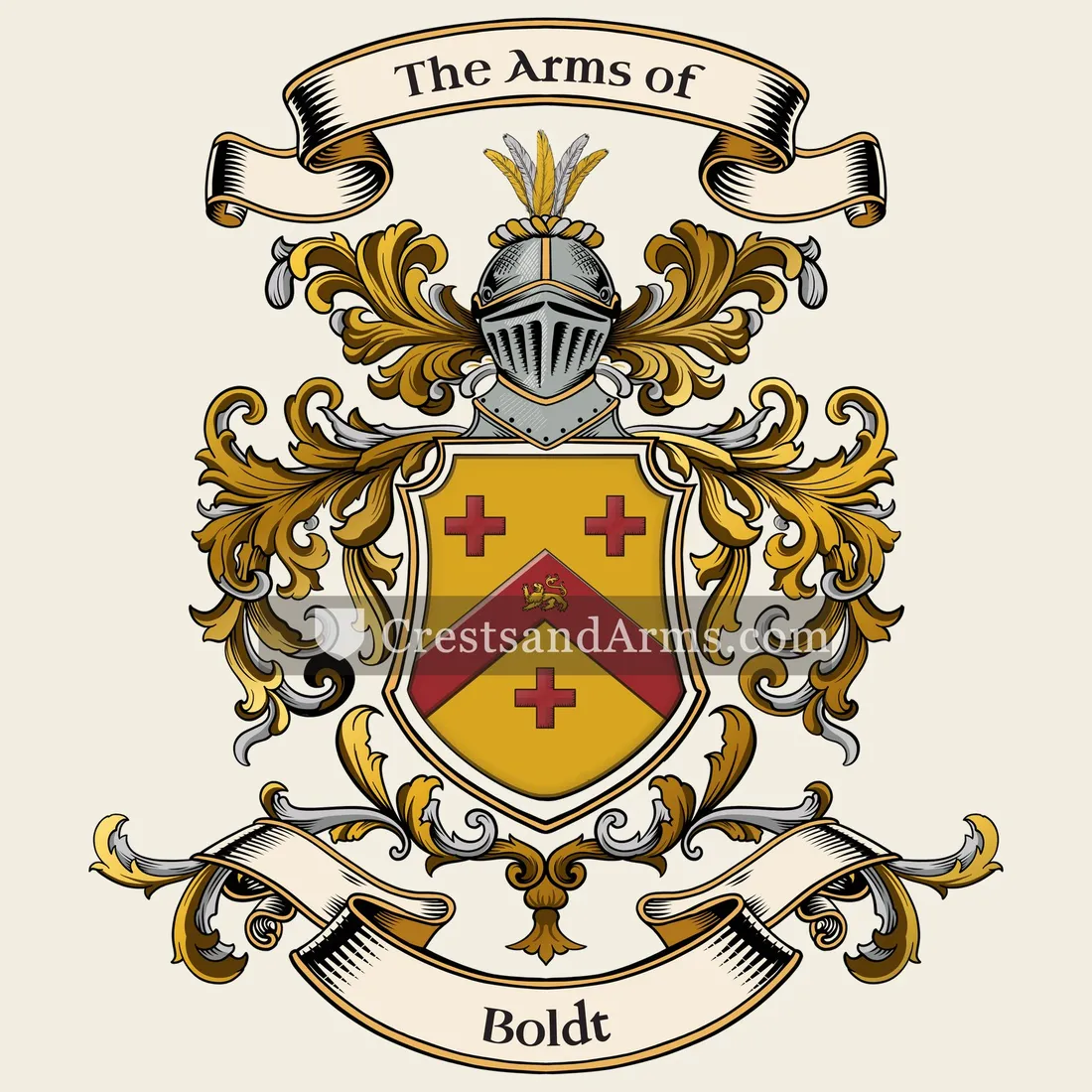
chevronProtection, and faithful service completed
cross symbolChristian faith and service
lionCourage, strength and royalty
Colours
Gold (Or)Means: Generosity
Red (Gules)Means: Military strength
Historical info
Source
Sir Bernard Burke, The General Armory of England, Scotland, Ireland and Wales, London: Harrison & Sons, 1884
Blazon (the actual original written record)
“Or, on a chev. betw. three crosses crosslet fitchée gu. a lion pass. guard. of the field”
Englandc. 1620
Digital archive packCoat of arms PNG, gold border print PDF, vector SVG and the certificate of authenticity. Sent to your email in minutes.
Map of England showing where the Boldt arms are recorded
The Boldt arms were recorded in England, c. 1620.
Arms such as these were typically recorded in York.
Yorkshire is the largest of the English counties, and it held more gentry families than any other. Land there was split among a great many households rather than a few, so a great many of them carried arms.
This is where the arms were entered in the register. Families often moved to other parts of the country, so the same name can turn up in more than one region.
The body that granted and recorded arms in England in this period.
James VI and I
Sovereign of the period
James VI and I
1603–1625
Reigning in Norway when the Boldt arms are first recorded.
How Arms Worked in England
English heraldry allowed arms to be shared by all legitimate descendants of the original owner. These symbols were treated as personal property that moved through the generations to all children. While the eldest son kept the original design, other family members could use the same shield without needing to change it or register their own unique versions.
Granting authority
The College of Arms in London has regulated the use of coats of arms throughout England and Wales since 1484.
How they got arms
Families typically obtained their coats of arms through a formal grant from the Crown or by proving their ancient right to them.
Where arms were recorded
All official coats of arms are recorded in the registers kept at the College of Arms, which date back to the fifteenth century.
The family's standing
Recorded among the armigerous families of England.
Origin & History of the Boldt Family in England
The surname Boldt is rooted in the linguistic traditions of Northern Europe, where it functioned as a descriptive nickname for a person characterized by their bold or courageous nature. By the early 17th century, members of the family had established a presence in the historic city of York, England. During this period, York served as a vital regional hub for trade and administration, attracting families who sought to participate in the growing merchant class. The presence of the Boldt family in York by 1620 suggests they were part of the steady movement of people across the North Sea who integrated into English society through local commerce and community life. As these individuals settled in the city, the name became a permanent part of the local social fabric, reflecting a history of migration and adaptation that defined many families in Northern England during the Stuart era.
Boldt Meaning & Related Branches
Root word
Bald
Old Germanic term meaning bold, brave, or courageous.
This name
BoldtA surname denoting a person who is fearless, daring, or valiant in character.
also spelled
Bolte
Boltt
Bolth
Bollte
Documented Sources
J. B. Rietstap, Armorial Général, Gouda: G. B. van Goor Zonen, 1884–87
Daae, Ludvig. Det gamle Christiania 1624-1814. 1891
Schilbred, C. S. Slekten Boldt i Norge. 1960
National Archives of Norway (Arkivverket), Oslo bys magistrat, Skifteprotokoller
National Archives of Norway (Arkivverket), Rentekammeret, Diverse regnskaper
Digital archive packCoat of arms PNG, gold border print PDF, vector SVG and the certificate of authenticity. Sent to your email in minutes.


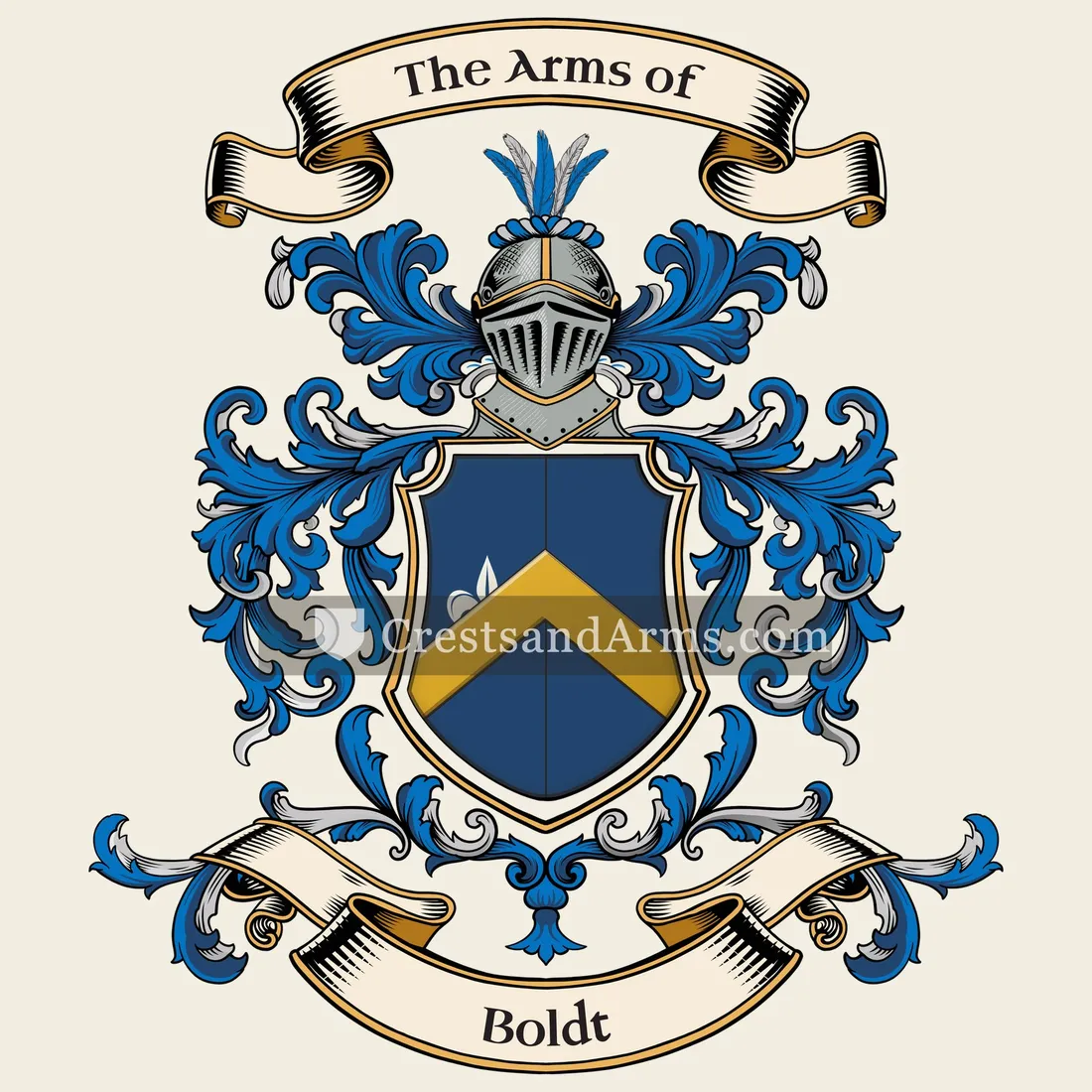
 chevronProtection, and faithful service completed
 fleur de lisPurity, light, and the sixth son
 chevronProtection, and faithful service completed
 fleur de lisPurity, light, and the sixth son


 cross symbolChristian faith and service
 lionCourage, strength and royalty