Map of England showing where the Boleyn arms are recorded
The Boleyn arms were recorded in London, c. 1457.
This is where the arms were entered in the register. Families often moved to other parts of the country, so the same name can turn up in more than one region.
The body that granted and recorded arms in England in this period.
Henry VI of England
Sovereign of the period
Henry VI of England
1422–1461
Reigning in England when the Boleyn arms are first recorded.
How Arms Worked in England
English heraldry allowed arms to be shared by all legitimate descendants of the original owner. These symbols were treated as personal property that moved through the generations to all children. While the eldest son kept the original design, other family members could use the same shield without needing to change it or register their own unique versions.
Granting authority
The College of Arms in London has regulated the use of coats of arms throughout England and Wales since 1484.
How they got arms
Families typically obtained their coats of arms through a formal grant from the Crown or by proving their ancient right to them.
Where arms were recorded
All official coats of arms are recorded in the registers kept at the College of Arms, which date back to the fifteenth century.
The family's standing
Recorded among the armigerous families of England.
Origin & History of the Boleyn Family in England
The Boleyn family name originated in the Norfolk region of England, where early ancestors were primarily successful farmers and landowners. By the middle of the fifteenth century, the family began to shift their focus toward the bustling trade environment of London. Records confirm that members of the family were active in the city by 1457, where they worked as skilled merchants and members of the powerful Mercers’ Company. This transition from rural life to urban commerce allowed the family to accumulate significant wealth and social influence. Through their involvement in the textile trade and local government, the Boleyns steadily climbed the social ladder. This period of professional growth laid the foundation for the family to eventually enter the royal court during the following century.
Boleyn Meaning & Related Branches
Root word
Boulogne
A place name derived from the Gaulish settlement Bononia.
This name
BoleynAn English locational surname for someone who originated from the French city of Boulogne-sur-Mer.
also spelled
Bolein
Bulin
Bolin
Bullen
Bulleyn
Related arms
Bullaynvariant spelling
Bullein, or Bolenvariant spelling
Bullenvariant spelling
Bulleynevariant spelling
Documented Sources
Sir Bernard Burke, The General Armory of England, Scotland, Ireland and Wales, London: Harrison & Sons, 1884
Ives, Eric. The Life and Death of Anne Boleyn. 2004
Loades, David. The Boleyns: The Rise and Fall of a Tudor Family. 2011
The National Archives. Records of the Prerogative Court of Canterbury, PROB 11
Digital archive packCoat of arms PNG, gold border print PDF, vector SVG and the certificate of authenticity. Sent to your email in minutes.


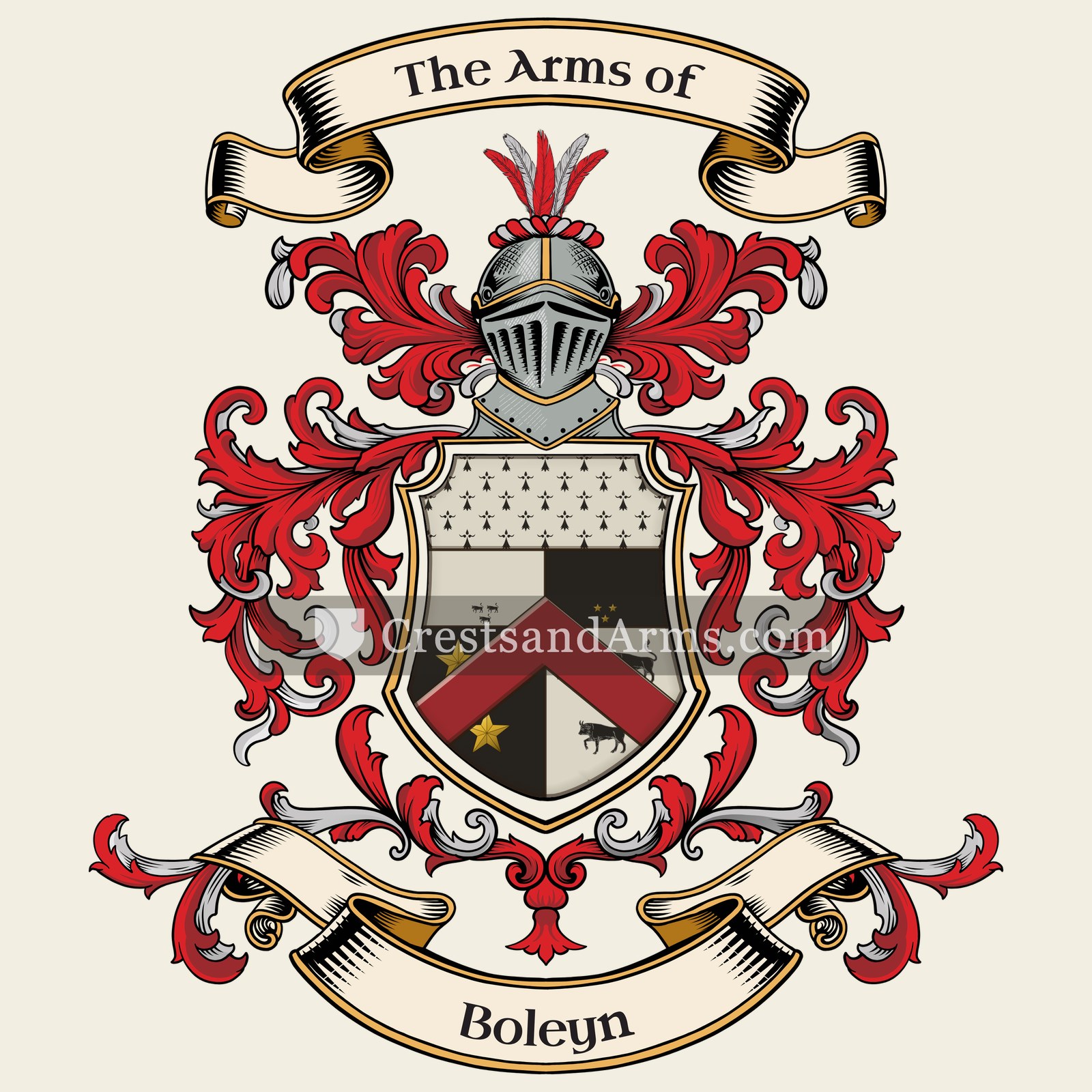
 chevronProtection, and faithful service completed
 chiefAuthority, wisdom and dominion
 bullValour and generosity
 mulletThe third son, and a divine quality from above
 chevronProtection, and faithful service completed
 chiefAuthority, wisdom and dominion
 bullValour and generosity
 mulletThe third son, and a divine quality from above