Map of France showing where the Bolle arms are recorded
The Bolle arms were recorded in Flandre, c. 1663.
Flandre grew rich on cloth, and its towns were among the busiest in Europe. Merchant families bought land with their profits and took arms to go with it, so trade put as many names in the registers here as land did.
This is where the arms were entered in the register. Families often moved to other parts of the country, so the same name can turn up in more than one region.
The body that granted and recorded arms in France in this period.
Louis XIV of France
Sovereign of the period
Louis XIV of France
1643–1715
Reigning in France when the Bolle arms are first recorded.
How Arms Worked in France
In France, a coat of arms was a mark of honor that passed down through the male line to all legitimate descendants. Families often used the same shield without changes to show their shared heritage. If a branch wanted to stand out, they could add a small mark to their shield to show their specific place in the family tree.
Granting authority
The Juge d'armes de France acted as the official authority that regulated and verified coats of arms across the country.
How they got arms
Families typically inherited their arms from ancestors, though they could also receive them through royal grants or by proving their noble status.
Where arms were recorded
Coats of arms were officially recorded in the Armorial Général de France, which began its main collection in the year 1696.
The family's standing
Recorded among the armigerous families of Flandre.
Origin & History of the Bolle Family in France
The family name Bolle has deep roots in the northern regions of France and the neighboring territories of Flanders. By the mid-seventeenth century, the name was firmly established in the local landscape, with documented records confirming that family members were living in the region of Flandre as early as 1663. During this period, the name was often associated with families who worked the land or participated in the growing trade networks of the Low Countries. Because this area was a crossroads for different cultures and languages, the name likely evolved from local nicknames or descriptions of people who lived near specific geographic landmarks. As the family grew, they became part of the social fabric of northern France, contributing to the agricultural and economic life of the region for generations.
Coat of Arms & Family Crest Details
Symbols on this shield
fessThe military belt, and readiness to serve
Colours
Blue (Azure)Means: Loyalty and truth
Silver (Argent)Means: Peace and sincerity
Historical info
Source
J. B. Rietstap, Armorial Général, Gouda: G. B. van Goor Zonen, 1884–87
Blazon (the actual original written record)
“D'azur à deux fasces ondées d'arg. C.: un vol d'arg.”
Denmarkc. 1722
Digital archive packCoat of arms PNG, gold border print PDF, vector SVG and the certificate of authenticity. Sent to your email in minutes.
Map of Denmark showing where the Bolle arms are recorded
The Bolle arms were recorded in Denmark, c. 1722.
Arms such as these were typically recorded in Sjaælland.
Zealand held the Danish court, the crown's offices and Copenhagen itself. Families who served the king kept estates within reach of it, and royal service was the ordinary route to a coat of arms.
This is where the arms were entered in the register. Families often moved to other parts of the country, so the same name can turn up in more than one region.
The body that granted and recorded arms in Denmark in this period.
Frederik IV of Denmark
Sovereign of the period
Frederik IV of Denmark
1699–1730
Reigning in France when the Bolle arms are first recorded.
How Arms Worked in Denmark
Danish heraldry during this period was closely tied to noble status and royal favor rather than being open to all citizens. Arms were typically granted by the monarch to individuals, and these symbols were then shared by all members of the noble house. If a family line died out, the right to use those specific arms ended with them.
Granting authority
The Danish royal chancery held the power to issue and regulate official coats of arms for the kingdom.
How they got arms
Families usually received their arms through a formal royal grant that confirmed their noble status and rights.
Where arms were recorded
These grants were officially recorded in the Danish Royal Chancery records starting in the sixteenth century.
The family's standing
Recorded among the armigerous families of Denmark.
Origin & History of the Bolle Family in Denmark
The Bolle family name in Denmark is deeply rooted in the agricultural landscape of the island of Sjælland, where records confirm their presence as early as 1722. During this period, the name was closely tied to the rural social structure of the Danish countryside, where families were often identified by their connection to specific parishes and local farming communities. As the eighteenth century progressed, members of the Bolle family lived through a time of significant transition in Denmark, including the major land reforms of the late 1700s that changed how peasants held their property and interacted with local landowners. These early generations likely worked as tenant farmers or laborers, contributing to the local economy of the region while maintaining a consistent presence in the parish registers. By tracing their history through these official church records, we can see a family that was well-integrated into the local fabric of Sjælland, reflecting the broader experiences of rural Danish families during the transition into the modern era.
Coat of Arms & Family Crest Details
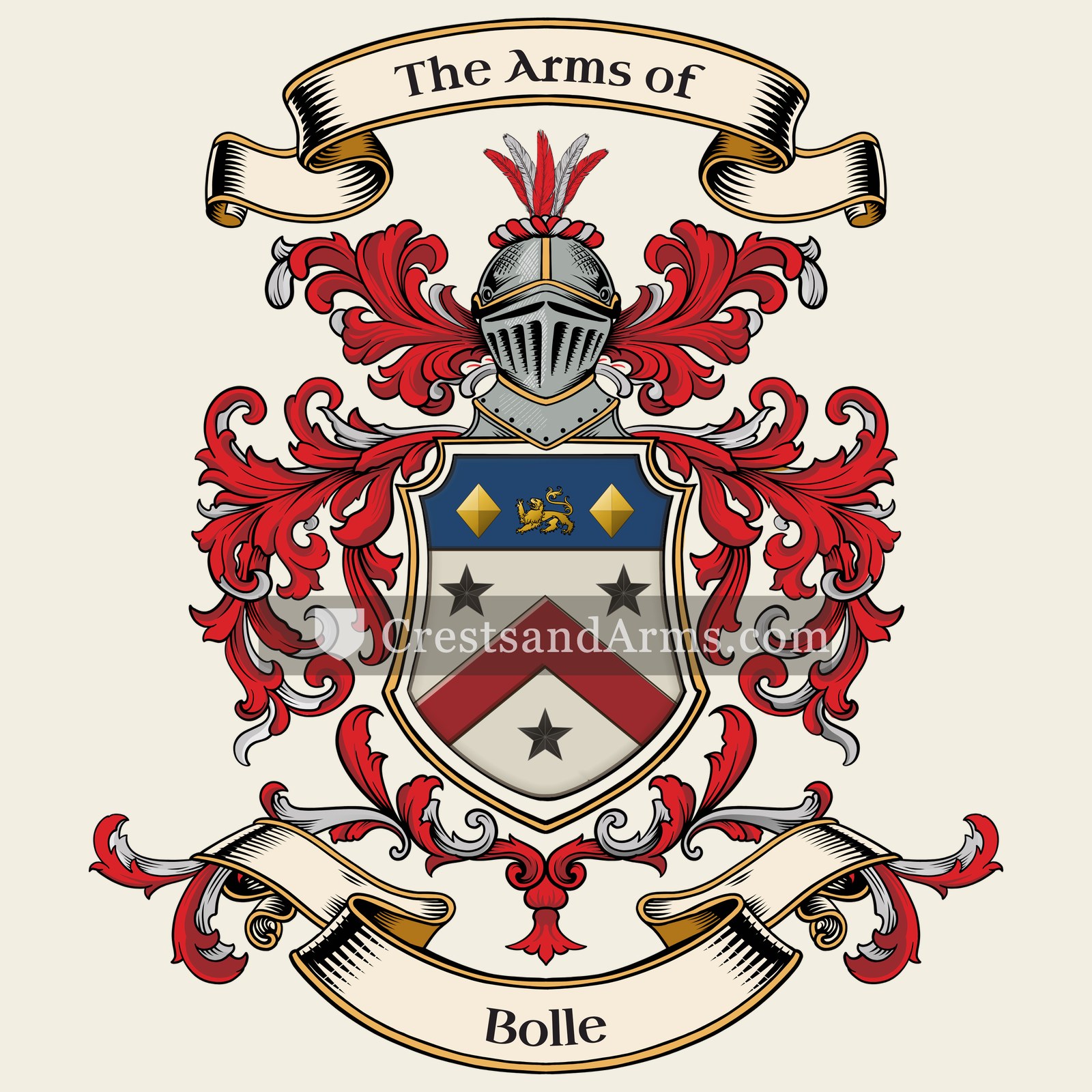
Symbols on this shield
chevronProtection, and faithful service completed
chiefAuthority, wisdom and dominion
lionCourage, strength and royalty
mulletThe third son, and a divine quality from above
lozengeHonour and nobility, and the arms of a woman
Colours
Silver (Argent)Means: Peace and sincerity
Red (Gules)Means: Military strength
Blue (Azure)Means: Loyalty and truth
Gold (Or)Means: Generosity
Black (Sable)Means: Constancy
Historical info
Source
Sir Bernard Burke, The General Armory of England, Scotland, Ireland and Wales, London: Harrison & Sons, 1884
Blazon (the actual original written record)
“Ar. a chev. gu. betw. three mullets sa. on a chief az. a lion's head erased betw. two lozenges or”
SuffolkWorthin · Suffolk, c. 1528
Digital archive packCoat of arms PNG, gold border print PDF, vector SVG and the certificate of authenticity. Sent to your email in minutes.
Map of England showing where the Bolle arms are recorded
The Bolle arms were recorded in Suffolk, c. 1528.
Suffolk was wool country, and its cloth towns were among the wealthiest in England. Clothier families bought manors with their profits, and holding a manor was the ordinary route to a coat of arms.
This is where the arms were entered in the register. Families often moved to other parts of the country, so the same name can turn up in more than one region.
The body that granted and recorded arms in England in this period.
Henry VIII of England
Sovereign of the period
Henry VIII of England
1509–1547
Reigning in France when the Bolle arms are first recorded.
How Arms Worked in England
English heraldry allowed arms to be shared by all legitimate descendants of the original owner. These symbols were treated as personal property that moved through the generations to all children. While the eldest son kept the original design, other family members could use the same shield without needing to change it or register their own unique versions.
Granting authority
The College of Arms in London has regulated the use of coats of arms throughout England and Wales since 1484.
How they got arms
Families typically obtained their coats of arms through a formal grant from the Crown or by proving their ancient right to them.
Where arms were recorded
All official coats of arms are recorded in the registers kept at the College of Arms, which date back to the fifteenth century.
The family's standing
Recorded among the armigerous families of Suffolk.
Origin & History of the Bolle Family in England
The history of the Bolle family in England is firmly rooted in the landscape of Suffolk, where records confirm their presence as early as 1528. During this period, the name was often associated with families of modest means who worked the land or engaged in local trade. The name itself likely evolved from Old English or Germanic roots, potentially serving as a descriptive nickname for a person with a round physical appearance or someone who lived near a specific rounded geographic feature. As the family established itself in the East Anglian countryside, they became integrated into the local parish systems, which were the primary way of tracking births, marriages, and deaths in the sixteenth century. By remaining in the same region for generations, the Bolle family contributed to the social fabric of Suffolk, gradually transitioning from local tenants to established members of the community during a time of significant economic change in England.
Bolle Meaning & Related Branches
Root word
Bolla
A Germanic or Latin term referring to a round object or bubble.
This name
BolleA topographic name for someone living near a round hill or a nickname for a rotund person.
also spelled
Boelle
Boll
Boell
Bole
Bol
Related arms
Bowlessame arms
Bollvariant spelling
Bolesvariant spelling
Documented Sources
J. B. Rietstap, Armorial Général, Gouda: G. B. van Goor Zonen, 1884–87
Archives départementales du Nord, Registres paroissiaux et d'état civil, 1663
Debrabandere, Frans, Woordenboek van de familienamen in België en Noord-Frankrijk, 2003
Digital archive packCoat of arms PNG, gold border print PDF, vector SVG and the certificate of authenticity. Sent to your email in minutes.


 bendDefence, and the scarf of a commander
 roundelA coin, and one who has been to the crusades
 bendDefence, and the scarf of a commander
 roundelA coin, and one who has been to the crusades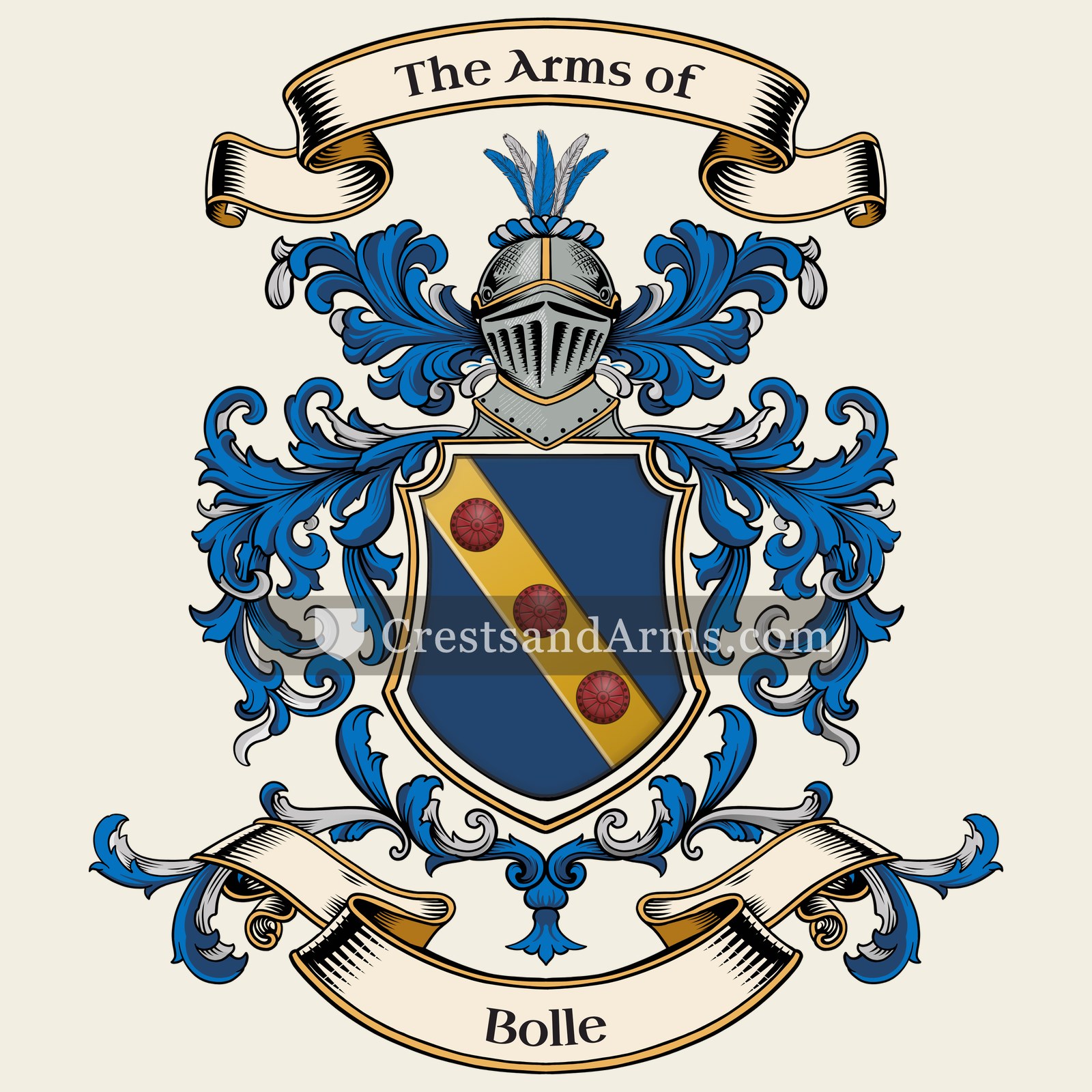


 fessThe military belt, and readiness to serve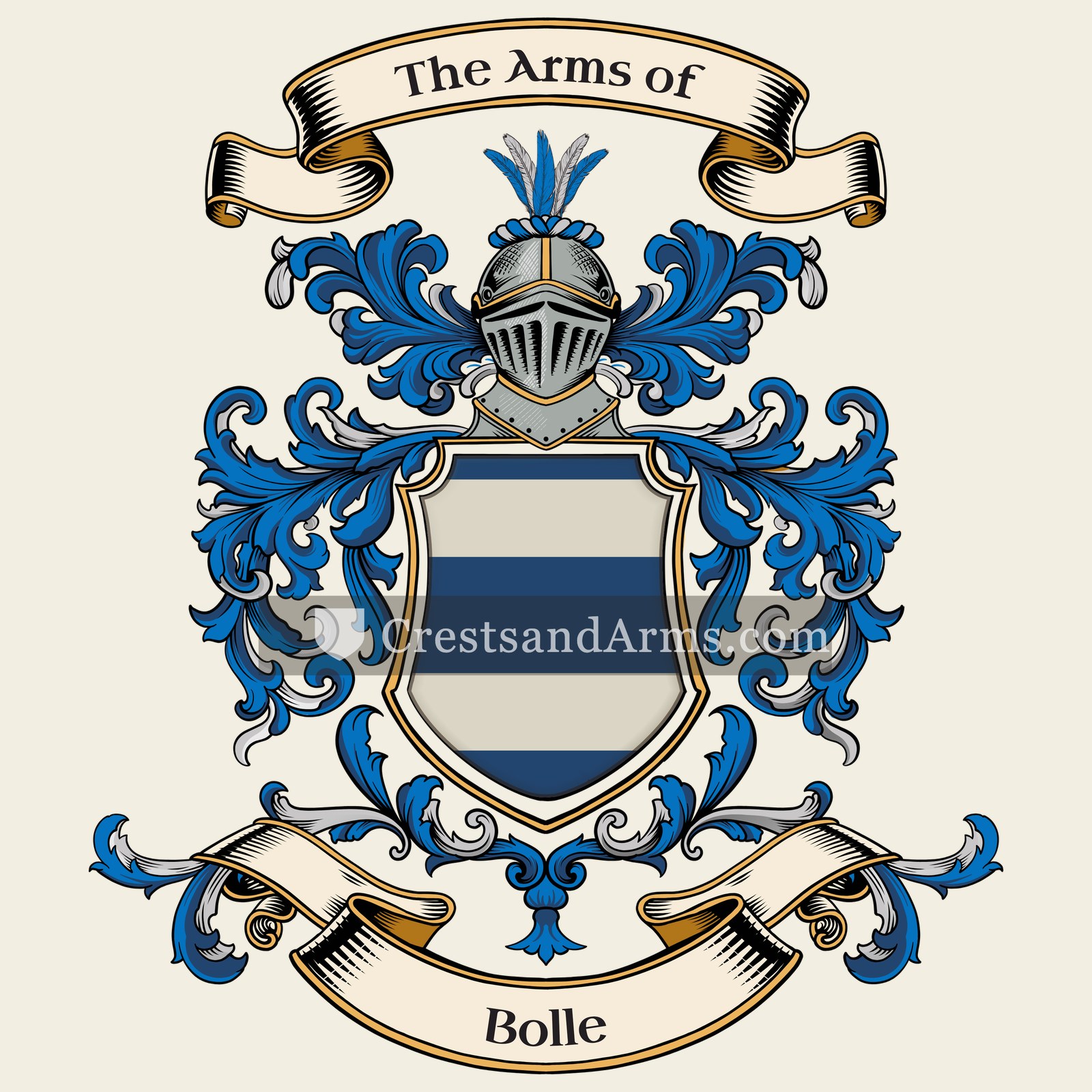


 chevronProtection, and faithful service completed
 chiefAuthority, wisdom and dominion
 lionCourage, strength and royalty
 mulletThe third son, and a divine quality from above
 lozengeHonour and nobility, and the arms of a woman