Map of Netherlands showing where the Bolman arms are recorded
The Bolman arms were recorded in Netherlands, c. 1815.
Arms such as these were typically recorded in Friesland.
Friesland was low, wet country on the northern coast of the Netherlands, farmed by families who had held the same land for centuries. Free landholders were unusually common there, and a free landholder could carry arms.
This is where the arms were entered in the register. Families often moved to other parts of the country, so the same name can turn up in more than one region.
Region
Friesland
First recorded
1815
Granting Authority for the Bolman Arms
Hoge Raad van Adel
Photograph made by me · CC BY-SA 3.0
The body that granted and recorded arms in Netherlands in this period.
William I of the Netherlands
Sovereign of the period
William I of the Netherlands
1815–1840
Reigning in Netherlands when the Bolman arms are first recorded.
How Arms Worked in Netherlands
In the Netherlands, coats of arms were often used by noble families and those who held specific public offices. These arms were passed down through the generations to legitimate descendants. Younger branches of a family usually kept the original design without needing to add special marks. This system ensured that the family identity remained clear and consistent over many years.
Granting authority
The Hoge Raad van Adel is the official body that regulates and manages noble titles and coats of arms in the Netherlands.
How they got arms
Families typically obtained their coats of arms through official royal grants or by proving their long-standing historical use of the symbols.
Where arms were recorded
Coats of arms are officially recorded in the registers held by the Hoge Raad van Adel, which began its work in 1814.
The family's standing
Recorded among the armigerous families of Netherlands.
Origin & History of the Bolman Family in Netherlands
The surname Bolman traces its roots to the northern coastal regions of the Netherlands, particularly the province of Friesland. By the early nineteenth century, the family was well-established in this area, a time when the Napoleonic Wars had recently ended and the Kingdom of the Netherlands was newly formed. The name itself likely originated as a descriptive term or a locational identifier, as was common for families living in the rural, marshy landscapes of the Frisian countryside. During this period, the Bolman family would have been part of a society deeply connected to agriculture and maritime trade, navigating the unique cultural and linguistic traditions that defined the Frisian identity. As the family grew, they became part of the local social fabric, leaving behind records in civil registries that document their presence in the region during the transition into the modern era.
Bolman Meaning & Related Branches
Root word
Bode
A messenger or envoy from the Germanic language family.
This name
BolmanA person who served as a messenger or a herald in medieval society.
also spelled
Bollman
Bolmann
Bolmans
Related arms
Dortsmansimilar arms
Jongsmasimilar arms
Nako de Nagy-Szent-Miklóssimilar arms
Documented Sources
J. B. Rietstap, Armorial Général, Gouda: G. B. van Goor Zonen, 1884–87
AlleFriezen, Burgerlijke Stand (Civil Registration)


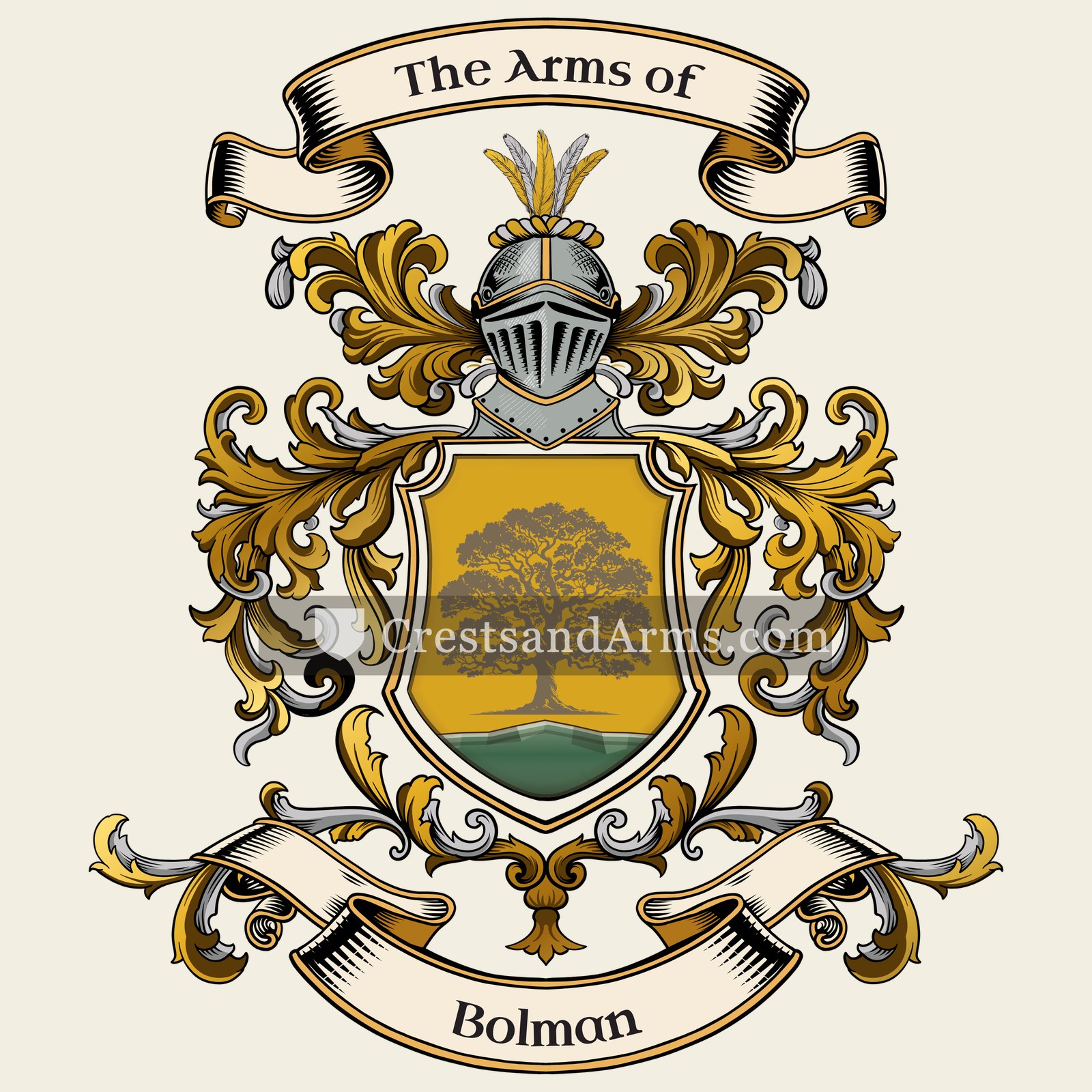
 mountThe ground held, and steadfastness upon it
 treeLife, endurance and deep roots
 mountThe ground held, and steadfastness upon it
 treeLife, endurance and deep roots