Map of Norway showing where the Bolt arms are recorded
The Bolt arms were recorded in Norvège, c. 1605.
Arms such as these were typically recorded in Oslo.
Oslo held the Norwegian court and the offices that went with it. Norway's landed families were few and most held some post under the crown, and a post of that kind was what brought a shield.
This is where the arms were entered in the register. Families often moved to other parts of the country, so the same name can turn up in more than one region.
The body that granted and recorded arms in Norway in this period.
Christian IV of Denmark
Sovereign of the period
Christian IV of Denmark
1588–1648
Reigning in Norway when the Bolt arms are first recorded.
How Arms Worked in Norway
Norwegian families often assumed their own coats of arms freely without needing official permission from the crown. These symbols functioned as personal seals for merchants and farmers rather than just marks of nobility. Families passed these designs through generations as private property. When branches split, they frequently modified the original colors or shapes to create distinct versions for their own use.
Granting authority
The Norwegian royal chancery oversaw the formal recognition of noble status and the official registration of coats of arms.
How they got arms
Most families simply adopted their own unique designs to use on seals and property, though some sought royal confirmation.
Where arms were recorded
Official records of noble arms were kept in the royal chancery archives, which began documenting these grants during the union period.
The family's standing
Recorded among the armigerous families of Norway.
Origin & History of the Bolt Family in Norway
The history of the Bolt family in Norway is deeply connected to the social and political landscape of the seventeenth century. By 1605, members of the family were well-established in Oslo, which was then a growing center of trade and administration under Danish rule. The name itself likely originated as a descriptive nickname, as the Old Norse word "boltr" referred to a bolt or a sturdy object, suggesting that early ancestors may have been known for their physical strength or a specific trade. During this period, families in urban centers like Oslo were often linked to the merchant class or local government officials who helped manage the city’s resources. As the family settled into the capital, they became part of the evolving fabric of Norwegian society, transitioning from traditional rural roots to the more structured life of an emerging administrative hub. This period marked a time of stability for the family, allowing them to integrate into the professional life of the city as it began its slow transformation into a modern capital.
Coat of Arms & Family Crest Details
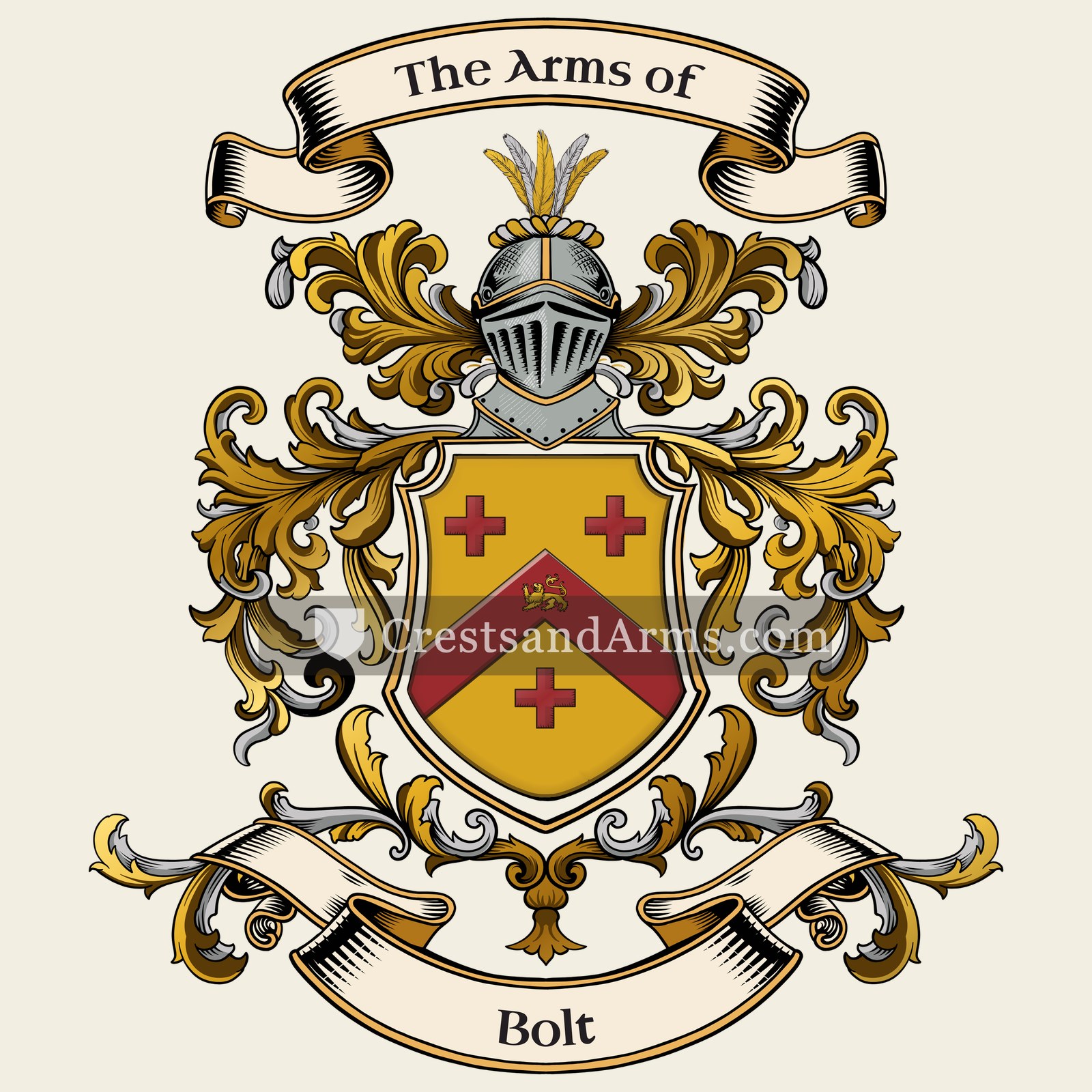
Symbols on this shield
chevronProtection, and faithful service completed
cross symbolChristian faith and service
lionCourage, strength and royalty
Colours
Gold (Or)Means: Generosity
Red (Gules)Means: Military strength
Historical info
Source
Sir Bernard Burke, The General Armory of England, Scotland, Ireland and Wales, London: Harrison & Sons, 1884
Blazon (the actual original written record)
“Or, on a chev. betw. three crosses crosslet fitchée gu. a lion pass. guard. of the field”
Englandc. 1620
Digital archive packCoat of arms PNG, gold border print PDF, vector SVG and the certificate of authenticity. Sent to your email in minutes.
Map of England showing where the Bolt arms are recorded
The Bolt arms were recorded in England, c. 1620.
Arms such as these were typically recorded in York.
Yorkshire is the largest of the English counties, and it held more gentry families than any other. Land there was split among a great many households rather than a few, so a great many of them carried arms.
This is where the arms were entered in the register. Families often moved to other parts of the country, so the same name can turn up in more than one region.
The body that granted and recorded arms in England in this period.
James VI and I
Sovereign of the period
James VI and I
1603–1625
Reigning in Norway when the Bolt arms are first recorded.
How Arms Worked in England
English heraldry allowed arms to be shared by all legitimate descendants of the original owner. These symbols were treated as personal property that moved through the generations to all children. While the eldest son kept the original design, other family members could use the same shield without needing to change it or register their own unique versions.
Granting authority
The College of Arms in London has regulated the use of coats of arms throughout England and Wales since 1484.
How they got arms
Families typically obtained their coats of arms through a formal grant from the Crown or by proving their ancient right to them.
Where arms were recorded
All official coats of arms are recorded in the registers kept at the College of Arms, which date back to the fifteenth century.
The family's standing
Recorded among the armigerous families of England.
Origin & History of the Bolt Family in England
The surname Bolt emerged in England as a descriptive name rooted in the Old English and Old Norse languages. It was often used to identify a person who was physically stout or swift, much like the quick movement of a crossbow arrow or bolt. By the early seventeenth century, the family had established a clear presence in the historic city of York. Records from 1620 confirm that members of the Bolt family were active participants in the local community during this period of English history. As residents of a major northern trade hub, these early ancestors likely engaged in the bustling commerce and craft industries that defined York at the time. Their presence in such a prominent city suggests that the family was well-integrated into the social and economic fabric of northern England long before the modern era.
Bolt Meaning & Related Branches
Root word
boltr
Old Norse term referring to a bolt, pin, or fastening object.
This name
BoltA descriptive nickname for a person who was sturdy, quick, or acted like a bolt.
also spelled
Bolte
Boltt
Bolth
Bollte
Documented Sources
J. B. Rietstap, Armorial Général, Gouda: G. B. van Goor Zonen, 1884–87
Nielsen, Yngvar. Det norske Rigsraad. 1880
Oslo byarkiv, Oslo bys historie
Schilbred, C. S. Slekten Bolt i Norge. 1968
Digital archive packCoat of arms PNG, gold border print PDF, vector SVG and the certificate of authenticity. Sent to your email in minutes.


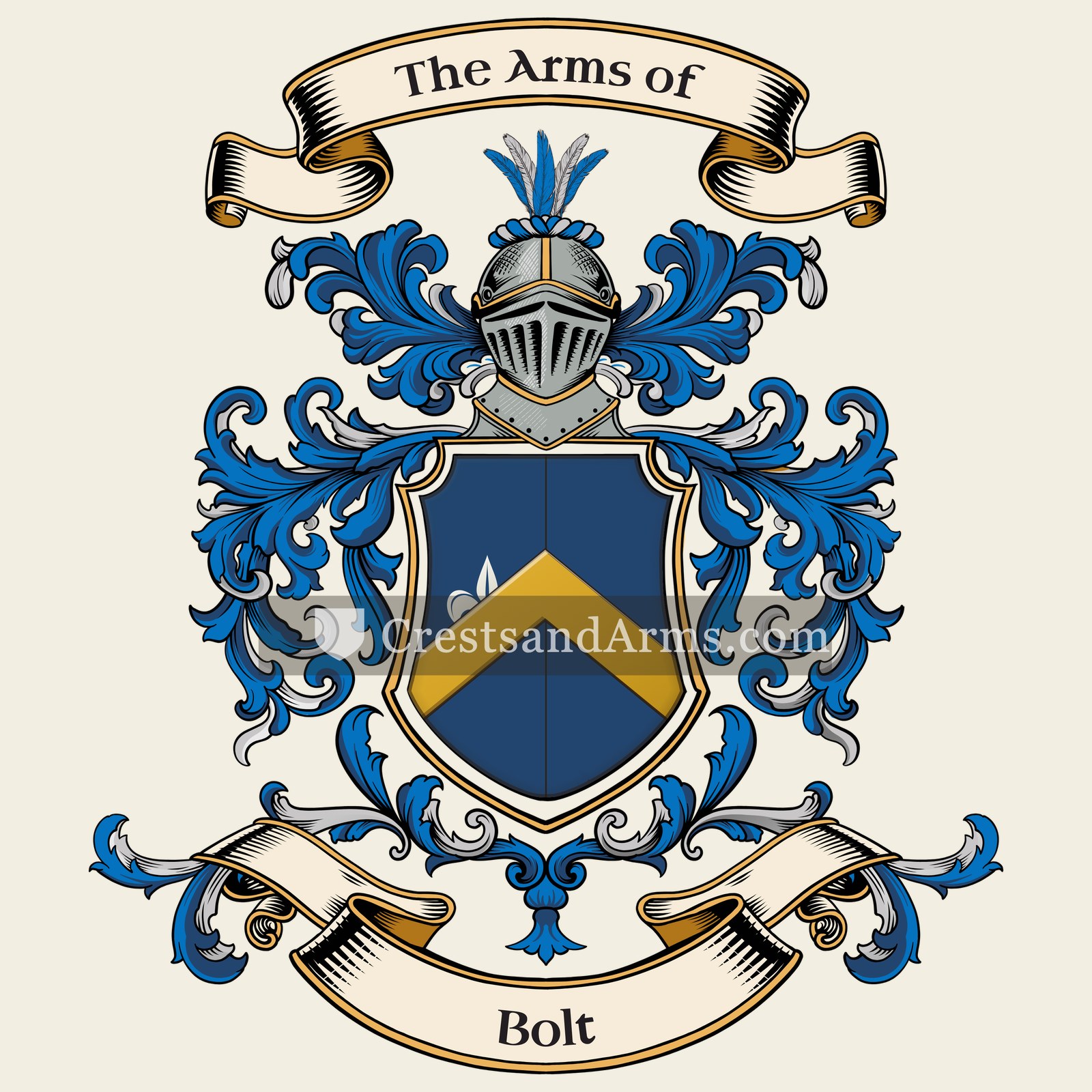
 chevronProtection, and faithful service completed
 fleur de lisPurity, light, and the sixth son
 chevronProtection, and faithful service completed
 fleur de lisPurity, light, and the sixth son


 cross symbolChristian faith and service
 lionCourage, strength and royalty