A record of documented arms, meaning and origin, researched for the Bona family lines. Documented in 2 countries.
Reg. 9201 · French, A–C
Coat of Arms & Family Crest Details
Symbols on this shield
cross symbolChristian faith and service
chiefAuthority, wisdom and dominion
roseThe seventh son, and beauty with grace
lionCourage, strength and royalty
Colours
Blue (Azure)Means: Loyalty and truth
Gold (Or)Means: Generosity
Silver (Argent)Means: Peace and sincerity
Historical info
Source
J. B. Rietstap, Armorial Général, Gouda: G. B. van Goor Zonen, 1884–87
Blazon (the actual original written record)
“Ec.: aux 1 et 4 coupé d'azur sur or; à la croix pattée d'arg., br. sur le coupé; aux 2 et 3 coupé d'or sur azur, au lion d'arg., br. sur le coupé. Au chef de l'écu d'azur, br. sur l'écartelé et ch. de trois roses d'or.”
LyonnaisLyonnais, c. 1663
Digital archive packCoat of arms PNG, gold border print PDF, vector SVG and the certificate of authenticity. Sent to your email in minutes.
Map of France showing where the Bona arms are recorded
The Bona arms were recorded in Lyonnais, c. 1663.
Lyonnais centred on Lyon, one of the great banking and silk towns of France. Money made in the city bought estates in the countryside around it, and those estates brought arms with them.
This is where the arms were entered in the register. Families often moved to other parts of the country, so the same name can turn up in more than one region.
The body that granted and recorded arms in France in this period.
Louis XIV of France
Sovereign of the period
Louis XIV of France
1643–1715
Reigning in France when the Bona arms are first recorded.
How Arms Worked in France
In France, a coat of arms was a mark of honor that passed down through the male line to all legitimate descendants. Families often used the same shield without changes to show their shared heritage. If a branch wanted to stand out, they could add a small mark to their shield to show their specific place in the family tree.
Granting authority
The Juge d'armes de France acted as the official authority that regulated and verified coats of arms across the country.
How they got arms
Families typically inherited their arms from ancestors, though they could also receive them through royal grants or by proving their noble status.
Where arms were recorded
Coats of arms were officially recorded in the Armorial Général de France, which began its main collection in the year 1696.
The family's standing
Recorded among the armigerous families of Lyonnais.
Origin & History of the Bona Family in France
The Bona family name has deep roots in the historical region of Lyonnais, where records confirm their presence as early as 1663. During the seventeenth century, this area was a vital center for trade and silk production, which likely influenced the daily lives and professional paths of the family members living there. The name itself is thought to be derived from the Latin word bonus, meaning good, which was a common way to describe a person of high moral character or positive standing within a village. As residents of the Lyonnais region, the Bona family would have lived through a period of significant transition in France as the monarchy consolidated power and local traditions began to blend with national identity. By maintaining their presence in this region, the early members of the family contributed to the long-standing cultural fabric of eastern France, participating in the agricultural and social systems that defined life in the French provinces during the reign of King Louis XIV.
Coat of Arms & Family Crest Details
Symbols on this shield
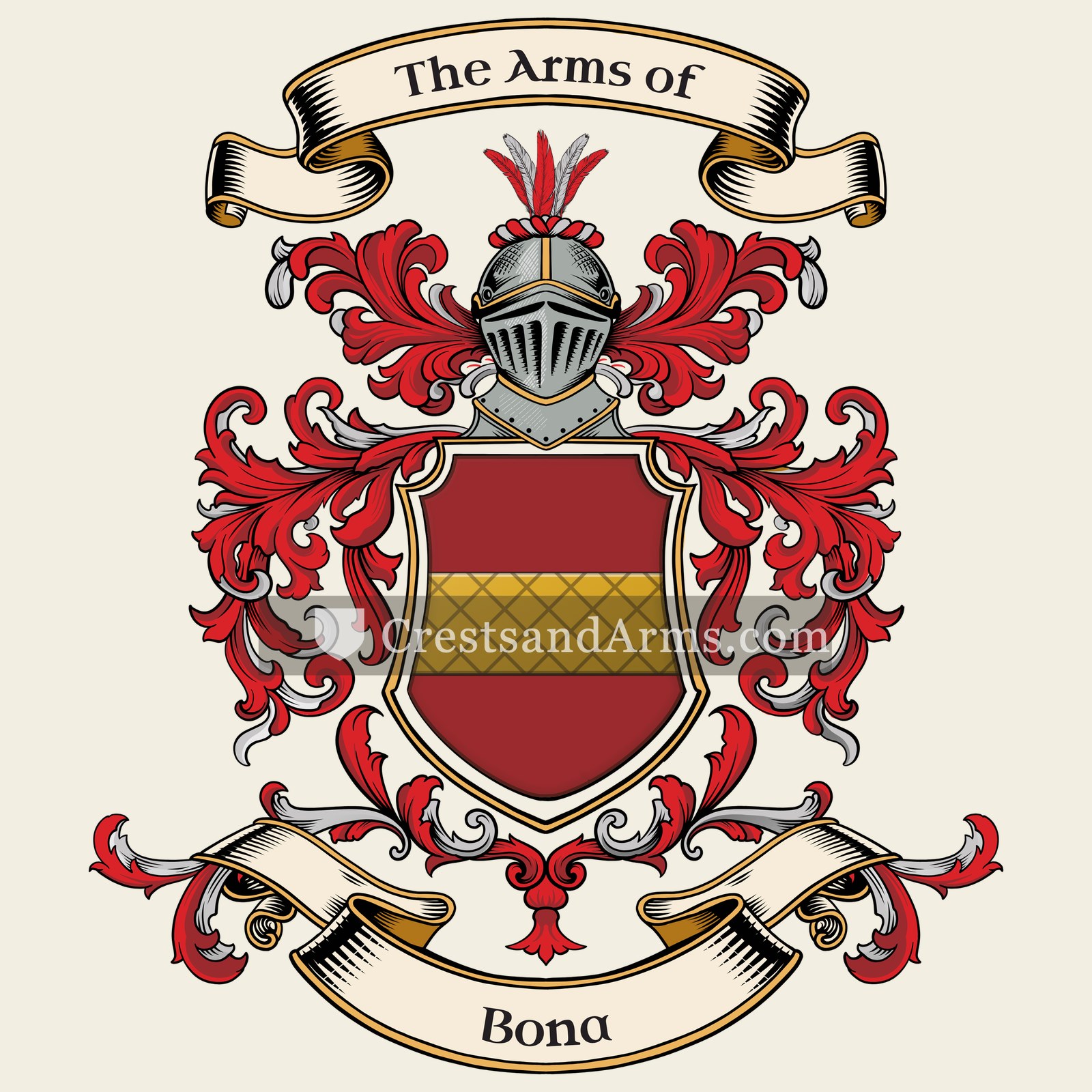
fessThe military belt, and readiness to serve
Colours
Red (Gules)Means: Military strength
Gold (Or)Means: Generosity
Historical info
Source
J. B. Rietstap, Armorial Général, Gouda: G. B. van Goor Zonen, 1884–87
Blazon (the actual original written record)
“De gu. à la fasce d'or.”
ItalyVérone, c. 1775
Digital archive packCoat of arms PNG, gold border print PDF, vector SVG and the certificate of authenticity. Sent to your email in minutes.
Map of Italy showing where the Bona arms are recorded
The Bona arms were recorded in Vérone, c. 1775.
This is where the arms were entered in the register. Families often moved to other parts of the country, so the same name can turn up in more than one region.
The body that granted and recorded arms in Italy in this period.
Alvise Giovanni Mocenigo
Sovereign of the period
Alvise Giovanni Mocenigo
1763–1778
Reigning in France when the Bona arms are first recorded.
How Arms Worked in Italy
In the Italian states, coats of arms were often used by noble families to show their status and history. These symbols were passed down through the generations to all legitimate male descendants. Younger branches of a family usually kept the original design but sometimes added small changes to distinguish their specific line from the main branch.
Granting authority
Various local rulers and city governments controlled the use of coats of arms across the different Italian states.
How they got arms
Families often assumed their own arms or received them as official grants from local lords, popes, or city councils.
Where arms were recorded
Arms were recorded in local city archives or private family books rather than in one single national register.
The family's standing
Recorded among the armigerous families of Italy.
Origin & History of the Bona Family in Italy
The family name Bona carries a long history rooted in the northern regions of Italy, particularly within the historic city of Verona. By the late 18th century, records confirm that members of the Bona family were well-established residents of Verona, participating in the social and civic life of the city. The name itself is derived from the Italian word for good, which often served as a nickname or a descriptor for a person of favorable character or standing in their community. During the 1700s, families like the Bona were often integrated into the local merchant or professional classes, contributing to the vibrant urban culture that defined the Venetian territories. As the family grew, they became part of the enduring fabric of Veronese society, leaving behind a legacy that reflects the broader patterns of migration and family development across the Italian peninsula.
Bona Meaning & Related Branches
Root word
Bonus
Latin term meaning good or virtuous.
This name
BonaA surname indicating a person of good character or a kind individual.
also spelled
Bonna
Bonne
Related arms
Bonnevariant spelling
Benessarecorded with Bona, same area
Ismaellirecorded with Bona, same area
Jacognarecorded with Bona, same area
Documented Sources
J. B. Rietstap, Armorial Général, Gouda: G. B. van Goor Zonen, 1884–87
Archives départementales du Rhône, Registres paroissiaux et d'état civil du Lyonnais, 1663
Béghain, Patrice, Dictionnaire historique de Lyon, 2009
Fournier, Gabriel, La vie rurale en France au XVIIe siècle, 1976
Digital archive packCoat of arms PNG, gold border print PDF, vector SVG and the certificate of authenticity. Sent to your email in minutes.


 cross symbolChristian faith and service
 chiefAuthority, wisdom and dominion
 roseThe seventh son, and beauty with grace
 lionCourage, strength and royalty
 cross symbolChristian faith and service
 chiefAuthority, wisdom and dominion
 roseThe seventh son, and beauty with grace
 lionCourage, strength and royalty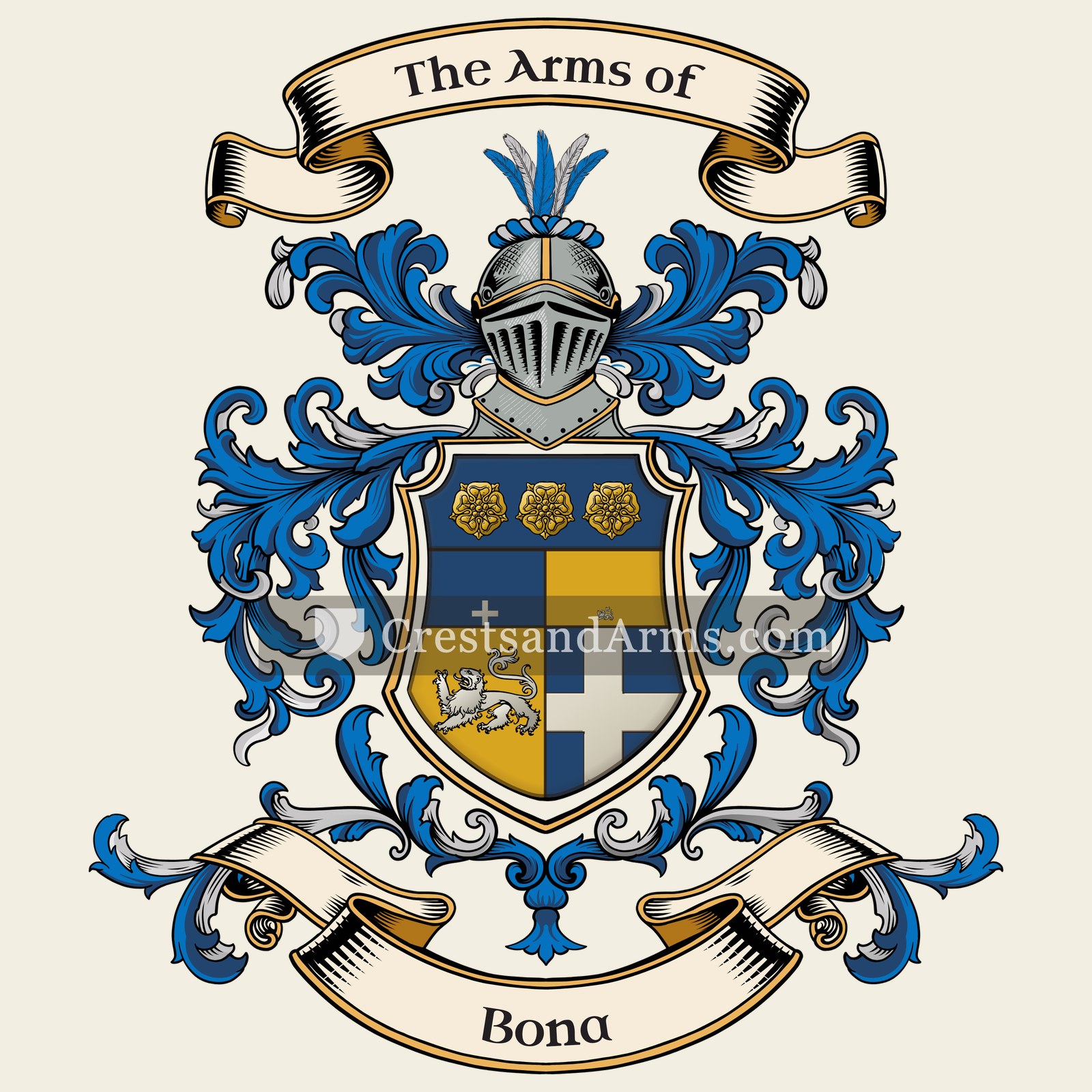


 fessThe military belt, and readiness to serve