Map of Italy showing where the Bonda arms are recorded
The Bonda arms were recorded in Raguse, c. 1817.
This is where the arms were entered in the register. Families often moved to other parts of the country, so the same name can turn up in more than one region.
The body that granted and recorded arms in Italy in this period.
How Arms Worked in Italy
In the Italian states, coats of arms were often used by noble families to show their status and history. These symbols were passed down through the generations to all legitimate male descendants. Younger branches of a family usually kept the original design but sometimes added small changes to distinguish their specific line from the main branch.
Granting authority
Various local rulers and city governments controlled the use of coats of arms across the different Italian states.
How they got arms
Families often assumed their own arms or received them as official grants from local lords, popes, or city councils.
Where arms were recorded
Arms were recorded in local city archives or private family books rather than in one single national register.
The family's standing
Recorded among the armigerous families of Italy.
Origin & History of the Bonda Family in Italy
The Bonda family name is deeply rooted in the history of the Republic of Ragusa, which is known today as the city of Dubrovnik in Croatia. By the early 19th century, the family was well-established within the local social and political structures of this historic maritime city. The Bonda family belonged to the patrician class, which meant they held significant influence over the governance and trade activities of the region. As members of the Ragusan nobility, they were deeply involved in the complex diplomatic and economic life of the Adriatic coast. Their presence in 1817 reflects a long tradition of civic participation that defined the lives of prominent families in this independent city-state. Through their work in local administration and commerce, the Bonda family helped shape the cultural and historical identity of Ragusa during a time of great transition in Europe.
Bonda Meaning & Related Branches
Root word
Abundare
Latin verb meaning to overflow, abound, or be present in large quantities.
This name
BondaRefers to a person who is prosperous, wealthy, or possesses an abundance of resources.
also spelled
Bondae
Bond
Documented Sources
J. B. Rietstap, Armorial Général, Gouda: G. B. van Goor Zonen, 1884–87
Krekic, Barisa, Dubrovnik in the Fourteenth and Fifteenth Centuries: A City between Two Worlds, 1972
Harris, Robin, Dubrovnik: A History, 2003
State Archives in Dubrovnik (Državni arhiv u Dubrovniku), Acta Consilii Minoris
Digital archive packCoat of arms PNG, gold border print PDF, vector SVG and the certificate of authenticity. Sent to your email in minutes.


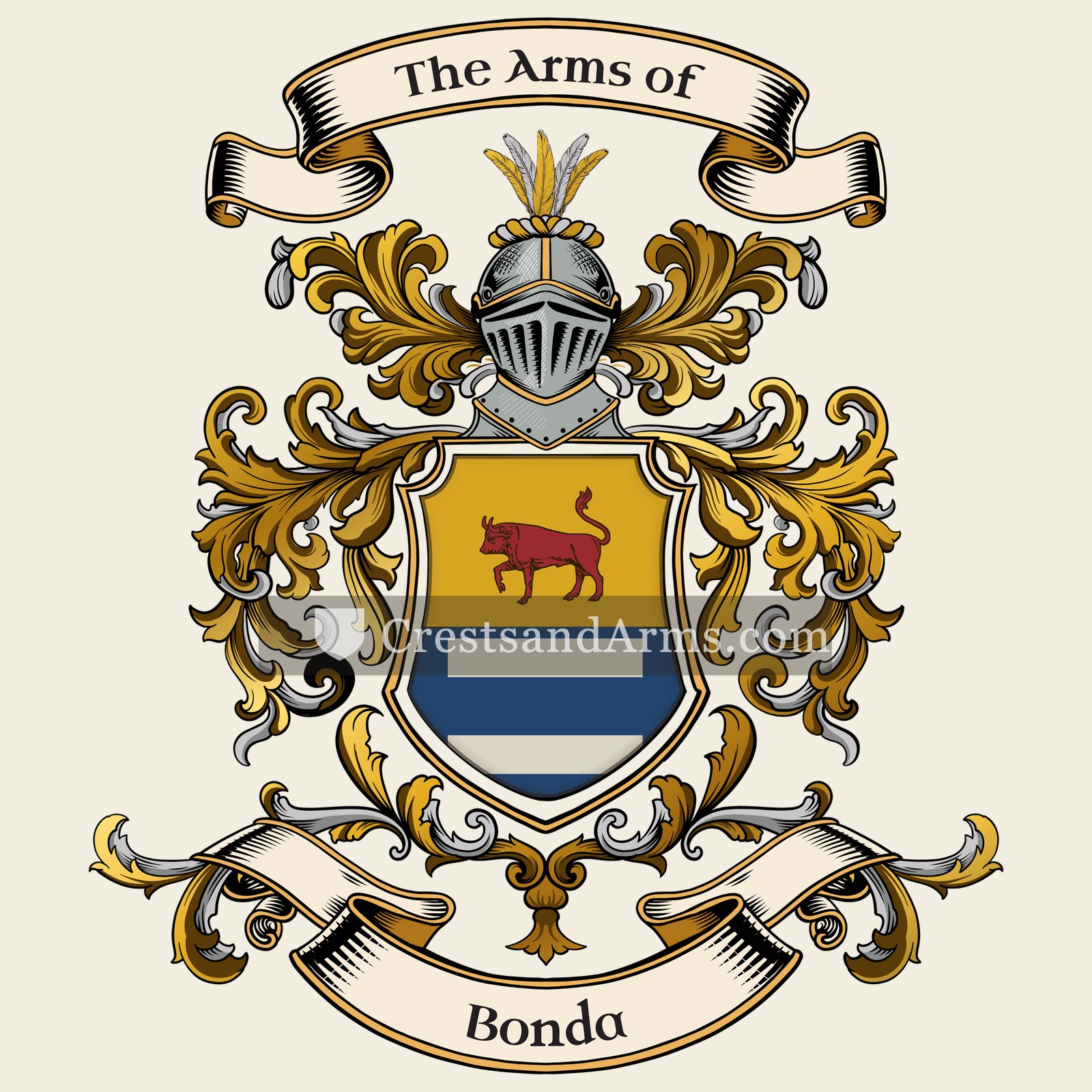
 fessThe military belt, and readiness to serve
 bullValour and generosity
 fessThe military belt, and readiness to serve
 bullValour and generosity