Map of Netherlands showing where the Bonn arms are recorded
The Bonn arms were recorded in Netherlands, c. 1815.
Arms such as these were typically recorded in Friesland.
Friesland was low, wet country on the northern coast of the Netherlands, farmed by families who had held the same land for centuries. Free landholders were unusually common there, and a free landholder could carry arms.
This is where the arms were entered in the register. Families often moved to other parts of the country, so the same name can turn up in more than one region.
Region
Friesland
First recorded
1815
Granting Authority for the Bonn Arms
Hoge Raad van Adel
Photograph made by me · CC BY-SA 3.0
The body that granted and recorded arms in Netherlands in this period.
William I of the Netherlands
Sovereign of the period
William I of the Netherlands
1815–1840
Reigning in Netherlands when the Bonn arms are first recorded.
How Arms Worked in Netherlands
In the Netherlands, coats of arms were often used by noble families and those who held specific public offices. These arms were passed down through the generations to legitimate descendants. Younger branches of a family usually kept the original design without needing to add special marks. This system ensured that the family identity remained clear and consistent over many years.
Granting authority
The Hoge Raad van Adel is the official body that regulates and manages noble titles and coats of arms in the Netherlands.
How they got arms
Families typically obtained their coats of arms through official royal grants or by proving their long-standing historical use of the symbols.
Where arms were recorded
Coats of arms are officially recorded in the registers held by the Hoge Raad van Adel, which began its work in 1814.
The family's standing
Recorded among the armigerous families of Netherlands.
Origin & History of the Bonn Family in Netherlands
The surname Bonn carries a deep connection to the northern landscapes of the Netherlands, particularly within the province of Friesland. By the early nineteenth century, the family was well-established in this region, a time when the Dutch government began formalizing civil registration to track citizens more accurately. The name itself likely originated as a topographic identifier, referring to individuals who lived near a specific settlement or a prominent landmark. In the context of Frisian history, families often held strong ties to local agricultural communities or maritime trade routes that defined the coastal provinces. As the family grew during the 1800s, they became part of the social fabric of the Dutch countryside, contributing to the development of local industries and the unique cultural identity of the Frisian people. This period of history reflects a time of transition as the Netherlands moved toward a more centralized national identity while preserving the distinct traditions of its northern provinces.
Coat of Arms & Family Crest Details
Symbols on this shield
eagleNobility, strength and a keen mind
roseThe seventh son, and beauty with grace
Colours
Blue (Azure)Means: Loyalty and truth
Gold (Or)Means: Generosity
Silver (Argent)Means: Peace and sincerity
Red (Gules)Means: Military strength
Historical info
Source
J. B. Rietstap, Armorial Général, Gouda: G. B. van Goor Zonen, 1884–87
Blazon (the actual original written record)
“Parti: au 1 d'azur à une demi-aigle d'arg., mouv. du parti; au 2 d'or à une rose de gu., tigée et feuillée de sin. C.: la rose, entre un vol d'arg. L.: à dextre d'arg. et d'azur, à sen. d'or et de gu.”
GermanyFrancfort s, c. 1765
Digital archive packCoat of arms PNG, gold border print PDF, vector SVG and the certificate of authenticity. Sent to your email in minutes.
Map of Germany showing where the Bonn arms are recorded
The Bonn arms were recorded in Francfort s, c. 1765.
This is where the arms were entered in the register. Families often moved to other parts of the country, so the same name can turn up in more than one region.
The body that granted and recorded arms in Germany in this period.
Francis I, Holy Roman Emperor
Sovereign of the period
Francis I, Holy Roman Emperor
1745–1765
Reigning in Netherlands when the Bonn arms are first recorded.
How Arms Worked in Germany
In the Holy Roman Empire, coats of arms were often granted to individuals by the Emperor or his representatives. These arms were then passed down through the generations to all legitimate descendants of the original holder. Younger branches of a family usually kept the same shield design without needing to change it, as the arms belonged to the entire lineage.
Granting authority
The Holy Roman Emperor held the sole power to grant new coats of arms throughout his vast imperial territories.
How they got arms
Families typically obtained their coats of arms through a formal imperial grant or by proving their noble status to the authorities.
Where arms were recorded
These grants were officially recorded in the Imperial Chancery registers, which began keeping formal records of such honors during the Middle Ages.
The family's standing
Recorded among the armigerous families of Germany.
Origin & History of the Bonn Family in Germany
The family name Bonn is deeply rooted in the history of the Rhineland region of Germany, where it likely originated as a topographic name for people who lived in or near the city of Bonn. During the eighteenth century, the family established a notable presence in the bustling trade hub of Frankfurt am Main. By 1765, records indicate that members of the family were active participants in the social and economic life of this city, which served as a major center for commerce and banking at the time. As the family grew, they integrated into the urban fabric of Frankfurt, contributing to the local community as merchants and skilled professionals. This migration from the Rhine valley to the heart of German trade reflects the broader patterns of movement that defined the lives of many middle-class families during the Enlightenment era.
Coat of Arms & Family Crest Details
Symbols on this shield
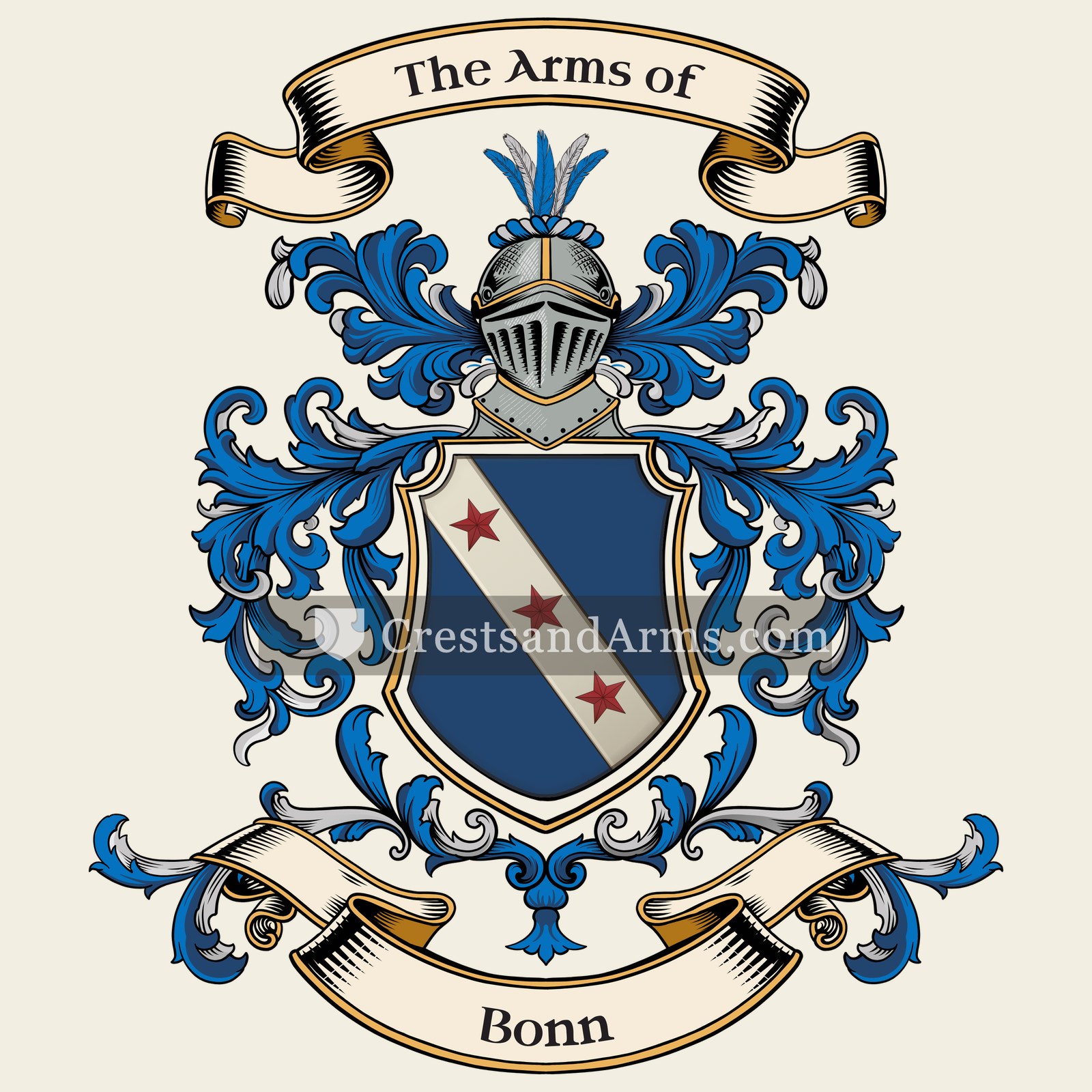
bendDefence, and the scarf of a commander
mulletThe third son, and a divine quality from above
Colours
Blue (Azure)Means: Loyalty and truth
Silver (Argent)Means: Peace and sincerity
Red (Gules)Means: Military strength
Historical info
Source
Sir Bernard Burke, The General Armory of England, Scotland, Ireland and Wales, London: Harrison & Sons, 1884
Blazon (the actual original written record)
“Az. on a bend ar. three mullets pierced gu”
NorthamptonshireNorthamptonshire, c. 1620
Digital archive packCoat of arms PNG, gold border print PDF, vector SVG and the certificate of authenticity. Sent to your email in minutes.
Map of England showing where the Bonn arms are recorded
The Bonn arms were recorded in Northamptonshire, c. 1620.
This is where the arms were entered in the register. Families often moved to other parts of the country, so the same name can turn up in more than one region.
The body that granted and recorded arms in England in this period.
James VI and I
Sovereign of the period
James VI and I
1603–1625
Reigning in Netherlands when the Bonn arms are first recorded.
How Arms Worked in England
English heraldry allowed arms to be shared by all legitimate descendants of the original owner. These symbols were treated as personal property that moved through the generations to all children. While the eldest son kept the original design, other family members could use the same shield without needing to change it or register their own unique versions.
Granting authority
The College of Arms in London has regulated the use of coats of arms throughout England and Wales since 1484.
How they got arms
Families typically obtained their coats of arms through a formal grant from the Crown or by proving their ancient right to them.
Where arms were recorded
All official coats of arms are recorded in the registers kept at the College of Arms, which date back to the fifteenth century.
The family's standing
Recorded among the armigerous families of Northamptonshire.
Origin & History of the Bonn Family in England
The history of the Bonn family in England is deeply rooted in the rural landscape of Northamptonshire, where records confirm their presence by the early seventeenth century. During this period, the name likely emerged as a topographic or locational identifier, often linked to individuals who lived near specific landmarks or within small settlements. Life in Northamptonshire during the 1620s was defined by agricultural labor and the rigid social structures of the English countryside. As members of the Bonn family established themselves in these local parishes, they became part of the fabric of village life, contributing to the local economy and participating in community affairs. Over time, the family name became a permanent fixture in the region, reflecting the steady migration and settlement patterns that shaped the history of the English Midlands.
Bonn Meaning & Related Branches
Root word
Bona
Latin term meaning good or auspicious.
This name
BonnA habitational name referring to someone from the city of Bonn.
also spelled
Bon
Bonne
Bone
Boan
Bown
Related arms
Graefesimilar arms
Hertinghausensimilar arms
Vegrisimilar arms
Bonvariant spelling
Documented Sources
J. B. Rietstap, Armorial Général, Gouda: G. B. van Goor Zonen, 1884–87
Tresoar (Fries Historisch en Letterkundig Centrum), Burgerlijke Stand van Friesland
Netherlands Nationaal Archief, Registers van de Burgerlijke Stand
Dijkstra, B., Friese familienamen: een overzicht van hun herkomst en verspreiding, 1998
Digital archive packCoat of arms PNG, gold border print PDF, vector SVG and the certificate of authenticity. Sent to your email in minutes.


 bendDefence, and the scarf of a commander
 pawStrength held ready, the beast's power in a single limb
 bendDefence, and the scarf of a commander
 pawStrength held ready, the beast's power in a single limb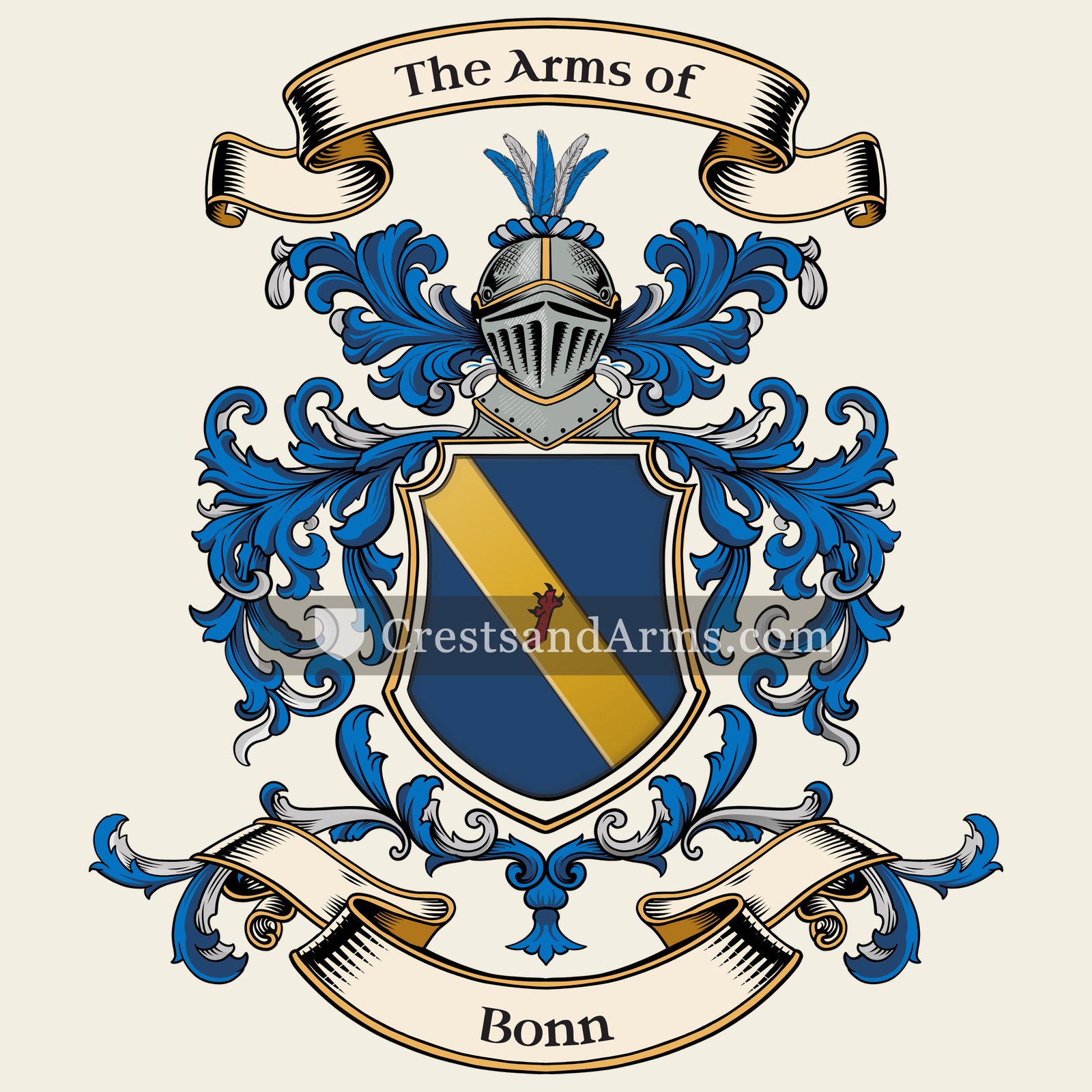


 eagleNobility, strength and a keen mind
 roseThe seventh son, and beauty with grace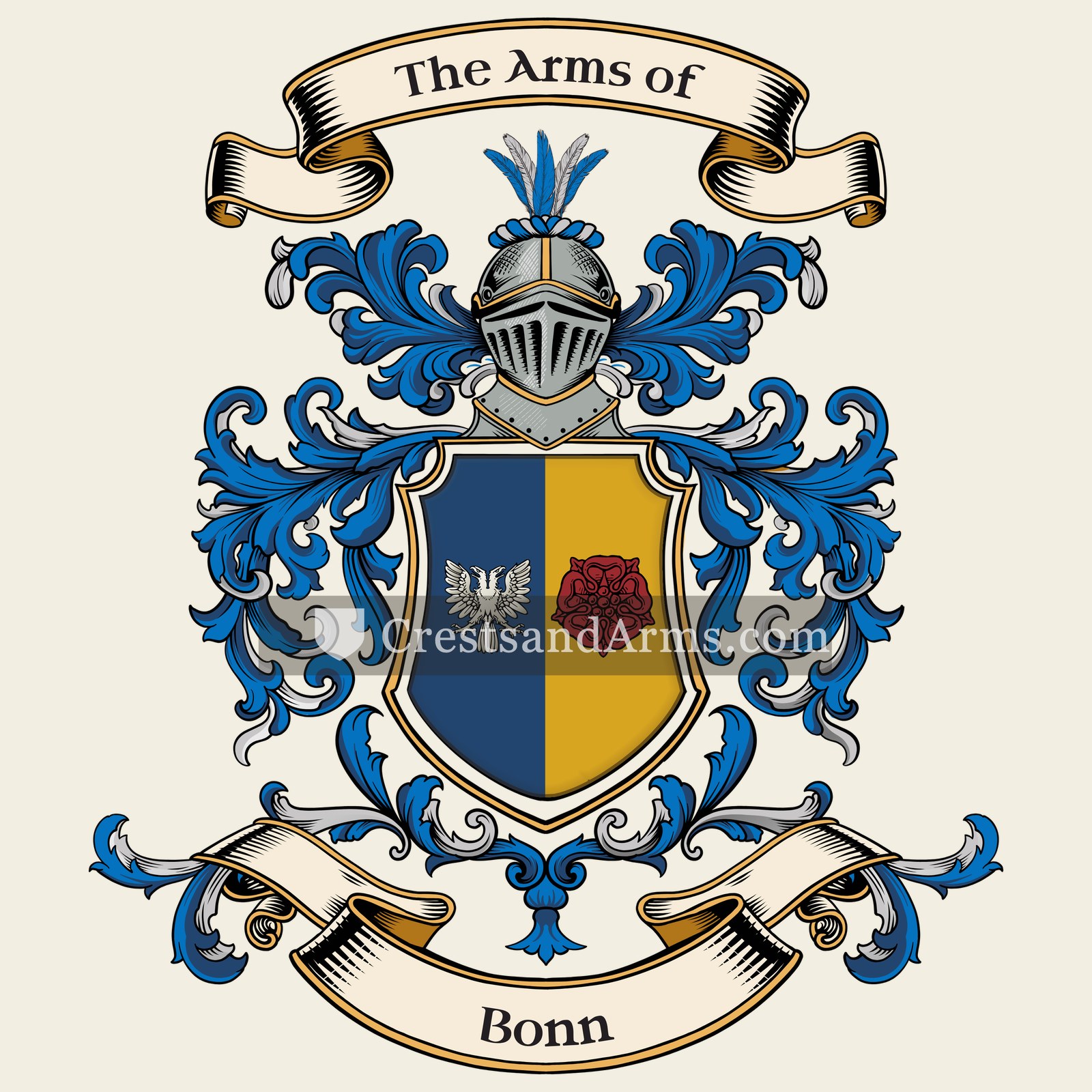


 mulletThe third son, and a divine quality from above