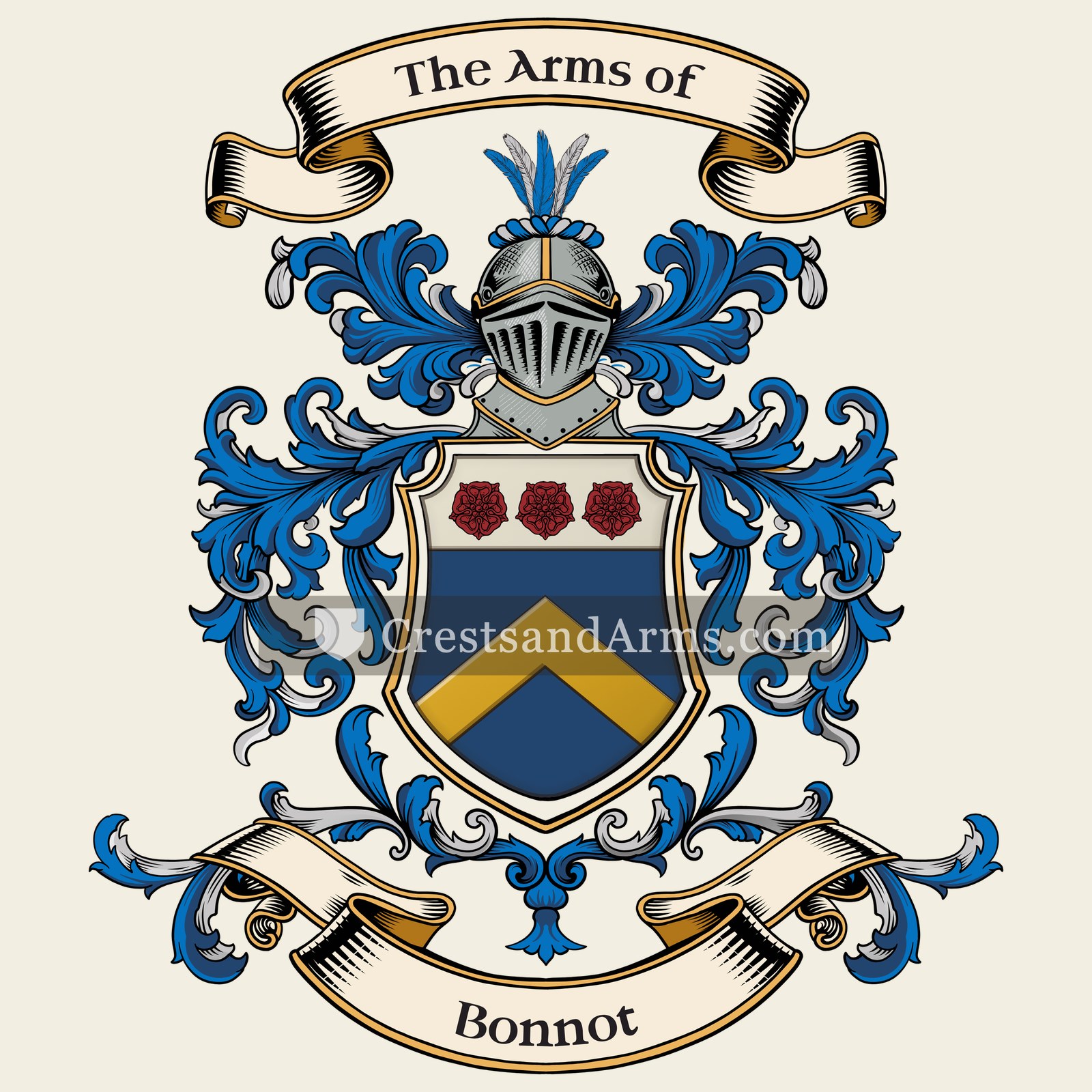
A record of documented arms, meaning and origin, researched for the Bonnot family of France.
Reg. 7224 · French, A–C
Coat of Arms & Family Crest Details
Symbols on this shield
chevronProtection, and faithful service completed
chiefAuthority, wisdom and dominion
roseThe seventh son, and beauty with grace
Colours
Blue (Azure)Means: Loyalty and truth
Gold (Or)Means: Generosity
Silver (Argent)Means: Peace and sincerity
Red (Gules)Means: Military strength
Historical info
Source
J. B. Rietstap, Armorial Général, Gouda: G. B. van Goor Zonen, 1884–87
Blazon (the actual original written record)
“D'azur au chev. d'or; au chef d'arg., ch. de trois roses de gu.”
ForezForez, c. 1663
Where the Bonnot Arms Were Recorded
Forez
Map of France showing where the Bonnot arms are recorded
The Bonnot arms were recorded in Forez, c. 1663.
Forez was a small upland county in central France, thick with minor gentry holding modest estates. Its families were more numerous than wealthy, and even a small holding was enough for a shield of one's own.
This is where the arms were entered in the register. Families often moved to other parts of the country, so the same name can turn up in more than one region.
The body that granted and recorded arms in France in this period.
Louis XIV of France
Sovereign of the period
Louis XIV of France
1643–1715
Reigning in France when the Bonnot arms are first recorded.
How Arms Worked in France
In France, a coat of arms was a mark of honor that passed down through the male line to all legitimate descendants. Families often used the same shield without changes to show their shared heritage. If a branch wanted to stand out, they could add a small mark to their shield to show their specific place in the family tree.
Granting authority
The Juge d'armes de France acted as the official authority that regulated and verified coats of arms across the country.
How they got arms
Families typically inherited their arms from ancestors, though they could also receive them through royal grants or by proving their noble status.
Where arms were recorded
Coats of arms were officially recorded in the Armorial Général de France, which began its main collection in the year 1696.
The family's standing
Recorded among the armigerous families of Forez.
Origin & History of the Bonnot Family in France
The surname Bonnot originates from the historical province of Forez in east-central France. The name is derived from the Old French word bon, which means good, and it was likely used as a descriptive nickname for a person with a kind or reliable nature. By the year 1663, records confirm that families bearing this name were well-established within the local communities of the Forez region. During this period, the Bonnot family members were typically integrated into the rural social structure, often working as skilled craftsmen or land-owning farmers. As the name spread through the surrounding villages, it became a common identifier for families who were deeply rooted in the agricultural and economic life of the Loire valley. These early generations helped shape the local identity of the region through their consistent presence in parish registers and legal documents.
Related Branches & Arms
Root word
Bon
Derived from the Latin word bonus meaning good or virtuous.
This name
BonnotA diminutive form indicating a person who is good or kind-hearted.
also spelled
Bonot
Bonno
Bono
Related arms
Houdaillesame arms
Perrinsame arms
Bonotvariant spelling
Documented Sources
J. B. Rietstap, Armorial Général, Gouda: G. B. van Goor Zonen, 1884–87
Dauzat, Albert, Dictionnaire étymologique des noms de famille et prénoms de France, 1951
Morlet, Marie-Thérèse, Dictionnaire étymologique des noms de famille, 1991
Archives départementales de la Loire, Registres paroissiaux et d'état civil du Forez
Digital archive packCoat of arms PNG, gold border print PDF, vector SVG and the certificate of authenticity. Sent to your email in minutes.


 chevronProtection, and faithful service completed
 chiefAuthority, wisdom and dominion
 roseThe seventh son, and beauty with grace
 chevronProtection, and faithful service completed
 chiefAuthority, wisdom and dominion
 roseThe seventh son, and beauty with grace