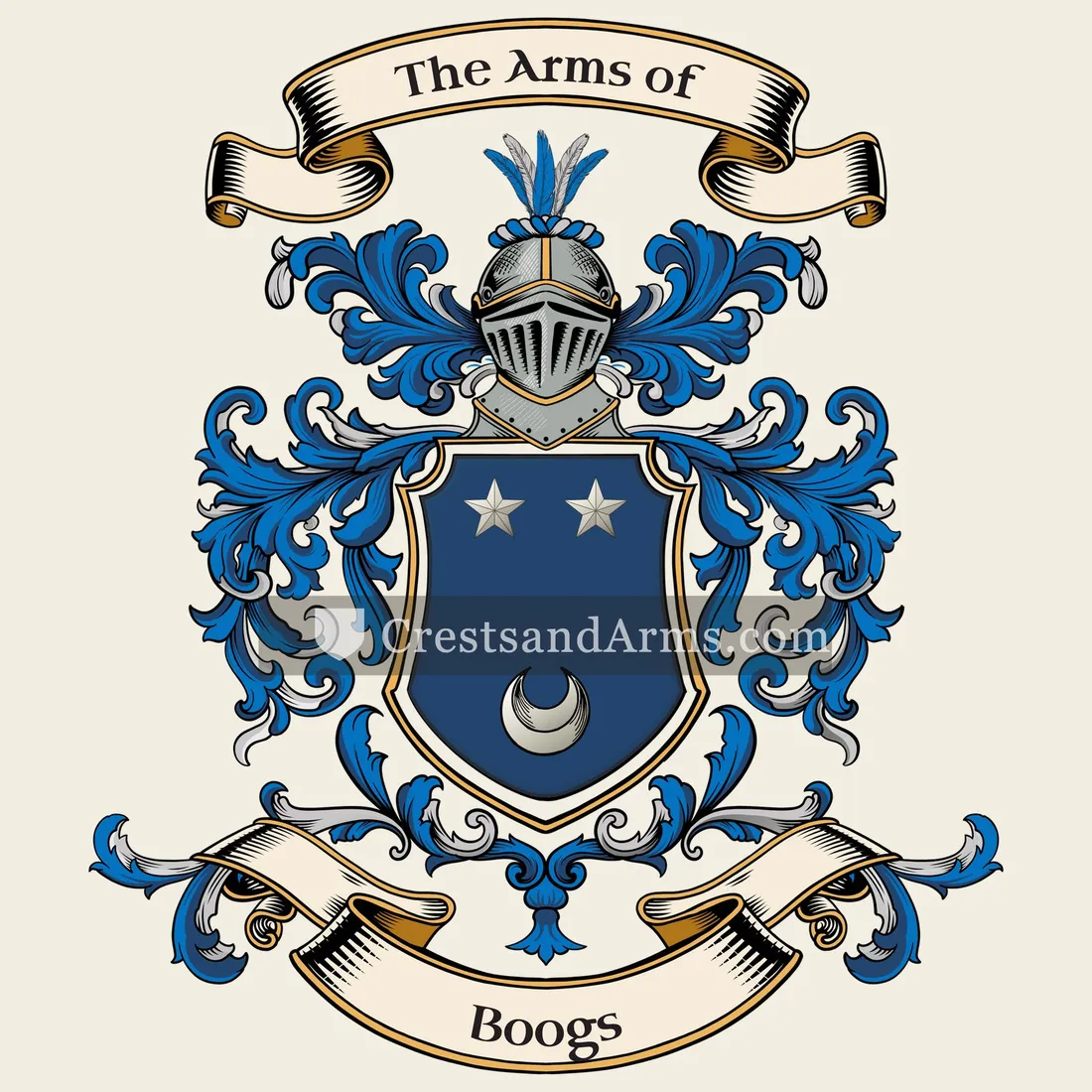
A record of documented arms, meaning and origin, researched for the Boogs family of Sweden.
Reg. 9640 · Swedish, A–C
Meaning of the Boogs family crest colors & symbols
Symbols on this shield
mulletThe third son, and a divine quality from above
crescentHonour by the sovereign, and the second son
Colours
Blue (Azure)Means: Loyalty and truth
Silver (Argent)Means: Peace and sincerity
Historical info
Source
J. B. Rietstap, Armorial Général, Gouda: G. B. van Goor Zonen, 1884–87
Blazon (the actual original written record)
“D'azur à deux étoiles d'arg. en chef et un croiss. figuré du même en p. C.: un croiss. figuré d'arg., supp. trois étoiles mal-ordonnées du même, s'entretouchant.”
Swedenc. 1700
Digital archive packCoat of arms PNG, gold border print PDF, vector SVG and the certificate of authenticity. Sent to your email in minutes.
Map of Sweden showing where the Boogs arms are recorded
The Boogs arms were recorded in Sweden, c. 1700.
Arms such as these were typically recorded in Stockholm.
Stockholm held the Swedish court and the House of Nobility, where every noble family's arms were entered and kept. Families ennobled for service registered there, which is why so many are recorded around the city.
This is where the arms were entered in the register. Families often moved to other parts of the country, so the same name can turn up in more than one region.
The body that granted and recorded arms in Sweden in this period.
Carl XII of Sweden
Sovereign of the period
Carl XII of Sweden
1697–1718
Reigning in Sweden when the Boogs arms are first recorded.
How Arms Worked in Sweden
In Sweden, a coat of arms belonged to a noble family as a whole rather than just one individual. These arms were passed down through the generations to all legitimate descendants. Younger branches of the family used the same shield without needing to change it. This system ensured that the entire lineage shared the same identity and status under the law.
Granting authority
The Riddarhuset, or House of Nobility, regulated all noble coats of arms in Sweden under royal authority.
How they got arms
Families received their coats of arms through royal grants of nobility which were then officially registered with the House.
Where arms were recorded
Coats of arms were officially recorded in the Swedish House of Nobility register starting in the year 1626.
The family's standing
Recorded among the armigerous families of Sweden.
Origin & History of the Boogs Family in Sweden
The family name Boogs traces its roots to the vibrant urban landscape of Stockholm during the early 18th century. By the year 1700, members of the family were already established residents within the city, navigating the social and economic shifts of the Swedish Empire. During this period, Stockholm served as a bustling hub for trade and administration, and families like the Boogs were often integrated into the growing merchant or artisan classes that kept the capital functioning. While the name itself may have evolved from older linguistic roots common in Northern Europe, its early documented presence in Sweden suggests a family that was deeply connected to the local community. These early ancestors likely lived through the Great Northern War, witnessing the transformation of their city as it expanded into a major European power. Through their daily work and civic participation, they helped build the foundation for the family legacy that persisted long after the turn of the century.
Boogs Meaning & Related Branches
Root word
Boge
A bow or a curved piece of wood.
This name
BoogsDerived from a topographic feature or a nickname related to someone living near a curved landscape.
also spelled
Boos
Bose
Documented Sources
J. B. Rietstap, Armorial Général, Gouda: G. B. van Goor Zonen, 1884–87
Stockholm City Archives, Mantalslängder för Stockholms stad (1700)
National Archives of Sweden, Kyrkoarkiv, Födelse- och dopböcker (1700)
Digital archive packCoat of arms PNG, gold border print PDF, vector SVG and the certificate of authenticity. Sent to your email in minutes.


 mulletThe third son, and a divine quality from above
 crescentHonour by the sovereign, and the second son
 mulletThe third son, and a divine quality from above
 crescentHonour by the sovereign, and the second son