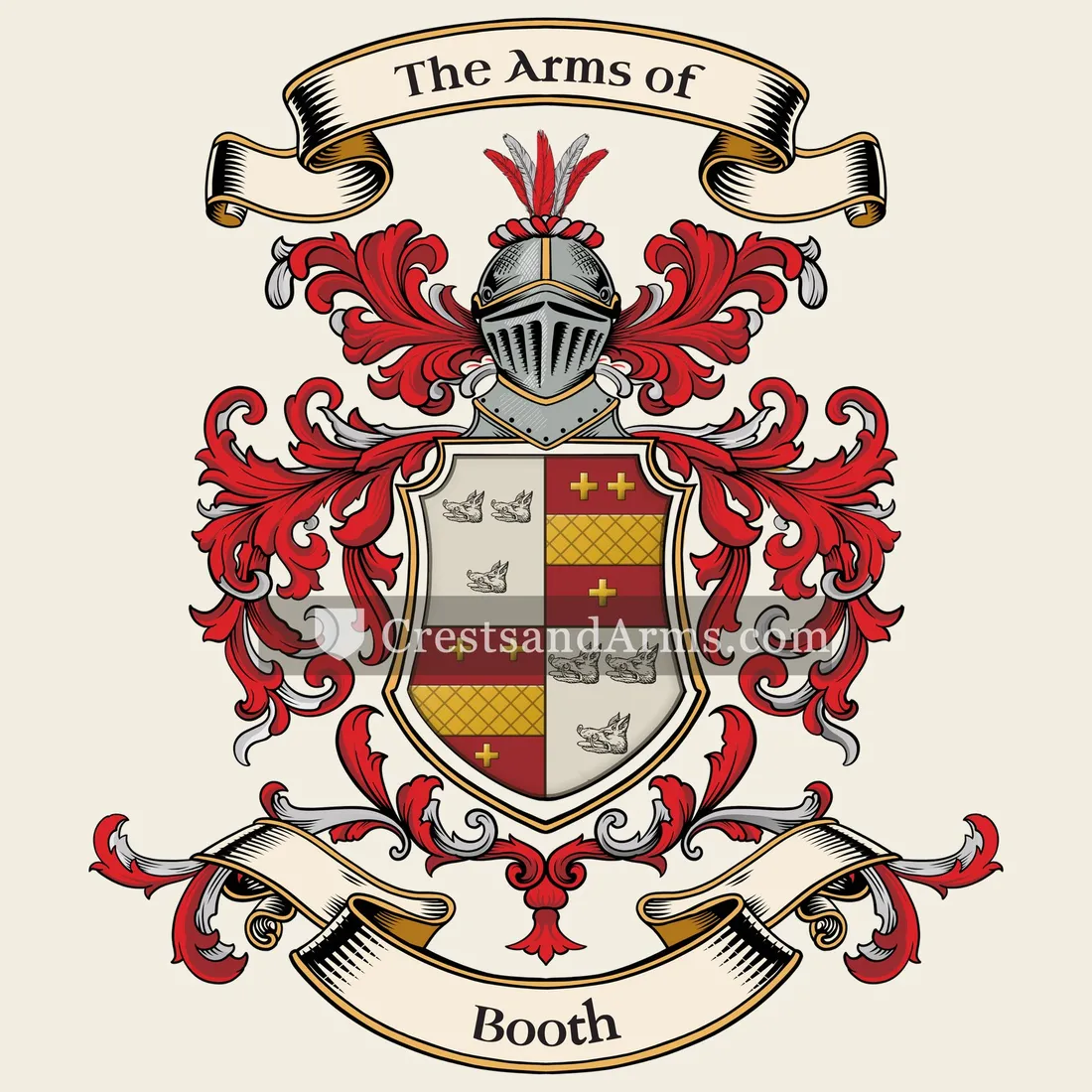
A record of documented arms, meaning and origin, researched for the Booth family lines. Documented in 3 countries.
Reg. 8794 · Dutch, A–C
Meaning of the Booth family crest colors & symbols
Symbols on this shield
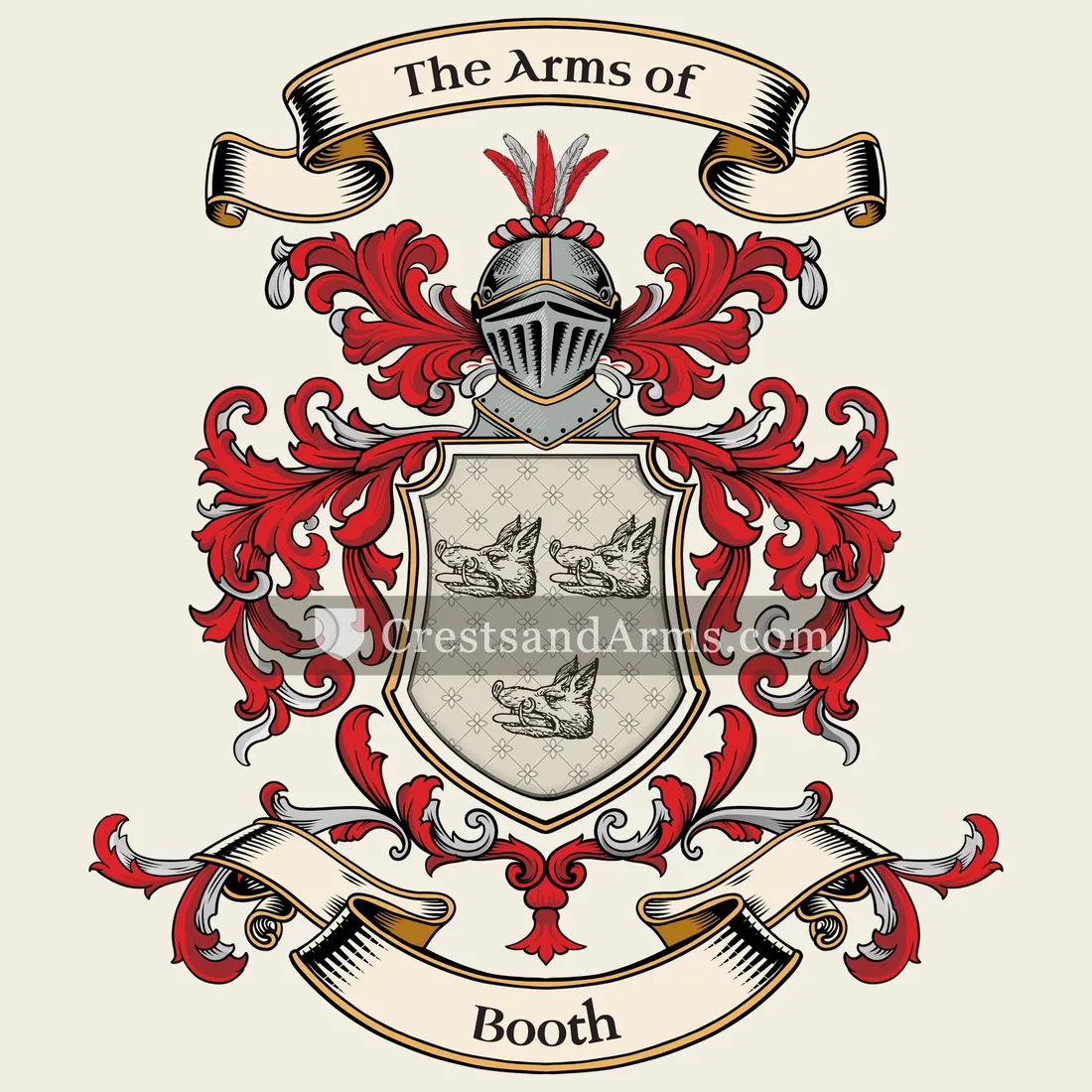
boars headA fierce fighter who battles to the end
Colours
Silver (Argent)Means: Peace and sincerity
Black (Sable)Means: Constancy
Historical info
Source
J. B. Rietstap, Armorial Général, Gouda: G. B. van Goor Zonen, 1884–87
Blazon (the actual original written record)
“D'arg. à trois hures de sanglier de sa., le boutoir vers le chef. C.: un lion posé d'arg., soutenu d'une couronne de feuillage. S.: deux sangliers. D.: QUOD ERO SPERO.”
Netherlandsc. 1661
Digital archive packCoat of arms PNG, gold border print PDF, vector SVG and the certificate of authenticity. Sent to your email in minutes.
Map of Netherlands showing where the Booth arms are recorded
The Booth arms were recorded in Netherlands, c. 1661.
Arms such as these were typically recorded in Friesland.
Friesland was low, wet country on the northern coast of the Netherlands, farmed by families who had held the same land for centuries. Free landholders were unusually common there, and a free landholder could carry arms.
This is where the arms were entered in the register. Families often moved to other parts of the country, so the same name can turn up in more than one region.
Region
Friesland
First recorded
1661
Granting Authority for the Booth Arms
Hoge Raad van Adel
Photograph made by me · CC BY-SA 3.0
The body that granted and recorded arms in Netherlands in this period.
How Arms Worked in Netherlands
In the Netherlands, coats of arms were often used by noble families and those who held specific public offices. These arms were passed down through the generations to legitimate descendants. Younger branches of a family usually kept the original design without needing to add special marks. This system ensured that the family identity remained clear and consistent over many years.
Granting authority
The Hoge Raad van Adel is the official body that regulates and manages noble titles and coats of arms in the Netherlands.
How they got arms
Families typically obtained their coats of arms through official royal grants or by proving their long-standing historical use of the symbols.
Where arms were recorded
Coats of arms are officially recorded in the registers held by the Hoge Raad van Adel, which began its work in 1814.
The family's standing
Recorded among the armigerous families of Netherlands.
Origin & History of the Booth Family in Netherlands
The family name Booth has deep roots in the northern regions of the Netherlands, particularly within the province of Friesland. By the year 1661, records confirm that members of the family were already established in this area, living among the unique cultural landscape of the Frisian people. The name itself likely originated as a topographic descriptor, referring to individuals who lived in or near a small hut or a temporary shelter used by farmers and herdsmen. In the context of the Dutch landscape, these early ancestors were often associated with the management of land and livestock. As the family grew, they integrated into the local community, adapting to the distinct Frisian language and the maritime traditions that defined the region during the seventeenth century. This early presence in Friesland highlights a history of resilience and adaptation as the family navigated the social and economic shifts of the Dutch Golden Age.
Meaning of the Booth family crest colors & symbols
Symbols on this shield
boars headA fierce fighter who battles to the end
Colours
Silver (Argent)Means: Peace and sincerity
Black (Sable)Means: Constancy
Historical info
Source
Sir Bernard Burke, The General Armory of England, Scotland, Ireland and Wales, London: Harrison & Sons, 1884
Blazon (the actual original written record)
“Ar. three boars' heads erect and erased sa. langued gu”
LancasterBarton · Lancaster, c. 1275
Digital archive packCoat of arms PNG, gold border print PDF, vector SVG and the certificate of authenticity. Sent to your email in minutes.
Map of England showing where the Booth arms are recorded
The Booth arms were recorded in Lancaster, c. 1275.
Lancashire was divided among a great many small landed families, more than most northern counties. Estates were passed down whole rather than split up, so the same names hold the same ground for centuries in the records.
This is where the arms were entered in the register. Families often moved to other parts of the country, so the same name can turn up in more than one region.
The body that granted and recorded arms in England in this period.
Edward I of England
Sovereign of the period
Edward I of England
1272–1307
Reigning in Netherlands when the Booth arms are first recorded.
How Arms Worked in England
English heraldry allowed arms to be shared by all legitimate descendants of the original owner. These symbols were treated as personal property that moved through the generations to all children. While the eldest son kept the original design, other family members could use the same shield without needing to change it or register their own unique versions.
Granting authority
The College of Arms in London has regulated the use of coats of arms throughout England and Wales since 1484.
How they got arms
Families typically obtained their coats of arms through a formal grant from the Crown or by proving their ancient right to them.
Where arms were recorded
All official coats of arms are recorded in the registers kept at the College of Arms, which date back to the fifteenth century.
The family's standing
Recorded among the armigerous families of Lancaster.
Origin & History of the Booth Family in England
The surname Booth is a locative name, meaning it originated from a specific place rather than a trade or a personal trait. It is derived from the Old Norse word *búð*, which refers to a temporary hut or a small shed used by herdsmen during the summer months. By the time the name began to appear in official English records, it identified families who lived near these small shelters or in areas where such structures were common. Records confirm that members of the Booth family were well-established in the county of Lancaster by 1275, suggesting they were part of the local landholding class in Northern England during the Middle Ages. Over time, the name spread from these rural settlements as family members moved into towns and cities, eventually becoming a recognized surname across the region.
Meaning of the Booth family crest colors & symbols
Symbols on this shield
fessThe military belt, and readiness to serve
cross symbolChristian faith and service
boars headA fierce fighter who battles to the end
Colours
Silver (Argent)Means: Peace and sincerity
Red (Gules)Means: Military strength
Gold (Or)Means: Generosity
Black (Sable)Means: Constancy
Historical info
Source
Sir Bernard Burke, The General Armory of England, Scotland, Ireland and Wales, London: Harrison & Sons, 1884
Blazon (the actual original written record)
“Quarterly, 1st and 4th, ar. three boars' heads couped sa., for BOOTH; 2nd and 3rd, gu. a fesse betw. three crosses crosslet fitchée or, for GORE”
SligoLissadell · Sligo, c. 1645
Digital archive packCoat of arms PNG, gold border print PDF, vector SVG and the certificate of authenticity. Sent to your email in minutes.
Map of Ireland showing where the Booth arms are recorded
The Booth arms were recorded in Sligo, c. 1645.
Sligo was north-western Irish country with a harbour and poor land behind it. Its families were few and held their ground for a very long time, which is what put them in the records.
This is where the arms were entered in the register. Families often moved to other parts of the country, so the same name can turn up in more than one region.
The body that granted and recorded arms in Ireland in this period.
Charles I of England
Sovereign of the period
Charles I of England
1625–1649
Reigning in Netherlands when the Booth arms are first recorded.
How Arms Worked in Ireland
The Ulster King of Arms granted coats of arms to individuals who proved their social standing and good character. These symbols were typically inherited by all legitimate descendants of the original holder. If a family branch wanted a unique look, they could apply for a specific change to their design through the office to ensure their identity remained distinct.
Granting authority
The Ulster King of Arms acted as the official body that regulated and issued all coats of arms throughout Ireland.
How they got arms
Families obtained their arms through formal grants issued by the office after proving their eligibility and paying the required fees.
Where arms were recorded
All official grants were recorded in the registers held by the Ulster King of Arms starting from the year 1552.
The family's standing
Recorded among the armigerous families of Sligo.
Origin & History of the Booth Family in Ireland
The Booth family name has roots that stretch back to the mid-seventeenth century in County Sligo, Ireland. Historical records confirm that members of the family were established in this region by 1645. During this period, Ireland was undergoing significant political and social upheaval, which often led to the movement of families across the landscape. The Booths were among those who settled in the west of Ireland, likely drawn by the availability of land and the shifting administrative policies of the time. As the family integrated into the local community, they became part of the complex social fabric of Sligo. Their presence in the area during the mid-1600s highlights the broader patterns of migration and settlement that defined the history of the Irish province of Connacht. By establishing themselves in Sligo, the early Booths contributed to the long-term development of the region through their involvement in local life and land management.
Booth Meaning & Related Branches
Root word
bōth
A small hut, shed, or temporary dwelling made of wood.
This name
BoothAn occupational or topographical name for someone who lived in or built a small hut.
also spelled
Both
Boothe
Bothe
Bouth
Related arms
Bugletsimilar arms
Elphinstonesimilar arms
Lée du Drouillaysimilar arms
Bothvariant spelling
Documented Sources
J. B. Rietstap, Armorial Général, Gouda: G. B. van Goor Zonen, 1884–87
Tresoar (Fries Historisch en Letterkundig Centrum), Doop-, trouw- en begraafboeken (DTB), 1661
Nationaal Archief, Registers van de Staten van Friesland, 1661
Brouwer, J.H., Encyclopedie van Friesland, 1958
Van der Meer, G., Friese familienamen: Een onderzoek naar hun herkomst en verspreiding, 1985
Digital archive packCoat of arms PNG, gold border print PDF, vector SVG and the certificate of authenticity. Sent to your email in minutes.


 boars headA fierce fighter who battles to the end
 boars headA fierce fighter who battles to the end



 fessThe military belt, and readiness to serve
 cross symbolChristian faith and service