Map of Netherlands showing where the Bor arms are recorded
The Bor arms were recorded in Amsterdam, c. 1815.
This is where the arms were entered in the register. Families often moved to other parts of the country, so the same name can turn up in more than one region.
Region
Amsterdam
Town
Amsterdam
First recorded
1815
Granting Authority for the Bor Arms
Hoge Raad van Adel
Photograph made by me · CC BY-SA 3.0
The body that granted and recorded arms in Netherlands in this period.
William I of the Netherlands
Sovereign of the period
William I of the Netherlands
1815–1840
Reigning in Netherlands when the Bor arms are first recorded.
How Arms Worked in Netherlands
In the Netherlands, coats of arms were often used by noble families and those who held specific public offices. These arms were passed down through the generations to legitimate descendants. Younger branches of a family usually kept the original design without needing to add special marks. This system ensured that the family identity remained clear and consistent over many years.
Granting authority
The Hoge Raad van Adel is the official body that regulates and manages noble titles and coats of arms in the Netherlands.
How they got arms
Families typically obtained their coats of arms through official royal grants or by proving their long-standing historical use of the symbols.
Where arms were recorded
Coats of arms are officially recorded in the registers held by the Hoge Raad van Adel, which began its work in 1814.
The family's standing
Recorded among the armigerous families of Netherlands.
Origin & History of the Bor Family in Netherlands
The name Bor is a short and ancient surname that likely originated as a descriptive nickname or a reference to a specific location. In the Dutch language, the word can be linked to old terms for a well or a source of water, suggesting that early ancestors may have lived near a prominent community spring. By the time the family was firmly established in Amsterdam in 1815, the name had become a stable identifier for citizens participating in the city’s growing trade and bureaucratic sectors. During this period, Amsterdam was recovering from the Napoleonic era, and families like the Bors were part of the urban fabric that helped rebuild the city’s economy. Because the name is brief, it was easy to record in official ledgers and civil registries, which allowed the family to maintain a clear presence in municipal archives throughout the nineteenth century.
Bor Meaning & Related Branches
Root word
borre
A Middle Dutch term referring to a well or a spring.
This name
BorA topographic name for someone who lived near a well or water source.
also spelled
Boar
Boors
Borse
Related arms
Brühlsimilar arms
Seraryssimilar arms
Sweerts van der Reestsimilar arms
Boarvariant spelling
Documented Sources
J. B. Rietstap, Armorial Général, Gouda: G. B. van Goor Zonen, 1884–87
Meertens Instituut, Nederlandse Familienamenbank, 2023
Stadsarchief Amsterdam, Bevolkingsregister 1853-1863, Record Series 5000
Van der Schaar, J., Woordenboek van familienamen, 1988
Digital archive packCoat of arms PNG, gold border print PDF, vector SVG and the certificate of authenticity. Sent to your email in minutes.


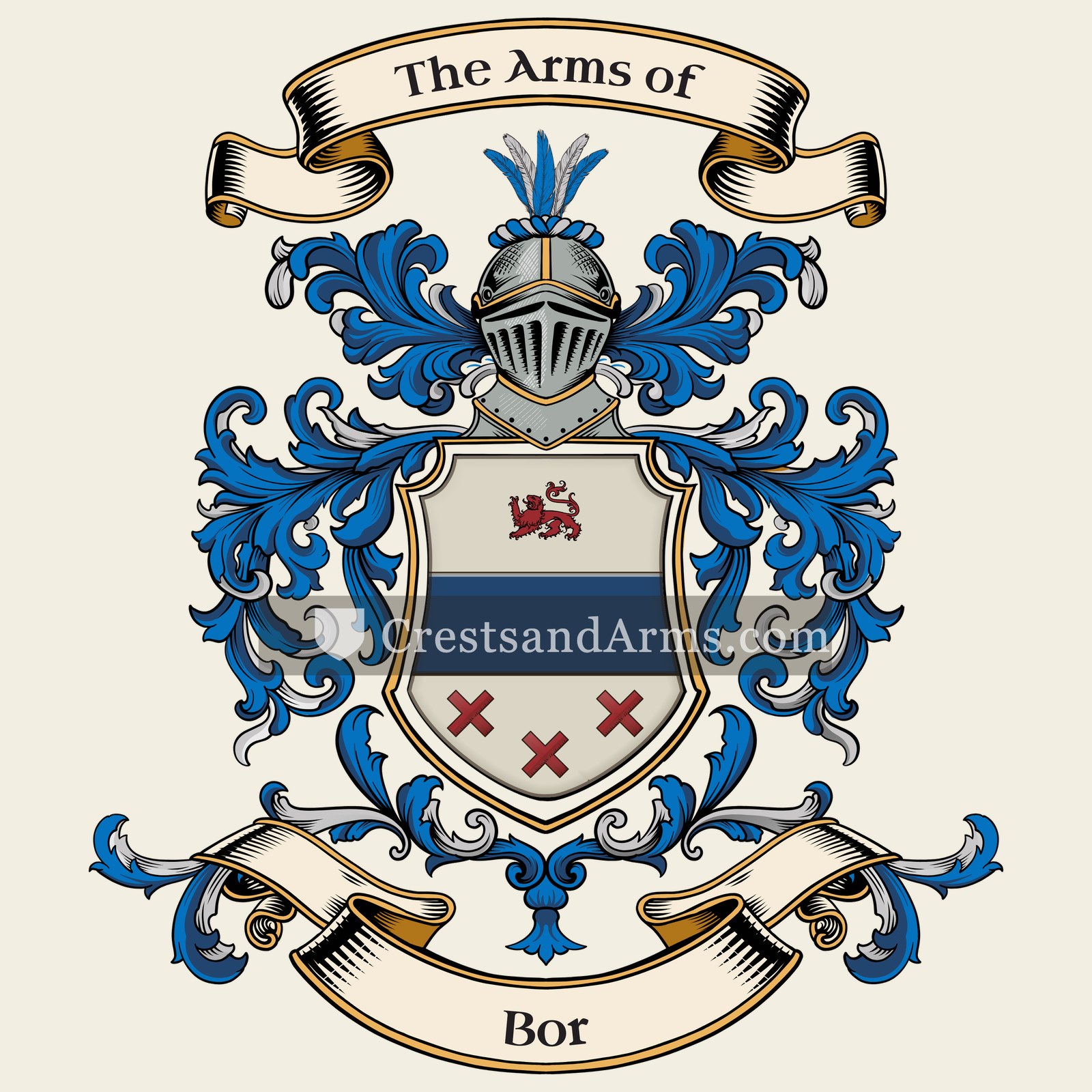
 fessThe military belt, and readiness to serve
 lionCourage, strength and royalty
 saltire coupedResolution, and the cross of St Andrew
 fessThe military belt, and readiness to serve
 lionCourage, strength and royalty
 saltire coupedResolution, and the cross of St Andrew