Map of Denmark showing where the Borch arms are recorded
The Borch arms were recorded in Denmark, c. 1722.
Arms such as these were typically recorded in Sjaælland.
Zealand held the Danish court, the crown's offices and Copenhagen itself. Families who served the king kept estates within reach of it, and royal service was the ordinary route to a coat of arms.
This is where the arms were entered in the register. Families often moved to other parts of the country, so the same name can turn up in more than one region.
The body that granted and recorded arms in Denmark in this period.
Frederik IV of Denmark
Sovereign of the period
Frederik IV of Denmark
1699–1730
Reigning in Denmark when the Borch arms are first recorded.
How Arms Worked in Denmark
Danish heraldry during this period was closely tied to noble status and royal favor rather than being open to all citizens. Arms were typically granted by the monarch to individuals, and these symbols were then shared by all members of the noble house. If a family line died out, the right to use those specific arms ended with them.
Granting authority
The Danish royal chancery held the power to issue and regulate official coats of arms for the kingdom.
How they got arms
Families usually received their arms through a formal royal grant that confirmed their noble status and rights.
Where arms were recorded
These grants were officially recorded in the Danish Royal Chancery records starting in the sixteenth century.
The family's standing
Recorded among the armigerous families of Denmark.
Origin & History of the Borch Family in Denmark
The history of the Borch family in Denmark is deeply rooted in the agricultural and social landscape of the island of Sjælland. By the early eighteenth century, the name was already well established in the region, with documented records confirming family members were living there by 1722. During this period, families like the Borchs were often tied to the local land and the evolving structures of the Danish parish system. The name itself is thought to be derived from the Old Danish word for a fortification or a castle, suggesting that the earliest ancestors may have lived near such a structure or served in roles associated with local defense. As the family grew, they became part of the steady rhythm of rural life in Sjælland, contributing to the local community through farming and trade. Their presence in the historical record during the 1700s provides a clear window into how common families navigated the social changes of the Danish Enlightenment.
Coat of Arms & Family Crest Details
Symbols on this shield
lionCourage, strength and royalty
Colours
Gold (Or)Means: Generosity
Red (Gules)Means: Military strength
Historical info
Source
J. B. Rietstap, Armorial Général, Gouda: G. B. van Goor Zonen, 1884–87
Blazon (the actual original written record)
“D'or au lion de gu. C.: le lion, iss., entre un vol d'or.”
Netherlandsc. 1815
Digital archive packCoat of arms PNG, gold border print PDF, vector SVG and the certificate of authenticity. Sent to your email in minutes.
Map of Netherlands showing where the Borch arms are recorded
The Borch arms were recorded in Netherlands, c. 1815.
Arms such as these were typically recorded in Friesland.
Friesland was low, wet country on the northern coast of the Netherlands, farmed by families who had held the same land for centuries. Free landholders were unusually common there, and a free landholder could carry arms.
This is where the arms were entered in the register. Families often moved to other parts of the country, so the same name can turn up in more than one region.
Region
Friesland
First recorded
1815
Granting Authority for the Borch Arms
Hoge Raad van Adel
Photograph made by me · CC BY-SA 3.0
The body that granted and recorded arms in Netherlands in this period.
William I of the Netherlands
Sovereign of the period
William I of the Netherlands
1815–1840
Reigning in Denmark when the Borch arms are first recorded.
How Arms Worked in Netherlands
In the Netherlands, coats of arms were often used by noble families and those who held specific public offices. These arms were passed down through the generations to legitimate descendants. Younger branches of a family usually kept the original design without needing to add special marks. This system ensured that the family identity remained clear and consistent over many years.
Granting authority
The Hoge Raad van Adel is the official body that regulates and manages noble titles and coats of arms in the Netherlands.
How they got arms
Families typically obtained their coats of arms through official royal grants or by proving their long-standing historical use of the symbols.
Where arms were recorded
Coats of arms are officially recorded in the registers held by the Hoge Raad van Adel, which began its work in 1814.
The family's standing
Recorded among the armigerous families of Netherlands.
Origin & History of the Borch Family in Netherlands
The family name Borch carries a deep connection to the northern landscapes of the Netherlands, particularly within the province of Friesland. By the early 19th century, records confirm that members of the family were firmly established in this region, which was a time of great transition following the end of the Napoleonic era. The name itself likely originates from the Middle Dutch word for a fortified place or a castle, suggesting that the earliest ancestors may have lived near or worked within such a structure. As the family settled into the Frisian countryside, they became part of a unique cultural identity that valued local autonomy and strong community ties. Over the decades, the name evolved alongside the changing administrative requirements of the Dutch state, reflecting the broader movement of families across the northern provinces as they adapted to new social and economic conditions.
Coat of Arms & Family Crest Details
Symbols on this shield
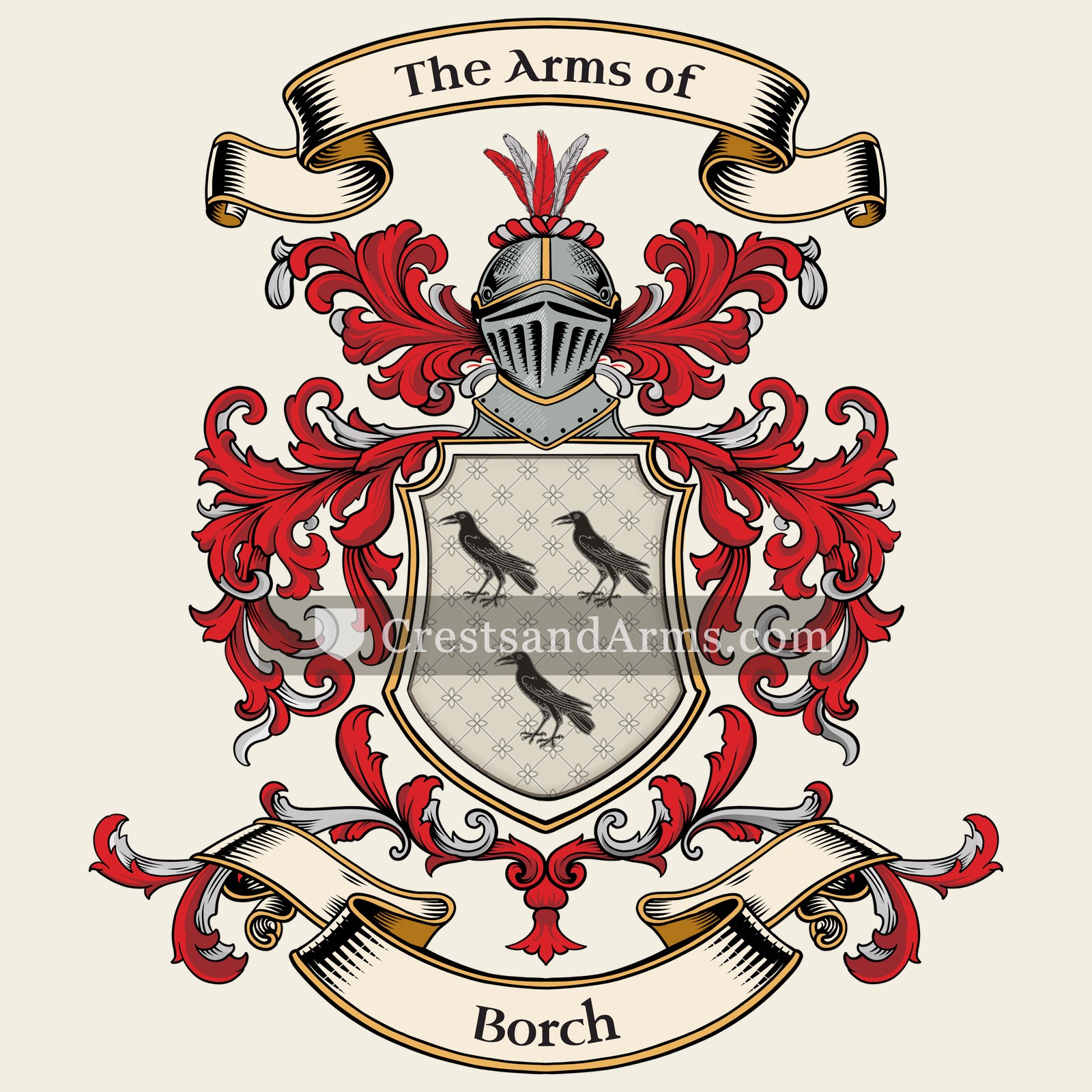
ravenConstancy and divine providence
Colours
Silver (Argent)Means: Peace and sincerity
Black (Sable)Means: Constancy
Historical info
Source
J. B. Rietstap, Armorial Général, Gouda: G. B. van Goor Zonen, 1884–87
Blazon (the actual original written record)
“D'arg. à trois corbeaux de sa., m. de gu. Cq. cour. C.: un corbeau de l'écu, entre un vol de sa. D.: POUR PARVENIR J'ENDURAY.”
WestphaliaHan · Westphalia, c. 1847
Digital archive packCoat of arms PNG, gold border print PDF, vector SVG and the certificate of authenticity. Sent to your email in minutes.
Map of Germany showing where the Borch arms are recorded
The Borch arms were recorded in Westphalia, c. 1847.
Westphalia was a land of small estates and fortified farmhouses in western Germany. Its families were numerous and not especially rich, but each held its own ground, and holding ground was what brought arms.
This is where the arms were entered in the register. Families often moved to other parts of the country, so the same name can turn up in more than one region.
The body that granted and recorded arms in Germany in this period.
Frederick William IV of Prussia
Sovereign of the period
Frederick William IV of Prussia
1840–1861
Reigning in Denmark when the Borch arms are first recorded.
How Arms Worked in Germany
Prussian heraldry was strictly tied to social rank and noble status rather than being a free choice for every citizen. These symbols were treated as permanent family property that moved through the generations to all legitimate heirs. If a family branch wanted to change their design to stand out, they had to apply for official permission to alter their specific version of the shield.
Granting authority
The Prussian Heroldsamt acted as the central state office that managed and strictly controlled all noble titles and coats of arms.
How they got arms
Families usually obtained their arms through formal royal grants or by proving their long-standing noble status to the state authorities.
Where arms were recorded
All official coats of arms were kept in the rolls of the Prussian Heroldsamt, which functioned from 1706 until 1918.
The family's standing
Recorded among the armigerous families of Westphalia.
Origin & History of the Borch Family in Germany
The name Borch finds its historical roots in the low-lying landscapes of northern Germany, where the term originally functioned as a topographic descriptor. In the local dialects of the region, the word referred to a fortification or a castle, suggesting that the earliest bearers of the name likely lived near or served at such a site. By the mid-nineteenth century, the family established a notable presence in the Westphalia region, a territory defined by its dense forests and industrial growth. During this era, many families with this name were deeply integrated into the local agrarian and emerging trade economies of the Prussian province. As the population shifted during the 1840s, members of the Borch family were documented as active participants in the social and economic life of Westphalian towns, contributing to the steady development of the region before many eventually sought new opportunities abroad.
Borch Meaning & Related Branches
Root word
Burg
A fortified place, castle, or town.
This name
BorchRefers to a person who lived near or worked at a fortified castle or town.
also spelled
Bork
Related arms
Borkvariant spelling
Documented Sources
J. B. Rietstap, Armorial Général, Gouda: G. B. van Goor Zonen, 1884–87
Rigsarkivet (Danish National Archives), Kirkebøger for Sjællands Stift (Parish registers for the Diocese of Sjælland)
Rigsarkivet (Danish National Archives), Folketællinger (Census records)
Nielsen, O., Kjøbenhavns Diplomatarium, 1872
Trap, J.P., Statistisk-topographisk Beskrivelse af Kongeriget Danmark, 1858
Digital archive packCoat of arms PNG, gold border print PDF, vector SVG and the certificate of authenticity. Sent to your email in minutes.




 lionCourage, strength and royalty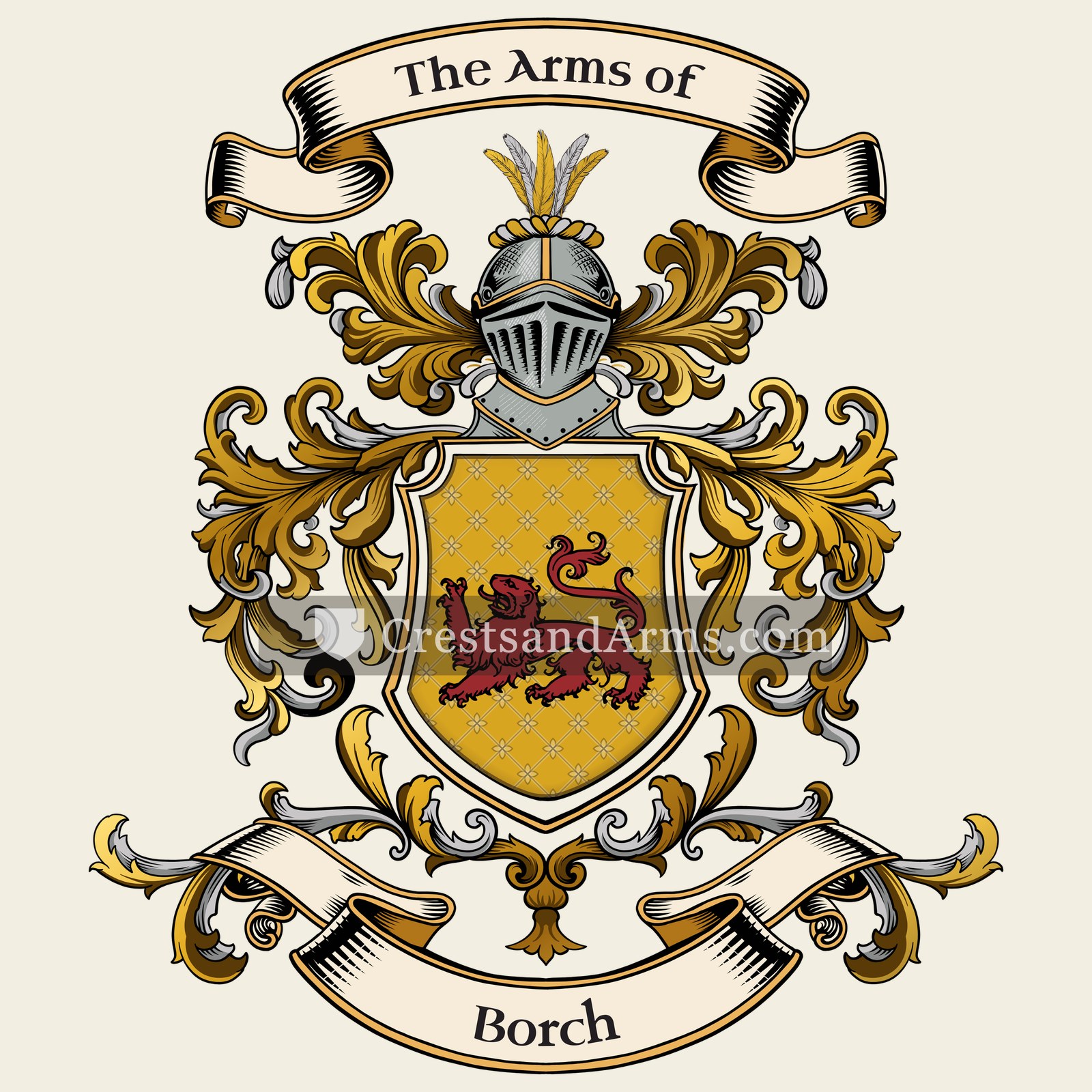


 ravenConstancy and divine providence