Map of Italy showing where the Borcherding arms are recorded
The Borcherding arms were recorded in Florence, c. 1775.
This is where the arms were entered in the register. Families often moved to other parts of the country, so the same name can turn up in more than one region.
The body that granted and recorded arms in Italy in this period.
Alvise Giovanni Mocenigo
Sovereign of the period
Alvise Giovanni Mocenigo
1763–1778
Reigning in Italy when the Borcherding arms are first recorded.
How Arms Worked in Italy
In the Italian states, coats of arms were often used by noble families to show their status and history. These symbols were passed down through the generations to all legitimate male descendants. Younger branches of a family usually kept the original design but sometimes added small changes to distinguish their specific line from the main branch.
Granting authority
Various local rulers and city governments controlled the use of coats of arms across the different Italian states.
How they got arms
Families often assumed their own arms or received them as official grants from local lords, popes, or city councils.
Where arms were recorded
Arms were recorded in local city archives or private family books rather than in one single national register.
The family's standing
Recorded among the armigerous families of Italy.
Origin & History of the Borcherding Family in Italy
The family name Borcherding originates from the northern regions of Germany, where it developed as a descriptive surname based on local naming customs. The suffix "ing" typically indicates a connection to a specific group or family line, while the root suggests an association with a person named Borchard. By the mid-eighteenth century, members of the family had migrated from their ancestral lands to establish a presence in Florence, Italy, by 1775. This movement was likely driven by the expanding trade networks and diplomatic connections that linked German merchants and artisans to the Italian peninsula during the Enlightenment. These early family members integrated into the local economy, contributing to the cultural and commercial life of the city while maintaining their distinct northern heritage.
Borcherding Meaning & Related Branches
Root word
Burchard
Derived from the Germanic elements for castle or fort and hardy.
This name
BorcherdingA patronymic surname indicating a descendant of someone named Burchard, meaning strong as a fortress.
also spelled
Borgheriny
Borgereenee
Documented Sources
J. B. Rietstap, Armorial Général, Gouda: G. B. van Goor Zonen, 1884–87
Bahlow, Hans. Deutsches Namenlexikon: Familien- und Vornamen nach Ursprung und Sinn erklärt. 1967
Gottschald, Max. Deutsche Namenkunde: Unsere Familiennamen nach ihrer Entstehung und Bedeutung. 1971
Archivio di Stato di Firenze, Stato Civile della Restaurazione
Digital archive packCoat of arms PNG, gold border print PDF, vector SVG and the certificate of authenticity. Sent to your email in minutes.


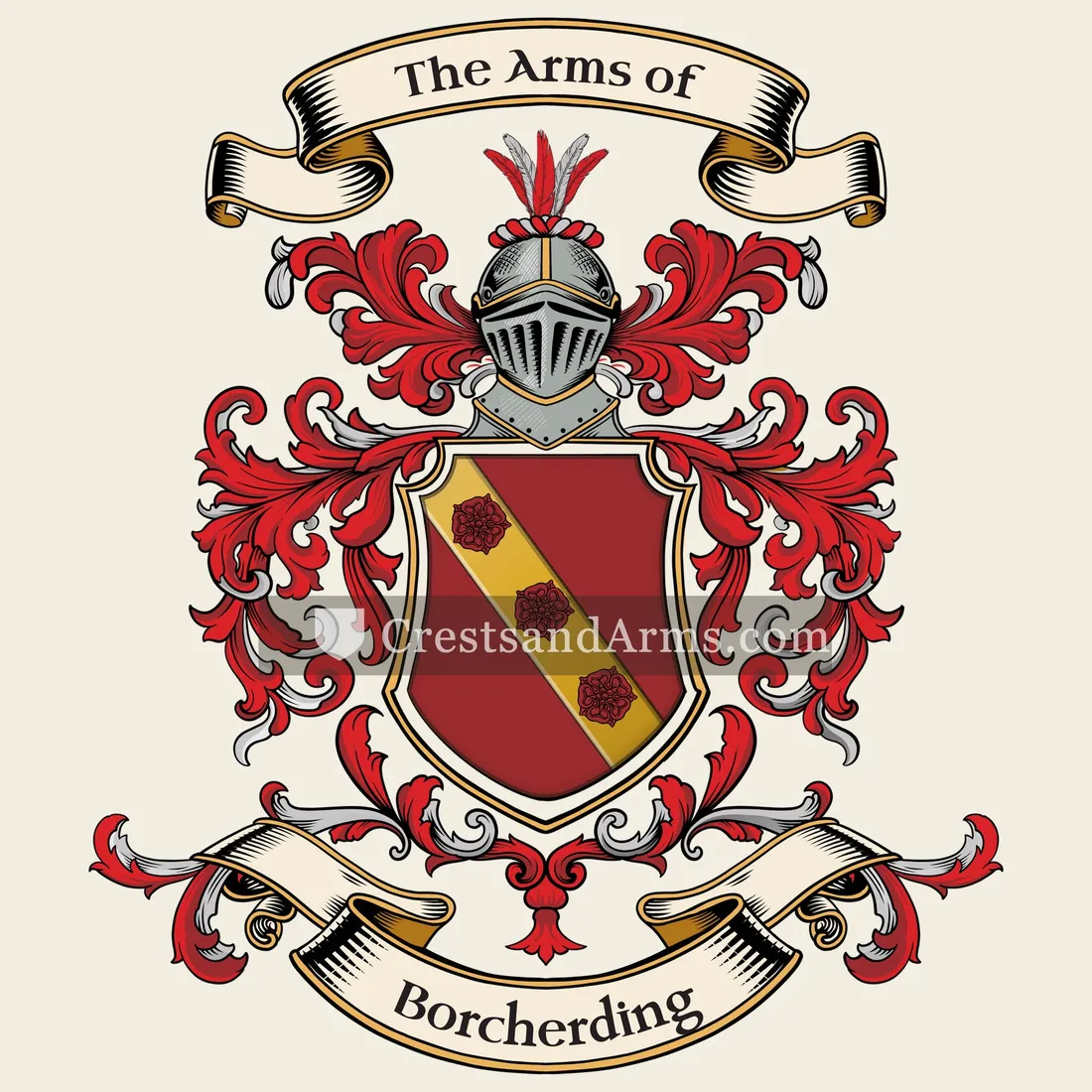
 bendDefence, and the scarf of a commander
 roseThe seventh son, and beauty with grace
 bendDefence, and the scarf of a commander
 roseThe seventh son, and beauty with grace