Map of Britain showing where the Boreham arms are recorded
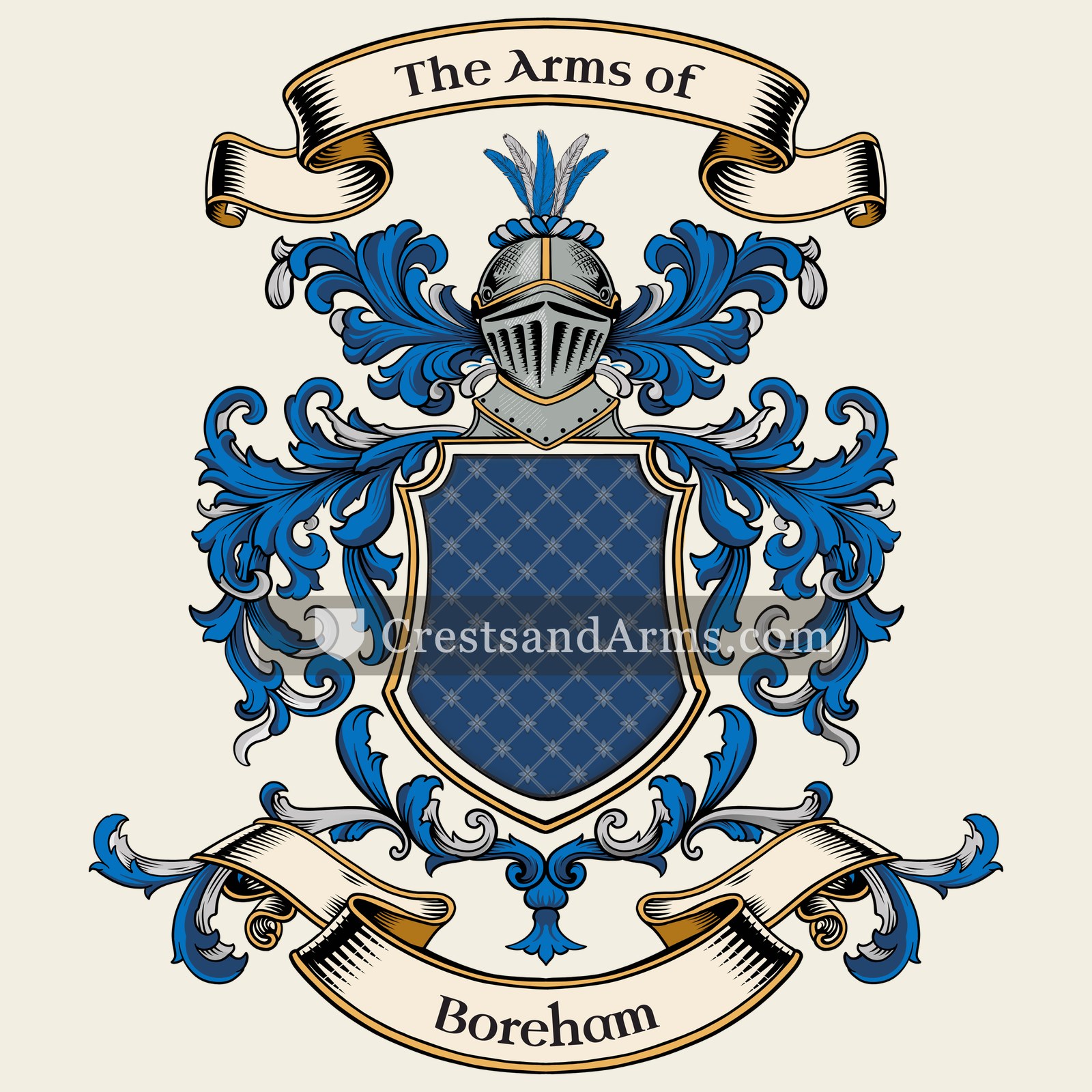
The Boreham arms were recorded in Sussex, c. 1621.
Sussex had ironworks in its woods and good farmland on its downs. Both made money, and families who made it bought manors, which is what put their names in the heraldic records.
This is where the arms were entered in the register. Families often moved to other parts of the country, so the same name can turn up in more than one region.
The body that granted and recorded arms in Britain in this period.
James VI and I
Sovereign of the period
James VI and I
1603–1625
Reigning in Britain when the Boreham arms are first recorded.
How Arms Worked in Britain
English heraldry allowed arms to be shared by all legitimate descendants of the original owner. These symbols were treated as personal property that moved through the generations to all children. While the eldest son kept the original design, other family members could use the same shield without needing to change it or register their own unique versions.
Granting authority
The College of Arms in London has regulated the use of coats of arms throughout England and Wales since 1484.
How they got arms
Families typically obtained their coats of arms through a formal grant from the Crown or by proving their ancient right to them.
Where arms were recorded
All official coats of arms are recorded in the registers kept at the College of Arms, which date back to the fifteenth century.
The family's standing
Recorded among the armigerous families of Sussex.
Origin & History of the Boreham Family in Britain
The surname Boreham is a locational name that originated in England, specifically derived from a place name meaning a homestead or village near a brook. By the early seventeenth century, members of the Boreham family were well-established in the county of Sussex, with records confirming their presence in the region by 1621. During this era, families often took their surnames from the specific hamlets or manors where they lived and worked as farmers or tradespeople. As the family moved across the English countryside, they maintained their connection to these ancestral lands through their name. This naming tradition helped local officials and neighbors identify individuals by their geographic origins long before modern census records were created.
Boreham Meaning & Related Branches
Root word
Burg-ham
A fortified enclosure or settlement near a river meadow.
This name
BorehamDerived from Old English elements referring to a homestead or dwelling located by a fortified site.
also spelled
Colbrand
Boreham
Colbrand de Boram
Documented Sources
J. B. Rietstap, Armorial Général, Gouda: G. B. van Goor Zonen, 1884–87
Bardsley, Charles Wareing, A Dictionary of English and Welsh Surnames, 1901
Mills, Anthony David, A Dictionary of English Place-Names, 1991
The National Archives, Kew, Prerogative Court of Canterbury and related Probate Jurisdictions: Will Registers, 1621
Digital archive packCoat of arms PNG, gold border print PDF, vector SVG and the certificate of authenticity. Sent to your email in minutes.