Map of France showing where the Borel arms are recorded
The Borel arms were recorded in Languedoc, c. 1663.
Languedoc stretched across the south of France, a country of small towns, vineyards and old local families. Its gentry were numerous rather than grand, and a great many of them held arms even where their estates were modest.
This is where the arms were entered in the register. Families often moved to other parts of the country, so the same name can turn up in more than one region.
The body that granted and recorded arms in France in this period.
Louis XIV of France
Sovereign of the period
Louis XIV of France
1643–1715
Reigning in France when the Borel arms are first recorded.
How Arms Worked in France
In France, a coat of arms was a mark of honor that passed down through the male line to all legitimate descendants. Families often used the same shield without changes to show their shared heritage. If a branch wanted to stand out, they could add a small mark to their shield to show their specific place in the family tree.
Granting authority
The Juge d'armes de France acted as the official authority that regulated and verified coats of arms across the country.
How they got arms
Families typically inherited their arms from ancestors, though they could also receive them through royal grants or by proving their noble status.
Where arms were recorded
Coats of arms were officially recorded in the Armorial Général de France, which began its main collection in the year 1696.
The family's standing
Recorded among the armigerous families of Languedoc.
Origin & History of the Borel Family in France
The family name Borel has deep roots in the southern French region of Languedoc, where records confirm the presence of the family as early as 1663. The name is believed to originate from the Old Occitan word "borrel," which was a term used to describe a person who worked with reddish-brown wool or leather. During the seventeenth century, many families in this region lived in rural communities where their surnames were often tied to their specific trade or physical appearance. By the time the name appeared in official documents in the 1660s, the Borel family was already well-integrated into the local social fabric of Languedoc. This area was a center for trade and agriculture, and the family likely played a role in the local economy through their work in textiles or land cultivation. Over time, the name spread from these southern provinces to other parts of France, reflecting the movement of families seeking new opportunities in growing urban centers.
Meaning of the Borel family crest colors & symbols
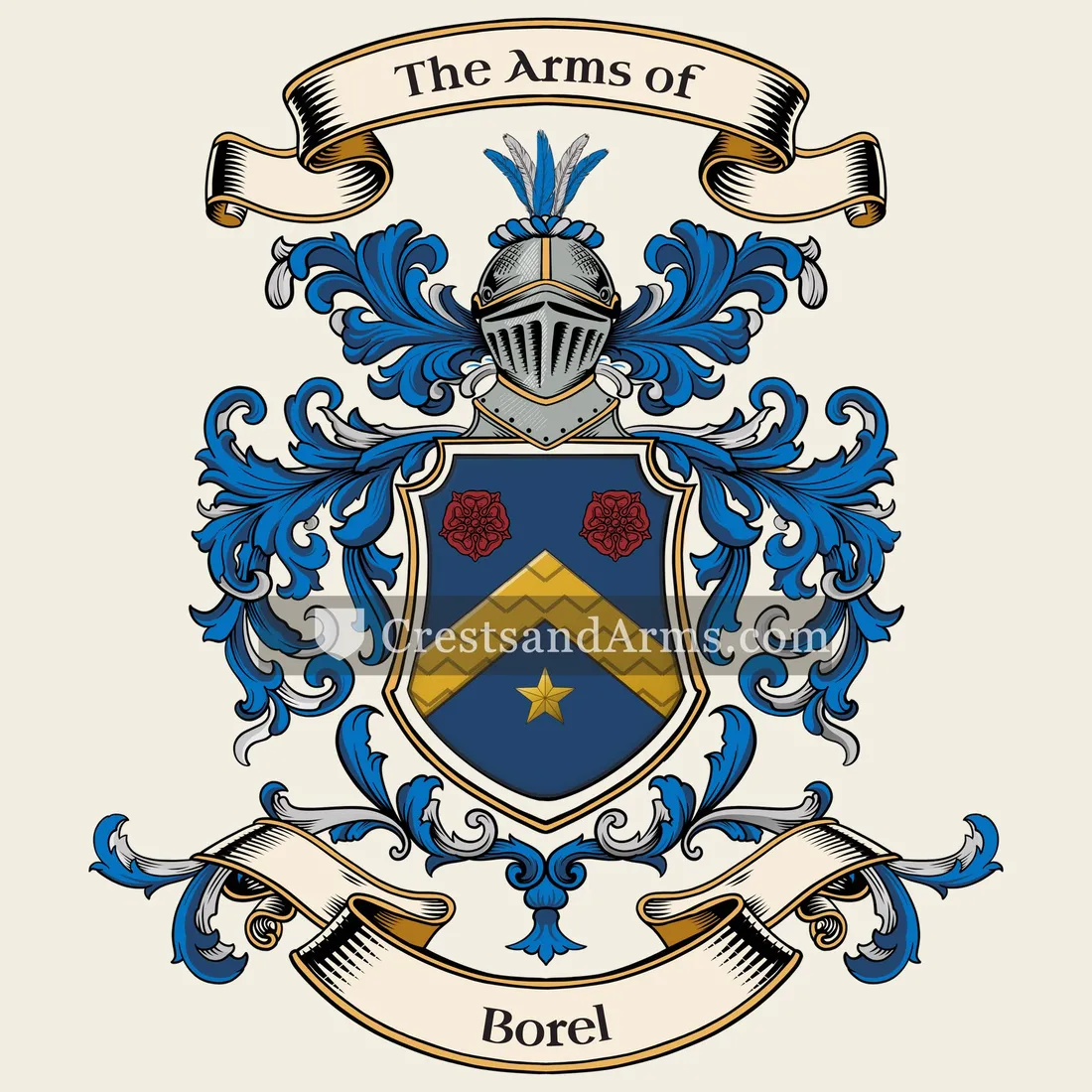
Symbols on this shield
chevronProtection, and faithful service completed
roseThe seventh son, and beauty with grace
mulletThe third son, and a divine quality from above
Colours
Blue (Azure)Means: Loyalty and truth
Gold (Or)Means: Generosity
Red (Gules)Means: Military strength
Historical info
Source
J. B. Rietstap, Armorial Général, Gouda: G. B. van Goor Zonen, 1884–87
Blazon (the actual original written record)
“D'azur au chev. d'or, acc. en chef de deux roses de gu. et en p. d'une étoile (5) du sec.”
SwitzerlandNeufchâtel, c. 1745
Digital archive packCoat of arms PNG, gold border print PDF, vector SVG and the certificate of authenticity. Sent to your email in minutes.
Map of Switzerland showing where the Borel arms are recorded
The Borel arms were recorded in Neufchâtel, c. 1745.
This is where the arms were entered in the register. Families often moved to other parts of the country, so the same name can turn up in more than one region.
The body that granted and recorded arms in Switzerland in this period.
How Arms Worked in Switzerland
In Switzerland, coats of arms were not restricted to the nobility and were often adopted by common citizens and families. These symbols were passed down through generations to show family identity. When branches of a family grew, they often changed small details of the design to distinguish their own line from the original group.
Granting authority
Cantonal and civic authorities managed the use of coats of arms within their specific regions and local jurisdictions.
How they got arms
Families typically assumed their own coats of arms based on local custom rather than receiving them from a central monarch.
Where arms were recorded
Arms were recorded in various cantonal and civic registers starting from the fourteenth century throughout the Swiss region.
The family's standing
Recorded among the armigerous families of Switzerland.
Origin & History of the Borel Family in Switzerland
The Borel family name has deep roots in the mountainous region of Neuchâtel, Switzerland, where members of the family were firmly established by the mid-eighteenth century. The name itself is thought to be derived from the Old French word "borel," which historically referred to a coarse, reddish-brown woolen cloth worn by common people or monks. In the context of Neuchâtel, the family likely integrated into the local economy through the region's famous watchmaking industry and agricultural trade. During the 1700s, the area was a hub for skilled craftsmen and independent thinkers, and the Borels were part of a growing middle class that helped shape the social fabric of the canton. By 1745, records show that the family was well-integrated into the local community, participating in the civic and religious life that defined life in the Jura Mountains. Their presence in this region reflects the broader history of Swiss families who built their livelihoods through specialized trades and strong local community ties.
Borel Meaning & Related Branches
Root word
bor
A Gaulish or Old French term referring to a small wood.
This name
BorelA topographic name for someone who lived near a small forest or thicket.
Related arms
Costasimilar arms
Temodiosimilar arms
Borrelvariant spelling
Documented Sources
J. B. Rietstap, Armorial Général, Gouda: G. B. van Goor Zonen, 1884–87
Dauzat, Albert. Dictionnaire étymologique des noms et prénoms de France. 1951
Morlet, Marie-Thérèse. Dictionnaire étymologique des noms de famille. 1991
Digital archive packCoat of arms PNG, gold border print PDF, vector SVG and the certificate of authenticity. Sent to your email in minutes.


 chevronProtection, and faithful service completed
 chiefAuthority, wisdom and dominion
 mulletThe third son, and a divine quality from above
 chevronProtection, and faithful service completed
 chiefAuthority, wisdom and dominion
 mulletThe third son, and a divine quality from above
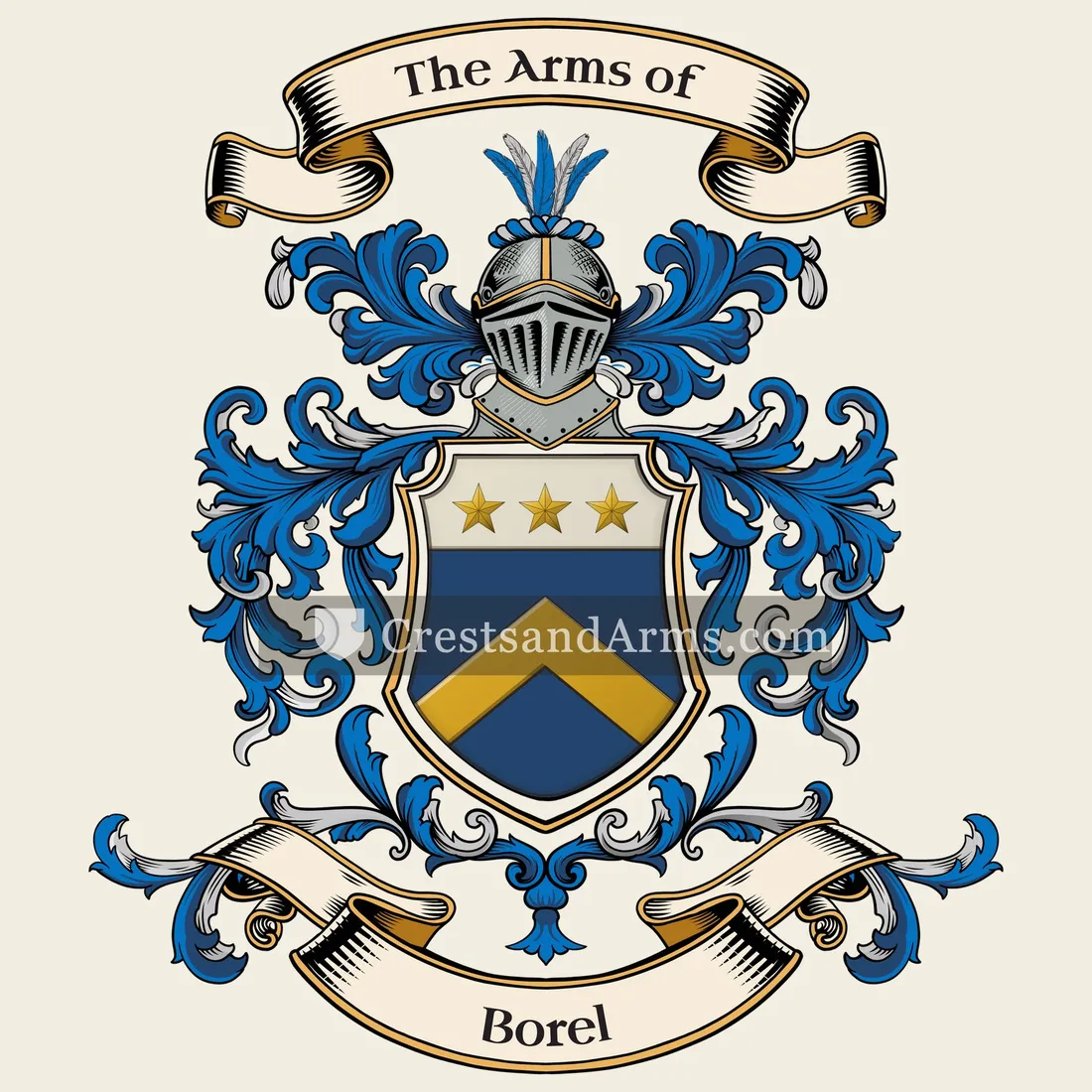


 roseThe seventh son, and beauty with grace