A record of documented arms, meaning and origin, researched for the Borelli family lines. Documented in 2 countries.
Reg. 9578 · Italian, A–C
Coat of Arms & Family Crest Details
Symbols on this shield
mountThe ground held, and steadfastness upon it
chiefAuthority, wisdom and dominion
paleMilitary strength, and a fortified defence
griffinValour and vigilance, guarding great treasure
fleur de lisPurity, light, and the sixth son
Colours
Blue (Azure)Means: Loyalty and truth
Green (Vert)Means: Hope
Silver (Argent)Means: Peace and sincerity
Gold (Or)Means: Generosity
Historical info
Source
J. B. Rietstap, Armorial Général, Gouda: G. B. van Goor Zonen, 1884–87
Blazon (the actual original written record)
“D'azur à un griffon d'un vert doré, soutenu d'un rocher de trois coupeaux au nat.; à une champagne d'or, et un chef d'arg. ch. de deux pals d'azur, alternant avec trois fleurs-de-lis d'or. Cq. cour. C.: une queue de paon, au nat. L.: à dextre d'or et d'azur, à sen. d'or et de gu.”
Italyc. 1752
Digital archive packCoat of arms PNG, gold border print PDF, vector SVG and the certificate of authenticity. Sent to your email in minutes.
Map of Italy showing where the Borelli arms are recorded
The Borelli arms were recorded in Italy, c. 1752.
Arms such as these were typically recorded in Venice.
Venice ran on trade, and its great families were merchants before they were anything else. The city kept a formal list of its noble houses, and a name on that list carried arms as a matter of record.
This is where the arms were entered in the register. Families often moved to other parts of the country, so the same name can turn up in more than one region.
The body that granted and recorded arms in Italy in this period.
Charles III of Spain
Sovereign of the period
Charles III of Spain
1734–1759
Reigning in Italy when the Borelli arms are first recorded.
How Arms Worked in Italy
In the Italian states, coats of arms were often used by noble families to show their status and history. These symbols were passed down through the generations to all legitimate male descendants. Younger branches of a family usually kept the original design but sometimes added small changes to distinguish their specific line from the main branch.
Granting authority
Various local rulers and city governments controlled the use of coats of arms across the different Italian states.
How they got arms
Families often assumed their own arms or received them as official grants from local lords, popes, or city councils.
Where arms were recorded
Arms were recorded in local city archives or private family books rather than in one single national register.
The family's standing
Recorded among the armigerous families of Italy.
Origin & History of the Borelli Family in Italy
The surname Borelli traces its roots to the northern regions of Italy, where it evolved as a patronymic name derived from the personal name Borello. By the middle of the eighteenth century, the family had established a notable presence in the Republic of Venice. During this era, Venice served as a major hub for trade and intellectual exchange, allowing families like the Borellis to integrate into the city’s complex social and economic structures. Historical records confirm that members of the family were active in Venetian society by 1752, participating in the vibrant life of a city that was then transitioning from a dominant maritime power to a center of art and culture. This period of residency suggests that the family was well-positioned within the urban fabric of the Italian peninsula, contributing to the local history of the region through their professional and civic engagements.
Coat of Arms & Family Crest Details
Symbols on this shield
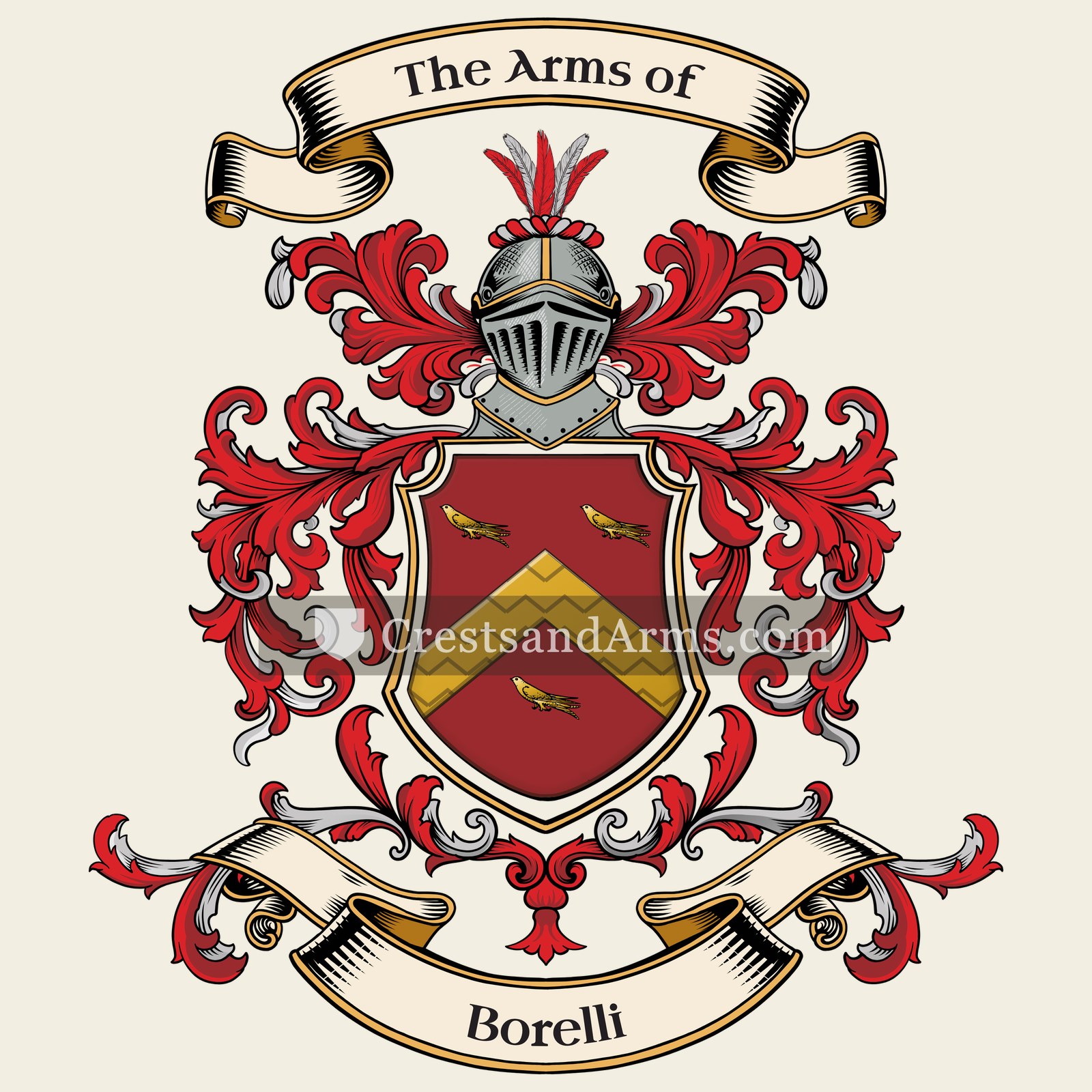
chevronProtection, and faithful service completed
martletA younger son, who must win his own land
Colours
Red (Gules)Means: Military strength
Gold (Or)Means: Generosity
Historical info
Source
J. B. Rietstap, Armorial Général, Gouda: G. B. van Goor Zonen, 1884–87
Blazon (the actual original written record)
“De gu. au chev. d'or, acc. de trois merlettes du même.”
LanguedocLanguedoc, c. 1663
Digital archive packCoat of arms PNG, gold border print PDF, vector SVG and the certificate of authenticity. Sent to your email in minutes.
Map of France showing where the Borelli arms are recorded
The Borelli arms were recorded in Languedoc, c. 1663.
Languedoc stretched across the south of France, a country of small towns, vineyards and old local families. Its gentry were numerous rather than grand, and a great many of them held arms even where their estates were modest.
This is where the arms were entered in the register. Families often moved to other parts of the country, so the same name can turn up in more than one region.
The body that granted and recorded arms in France in this period.
Louis XIV of France
Sovereign of the period
Louis XIV of France
1643–1715
Reigning in Italy when the Borelli arms are first recorded.
How Arms Worked in France
In France, a coat of arms was a mark of honor that passed down through the male line to all legitimate descendants. Families often used the same shield without changes to show their shared heritage. If a branch wanted to stand out, they could add a small mark to their shield to show their specific place in the family tree.
Granting authority
The Juge d'armes de France acted as the official authority that regulated and verified coats of arms across the country.
How they got arms
Families typically inherited their arms from ancestors, though they could also receive them through royal grants or by proving their noble status.
Where arms were recorded
Coats of arms were officially recorded in the Armorial Général de France, which began its main collection in the year 1696.
The family's standing
Recorded among the armigerous families of Languedoc.
Origin & History of the Borelli Family in France
The family name Borelli has deep roots in the southern regions of France, particularly within the historic province of Languedoc. By the year 1663, records confirm that members of the family were already well-established in this area, living through a period marked by significant religious and social shifts. The name itself is thought to be derived from the Italian word "bore," which refers to a cold northern wind, suggesting that the family may have originally migrated from across the Alps before settling into the French countryside. During the seventeenth century, families in Languedoc often worked as landowners or local officials, helping to manage the agricultural wealth of the region. As the Borelli family integrated into French society, they became part of the local fabric of the Mediterranean coast, contributing to the unique cultural blend of the Languedoc region during the reign of King Louis XIV.
Borelli Meaning & Related Branches
Root word
Borel
Derived from the Old French word for a borer or drill.
This name
BorelliAn occupational surname for someone who worked as a borer or piercer.
also spelled
Borelly
Borelee
Related arms
del Montesimilar arms
Zancarisimilar arms
Adorno de Tscharnerrecorded with Borelli, same area
Albertinorecorded with Borelli, same area
Documented Sources
J. B. Rietstap, Armorial Général, Gouda: G. B. van Goor Zonen, 1884–87
De Felice, Emidio. Dizionario dei cognomi italiani. 1978
Archivio di Stato di Venezia, Anagrafi di cittadini e forestieri
Digital archive packCoat of arms PNG, gold border print PDF, vector SVG and the certificate of authenticity. Sent to your email in minutes.


 mountThe ground held, and steadfastness upon it
 chiefAuthority, wisdom and dominion
 paleMilitary strength, and a fortified defence
 griffinValour and vigilance, guarding great treasure
 fleur de lisPurity, light, and the sixth son
 mountThe ground held, and steadfastness upon it
 chiefAuthority, wisdom and dominion
 paleMilitary strength, and a fortified defence
 griffinValour and vigilance, guarding great treasure
 fleur de lisPurity, light, and the sixth son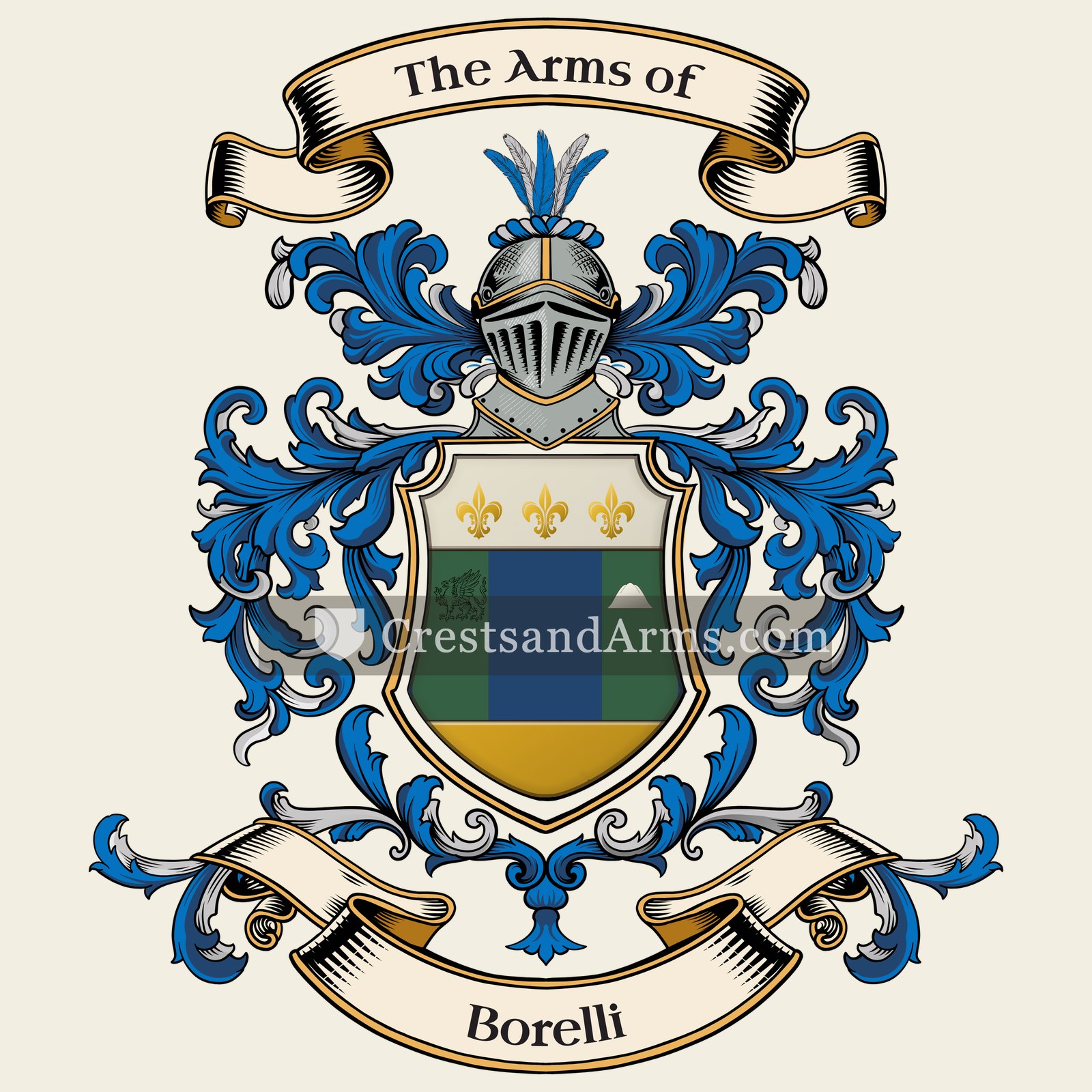


 chevronProtection, and faithful service completed
 martletA younger son, who must win his own land