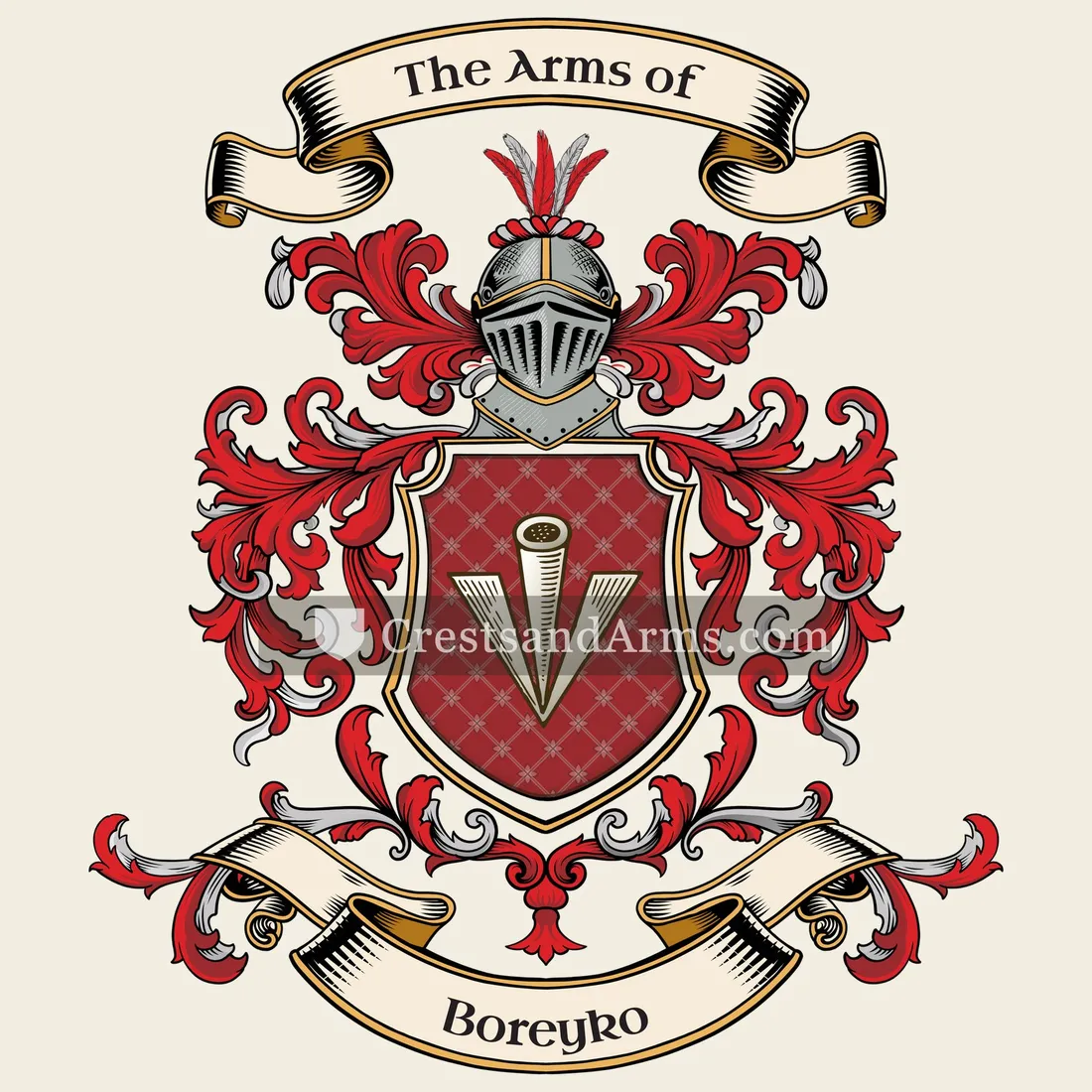
A record of documented arms, meaning and origin, researched for the Boreyko family of Germany.
Reg. 5641 · German, A–C
Meaning of the Boreyko family crest colors & symbols
Symbols on this shield
arrowReadiness for battle, and affliction endured
Colours
Red (Gules)Means: Military strength
Silver (Argent)Means: Peace and sincerity
Historical info
Source
J. B. Rietstap, Armorial Général, Gouda: G. B. van Goor Zonen, 1884–87
Blazon (the actual original written record)
“De gu. à une flèche d'arg., posée en pal. C.: une ramure de cerf, au nat. - (Barons). Parti: au 1 de gu. à une flèche d'arg., posée en pal; au 2 coupé: a. d'arg. à un bras arm., tenant une épée, le tout au nat.; b. de gu. à six cotices en barres de sa. Deux cq cour. C.: 1° une ramure de cerf, au nat.; l. d'arg. et de sa.; 2° le bras du 1 a: l. d'arg. et de gu.”
SilesiaSilesia, c. 1765
Digital archive packCoat of arms PNG, gold border print PDF, vector SVG and the certificate of authenticity. Sent to your email in minutes.
Map of Germany showing where the Boreyko arms are recorded
The Boreyko arms were recorded in Silesia, c. 1765.
Silesia was farming country in the east of the German lands, held in large estates by families who stayed put for generations. Owning land was what entitled a family to arms, so the region fills a good deal of the register.
This is where the arms were entered in the register. Families often moved to other parts of the country, so the same name can turn up in more than one region.
The body that granted and recorded arms in Germany in this period.
Francis I, Holy Roman Emperor
Sovereign of the period
Francis I, Holy Roman Emperor
1745–1765
Reigning in Germany when the Boreyko arms are first recorded.
How Arms Worked in Germany
In the Holy Roman Empire, coats of arms were often granted to individuals by the Emperor or his representatives. These arms were then passed down through the generations to all legitimate descendants of the original holder. Younger branches of a family usually kept the same shield design without needing to change it, as the arms belonged to the entire lineage.
Granting authority
The Holy Roman Emperor held the sole power to grant new coats of arms throughout his vast imperial territories.
How they got arms
Families typically obtained their coats of arms through a formal imperial grant or by proving their noble status to the authorities.
Where arms were recorded
These grants were officially recorded in the Imperial Chancery registers, which began keeping formal records of such honors during the Middle Ages.
The family's standing
Recorded among the armigerous families of Silesia.
Origin & History of the Boreyko Family in Germany
The surname Boreyko is rooted in the Slavic linguistic tradition, likely originating as a patronymic name that identified an individual as the son or descendant of a man named Borys. By the middle of the 18th century, historical records confirm that members of the family were established in the region of Silesia. During this period, Silesia was a crossroads of cultural and economic activity under the influence of the Prussian monarchy. Families living in this area often worked in agriculture or local trades, which allowed them to build stable lives in rural villages or growing towns. As the family moved and expanded across Central and Eastern Europe, the name became a marker of their specific ancestral origins and their connection to the social structures of the time. The persistence of the name in regional documents from 1765 suggests that the family was well-integrated into the local community and played a role in the daily life of the Silesian landscape.
Boreyko Meaning & Related Branches
Root word
Borey
Derived from the Slavic word for battle or fight.
This name
BoreykoA patronymic surname indicating descent from a person associated with combat or conflict.
also spelled
Borek
Documented Sources
J. B. Rietstap, Armorial Général, Gouda: G. B. van Goor Zonen, 1884–87
Kutsch, Karl-Ludwig, Die schlesische Bevölkerung im 18. Jahrhundert, 1974
State Archive in Wrocław (Archiwum Państwowe we Wrocławiu), Akta stanu cywilnego i księgi parafialne, 1765
Weczerka, Hugo, Handbuch der historischen Stätten: Schlesien, 1977
Digital archive packCoat of arms PNG, gold border print PDF, vector SVG and the certificate of authenticity. Sent to your email in minutes.


 arrowReadiness for battle, and affliction endured
 arrowReadiness for battle, and affliction endured