Map of Spain showing where the Borgia arms are recorded
The Borgia arms were recorded in Spain, c. 1722.
Arms such as these were typically recorded in Castile.
Castile was the heart of Spain and the source of most of its noble families. Land won in the long wars against the Moors was granted out to fighting men, and a man granted land was granted arms along with it.
This is where the arms were entered in the register. Families often moved to other parts of the country, so the same name can turn up in more than one region.
The body that granted and recorded arms in Spain in this period.
Philip V of Spain
Sovereign of the period
Philip V of Spain
1714–1724
Reigning in Spain when the Borgia arms are first recorded.
How Arms Worked in Spain
In Spain, a coat of arms was considered a form of property that belonged to the entire family line. These arms were passed down from a father to all his children equally. Younger branches of the family usually kept the original design without needing to add any special marks to distinguish their specific line.
Granting authority
The Cronista Rey de Armas was the official body that regulated and granted coats of arms throughout Spain.
How they got arms
Families often obtained their arms through royal grants or by proving their noble status to the official heraldic authority.
Where arms were recorded
Coats of arms were officially recorded in the registers of the Cronista Rey de Armas starting in 1496.
The family's standing
Recorded among the armigerous families of Spain.
Origin & History of the Borgia Family in Spain
The family name Borgia, originally known as Borja, traces its deepest roots to the Kingdom of Aragon in Spain. The family first gained prominence in the town of Borja, located in the province of Zaragoza, from which they took their surname. During the Middle Ages, members of the family served as loyal knights and administrators for the Spanish monarchs, helping to consolidate power during the period of the Reconquista. As the family expanded their influence, branches of the lineage moved into other regions of the Iberian Peninsula, including Castile. By the early 18th century, records confirm that the family remained well-established within the Castilian nobility, continuing their long tradition of service to the Spanish crown. This deep history highlights how the family evolved from local landowners in Aragon into a powerful political force that eventually influenced both Spanish and Italian history.
Coat of Arms & Family Crest Details
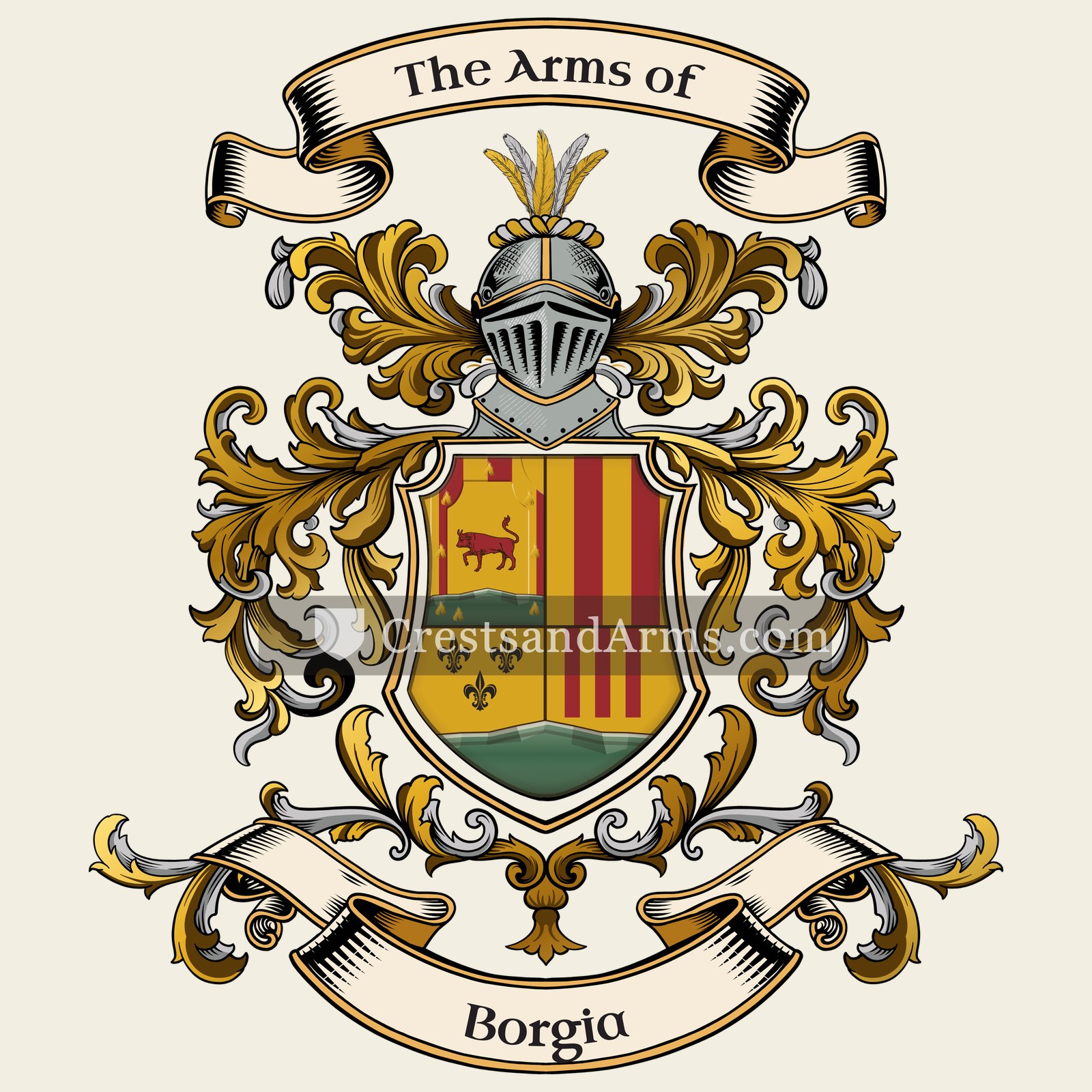
Symbols on this shield
mountThe ground held, and steadfastness upon it
paleMilitary strength, and a fortified defence
bullValour and generosity
fireZeal and purification
fleur de lisPurity, light, and the sixth son
Colours
Gold (Or)Means: Generosity
Green (Vert)Means: Hope
Red (Gules)Means: Military strength
Historical info
Source
J. B. Rietstap, Armorial Général, Gouda: G. B. van Goor Zonen, 1884–87
Blazon (the actual original written record)
“Ec.: au 1 d'or au boeuf de gu., pass. sur une terrasse de sin.; à la bord. du sec., ch. de huit flammes d'or; au 2 palé d'or et de gu., de huit pièces; au 3 d'azur à trois fleurs-de-lis d'or; au 4 fascé d'or et de gu. Deux cq. cour. C.: 1º un boeuf iss. et cont. de gu.; 1. d'or et d'azur; 2º une hydre iss. de sin.; 1. d'or et de gu.”
ItalyFlorence, c. 1775
Digital archive packCoat of arms PNG, gold border print PDF, vector SVG and the certificate of authenticity. Sent to your email in minutes.
Map of Italy showing where the Borgia arms are recorded
The Borgia arms were recorded in Florence, c. 1775.
This is where the arms were entered in the register. Families often moved to other parts of the country, so the same name can turn up in more than one region.
The body that granted and recorded arms in Italy in this period.
Alvise Giovanni Mocenigo
Sovereign of the period
Alvise Giovanni Mocenigo
1763–1778
Reigning in Spain when the Borgia arms are first recorded.
How Arms Worked in Italy
In the Italian states, coats of arms were often used by noble families to show their status and history. These symbols were passed down through the generations to all legitimate male descendants. Younger branches of a family usually kept the original design but sometimes added small changes to distinguish their specific line from the main branch.
Granting authority
Various local rulers and city governments controlled the use of coats of arms across the different Italian states.
How they got arms
Families often assumed their own arms or received them as official grants from local lords, popes, or city councils.
Where arms were recorded
Arms were recorded in local city archives or private family books rather than in one single national register.
The family's standing
Recorded among the armigerous families of Italy.
Origin & History of the Borgia Family in Italy
The history of the Borgia name in Italy is often associated with power and influence, though its origins trace back to the Iberian Peninsula before the family established a firm foothold in Italian society. While the family is most famous for its prominence during the Renaissance, records indicate that members of the family were active in Florence by 1775. By this time, the family had transitioned from their earlier roles in high politics and the church to becoming integrated into the local social and economic fabric of Italian cities. This period shows how the family name persisted long after the height of their political influence in the fifteenth century. Their presence in Florence highlights the family's ability to adapt and maintain a status within the Italian elite across several hundred years.
Borgia Meaning & Related Branches
Root word
Borja
A place name derived from the Arabic word for tower or castle.
This name
BorgiaRefers to a family originating from the town of Borja in Aragon.
also spelled
Borja
Borgia-Lanzol
Borjia
Documented Sources
J. B. Rietstap, Armorial Général, Gouda: G. B. van Goor Zonen, 1884–87
Batllori, Miguel. La familia Borja. 1994
Meyer, G. J. The Borgias: The Hidden History. 2013
Archivo de la Corona de Aragón, Cancillería Real
Digital archive packCoat of arms PNG, gold border print PDF, vector SVG and the certificate of authenticity. Sent to your email in minutes.


 mountThe ground held, and steadfastness upon it
 bullValour and generosity
 fireZeal and purification
 mountThe ground held, and steadfastness upon it
 bullValour and generosity
 fireZeal and purification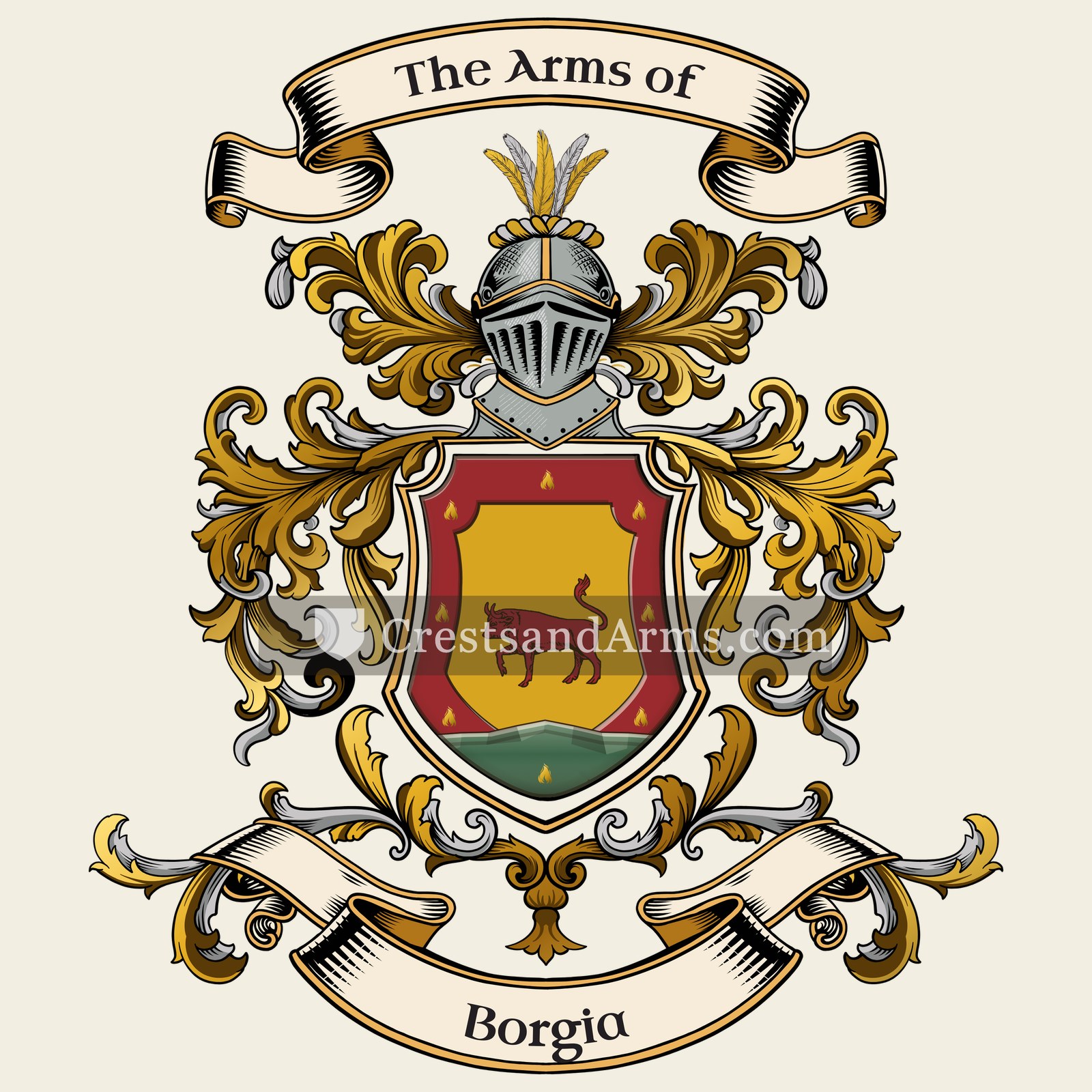


 paleMilitary strength, and a fortified defence
 fleur de lisPurity, light, and the sixth son