Map of Netherlands showing where the Borst arms are recorded
The Borst arms were recorded in Harlem, c. 1815.
This is where the arms were entered in the register. Families often moved to other parts of the country, so the same name can turn up in more than one region.
Region
Harlem
Town
Harlem
First recorded
1815
Granting Authority for the Borst Arms
Hoge Raad van Adel
Photograph made by me · CC BY-SA 3.0
The body that granted and recorded arms in Netherlands in this period.
William I of the Netherlands
Sovereign of the period
William I of the Netherlands
1815–1840
Reigning in Netherlands when the Borst arms are first recorded.
How Arms Worked in Netherlands
In the Netherlands, coats of arms were often used by noble families and those who held specific public offices. These arms were passed down through the generations to legitimate descendants. Younger branches of a family usually kept the original design without needing to add special marks. This system ensured that the family identity remained clear and consistent over many years.
Granting authority
The Hoge Raad van Adel is the official body that regulates and manages noble titles and coats of arms in the Netherlands.
How they got arms
Families typically obtained their coats of arms through official royal grants or by proving their long-standing historical use of the symbols.
Where arms were recorded
Coats of arms are officially recorded in the registers held by the Hoge Raad van Adel, which began its work in 1814.
The family's standing
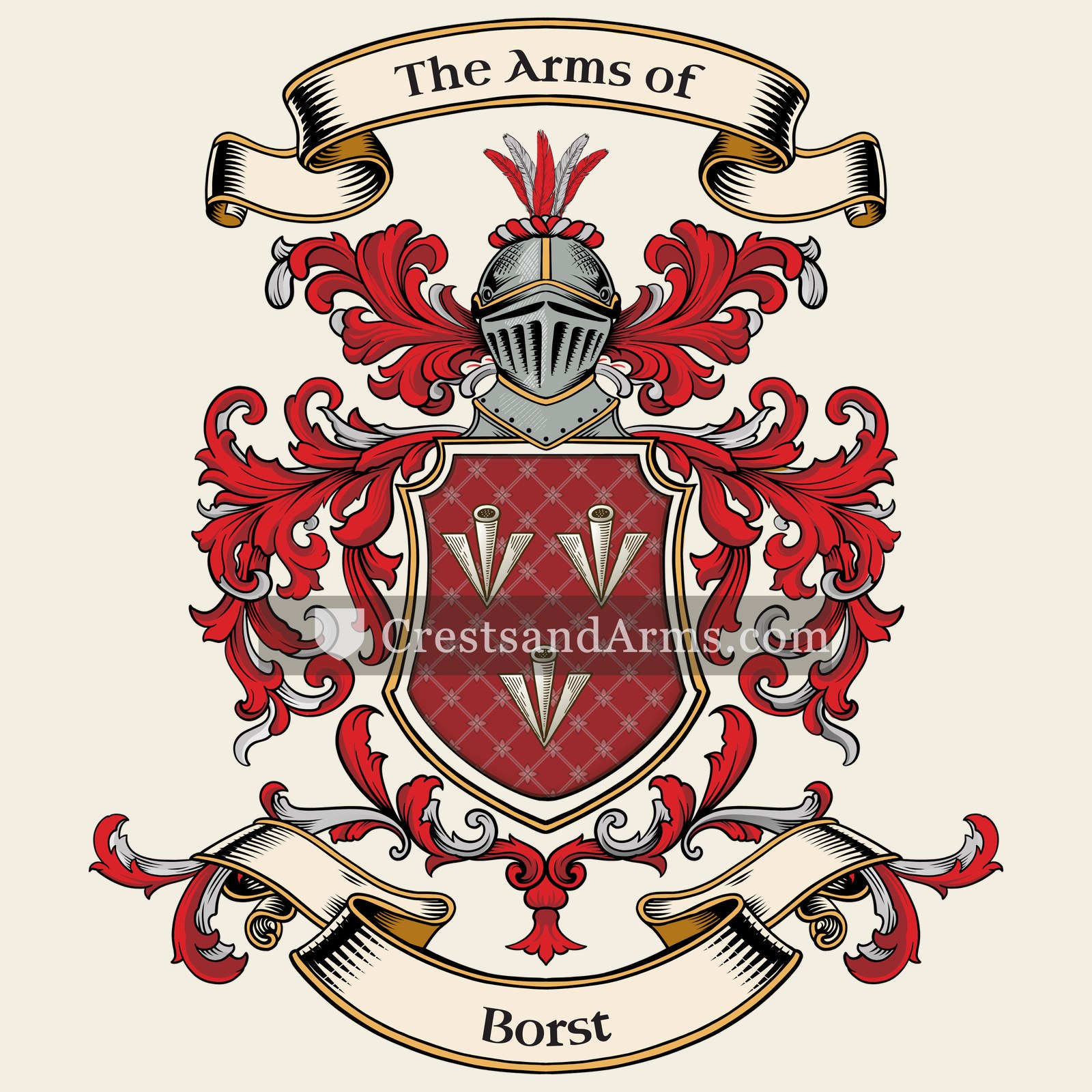
Recorded among the armigerous families of Netherlands.
Origin & History of the Borst Family in Netherlands
The surname Borst is of Germanic origin and is traditionally linked to the Middle High German word "borst," which translates to bristle. In early European naming conventions, this name often functioned as a descriptive nickname for someone with coarse hair or perhaps a person who worked with stiff animal bristles in trades like brush making or leather tanning. By the time the family established a presence in Harlem in 1815, the name had already been carried across generations and borders, evolving from a simple descriptor into a formal hereditary surname. The Borst family members who settled in the Harlem area were part of a growing community during a period of significant urban expansion. Their arrival in this region reflects the broader movement of families who sought new opportunities in the developing landscape of early nineteenth-century New York.
Borst Meaning & Related Branches
Root word
borst
A Middle Dutch term referring to the chest or breast area.
This name
BorstA topographic or descriptive nickname likely referring to a person with a prominent chest.
also spelled
Borste
Documented Sources
J. B. Rietstap, Armorial Général, Gouda: G. B. van Goor Zonen, 1884–87
Bahlow, Hans, Deutsches Namenlexikon: Familien- und Vornamen nach Ursprung und Sinn erklärt, 1967
New York City Municipal Archives, New York County (Manhattan) Deeds and Conveyances, 1815


 arrowReadiness for battle, and affliction endured
 arrowReadiness for battle, and affliction endured