Map of Germany showing where the Borucki arms are recorded
The Borucki arms were recorded in Brandenburg, c. 1765.
Brandenburg was sandy farming country around Berlin, held in large estates by families who served as officers. Land and military service each brought arms, and most families there had both.
This is where the arms were entered in the register. Families often moved to other parts of the country, so the same name can turn up in more than one region.
The body that granted and recorded arms in Germany in this period.
Francis I, Holy Roman Emperor
Sovereign of the period
Francis I, Holy Roman Emperor
1745–1765
Reigning in Germany when the Borucki arms are first recorded.
How Arms Worked in Germany
In the Holy Roman Empire, coats of arms were often granted to individuals by the Emperor or his representatives. These arms were then passed down through the generations to all legitimate descendants of the original holder. Younger branches of a family usually kept the same shield design without needing to change it, as the arms belonged to the entire lineage.
Granting authority
The Holy Roman Emperor held the sole power to grant new coats of arms throughout his vast imperial territories.
How they got arms
Families typically obtained their coats of arms through a formal imperial grant or by proving their noble status to the authorities.
Where arms were recorded
These grants were officially recorded in the Imperial Chancery registers, which began keeping formal records of such honors during the Middle Ages.
The family's standing
Recorded among the armigerous families of Brandenburg.
Origin & History of the Borucki Family in Germany
The Borucki family name is deeply rooted in the historical landscape of Brandenburg, where records confirm their presence by the year 1765. The name itself is likely of Slavic origin, reflecting the complex cultural exchanges that occurred as populations moved across the border regions of eastern Germany and western Poland. During the eighteenth century, Brandenburg was a center of agricultural expansion and social change under the Prussian administration. Families like the Boruckis were often part of the rural workforce that helped develop these lands during a period of significant demographic growth. As the family established their roots in the region, they became part of the local fabric of village life, contributing to the development of the Prussian countryside through their labor and community involvement. This early history highlights a family that was actively participating in the transformation of the German frontier during the Enlightenment era.
Meaning of the Borucki family crest colors & symbols
Colours
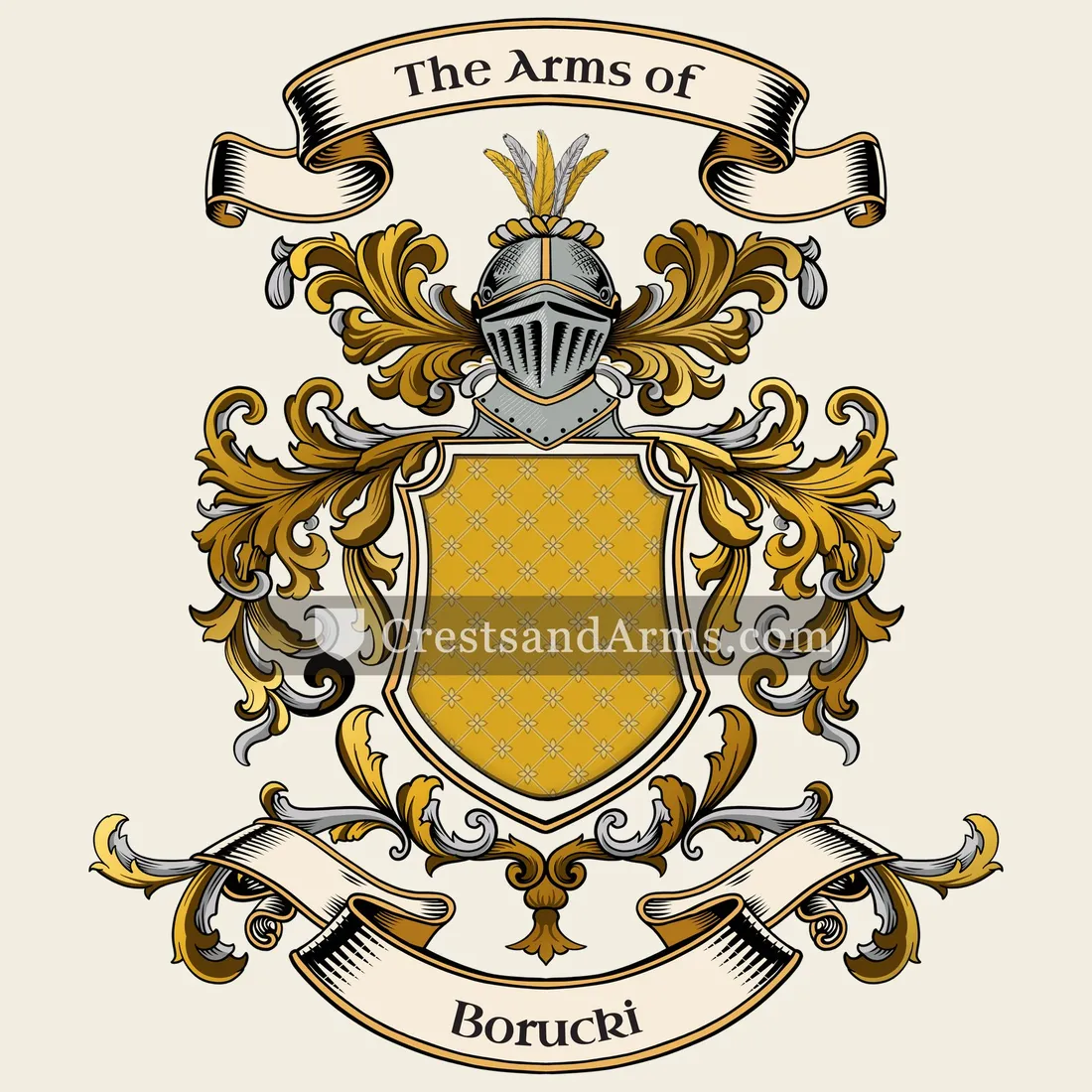
Gold (Or)Means: Generosity
Historical info
Source
J. B. Rietstap, Armorial Général, Gouda: G. B. van Goor Zonen, 1884–87
Blazon (the actual original written record)
“D'or à une vertenelle de gu., posée en bande. Cq. cour. C.: un cerf iss. de gu.”
AlsaceAlsace, c. 1663
Digital archive packCoat of arms PNG, gold border print PDF, vector SVG and the certificate of authenticity. Sent to your email in minutes.
Map of France showing where the Borucki arms are recorded
The Borucki arms were recorded in Alsace, c. 1663.
Alsace lay between France and the German lands and belonged to both at different times. Its families held small estates and served whichever side ruled, and men who served in arms carried arms of their own.
This is where the arms were entered in the register. Families often moved to other parts of the country, so the same name can turn up in more than one region.
The body that granted and recorded arms in France in this period.
Louis XIV of France
Sovereign of the period
Louis XIV of France
1643–1715
Reigning in Germany when the Borucki arms are first recorded.
How Arms Worked in France
In France, a coat of arms was a mark of honor that passed down through the male line to all legitimate descendants. Families often used the same shield without changes to show their shared heritage. If a branch wanted to stand out, they could add a small mark to their shield to show their specific place in the family tree.
Granting authority
The Juge d'armes de France acted as the official authority that regulated and verified coats of arms across the country.
How they got arms
Families typically inherited their arms from ancestors, though they could also receive them through royal grants or by proving their noble status.
Where arms were recorded
Coats of arms were officially recorded in the Armorial Général de France, which began its main collection in the year 1696.
The family's standing
Recorded among the armigerous families of Alsace.
Origin & History of the Borucki Family in France
The Borucki family name holds a unique place in the history of the Alsace region, a territory that has long served as a cultural bridge between France and its neighbors. By 1663, records confirm that members of the family were already established in this area, which was a time of significant transition as Alsace was gradually being integrated into the French kingdom under King Louis XIV. During the seventeenth century, families in this borderland often navigated a complex landscape of shifting political loyalties and changing administrative laws. The presence of the Borucki name in local parish registers suggests that these early ancestors were likely integrated into the agricultural or artisanal life of the region. As the area became more firmly tied to the French state, the family would have experienced the gradual standardization of record-keeping and the influence of French administrative reforms. This early foothold in Alsace highlights the family’s long-standing connection to a region defined by its resilience and its distinct identity within the broader French nation.
Meaning of the Borucki family crest colors & symbols
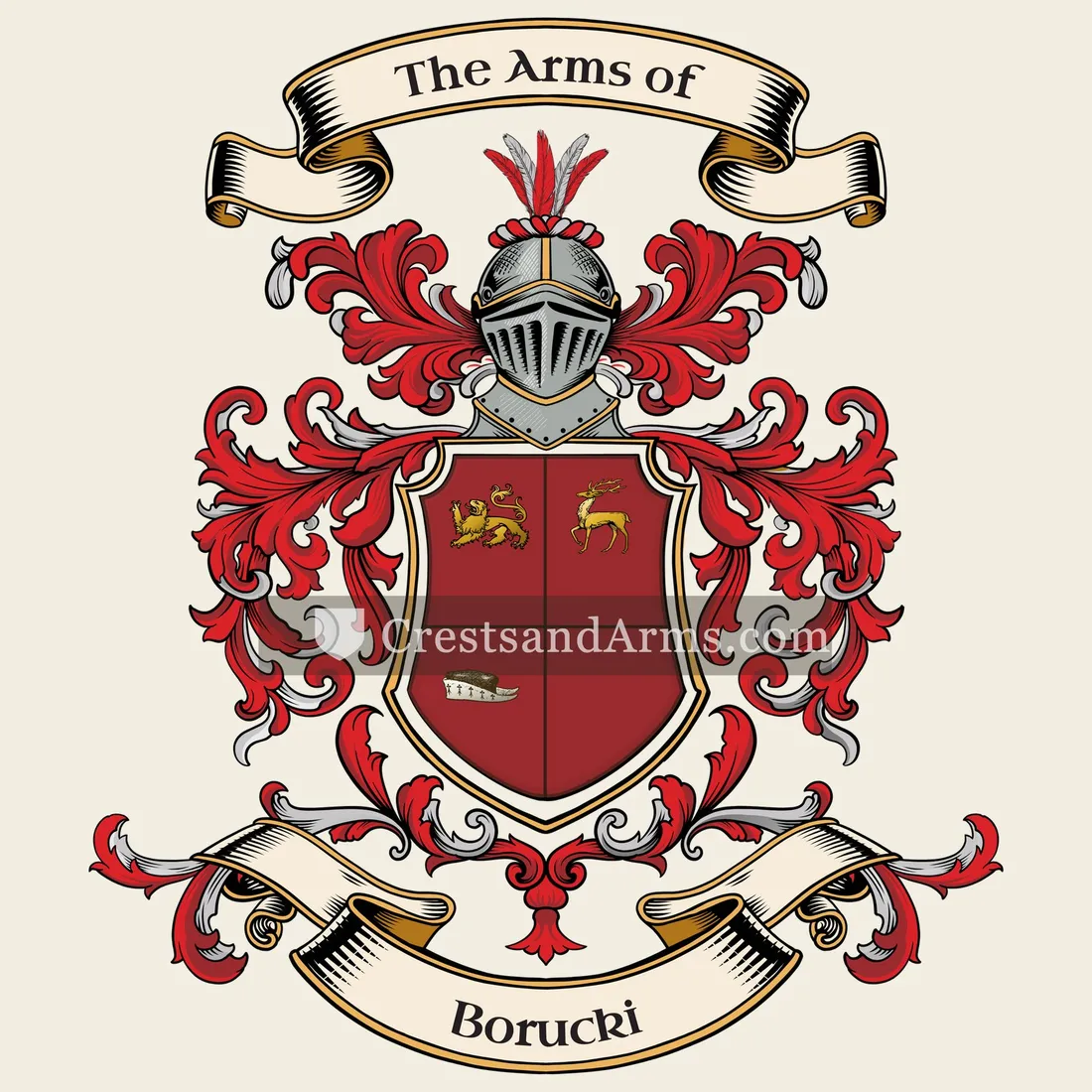
Symbols on this shield
lionCourage, strength and royalty
stagPeace and harmony, and one who will not fight unprovoked
hat or capDignity, and the honour of office
Colours
Red (Gules)Means: Military strength
Gold (Or)Means: Generosity
Silver (Argent)Means: Peace and sincerity
Historical info
Source
J. B. Rietstap, Armorial Général, Gouda: G. B. van Goor Zonen, 1884–87
Blazon (the actual original written record)
“Ec.: au 1 de gu. au lion d'or, tenant de sa patte dextre un fer de lance d'arg. et de sa. une palme de sin.; aux 2 et 3 d'or, à un fer de lance d'arg. en barre, br. sur ces deux quartiers; au 4 d'azur à une tête et col de cerf d'or. Sur le tout de sa. à un bonnet renv. d'arg., retr. d'herm., doublé de gu. Trois cq. cour. C.: 1º le lion du 1, iss. et cont.; l. d'or et de gu.; 2º le bonnet, entre un vol coupé d'arg. sur sa.; 1. d'arg. et de sa.; 3º un cerf iss. d'or; l. d'or et d'azur. S.: à dextre un léopard lionné d'or; à sen. un cerf au nat. D.: QUOD SIS, ESSE VELIS.”
AustriaVienne, c. 1772
Digital archive packCoat of arms PNG, gold border print PDF, vector SVG and the certificate of authenticity. Sent to your email in minutes.
Map of Austria showing where the Borucki arms are recorded
The Borucki arms were recorded in Vienne, c. 1772.
This is where the arms were entered in the register. Families often moved to other parts of the country, so the same name can turn up in more than one region.
Region
Vienne
Town
Vienne
First recorded
1772
Granting Authority for the Borucki Arms
Imperial and Royal chancery
Sodacan · CC BY-SA 3.0
The body that granted and recorded arms in Austria in this period.
Joseph II, Holy Roman Emperor
Sovereign of the period
Joseph II, Holy Roman Emperor
1765–1790
Reigning in Germany when the Borucki arms are first recorded.
How Arms Worked in Austria
Austrian coats of arms were often linked directly to noble titles granted by the Emperor. These symbols belonged to the entire family line rather than just one individual. When a family grew, new branches kept the original design without needing to change it. This system allowed all members of a noble house to share the same identity across many generations.
Granting authority
The Imperial and Royal chancery managed all heraldic matters and controlled the official granting of arms throughout the Austrian lands.
How they got arms
Families typically received their arms through a formal imperial decree that often accompanied the elevation of a person to noble status.
Where arms were recorded
Official records of these grants were kept in the Imperial Register of Nobility which began its formal documentation process in 1453.
The family's standing
Recorded among the armigerous families of Austria.
Origin & History of the Borucki Family in Austria
The Borucki family name carries a history deeply rooted in the cultural crossroads of Central Europe. By the year 1772, records confirm that members of the family were already established in Vienna, which served as the vibrant capital of the Habsburg Monarchy. During this era, Vienna acted as a magnet for families moving from various regions of the Polish-Lithuanian Commonwealth and the surrounding territories. The presence of the Borucki name in the city at this time suggests that the family was part of a broader movement of people seeking new opportunities in the administrative and commercial heart of the Austrian Empire. As the family settled into Viennese life, they became part of a diverse urban society that was rapidly modernizing under the influence of the Enlightenment. Their early history in Austria reflects the integration of families into the social fabric of a major European capital during a period of significant political and cultural change.
Borucki Meaning & Related Branches
Root word
Bor
A Slavic term referring to a pine forest or woodland.
This name
BoruckiA habitational name for someone who lived near or originated from a pine forest.
also spelled
Bruc
Brook
Documented Sources
J. B. Rietstap, Armorial Général, Gouda: G. B. van Goor Zonen, 1884–87
Brandenburgisches Landeshauptarchiv, General-Direktorium, Kurmärkische Kammer, Domänen- und Rentenämter
Geheimes Staatsarchiv Preußischer Kulturbesitz, I. Hauptabteilung, Repositur 9, General-Direktorium
Heitz, Gerhard, Ländliche Struktur und wirtschaftliche Entwicklung in Mecklenburg im 18. Jahrhundert, 1957
Kocka, Jürgen, Preußen: Aufstieg und Niedergang, 2001
Digital archive packCoat of arms PNG, gold border print PDF, vector SVG and the certificate of authenticity. Sent to your email in minutes.


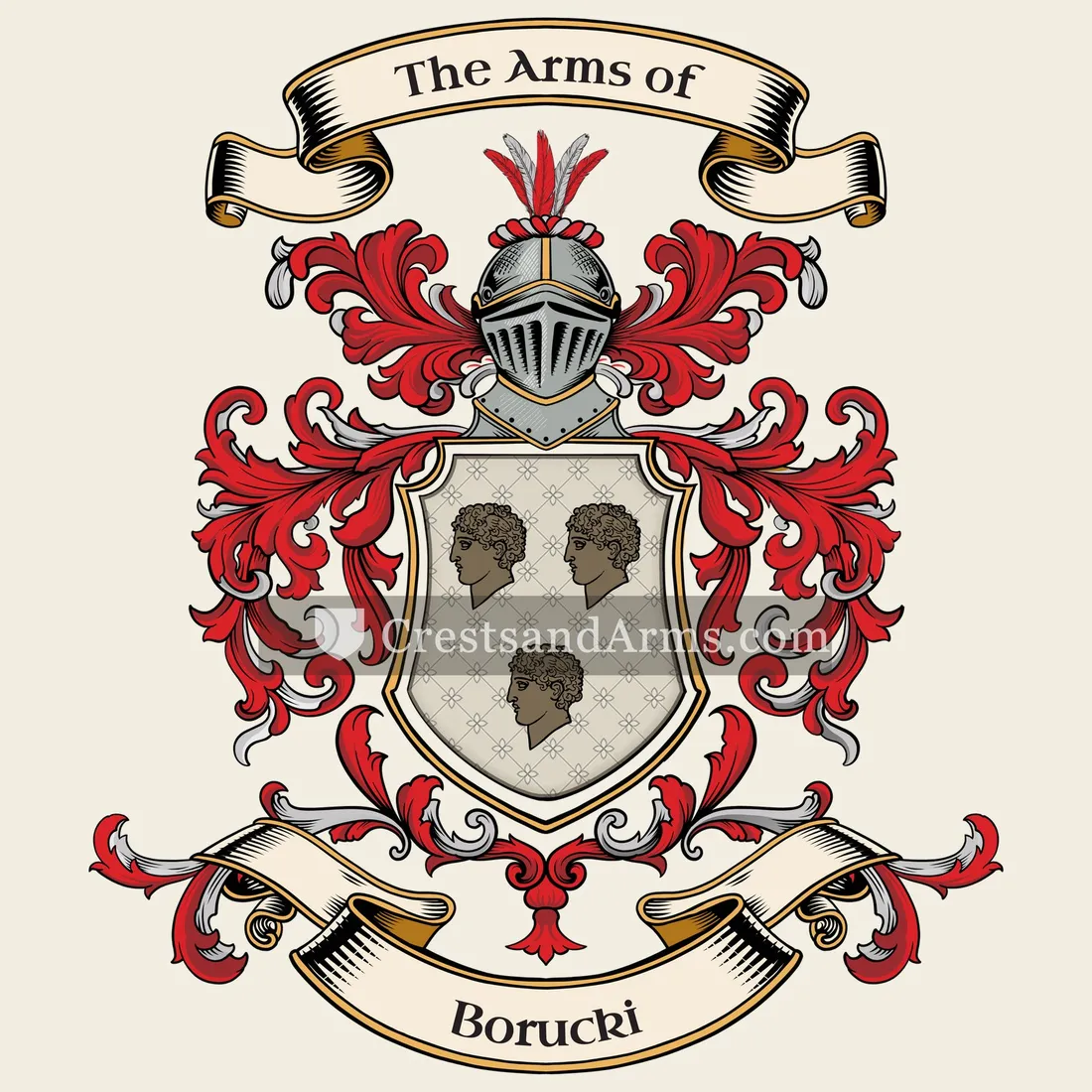
 savages head affrontyAn enemy overcome
 savages head affrontyAn enemy overcome




 lionCourage, strength and royalty
 stagPeace and harmony, and one who will not fight unprovoked
 hat or capDignity, and the honour of office