A record of documented arms, meaning and origin, researched for the Bos family lines. Documented in 2 countries.
Reg. 8082 · Dutch, A–C
Coat of Arms & Family Crest Details
Symbols on this shield
savages head affrontyAn enemy overcome
lionCourage, strength and royalty
Colours
Gold (Or)Means: Generosity
Red (Gules)Means: Military strength
Black (Sable)Means: Constancy
Historical info
Source
J. B. Rietstap, Armorial Général, Gouda: G. B. van Goor Zonen, 1884–87
Blazon (the actual original written record)
“Parti: au 1 d'or à trois têtes de More, rangées en pal; au 2 de gu. au lion d'or. C.: le lion, iss. L.: à dextre d'or et de sa., à sen. d'or et de gu.”
NetherlandsAmsterdam, c. 1815
Digital archive packCoat of arms PNG, gold border print PDF, vector SVG and the certificate of authenticity. Sent to your email in minutes.
Map of Netherlands showing where the Bos arms are recorded
The Bos arms were recorded in Amsterdam, c. 1815.
This is where the arms were entered in the register. Families often moved to other parts of the country, so the same name can turn up in more than one region.
Region
Amsterdam
Town
Amsterdam
First recorded
1815
Granting Authority for the Bos Arms
Hoge Raad van Adel
Photograph made by me · CC BY-SA 3.0
The body that granted and recorded arms in Netherlands in this period.
William I of the Netherlands
Sovereign of the period
William I of the Netherlands
1815–1840
Reigning in Netherlands when the Bos arms are first recorded.
How Arms Worked in Netherlands
In the Netherlands, coats of arms were often used by noble families and those who held specific public offices. These arms were passed down through the generations to legitimate descendants. Younger branches of a family usually kept the original design without needing to add special marks. This system ensured that the family identity remained clear and consistent over many years.
Granting authority
The Hoge Raad van Adel is the official body that regulates and manages noble titles and coats of arms in the Netherlands.
How they got arms
Families typically obtained their coats of arms through official royal grants or by proving their long-standing historical use of the symbols.
Where arms were recorded
Coats of arms are officially recorded in the registers held by the Hoge Raad van Adel, which began its work in 1814.
The family's standing
Recorded among the armigerous families of Netherlands.
Origin & History of the Bos Family in Netherlands
The surname Bos is a classic example of a topographic name, which means it was originally chosen to describe the physical environment where a person lived. In the Dutch language, the word "bos" translates to forest or woods. During the centuries before surnames became strictly regulated, people often identified themselves by their surroundings to distinguish one neighbor from another. By the time the family was firmly established in Amsterdam in 1815, the name had long been a common identifier for those living near wooded areas or working in timber-related trades. As the Netherlands moved toward a more formal system of civil registration in the early nineteenth century, families like the Bos line helped shape the urban landscape of Amsterdam during a period of significant growth and modernization. The name serves as a direct link to the rural roots of the Dutch people, even as members of the family transitioned into the bustling life of the capital city.
Coat of Arms & Family Crest Details
Symbols on this shield
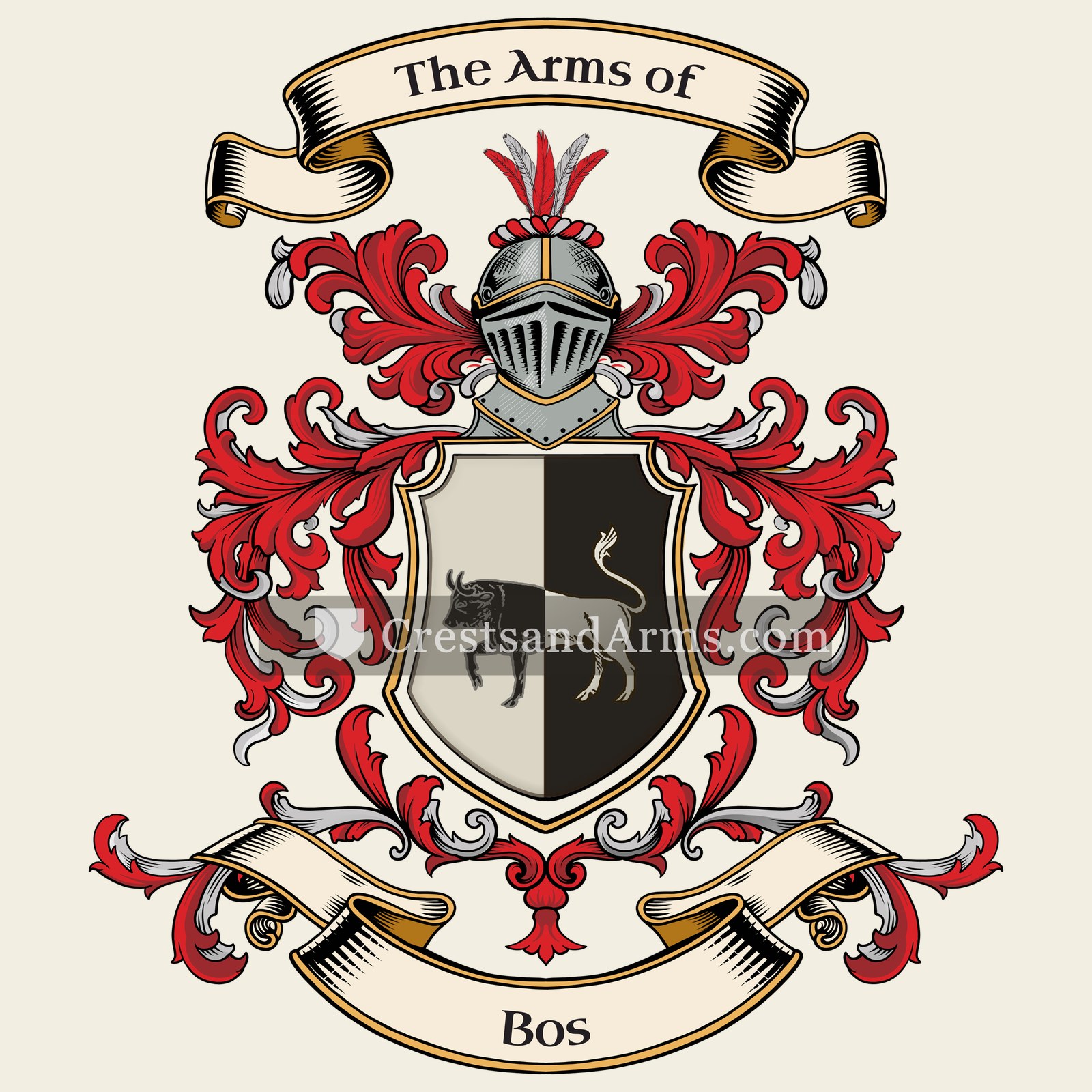
bullValour and generosity
Colours
Silver (Argent)Means: Peace and sincerity
Black (Sable)Means: Constancy
Historical info
Source
J. B. Rietstap, Armorial Général, Gouda: G. B. van Goor Zonen, 1884–87
Blazon (the actual original written record)
“Parti d'arg. et de sa.; à un rencontre de boeuf de l'un en l'autre. C.: deux cornes de buffle, d'arg. et de sa. (d'azur.”
Denmarkc. 1722
Digital archive packCoat of arms PNG, gold border print PDF, vector SVG and the certificate of authenticity. Sent to your email in minutes.
Map of Denmark showing where the Bos arms are recorded
The Bos arms were recorded in Denmark, c. 1722.
Arms such as these were typically recorded in Sjaælland.
Zealand held the Danish court, the crown's offices and Copenhagen itself. Families who served the king kept estates within reach of it, and royal service was the ordinary route to a coat of arms.
This is where the arms were entered in the register. Families often moved to other parts of the country, so the same name can turn up in more than one region.
The body that granted and recorded arms in Denmark in this period.
Frederik IV of Denmark
Sovereign of the period
Frederik IV of Denmark
1699–1730
Reigning in Netherlands when the Bos arms are first recorded.
How Arms Worked in Denmark
Danish heraldry during this period was closely tied to noble status and royal favor rather than being open to all citizens. Arms were typically granted by the monarch to individuals, and these symbols were then shared by all members of the noble house. If a family line died out, the right to use those specific arms ended with them.
Granting authority
The Danish royal chancery held the power to issue and regulate official coats of arms for the kingdom.
How they got arms
Families usually received their arms through a formal royal grant that confirmed their noble status and rights.
Where arms were recorded
These grants were officially recorded in the Danish Royal Chancery records starting in the sixteenth century.
The family's standing
Recorded among the armigerous families of Denmark.
Origin & History of the Bos Family in Denmark
The family name Bos has roots in Denmark that can be traced back to the early eighteenth century, specifically within the region of Sjaelland. By 1722, records confirm that members of the family were established in this area, which was a time of significant social and agricultural change for the Danish peasantry. During this period, most people in rural Denmark did not have hereditary surnames, instead using a patronymic system where a child took their father’s first name followed by "sen." The use of a fixed name like Bos suggests that the family may have held a distinct status or originated from a specific geographic location that set them apart from their neighbors. As they lived on the island of Sjaelland, they were likely involved in the traditional farming practices that defined the local economy before the great agrarian reforms of the late 1700s. This early presence indicates that the family was part of the foundational population that helped shape the local community structure in eastern Denmark.
Bos Meaning & Related Branches
Root word
busk
A Germanic term referring to a bush, thicket, or small forest.
This name
BosA topographic name for someone who lived near a forest or wooded area.
also spelled
Boss
Documented Sources
J. B. Rietstap, Armorial Général, Gouda: G. B. van Goor Zonen, 1884–87
Meertens, P.J., Voornamen in Nederland, 1959
Van der Schaar, J., Woordenboek van voornamen, 1964
Amsterdam City Archives (Stadsarchief Amsterdam), Bevolkingsregister 1815
Digital archive packCoat of arms PNG, gold border print PDF, vector SVG and the certificate of authenticity. Sent to your email in minutes.


 savages head affrontyAn enemy overcome
 lionCourage, strength and royalty
 savages head affrontyAn enemy overcome
 lionCourage, strength and royalty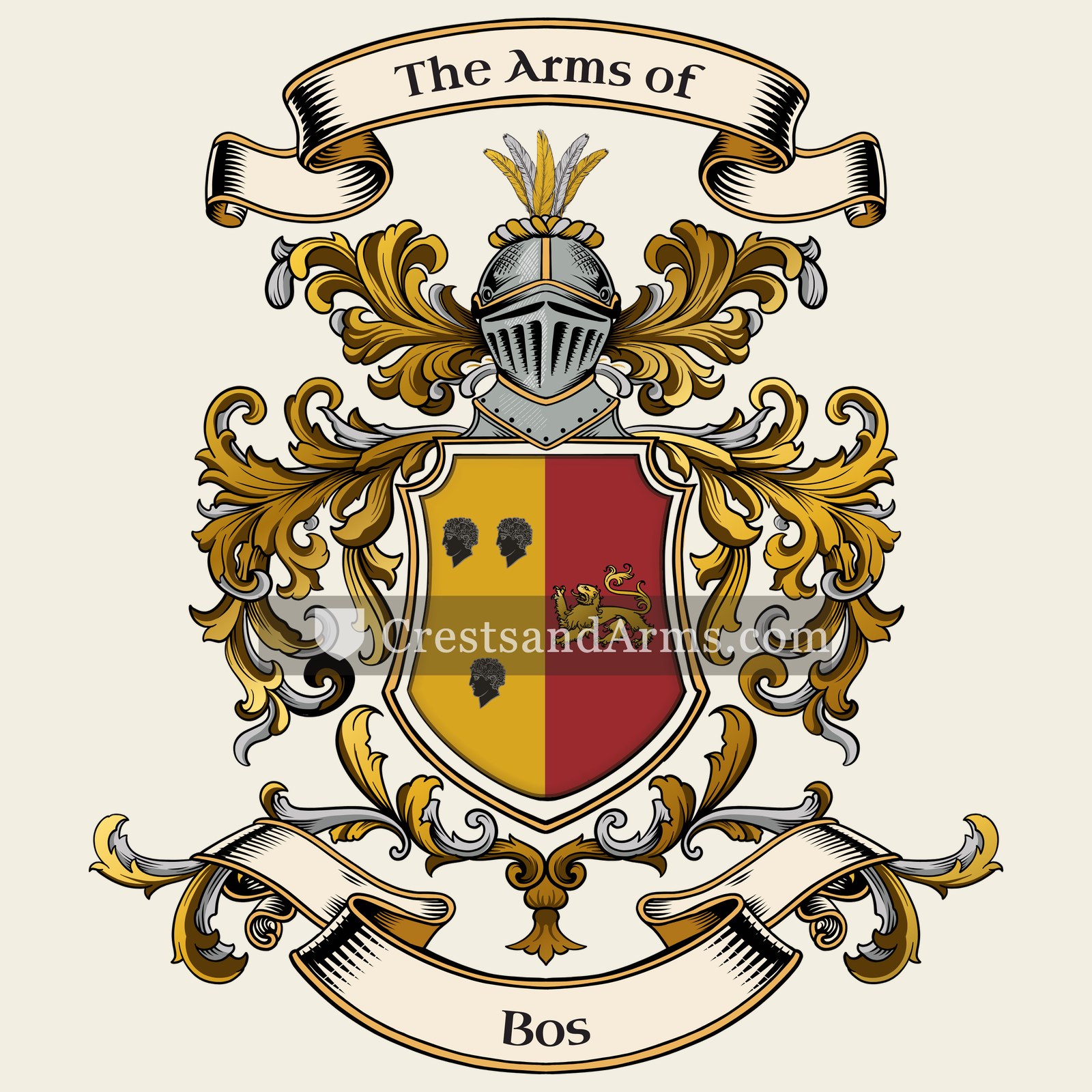


 bullValour and generosity