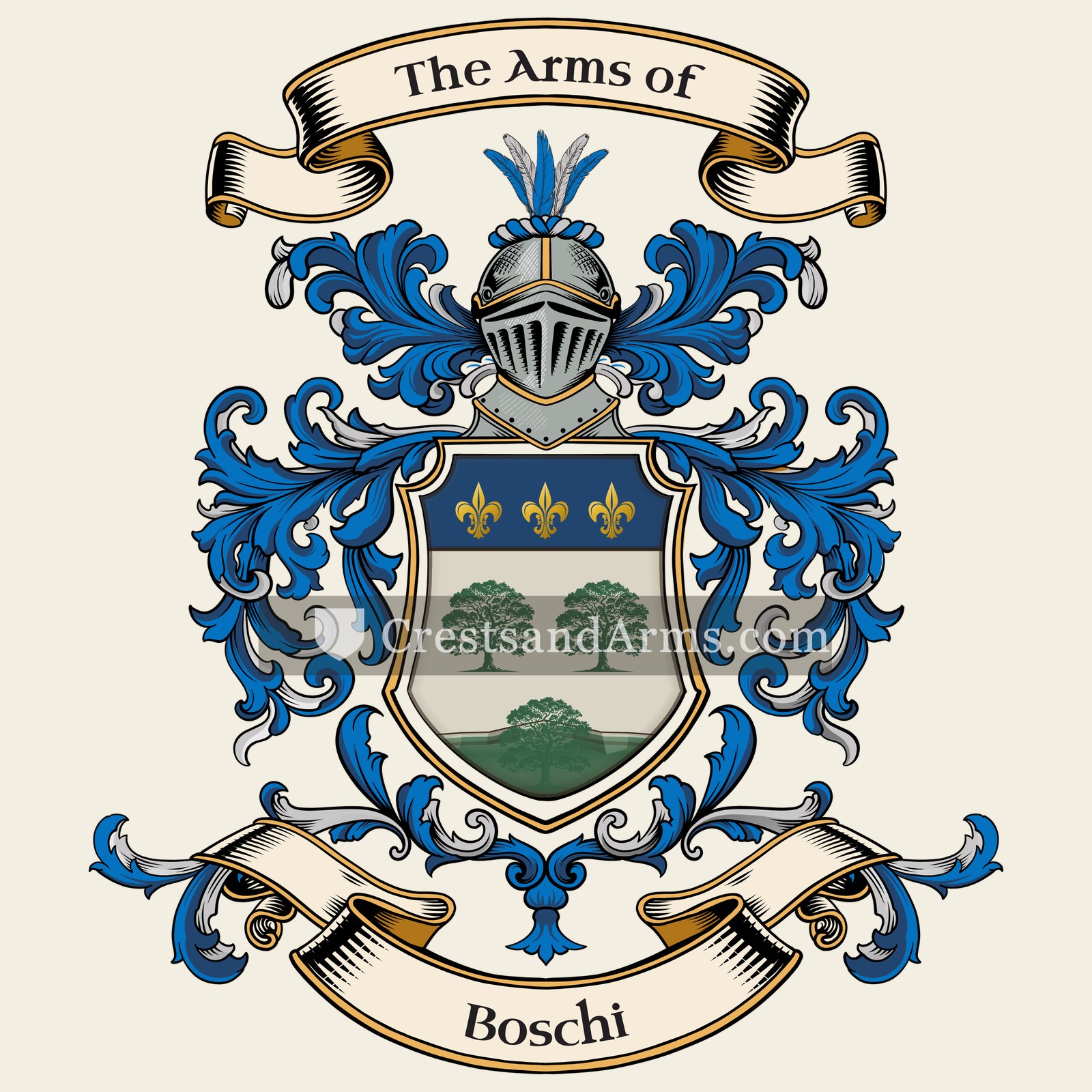
A record of documented arms, meaning and origin, researched for the Boschi family of Italy.
Reg. 6977 · Italian, A–C
Coat of Arms & Family Crest Details
Symbols on this shield
mountThe ground held, and steadfastness upon it
chiefAuthority, wisdom and dominion
treeLife, endurance and deep roots
fleur de lisPurity, light, and the sixth son
Colours
Silver (Argent)Means: Peace and sincerity
Blue (Azure)Means: Loyalty and truth
Green (Vert)Means: Hope
Gold (Or)Means: Generosity
Historical info
Source
J. B. Rietstap, Armorial Général, Gouda: G. B. van Goor Zonen, 1884–87
Blazon (the actual original written record)
“D'arg. à trois cyprès de sin., rangés sur un tertre du même: au chef voûté d'azur, ch. de trois fleurs-de-lis d'or et soutenu d'une divise voûtée du même.”
BavariaBavaria, c. 1710
Digital archive packCoat of arms PNG, gold border print PDF, vector SVG and the certificate of authenticity. Sent to your email in minutes.
Map of Italy showing where the Boschi arms are recorded
The Boschi arms were recorded in Bavaria, c. 1710.
Bavaria was a country of old landed families and walled market towns. Estates passed down the same line for centuries, and both the landowners and the leading townsmen kept arms, which is why so many Bavarian names sit in the registers.
This is where the arms were entered in the register. Families often moved to other parts of the country, so the same name can turn up in more than one region.
The body that granted and recorded arms in Italy in this period.
Victor Amadeus II of Savoy
Sovereign of the period
Victor Amadeus II of Savoy
1675–1730
Reigning in Italy when the Boschi arms are first recorded.
How Arms Worked in Italy
In the Italian states, coats of arms were often used by noble families to show their status and history. These symbols were passed down through the generations to all legitimate male descendants. Younger branches of a family usually kept the original design but sometimes added small changes to distinguish their specific line from the main branch.
Granting authority
Various local rulers and city governments controlled the use of coats of arms across the different Italian states.
How they got arms
Families often assumed their own arms or received them as official grants from local lords, popes, or city councils.
Where arms were recorded
Arms were recorded in local city archives or private family books rather than in one single national register.
The family's standing
Recorded among the armigerous families of Bavaria.
Origin & History of the Boschi Family in Italy
The family name Boschi is rooted in the linguistic traditions of the Alpine regions, where it evolved from terms describing those who lived near or worked within the dense woodlands. While the name is often associated with Italian origins, the presence of the family in Bavaria by 1710 suggests a history of migration and adaptation across Central Europe. During this period, families with this name were frequently involved in forestry, agriculture, or the management of timber resources, which were vital to the economy of the Bavarian territories. As they settled into these new regions, they integrated into local village life, often appearing in parish records as landowners or skilled laborers. This movement across borders highlights how the family name traveled alongside the people who carried it, adapting to new cultural environments while maintaining its connection to the natural landscape.
Boschi Meaning & Related Branches
Root word
Bosco
A wooded area or forest.
This name
BoschiDerived from a topographic name for someone who lived near a forest or woods.
also spelled
Boschy
Boskee
Documented Sources
J. B. Rietstap, Armorial Général, Gouda: G. B. van Goor Zonen, 1884–87
Kohlheim, Rosa and Volker Kohlheim, Duden Familiennamen: Herkunft und Bedeutung von 20.000 Nachnamen, 2005
Bayerisches Hauptstaatsarchiv, Kurbayern Hofkammer: Steuer- und Rechnungsunterlagen, 1710
Bahlow, Hans, Deutsches Namenlexikon: Familien- und Vornamen nach Ursprung und Sinn erklärt, 1967
Digital archive packCoat of arms PNG, gold border print PDF, vector SVG and the certificate of authenticity. Sent to your email in minutes.


 mountThe ground held, and steadfastness upon it
 chiefAuthority, wisdom and dominion
 treeLife, endurance and deep roots
 fleur de lisPurity, light, and the sixth son
 mountThe ground held, and steadfastness upon it
 chiefAuthority, wisdom and dominion
 treeLife, endurance and deep roots
 fleur de lisPurity, light, and the sixth son