Map of Germany showing where the Bosek arms are recorded
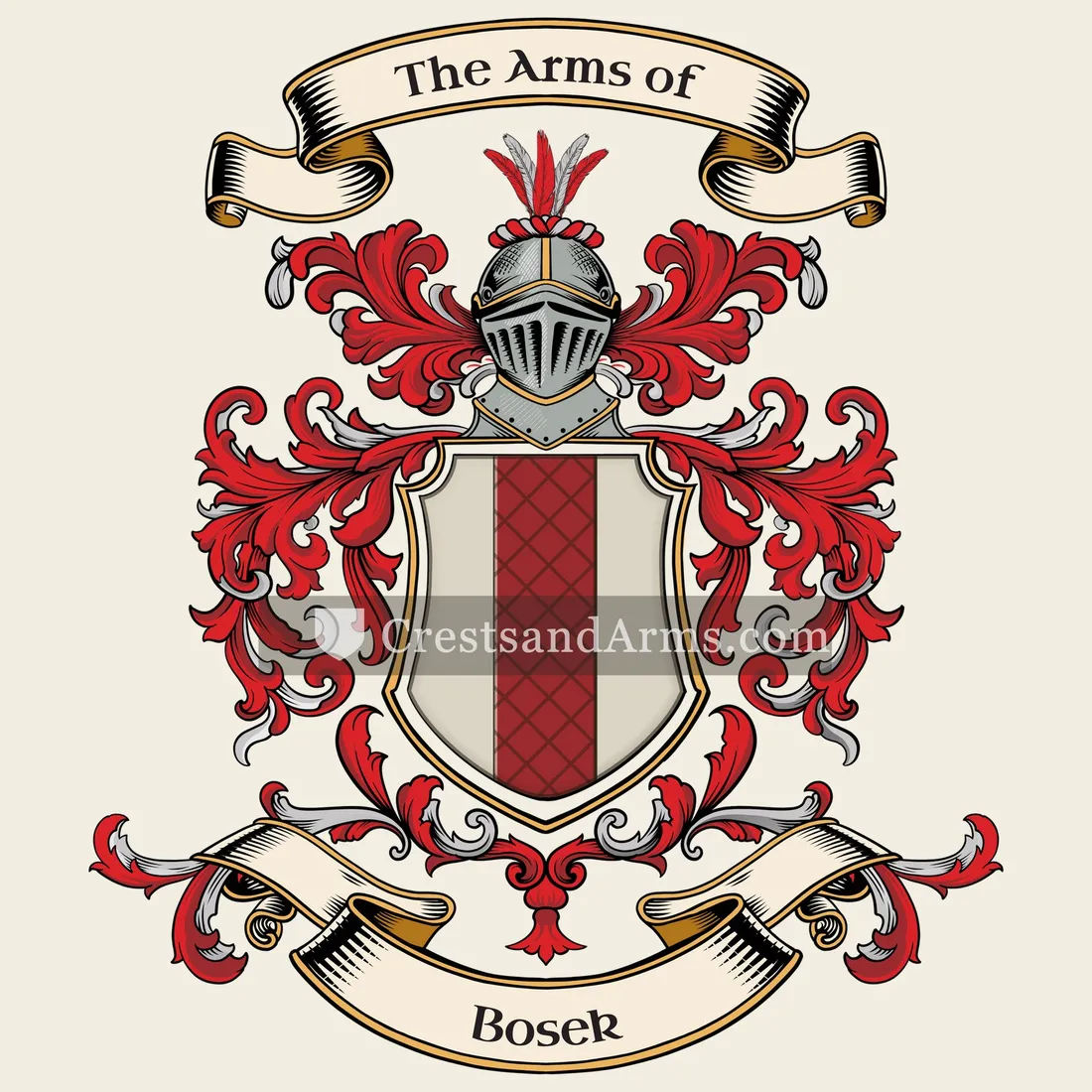
The Bosek arms were recorded in Franconia, c. 1765.
Franconia was a patchwork of small territories in central Germany, full of minor landowners and prosperous market towns. So many separate households held land there that the region produced a great many coats of arms.
This is where the arms were entered in the register. Families often moved to other parts of the country, so the same name can turn up in more than one region.
The body that granted and recorded arms in Germany in this period.
Francis I, Holy Roman Emperor
Sovereign of the period
Francis I, Holy Roman Emperor
1745–1765
Reigning in Germany when the Bosek arms are first recorded.
How Arms Worked in Germany
In the Holy Roman Empire, coats of arms were often granted to individuals by the Emperor or his representatives. These arms were then passed down through the generations to all legitimate descendants of the original holder. Younger branches of a family usually kept the same shield design without needing to change it, as the arms belonged to the entire lineage.
Granting authority
The Holy Roman Emperor held the sole power to grant new coats of arms throughout his vast imperial territories.
How they got arms
Families typically obtained their coats of arms through a formal imperial grant or by proving their noble status to the authorities.
Where arms were recorded
These grants were officially recorded in the Imperial Chancery registers, which began keeping formal records of such honors during the Middle Ages.
The family's standing
Recorded among the armigerous families of Franconia.
Origin & History of the Bosek Family in Germany
The family name Bosek has deep roots in the historical region of Franconia, where records confirm members of the family were established by the year 1765. During this period, Franconia was a collection of diverse territories within the Holy Roman Empire, characterized by a mix of small principalities and independent cities. Families like the Boseks often lived in rural or semi-urban settings where they contributed to the local agricultural or craft-based economy. The name itself is thought to be of Slavic origin, likely derived from a descriptive term or a shortened form of a personal name, which suggests that the family may have migrated into the German-speaking lands during earlier centuries of population movement. By the mid-eighteenth century, the Boseks were well-integrated into the social fabric of their Franconian communities, living through a time of significant cultural development and regional transition.
Bosek Meaning & Related Branches
Root word
Bose
Derived from the Middle High German word for evil or wicked.
This name
BosekA descriptive nickname for a person considered to be bad, wicked, or of a difficult temperament.
also spelled
Bosecke
Bosek
Documented Sources
J. B. Rietstap, Armorial Général, Gouda: G. B. van Goor Zonen, 1884–87


 paleMilitary strength, and a fortified defence
 paleMilitary strength, and a fortified defence