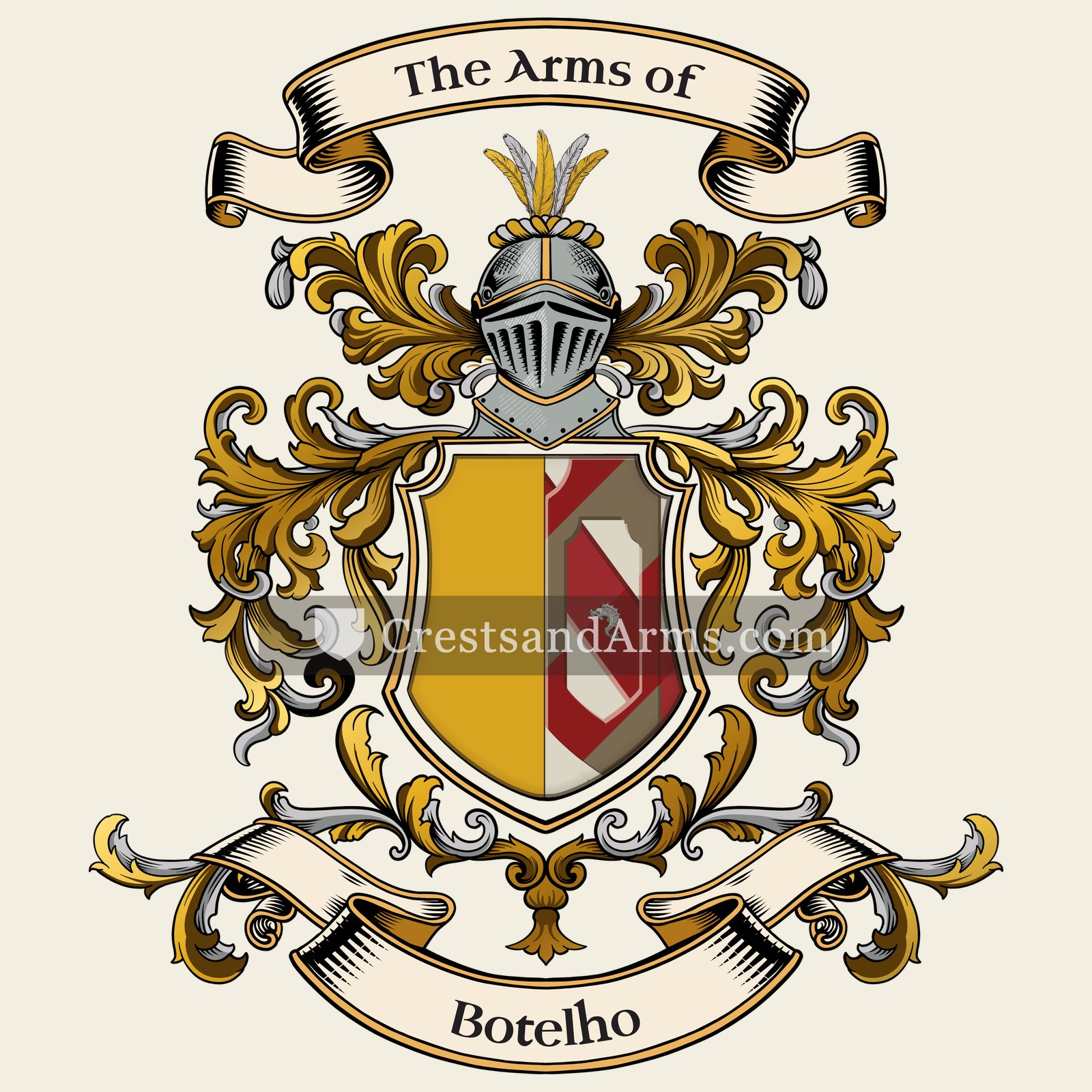
A record of documented arms, meaning and origin, researched for the Botelho family of Portugal.
Reg. 7015 · Portuguese, A–C
Coat of Arms & Family Crest Details
Symbols on this shield
bendDefence, and the scarf of a commander
dolphinSwiftness, charity and love
Colours
Gold (Or)Means: Generosity
Silver (Argent)Means: Peace and sincerity
Red (Gules)Means: Military strength
Historical info
Source
J. B. Rietstap, Armorial Général, Gouda: G. B. van Goor Zonen, 1884–87
Blazon (the actual original written record)
“Parti: au 1 d'or à quatre bande de gu.; au 2 de Tavora, qui est d'arg. à cinq fasces ondées d'azur, celle du milieu ch. d'un dauphin au nat., et une bord. d'arg. ch. de la D.: QUASCUMQUE FINDIT.”
Portugalc. 1706
Digital archive packCoat of arms PNG, gold border print PDF, vector SVG and the certificate of authenticity. Sent to your email in minutes.
Map of Portugal showing where the Botelho arms are recorded
The Botelho arms were recorded in Portugal, c. 1706.
Arms such as these were typically recorded in Lisboa.
Lisbon was the seat of the Portuguese crown and the port its wealth came through. Families made rich by trade and by service to the king took arms, and the crown's heralds recorded them there.
This is where the arms were entered in the register. Families often moved to other parts of the country, so the same name can turn up in more than one region.
The body that granted and recorded arms in Portugal in this period.
Peter II of Portugal
Sovereign of the period
Peter II of Portugal
1683–1706
Reigning in Portugal when the Botelho arms are first recorded.
How Arms Worked in Portugal
In Portugal, a coat of arms was a family possession that passed from a father to his children. Every legitimate descendant had the right to use the family shield without needing to change it. Younger branches of the family kept the original design, though they sometimes added small symbols to distinguish their specific line from the main branch.
Granting authority
The Cartório da Nobreza acted as the official body that managed and regulated noble titles and coats of arms in Portugal.
How they got arms
Families typically inherited their arms through bloodline, though they could also receive new grants from the crown for distinguished service.
Where arms were recorded
Coats of arms were officially recorded in the books of the Cartório da Nobreza starting in the year 1512.
The family's standing
Recorded among the armigerous families of Portugal.
Origin & History of the Botelho Family in Portugal
The surname Botelho is deeply rooted in the history of Portugal, with its origins likely linked to the medieval era. The name is often associated with the Portuguese word *botelho*, which historically referred to a type of vessel or a specific container used for liquids. By the early 18th century, the family had established a notable presence in Lisbon, as evidenced by records from 1706. During this period, Lisbon was a thriving center of trade and culture, and families like the Botelhos were often involved in the city's administrative, religious, or mercantile life. As the family grew, they became part of the broader social fabric of the capital, contributing to the development of the city during a time of significant architectural and economic expansion. Their presence in the city archives from this era highlights their integration into the urban society of the Portuguese kingdom.
Botelho Meaning & Related Branches
Root word
Botelho
Derived from the Portuguese word botelho meaning a small bottle or flask.
This name
BotelhoA topographic or occupational surname referring to a maker or seller of bottles.
also spelled
Botello
Botelo
Botelyo
Related arms
Botellovariant spelling
Documented Sources
J. B. Rietstap, Armorial Général, Gouda: G. B. van Goor Zonen, 1884–87
Freire, Anselmo Braamcamp. Brasões da Sala de Sintra. 1921
Machado, José Pedro. Dicionário Onomástico Etimológico da Língua Portuguesa. 1981
Arquivo Nacional da Torre do Tombo. Registos Paroquiais de Lisboa. 1706
Digital archive packCoat of arms PNG, gold border print PDF, vector SVG and the certificate of authenticity. Sent to your email in minutes.


 bendDefence, and the scarf of a commander
 dolphinSwiftness, charity and love
 bendDefence, and the scarf of a commander
 dolphinSwiftness, charity and love