Map of France showing where the Bouchie arms are recorded
The Bouchie arms were recorded in Flandre, c. 1663.
Flandre grew rich on cloth, and its towns were among the busiest in Europe. Merchant families bought land with their profits and took arms to go with it, so trade put as many names in the registers here as land did.
This is where the arms were entered in the register. Families often moved to other parts of the country, so the same name can turn up in more than one region.
The body that granted and recorded arms in France in this period.
Louis XIV of France
Sovereign of the period
Louis XIV of France
1643–1715
Reigning in France when the Bouchie arms are first recorded.
How Arms Worked in France
In France, a coat of arms was a mark of honor that passed down through the male line to all legitimate descendants. Families often used the same shield without changes to show their shared heritage. If a branch wanted to stand out, they could add a small mark to their shield to show their specific place in the family tree.
Granting authority
The Juge d'armes de France acted as the official authority that regulated and verified coats of arms across the country.
How they got arms
Families typically inherited their arms from ancestors, though they could also receive them through royal grants or by proving their noble status.
Where arms were recorded
Coats of arms were officially recorded in the Armorial Général de France, which began its main collection in the year 1696.
The family's standing
Recorded among the armigerous families of Flandre.
Origin & History of the Bouchie Family in France
The family name Bouchie finds its roots in the northern regions of France, specifically within the historical territory of Flanders. During the seventeenth century, this area was a complex landscape where French and Flemish cultures frequently overlapped due to shifting political borders and trade routes. By 1663, records confirm that members of the Bouchie family were well-established in this region. The name itself likely originated as a descriptive nickname or a reference to a specific occupation common in the local economy of the time. Families in this part of France often lived in close-knit communities centered around agriculture or textile production, which defined their daily lives and social standing. As the seventeenth century progressed, the movement of people across these northern provinces helped spread the name further into the heart of the French kingdom. This early history reflects the broader patterns of migration and identity that shaped the lives of families in the borderlands of northern France.
Meaning of the Bouchie family crest colors & symbols
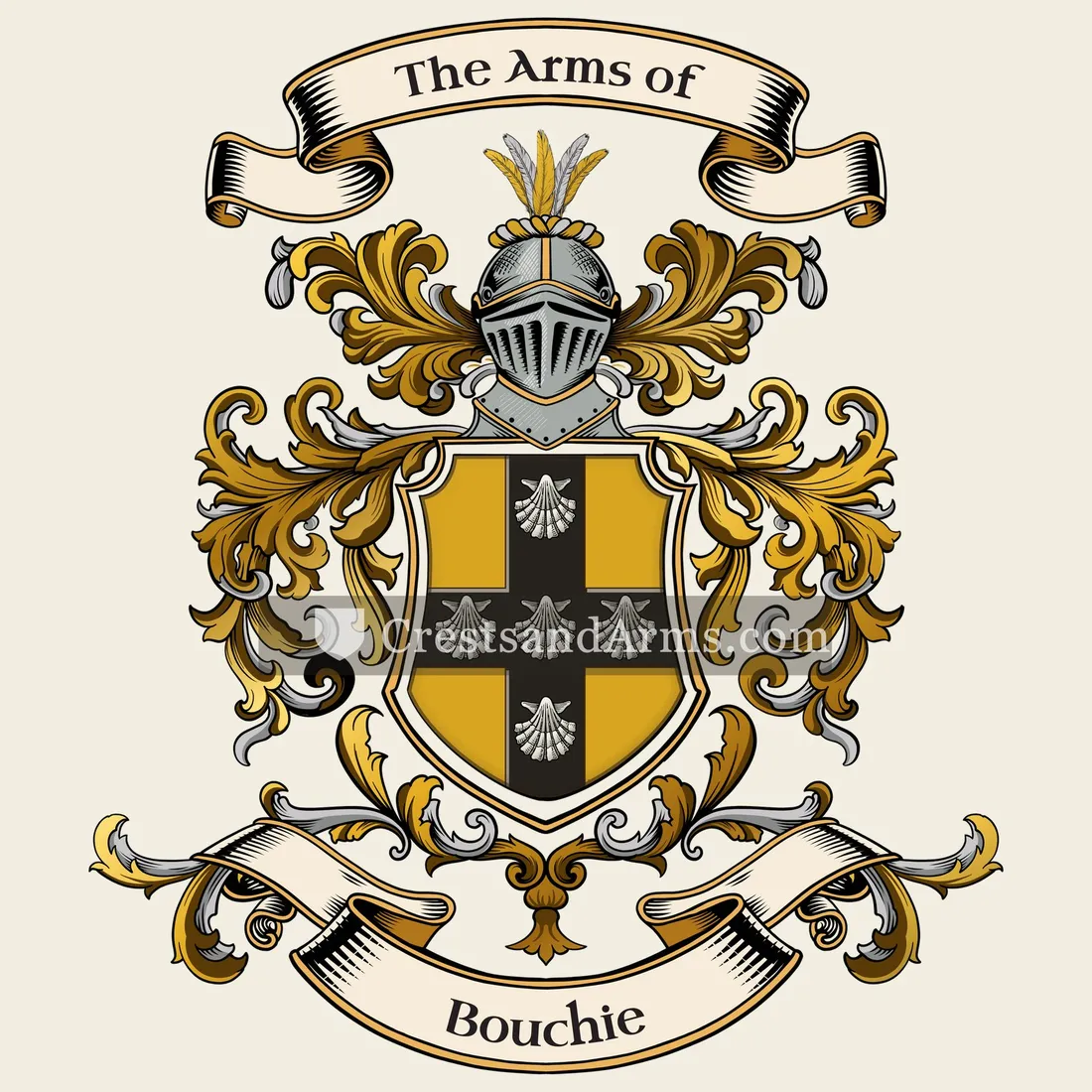
Symbols on this shield
cross symbolChristian faith and service
escallopThe pilgrim's shell, and a long journey made
Colours
Gold (Or)Means: Generosity
Black (Sable)Means: Constancy
Silver (Argent)Means: Peace and sincerity
Historical info
Source
Sir Bernard Burke, The General Armory of England, Scotland, Ireland and Wales, London: Harrison & Sons, 1884
Blazon (the actual original written record)
“Or, on a cross sa. five escallops ar”
Englandc. 1620
Digital archive packCoat of arms PNG, gold border print PDF, vector SVG and the certificate of authenticity. Sent to your email in minutes.
Map of England showing where the Bouchie arms are recorded
The Bouchie arms were recorded in England, c. 1620.
Arms such as these were typically recorded in York.
Yorkshire is the largest of the English counties, and it held more gentry families than any other. Land there was split among a great many households rather than a few, so a great many of them carried arms.
This is where the arms were entered in the register. Families often moved to other parts of the country, so the same name can turn up in more than one region.
The body that granted and recorded arms in England in this period.
James VI and I
Sovereign of the period
James VI and I
1603–1625
Reigning in France when the Bouchie arms are first recorded.
How Arms Worked in England
English heraldry allowed arms to be shared by all legitimate descendants of the original owner. These symbols were treated as personal property that moved through the generations to all children. While the eldest son kept the original design, other family members could use the same shield without needing to change it or register their own unique versions.
Granting authority
The College of Arms in London has regulated the use of coats of arms throughout England and Wales since 1484.
How they got arms
Families typically obtained their coats of arms through a formal grant from the Crown or by proving their ancient right to them.
Where arms were recorded
All official coats of arms are recorded in the registers kept at the College of Arms, which date back to the fifteenth century.
The family's standing
Recorded among the armigerous families of England.
Origin & History of the Bouchie Family in England
The Bouchie family name carries a history that reflects the movement of people across Northern England during the early seventeenth century. Records confirm that members of the family were established in the city of York by 1620, a time when the city served as a vital administrative and commercial hub for the region. During this era, York was recovering from the political shifts of the Elizabethan period and remained a central location for families involved in trade and local governance. The presence of the Bouchie name in parish registers and municipal documents from this period suggests that the family was integrated into the urban life of the city. While the name likely has roots tied to broader European migration patterns, its early English history is defined by this firm placement within the social fabric of York. By settling in such a prominent northern center, the family participated in the daily life and economic development of a city that acted as the gateway to the north of England.
Bouchie Meaning & Related Branches
Root word
Bouche
Derived from the Old French word for mouth or opening.
This name
BouchieA topographic name for someone living near a river mouth or a nickname for a talkative person.
also spelled
Bouches
Boosh
Bowche
Bouchier
Documented Sources
J. B. Rietstap, Armorial Général, Gouda: G. B. van Goor Zonen, 1884–87
Dauzat, Albert. Dictionnaire étymologique des noms de famille et prénoms de France. 1951
Morlet, Marie-Thérèse. Dictionnaire étymologique des noms de famille. 1991
Archives départementales du Nord, Série B: Cours et juridictions
Archives nationales de France, Série G: Clergé séculier et paroisses
Digital archive packCoat of arms PNG, gold border print PDF, vector SVG and the certificate of authenticity. Sent to your email in minutes.


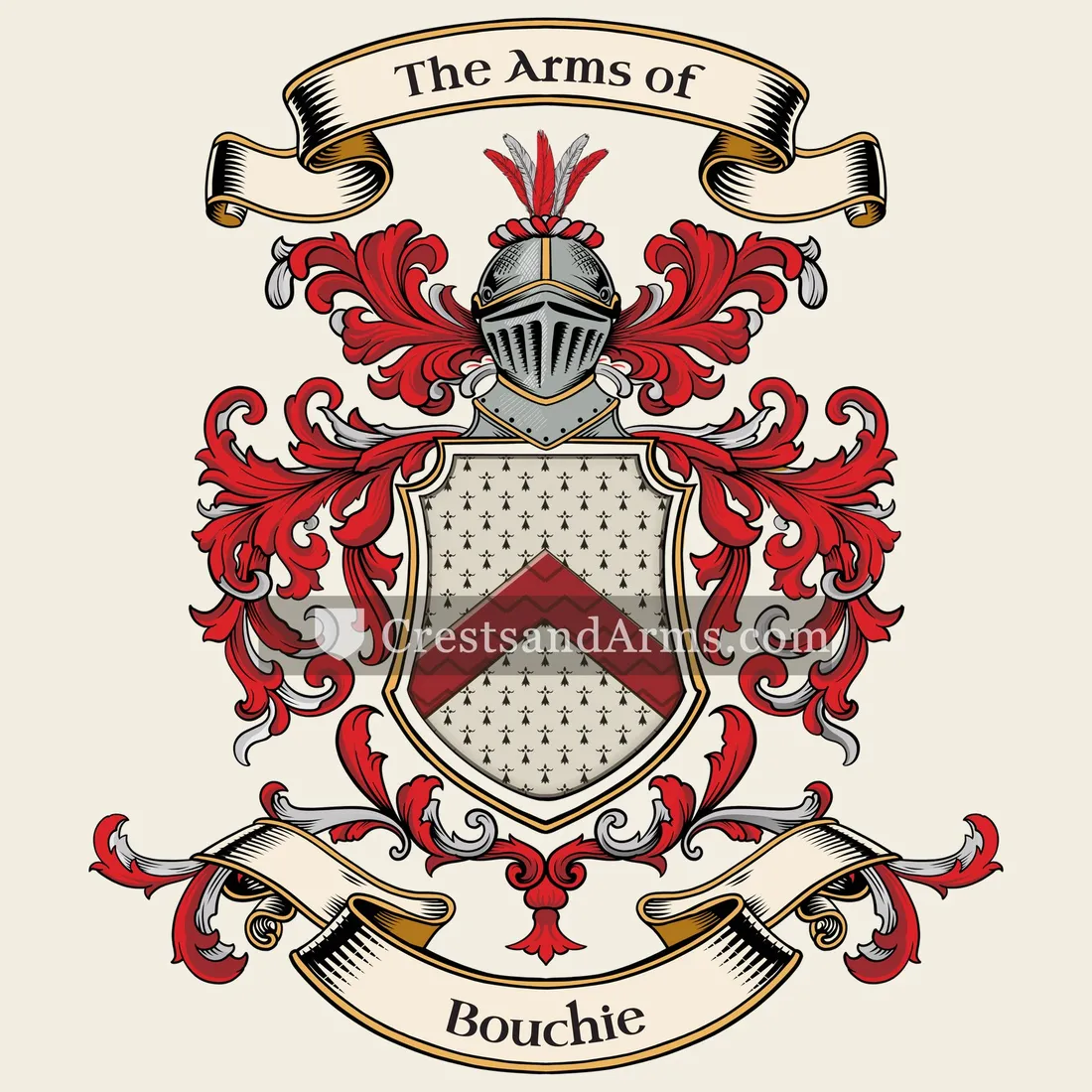
 chevronProtection, and faithful service completed
 chevronProtection, and faithful service completed


 cross symbolChristian faith and service
 escallopThe pilgrim's shell, and a long journey made