Map of England showing where the Bouchier arms are recorded
The Bouchier arms were recorded in Gloucester, c. 1620.
Gloucestershire had good farmland, a cloth trade in its valleys and a river carrying goods to Bristol. All three made money, and money bought the estates that brought arms with them.
This is where the arms were entered in the register. Families often moved to other parts of the country, so the same name can turn up in more than one region.
The body that granted and recorded arms in England in this period.
James VI and I
Sovereign of the period
James VI and I
1603–1625
Reigning in England when the Bouchier arms are first recorded.
How Arms Worked in England
English heraldry allowed arms to be shared by all legitimate descendants of the original owner. These symbols were treated as personal property that moved through the generations to all children. While the eldest son kept the original design, other family members could use the same shield without needing to change it or register their own unique versions.
Granting authority
The College of Arms in London has regulated the use of coats of arms throughout England and Wales since 1484.
How they got arms
Families typically obtained their coats of arms through a formal grant from the Crown or by proving their ancient right to them.
Where arms were recorded
All official coats of arms are recorded in the registers kept at the College of Arms, which date back to the fifteenth century.
The family's standing
Recorded among the armigerous families of Gloucester.
Origin & History of the Bouchier Family in England
The surname Bouchier, often linked to the French word for butcher, arrived in England following the Norman Conquest and gradually became established among the local population. By the early seventeenth century, the family had firmly planted roots in the historic city of Gloucester. Records from 1620 confirm that members of the Bouchier family were active participants in the social and economic life of this region. During this period, Gloucester served as a vital hub for trade and industry, providing a stable environment for families to grow and contribute to their local communities. The presence of the Bouchier name in these early English records highlights a long history of integration into the fabric of provincial life, reflecting the broader movement of families across the English landscape during the transition into the colonial era.
Coat of Arms & Family Crest Details
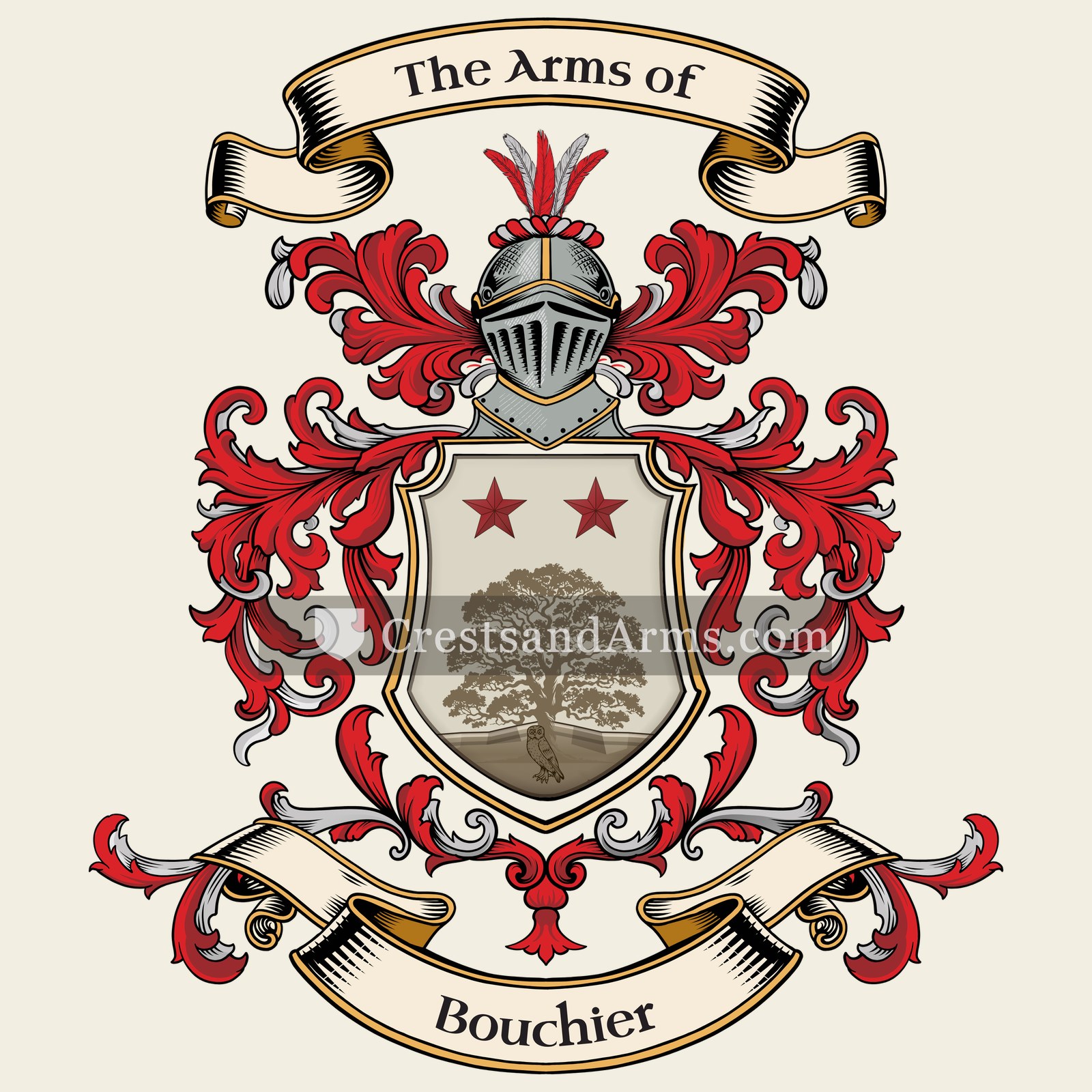
Symbols on this shield
mountThe ground held, and steadfastness upon it
treeLife, endurance and deep roots
owlWisdom and vigilance by night
mulletThe third son, and a divine quality from above
Colours
Silver (Argent)Means: Peace and sincerity
Red (Gules)Means: Military strength
Historical info
Source
Sir Bernard Burke, The General Armory of England, Scotland, Ireland and Wales, London: Harrison & Sons, 1884
Blazon (the actual original written record)
“Ar. on a mount a tree, on the top an owl ppr. in chief two mullets gu”
NetherlandsLondon, c. 1815
Digital archive packCoat of arms PNG, gold border print PDF, vector SVG and the certificate of authenticity. Sent to your email in minutes.
Map of Netherlands showing where the Bouchier arms are recorded
The Bouchier arms were recorded in London, c. 1815.
Arms such as these were typically recorded in Friesland.
Friesland was low, wet country on the northern coast of the Netherlands, farmed by families who had held the same land for centuries. Free landholders were unusually common there, and a free landholder could carry arms.
This is where the arms were entered in the register. Families often moved to other parts of the country, so the same name can turn up in more than one region.
Region
Friesland
Town
London
First recorded
1815
Granting Authority for the Bouchier Arms
Hoge Raad van Adel
Photograph made by me · CC BY-SA 3.0
The body that granted and recorded arms in Netherlands in this period.
William I of the Netherlands
Sovereign of the period
William I of the Netherlands
1815–1840
Reigning in England when the Bouchier arms are first recorded.
How Arms Worked in Netherlands
In the Netherlands, coats of arms were often used by noble families and those who held specific public offices. These arms were passed down through the generations to legitimate descendants. Younger branches of a family usually kept the original design without needing to add special marks. This system ensured that the family identity remained clear and consistent over many years.
Granting authority
The Hoge Raad van Adel is the official body that regulates and manages noble titles and coats of arms in the Netherlands.
How they got arms
Families typically obtained their coats of arms through official royal grants or by proving their long-standing historical use of the symbols.
Where arms were recorded
Coats of arms are officially recorded in the registers held by the Hoge Raad van Adel, which began its work in 1814.
The family's standing
Recorded among the armigerous families of Netherlands.
Origin & History of the Bouchier Family in Netherlands
The Bouchier family name carries a history that reflects the shifting borders and cultural exchanges of Northern Europe. While the name itself has roots that trace back to French and Norman origins, its presence in the Netherlands became firmly established by the early nineteenth century. Records confirm that members of the family were living in the province of Friesland by 1815, a time when the region was undergoing significant political change following the end of the Napoleonic Wars. During this era, many families in Friesland were required to formalize their surnames for official government registers, which helped solidify the spelling and identity of the Bouchier line within the Dutch population. The family likely integrated into the local community through trade, agriculture, or maritime activities, which were the primary drivers of the Frisian economy at the time. By settling in this northern province, the Bouchiers became part of a unique cultural landscape known for its distinct language and independent spirit, marking the beginning of their long-standing connection to the Dutch nation.
Bouchier Meaning & Related Branches
Root word
buche
Old French term for a log or a thick piece of wood.
This name
BouchierAn occupational name for a woodcutter or a nickname for a person with a stocky build.
also spelled
Bourchier
Bowchier
Boucher
Related arms
Bouchevariant spelling
Bouchervariant spelling
Bourchiervariant spelling
Bowchervariant spelling
Documented Sources
Sir Bernard Burke, The General Armory of England, Scotland, Ireland and Wales, London: Harrison & Sons, 1884
Herbert, Nicholas, A History of the County of Gloucester: Volume 4, the City of Gloucester, 1988
The National Archives, Records of the Prerogative Court of Canterbury, PROB 11
Digital archive packCoat of arms PNG, gold border print PDF, vector SVG and the certificate of authenticity. Sent to your email in minutes.


 chevronProtection, and faithful service completed
 martletA younger son, who must win his own land
 chevronProtection, and faithful service completed
 martletA younger son, who must win his own land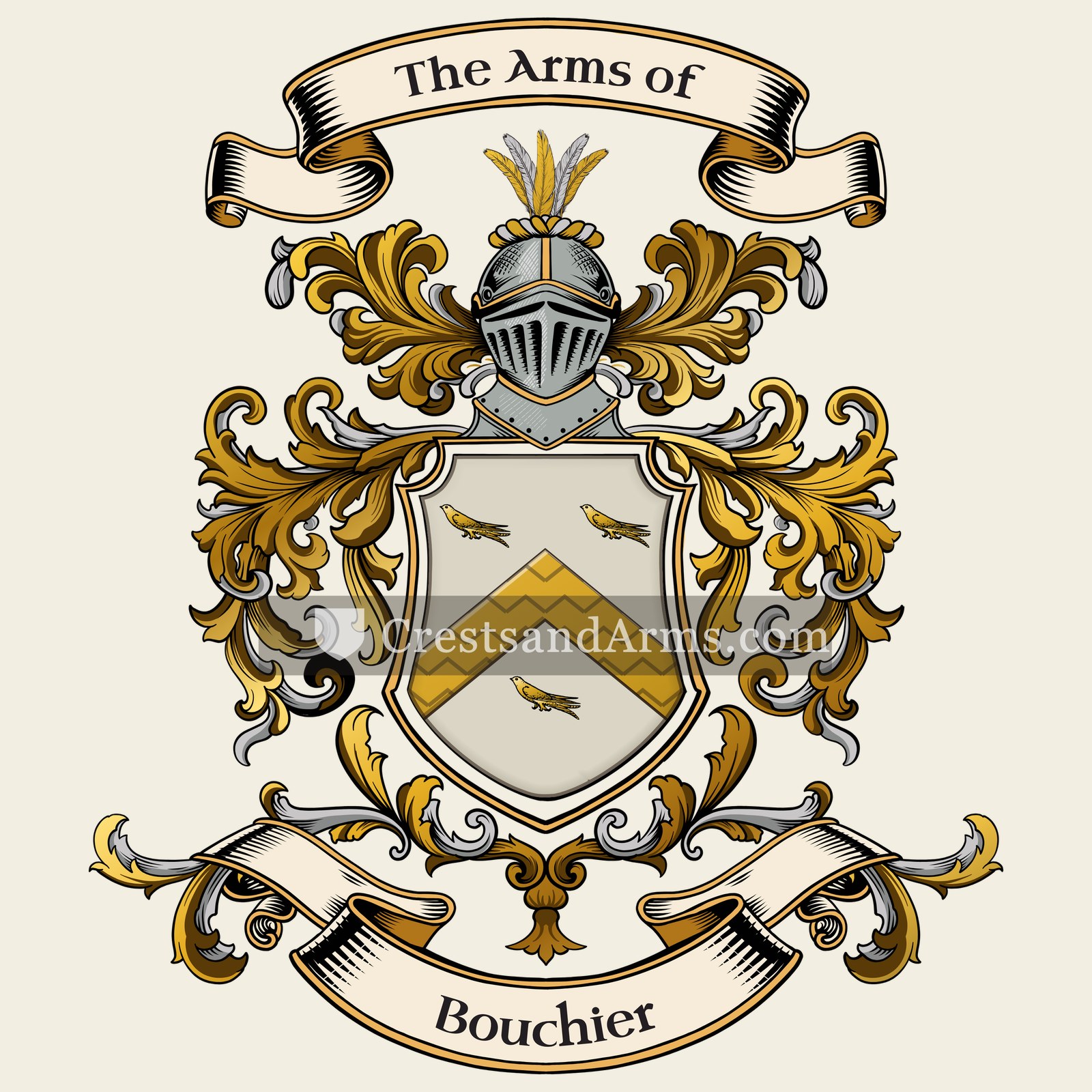


 mountThe ground held, and steadfastness upon it
 treeLife, endurance and deep roots
 owlWisdom and vigilance by night
 mulletThe third son, and a divine quality from above