Map of Belgium showing where the Bouillon arms are recorded
The Bouillon arms were recorded in Liege, c. 1737.
Liege was a prosperous town and its surrounding country, living on metalworking and trade. Merchant families grew rich, bought land outside the walls, and took arms as landowners rather than tradesmen.
This is where the arms were entered in the register. Families often moved to other parts of the country, so the same name can turn up in more than one region.
The body that granted and recorded arms in Belgium in this period.
Charles VI, Holy Roman Emperor
Sovereign of the period
Charles VI, Holy Roman Emperor
1711–1740
Reigning in Belgium when the Bouillon arms are first recorded.
How Arms Worked in Belgium
In Belgium, a coat of arms is considered personal property that is passed down through the male line to legitimate descendants. Families often use the same shield design across generations to show their shared heritage. If a branch of the family wants to change the design, they must apply for an official update to their specific version of the arms.
Granting authority
The Conseil héraldique is the official body that regulates and approves all coats of arms in Belgium.
How they got arms
Families obtain their coats of arms through formal royal grants or by confirming their historical right to use existing designs.
Where arms were recorded
All approved coats of arms are officially recorded in the public registers of the Conseil héraldique since 1844.
The family's standing
Recorded among the armigerous families of Liege.
Origin & History of the Bouillon Family in Belgium
The family name Bouillon carries a deep connection to the historical landscape of Belgium, particularly within the region of Liège. By the early eighteenth century, records confirm that members of the family were well-established in this area, with documented evidence of their presence in Liège as early as 1737. The name itself is linked to the town of Bouillon in the Ardennes, a place famous for its strategic fortress and its historical role as a center of power during the Middle Ages. Families who adopted this name often did so to signify their origins from this specific geographic location, which was a significant crossroads for trade and political influence. As these individuals moved into cities like Liège, they integrated into the local society, contributing to the growth of the region during a time of industrial and social transition. Their history reflects the broader movement of people across the Belgian landscape, where family names served as a way to maintain a link to one’s ancestral home while building a new life in a growing urban center.
Coat of Arms & Family Crest Details
Symbols on this shield
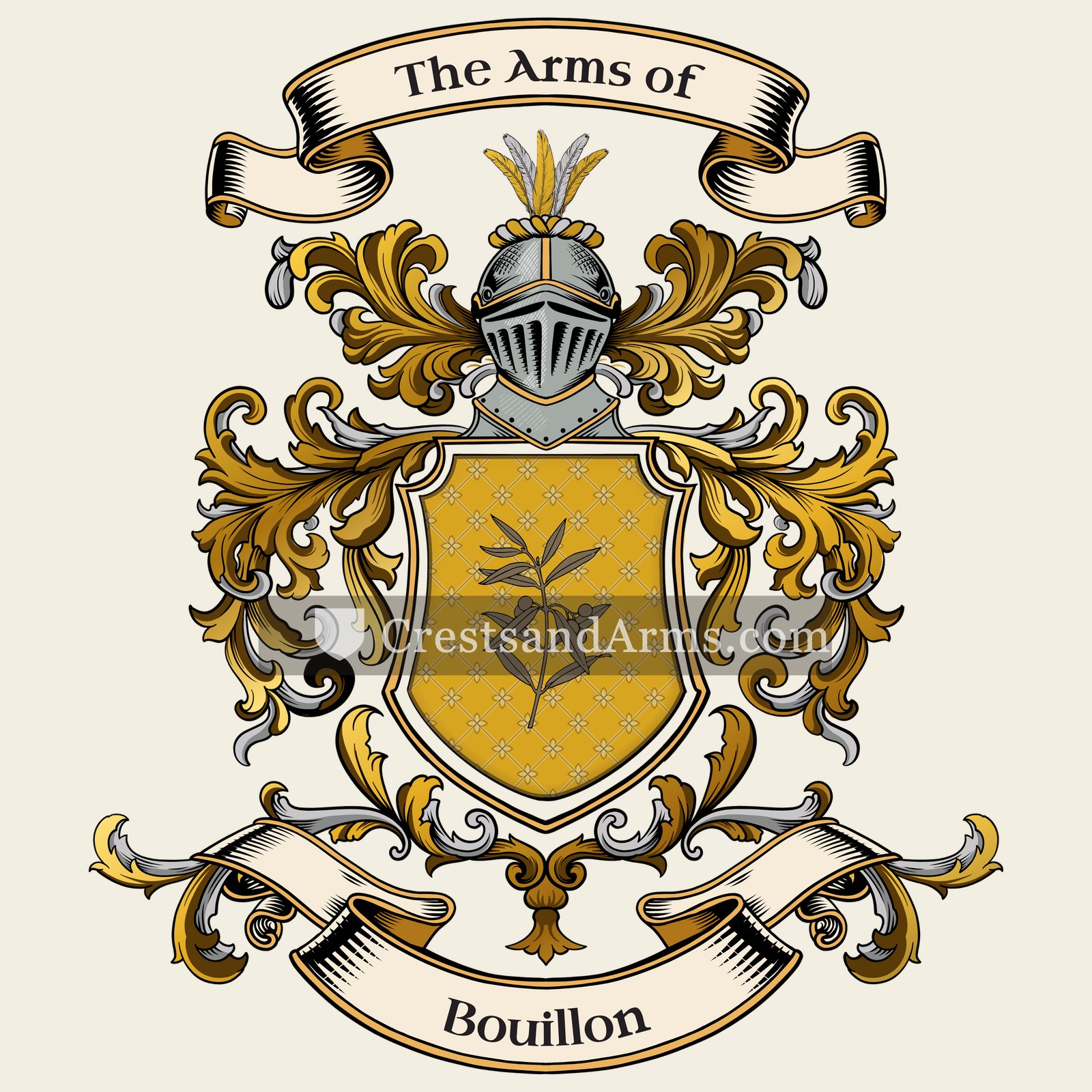
branchPeace, and new growth
Colours
Gold (Or)Means: Generosity
Historical info
Source
J. B. Rietstap, Armorial Général, Gouda: G. B. van Goor Zonen, 1884–87
Blazon (the actual original written record)
“D'or à un rameau de laurier au nat., fleuri de trois pièces.”
LorraineLorraine, c. 1595
Digital archive packCoat of arms PNG, gold border print PDF, vector SVG and the certificate of authenticity. Sent to your email in minutes.
Map of France showing where the Bouillon arms are recorded
The Bouillon arms were recorded in Lorraine, c. 1595.
Lorraine sat on the border between France and the German lands, and border country bred soldiers. Families here held small estates and served in arms, and a fighting man was exactly the sort who carried a shield of his own.
This is where the arms were entered in the register. Families often moved to other parts of the country, so the same name can turn up in more than one region.
The body that granted and recorded arms in France in this period.
Henry IV of France
Sovereign of the period
Henry IV of France
1589–1610
Reigning in Belgium when the Bouillon arms are first recorded.
How Arms Worked in France
In France, a coat of arms was a mark of honor that passed down through the male line to all legitimate descendants. Families often used the same shield without changes to show their shared heritage. If a branch wanted to stand out, they could add a small mark to their shield to show their specific place in the family tree.
Granting authority
The Juge d'armes de France acted as the official authority that regulated and verified coats of arms across the country.
How they got arms
Families typically inherited their arms from ancestors, though they could also receive them through royal grants or by proving their noble status.
Where arms were recorded
Coats of arms were officially recorded in the Armorial Général de France, which began its main collection in the year 1696.
The family's standing
Recorded among the armigerous families of Lorraine.
Origin & History of the Bouillon Family in France
The family name Bouillon finds its deep historical roots within the rugged landscape of the Lorraine region in northeastern France. By the year 1595, records confirm that members of the family were already established in this area, which served as a vital crossroads between French and Germanic cultures. The name itself is linked to the town of Bouillon, which sits along the Semois River and was a significant stronghold during the Middle Ages. Families who took this name often held ties to the land and the local administrative structures that governed the Duchy of Lorraine. As the family grew, they became part of the social fabric of the region, navigating the complex political shifts that defined life in the borderlands of the French kingdom. Their early presence in Lorraine reflects a history of stability and local influence that helped define their identity for generations.
Bouillon Meaning & Related Branches
Root word
bullio
Latin term referring to boiling, bubbling, or a bubbling spring.
This name
BouillonA topographic name for someone living near a bubbling stream or a boiling spring.
also spelled
Bouillone
Bouillonn
Bouillont
Builon
Documented Sources
J. B. Rietstap, Armorial Général, Gouda: G. B. van Goor Zonen, 1884–87
Archives de l'État à Liège, Registres paroissiaux de la ville de Liège
Archives de l'État à Liège, État civil et registres de population
Derenne, E., Histoire de la ville de Liège, 1952
Herbillon, J. and Germain, J., Dictionnaire des noms de famille en Belgique romane et dans les régions limitrophes, 1996
Digital archive packCoat of arms PNG, gold border print PDF, vector SVG and the certificate of authenticity. Sent to your email in minutes.


 cross symbolChristian faith and service
 lionCourage, strength and royalty
 cross symbolChristian faith and service
 lionCourage, strength and royalty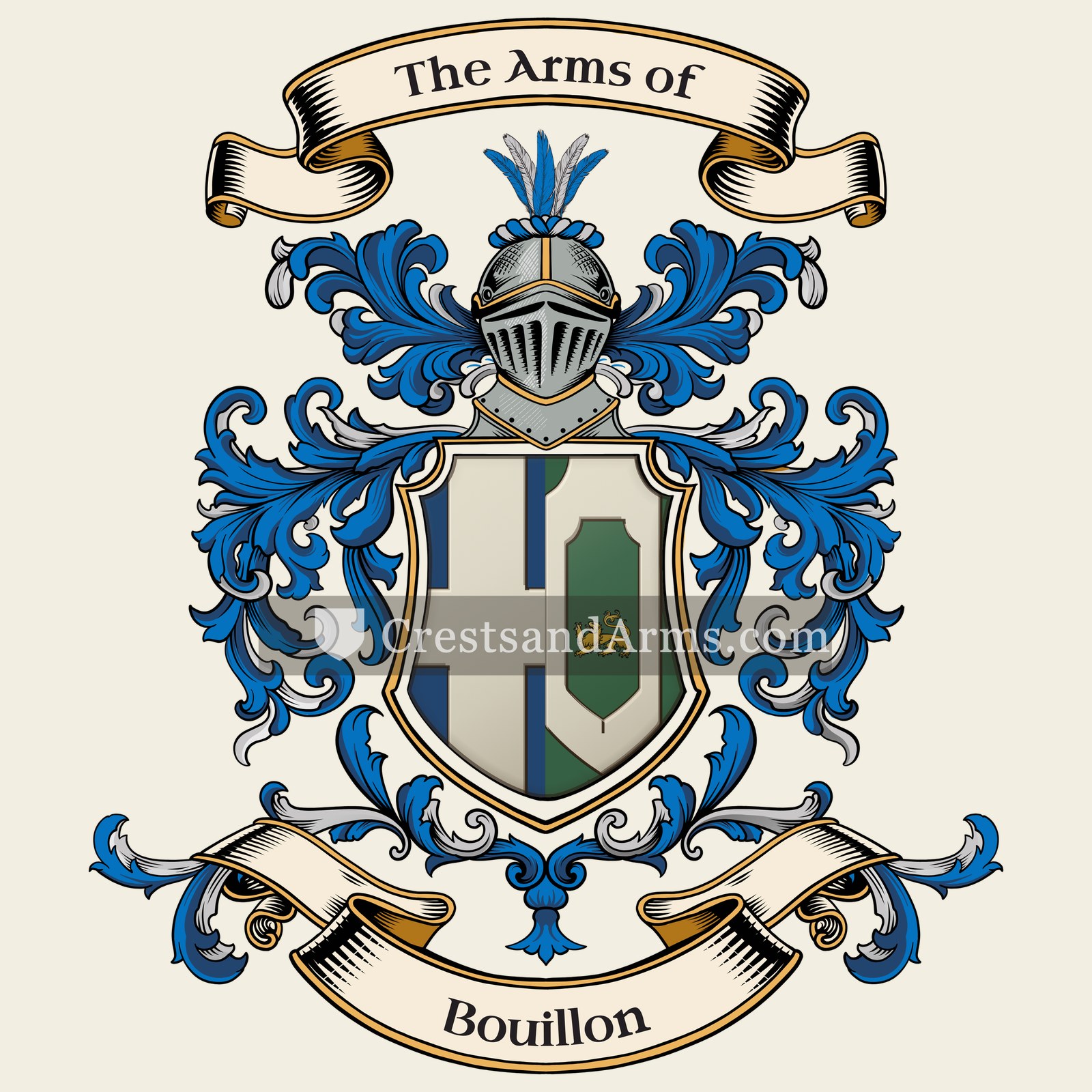


 branchPeace, and new growth