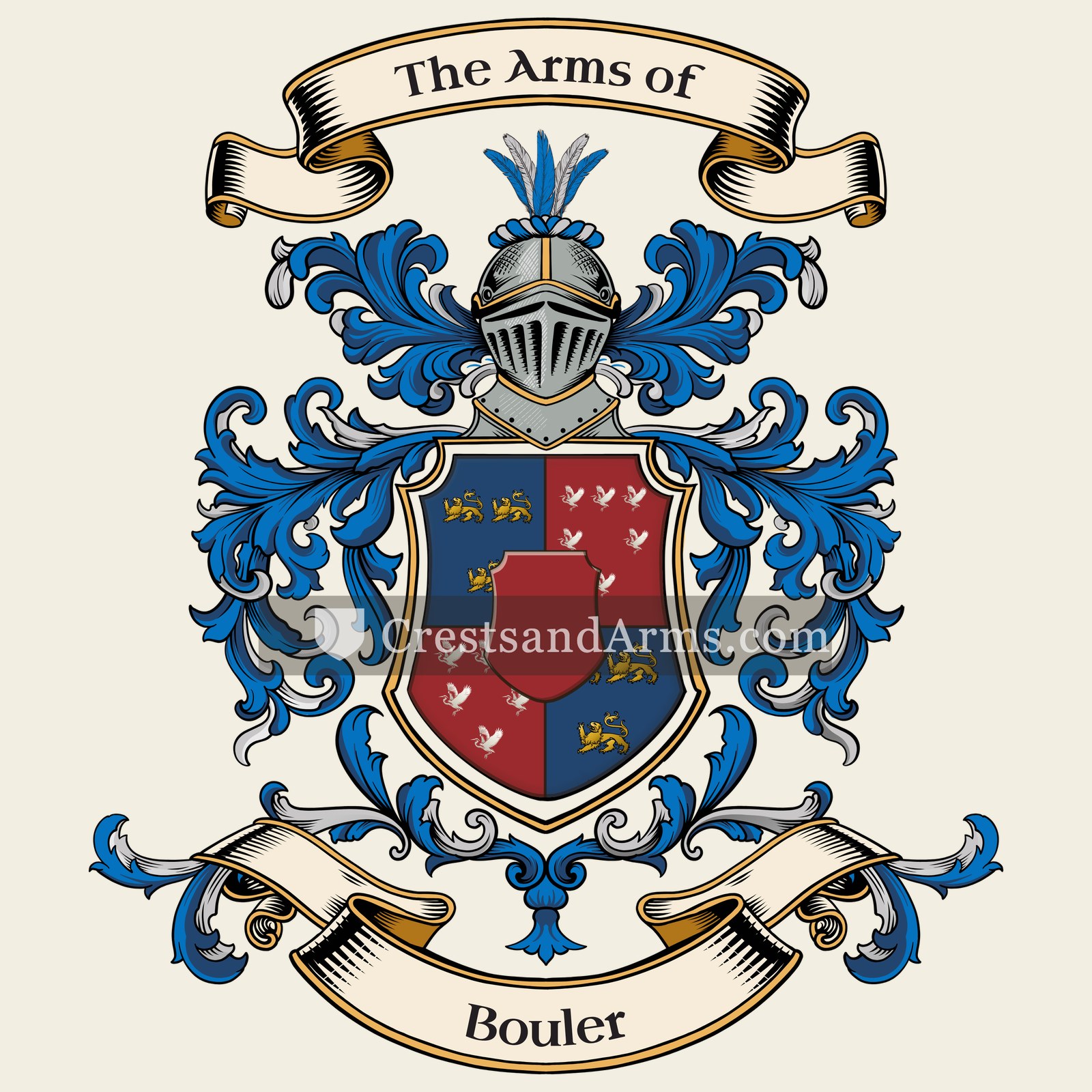
A record of documented arms, meaning and origin, researched for the Bouler family of France.
Reg. 0330 · French, A–C
Coat of Arms & Family Crest Details
Symbols on this shield
lionCourage, strength and royalty
heronPatience and quiet watchfulness
Colours
Blue (Azure)Means: Loyalty and truth
Red (Gules)Means: Military strength
Gold (Or)Means: Generosity
Silver (Argent)Means: Peace and sincerity
Historical info
Source
J. B. Rietstap, Armorial Général, Gouda: G. B. van Goor Zonen, 1884–87
Blazon (the actual original written record)
“Ec.: aux 1 et 4 d'azur à trois têtes de léopard d'or (des Lions); aux 2 et 3 de gu. à six têtes et cols de grue d'arg., cour. d'or (Signys). Sur le tout d'or à un écusson de gu. en abîme (Boulers). C.: une tête et col de boeuf, au nat. S.: deux ours de sa., emmuselés d'or.”
FranceParis, c. 1663
Digital archive packCoat of arms PNG, gold border print PDF, vector SVG and the certificate of authenticity. Sent to your email in minutes.
Map of France showing where the Bouler arms are recorded
The Bouler arms were recorded in Paris, c. 1663.
This is where the arms were entered in the register. Families often moved to other parts of the country, so the same name can turn up in more than one region.
The body that granted and recorded arms in France in this period.
Louis XIV of France
Sovereign of the period
Louis XIV of France
1643–1715
Reigning in France when the Bouler arms are first recorded.
How Arms Worked in France
In France, a coat of arms was a mark of honor that passed down through the male line to all legitimate descendants. Families often used the same shield without changes to show their shared heritage. If a branch wanted to stand out, they could add a small mark to their shield to show their specific place in the family tree.
Granting authority
The Juge d'armes de France acted as the official authority that regulated and verified coats of arms across the country.
How they got arms
Families typically inherited their arms from ancestors, though they could also receive them through royal grants or by proving their noble status.
Where arms were recorded
Coats of arms were officially recorded in the Armorial Général de France, which began its main collection in the year 1696.
The family's standing
Recorded among the armigerous families of France.
Origin & History of the Bouler Family in France
The family name Bouler has roots that trace back to the vibrant urban landscape of seventeenth-century France. Historical records confirm that members of the family were established residents of Paris by 1663, a period when the city was undergoing significant social and architectural transformation under the reign of King Louis XIV. During this era, families living in Paris often identified themselves through their specific trades or the neighborhoods they occupied within the growing metropolis. The name itself likely evolved from regional dialects or common occupational terms used in northern France, reflecting the practical lives of those who carried it. As these early ancestors navigated the bustling streets and complex social structures of the capital, they helped establish a lineage that would persist through the centuries. By settling in such a central hub of culture and commerce, the early Bouler family became part of the long and intricate narrative of Parisian history.
Bouler Meaning & Related Branches
Root word
boule
A round object, ball, or sphere.
This name
BoulerAn occupational name for a maker or seller of round loaves of bread.
also spelled
Bouler
Boulier
Boulay
Buler de Sery
Booler de Sery
Documented Sources
J. B. Rietstap, Armorial Général, Gouda: G. B. van Goor Zonen, 1884–87
Archives nationales, Minutier central des notaires de Paris
Archives de Paris, État civil reconstitué
Favier, Jean, Paris au XVe siècle, 1974
Roche, Daniel, Le Peuple de Paris: Essai sur la culture populaire au XVIIIe siècle, 1981
Digital archive packCoat of arms PNG, gold border print PDF, vector SVG and the certificate of authenticity. Sent to your email in minutes.


 lionCourage, strength and royalty
 heronPatience and quiet watchfulness
 lionCourage, strength and royalty
 heronPatience and quiet watchfulness