Map of France showing where the Bourdeille arms are recorded
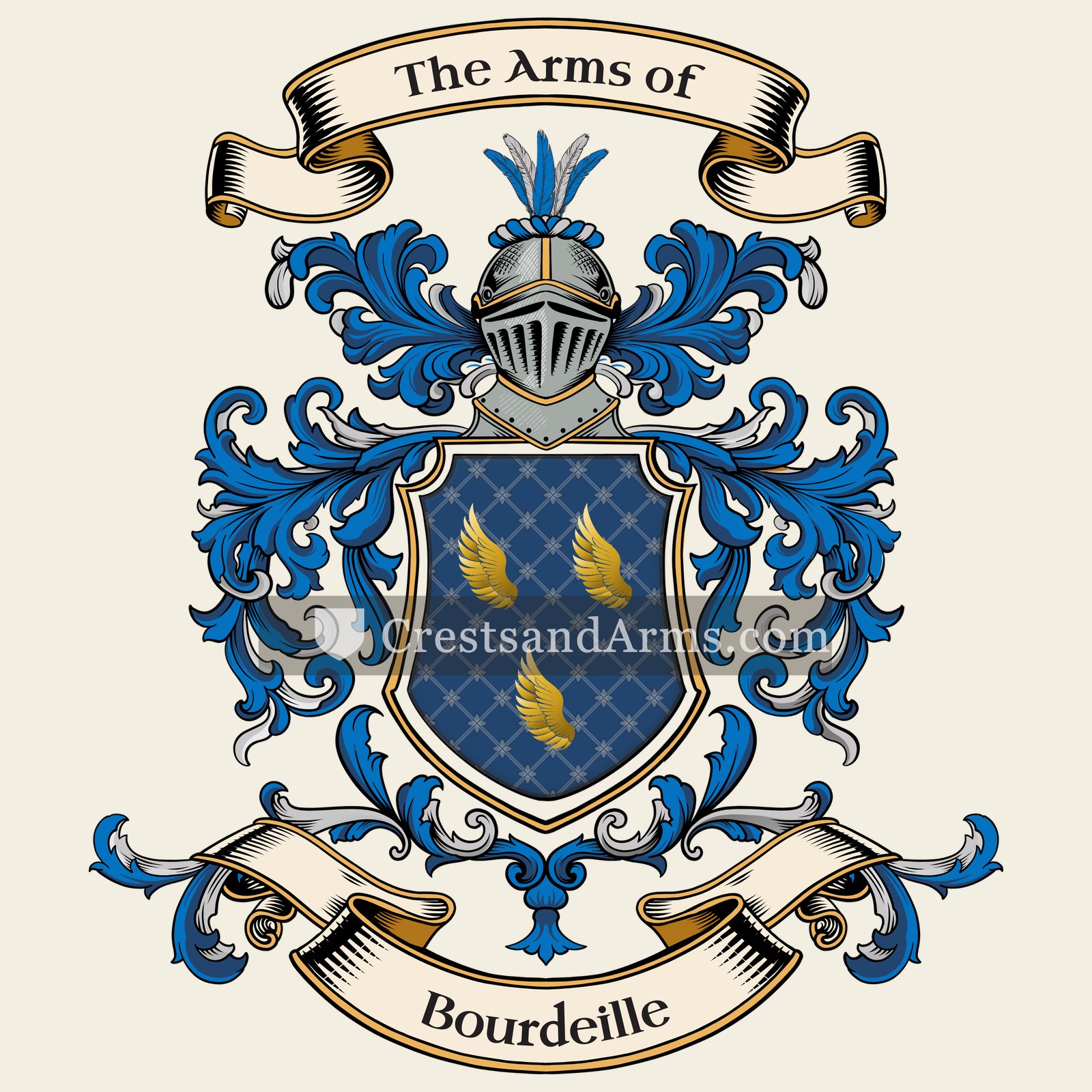
The Bourdeille arms were recorded in Auvergne, c. 1663.
Auvergne was mountain country in the middle of France, poor in money but thick with old families. Estates were small and held for a very long time, and long tenure counted for more than wealth when it came to arms.
This is where the arms were entered in the register. Families often moved to other parts of the country, so the same name can turn up in more than one region.
The body that granted and recorded arms in France in this period.
Louis XIV of France
Sovereign of the period
Louis XIV of France
1643–1715
Reigning in France when the Bourdeille arms are first recorded.
How Arms Worked in France
In France, a coat of arms was a mark of honor that passed down through the male line to all legitimate descendants. Families often used the same shield without changes to show their shared heritage. If a branch wanted to stand out, they could add a small mark to their shield to show their specific place in the family tree.
Granting authority
The Juge d'armes de France acted as the official authority that regulated and verified coats of arms across the country.
How they got arms
Families typically inherited their arms from ancestors, though they could also receive them through royal grants or by proving their noble status.
Where arms were recorded
Coats of arms were officially recorded in the Armorial Général de France, which began its main collection in the year 1696.
The family's standing
Recorded among the armigerous families of Auvergne.
Origin & History of the Bourdeille Family in France
The family name Bourdeille originates from the historic region of Périgord in southwestern France, taking its name from the picturesque town of Bourdeille located along the Dronne River. The family established deep roots in this area during the Middle Ages, becoming prominent members of the local nobility through their service to the crown and their management of ancestral lands. By the mid-seventeenth century, the family had expanded their reach into the Auvergne region, where records confirm their presence by 1663. This migration was common for noble families of the era who sought to increase their influence and administrative responsibilities in different parts of the kingdom. Over the centuries, the Bourdeille name became synonymous with the history of the French aristocracy, as various family members served as soldiers, writers, and court officials who helped shape the cultural and political life of their time.
Bourdeille Meaning & Related Branches
Root word
Bord
A border, edge, or boundary of a piece of land.
This name
BourdeilleRefers to someone who lived near the edge of a settlement or field.
also spelled
Bourdeil
Bourdeylle
Burday
Burdeille
Documented Sources
J. B. Rietstap, Armorial Général, Gouda: G. B. van Goor Zonen, 1884–87
Brantôme, Pierre de Bourdeille, Mémoires de messire Pierre de Bourdeille, seigneur de Brantôme, 1665
Archives départementales de la Dordogne, Fonds de la famille de Bourdeille, Series E
Archives départementales du Puy-de-Dôme, Registres paroissiaux et état civil de l'Auvergne, Series E
Digital archive packCoat of arms PNG, gold border print PDF, vector SVG and the certificate of authenticity. Sent to your email in minutes.


 wingSwiftness, and protection under a raised wing
 wingSwiftness, and protection under a raised wing