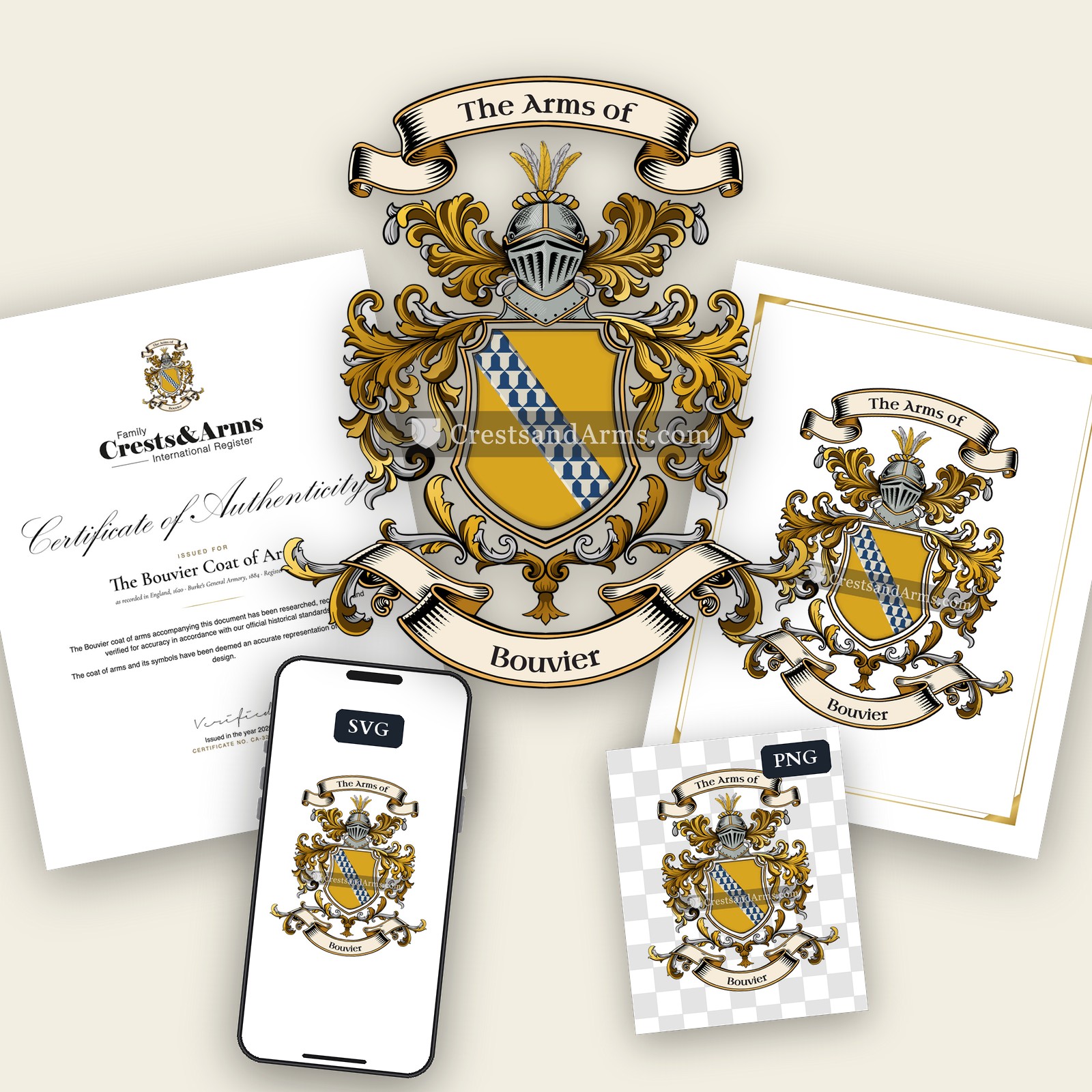
A record of documented arms, meaning and origin, researched for the Bouvier family lines. Documented in 3 countries.
Reg. 3286 · French, A–C
Coat of Arms & Family Crest Details
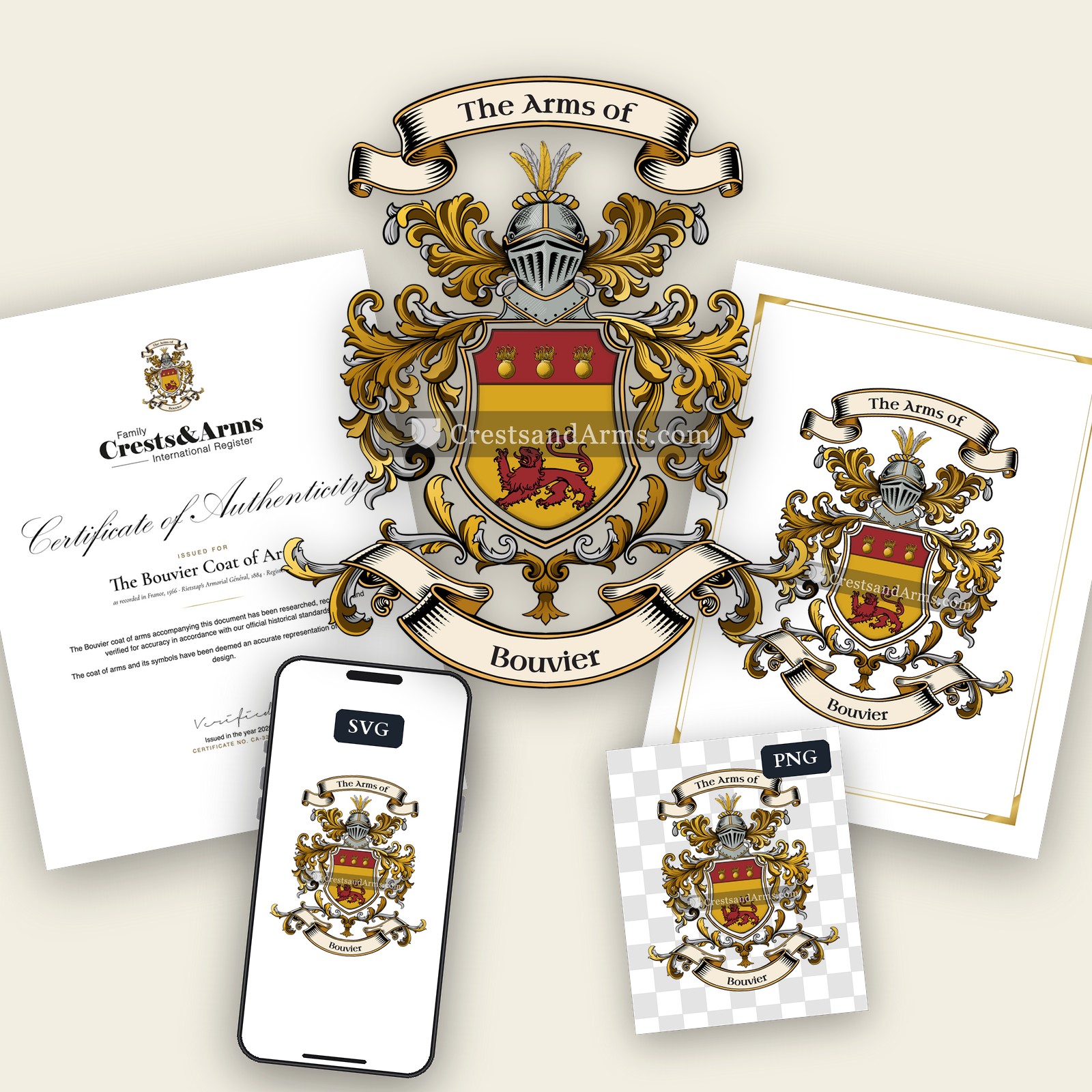
Symbols on this shield
chiefAuthority, wisdom and dominion
lionCourage, strength and royalty
bombOne who has faced a great siege
Colours
Gold (Or)Means: Generosity
Red (Gules)Means: Military strength
Historical info
Source
J. B. Rietstap, Armorial Général, Gouda: G. B. van Goor Zonen, 1884–87
Blazon (the actual original written record)
“D'or au léopard de gu., allumé et arm. d'azur; au chef du même, ch. de trois grenades d'or [Une branche obtint le 9 déc. 1627 l'autorisation de prendre le nom de Bouvier de Tervenus et de remplacer les trois grenades du chef par trois étoiles d'or.]”
LorraineLorraine, c. 1566
Digital archive packCoat of arms PNG, gold border print PDF, vector SVG and the certificate of authenticity. Sent to your email in minutes.
Map of France showing where the Bouvier arms are recorded
The Bouvier arms were recorded in Lorraine, c. 1566.
Lorraine sat on the border between France and the German lands, and border country bred soldiers. Families here held small estates and served in arms, and a fighting man was exactly the sort who carried a shield of his own.
This is where the arms were entered in the register. Families often moved to other parts of the country, so the same name can turn up in more than one region.
The body that granted and recorded arms in France in this period.
Charles IX of France
Sovereign of the period
Charles IX of France
1560–1574
Reigning in France when the Bouvier arms are first recorded.
How Arms Worked in France
In France, a coat of arms was a mark of honor that passed down through the male line to all legitimate descendants. Families often used the same shield without changes to show their shared heritage. If a branch wanted to stand out, they could add a small mark to their shield to show their specific place in the family tree.
Granting authority
The Juge d'armes de France acted as the official authority that regulated and verified coats of arms across the country.
How they got arms
Families typically inherited their arms from ancestors, though they could also receive them through royal grants or by proving their noble status.
Where arms were recorded
Coats of arms were officially recorded in the Armorial Général de France, which began its main collection in the year 1696.
The family's standing
Recorded among the armigerous families of Lorraine.
Origin & History of the Bouvier Family in France
The surname Bouvier is a classic occupational name that originated in medieval France, derived from the Old French word "bouvier," which means a cowherd or a man who tends to oxen. Because cattle were essential to the agricultural economy of the time, families carrying this name were often found in rural communities where farming was the primary way of life. By the mid-16th century, the family established a notable presence in the Lorraine region, a territory known for its complex history and its position along the border of the Holy Roman Empire. Records from 1566 confirm that members of the Bouvier family were active in this area during a time of significant religious and political transition. As the family grew, they integrated into the local social fabric of Lorraine, moving from simple agricultural duties to various roles within the village structure. This evolution from a descriptive job title to a permanent family name reflects the broader historical trend of how surnames became fixed in French society during the late Middle Ages and the Renaissance.
Coat of Arms & Family Crest Details
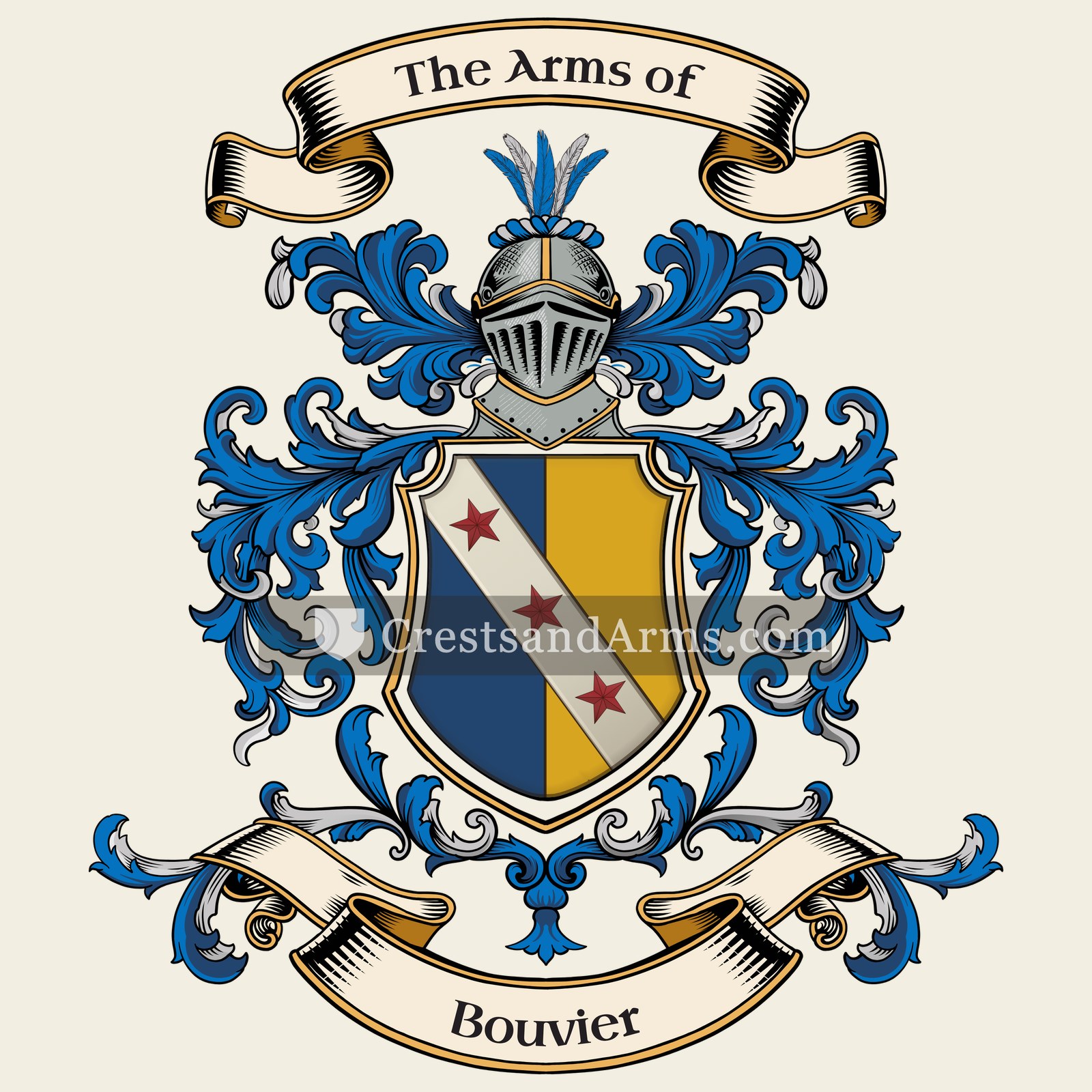
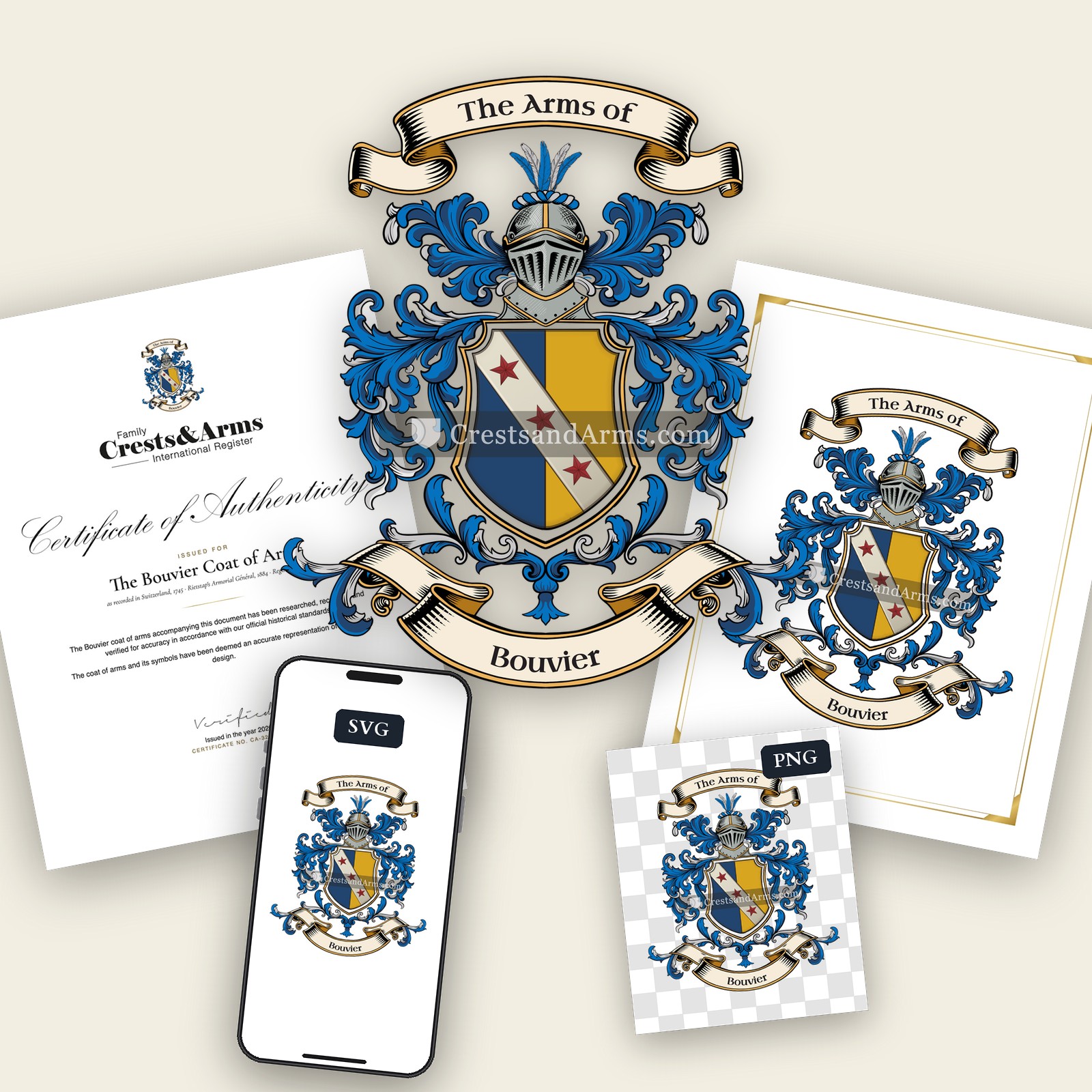
Symbols on this shield
bendDefence, and the scarf of a commander
mulletThe third son, and a divine quality from above
Colours
Blue (Azure)Means: Loyalty and truth
Gold (Or)Means: Generosity
Silver (Argent)Means: Peace and sincerity
Red (Gules)Means: Military strength
Historical info
Source
J. B. Rietstap, Armorial Général, Gouda: G. B. van Goor Zonen, 1884–87
Blazon (the actual original written record)
“d'azur et d'or, de quatre pièces: à la bande d'arg., br. sur le tout et ch. de trois étoiles (5) de gu.”
Switzerlandc. 1745
Digital archive packCoat of arms PNG, gold border print PDF, vector SVG and the certificate of authenticity. Sent to your email in minutes.
Map of Switzerland showing where the Bouvier arms are recorded
The Bouvier arms were recorded in Switzerland, c. 1745.
Arms such as these were typically recorded in Bern.
Bern was the largest of the Swiss cantons and ran itself, with its own council and its own courts. Its governing families held office for generations, and office of that kind carried a shield with it.
This is where the arms were entered in the register. Families often moved to other parts of the country, so the same name can turn up in more than one region.
The body that granted and recorded arms in Switzerland in this period.
How Arms Worked in Switzerland
In Switzerland, coats of arms were not restricted to the nobility and were often adopted by common citizens and families. These symbols were passed down through generations to show family identity. When branches of a family grew, they often changed small details of the design to distinguish their own line from the original group.
Granting authority
Cantonal and civic authorities managed the use of coats of arms within their specific regions and local jurisdictions.
How they got arms
Families typically assumed their own coats of arms based on local custom rather than receiving them from a central monarch.
Where arms were recorded
Arms were recorded in various cantonal and civic registers starting from the fourteenth century throughout the Swiss region.
The family's standing
Recorded among the armigerous families of Switzerland.
Origin & History of the Bouvier Family in Switzerland
The family name Bouvier originates from the Old French word for a cowherd, reflecting a deep historical connection to rural life and animal husbandry. By the time the family was firmly established in the Swiss canton of Bern in 1745, the name had already become a marker of a lineage deeply integrated into the local agricultural and civic structures of the region. During this period, the Swiss cantons functioned as a collection of semi-independent states where families often held specific roles within their local parishes and village councils. The Bouviers in Bern were part of a society that valued land management and community stability, which allowed them to maintain a consistent presence across generations. As the family grew, they transitioned from their traditional roots in cattle farming into various roles within the growing urban and administrative centers of Switzerland. This evolution from rural workers to established citizens illustrates the broader pattern of social mobility and regional integration that defined many Swiss families during the eighteenth century.
Coat of Arms & Family Crest Details
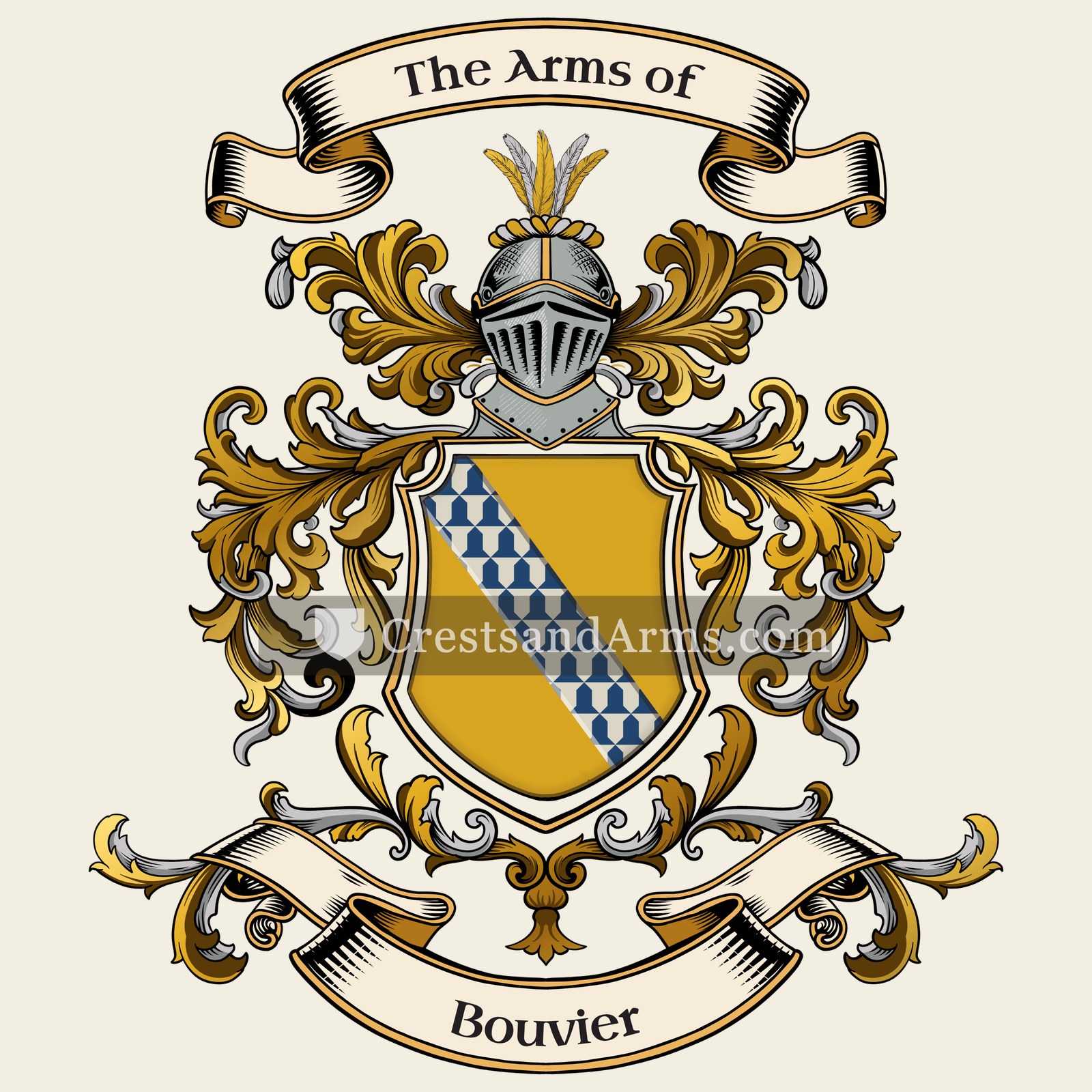
Symbols on this shield
bendDefence, and the scarf of a commander
Colours
Gold (Or)Means: Generosity
Red (Gules)Means: Military strength
Historical info
Source
Sir Bernard Burke, The General Armory of England, Scotland, Ireland and Wales, London: Harrison & Sons, 1884
Blazon (the actual original written record)
“Or, a bend vairé of the first and purp. betw. two cottises gu”
Englandc. 1620
Digital archive packCoat of arms PNG, gold border print PDF, vector SVG and the certificate of authenticity. Sent to your email in minutes.
Map of England showing where the Bouvier arms are recorded
The Bouvier arms were recorded in England, c. 1620.
Arms such as these were typically recorded in York.
Yorkshire is the largest of the English counties, and it held more gentry families than any other. Land there was split among a great many households rather than a few, so a great many of them carried arms.
This is where the arms were entered in the register. Families often moved to other parts of the country, so the same name can turn up in more than one region.
The body that granted and recorded arms in England in this period.
James VI and I
Sovereign of the period
James VI and I
1603–1625
Reigning in France when the Bouvier arms are first recorded.
How Arms Worked in England
English heraldry allowed arms to be shared by all legitimate descendants of the original owner. These symbols were treated as personal property that moved through the generations to all children. While the eldest son kept the original design, other family members could use the same shield without needing to change it or register their own unique versions.
Granting authority
The College of Arms in London has regulated the use of coats of arms throughout England and Wales since 1484.
How they got arms
Families typically obtained their coats of arms through a formal grant from the Crown or by proving their ancient right to them.
Where arms were recorded
All official coats of arms are recorded in the registers kept at the College of Arms, which date back to the fifteenth century.
The family's standing
Recorded among the armigerous families of England.
Origin & History of the Bouvier Family in England
The surname Bouvier originates from the Old French word for a cowherd, reflecting the family’s deep historical roots in agriculture and livestock management. While the name is famously associated with French heritage, records confirm that members of the Bouvier family were established in the city of York by 1620. During this period, York was a significant northern hub for trade and craftsmanship, and families moving from the continent often integrated into the local merchant or artisan classes. These early settlers likely arrived in England seeking new economic opportunities or fleeing the religious and social instability common in parts of Europe during the seventeenth century. By settling in a major urban center like York, the Bouvier family became part of the diverse social fabric of the city, transitioning from their traditional pastoral origins into the evolving professional landscape of early modern England.
Bouvier Meaning & Related Branches
Root word
bovarius
Latin term referring to an ox or cattle herder.
This name
BouvierAn occupational surname for a person who worked as a cowherd or cattle farmer.
also spelled
Bouvyer
Bouvie
Bovyay
Buvier
Bovier
Documented Sources
J. B. Rietstap, Armorial Général, Gouda: G. B. van Goor Zonen, 1884–87
Dauzat, Albert, Dictionnaire étymologique des noms et prénoms de France, 1951
Archives départementales de Meurthe-et-Moselle, Série B: Cours et juridictions, 1566
Morlet, Marie-Thérèse, Dictionnaire étymologique des noms de famille, 1991
Digital archive packCoat of arms PNG, gold border print PDF, vector SVG and the certificate of authenticity. Sent to your email in minutes.


 chiefAuthority, wisdom and dominion
 lionCourage, strength and royalty
 bombOne who has faced a great siege
 chiefAuthority, wisdom and dominion
 lionCourage, strength and royalty
 bombOne who has faced a great siege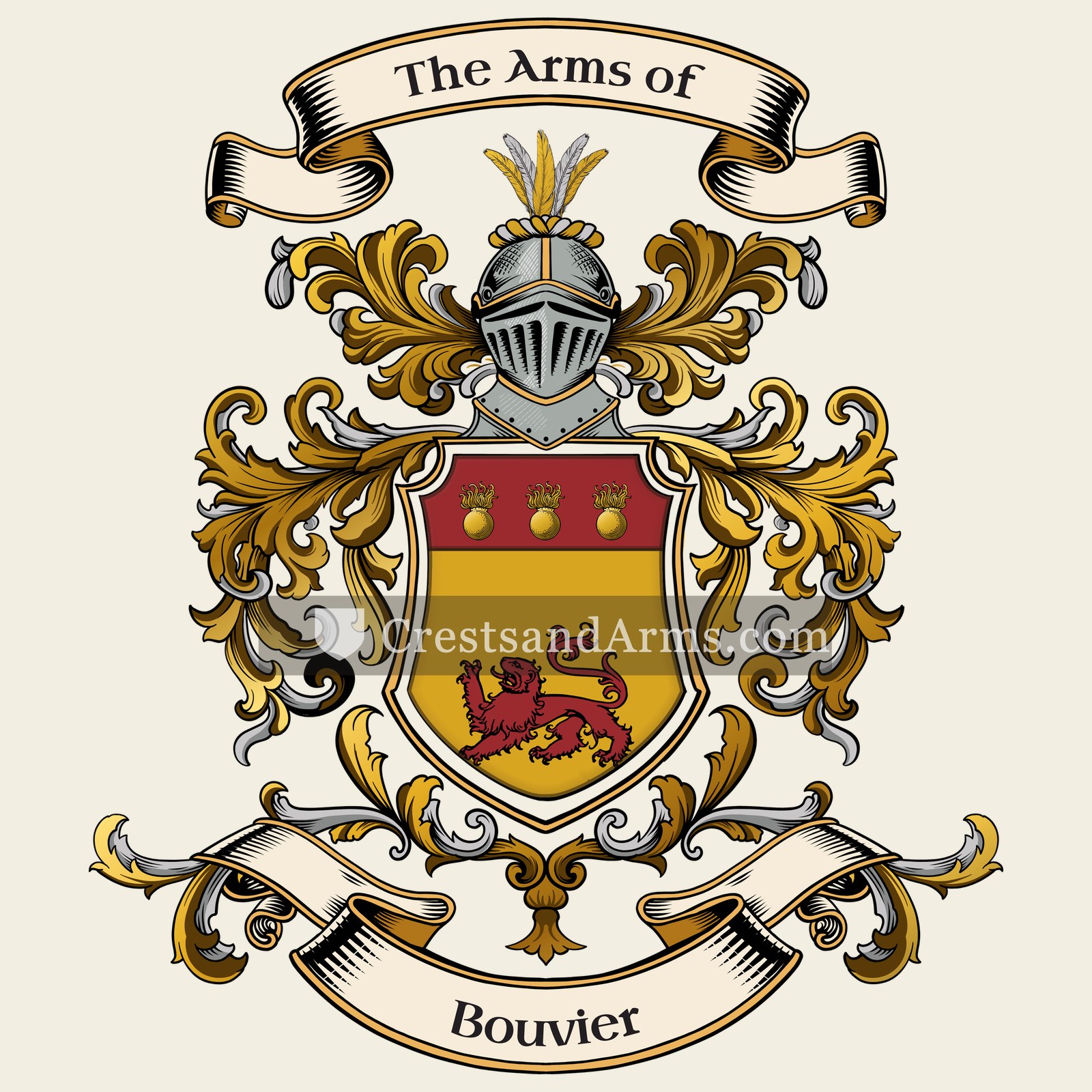


 bendDefence, and the scarf of a commander
 mulletThe third son, and a divine quality from above