Map of Netherlands showing where the Bouwman arms are recorded
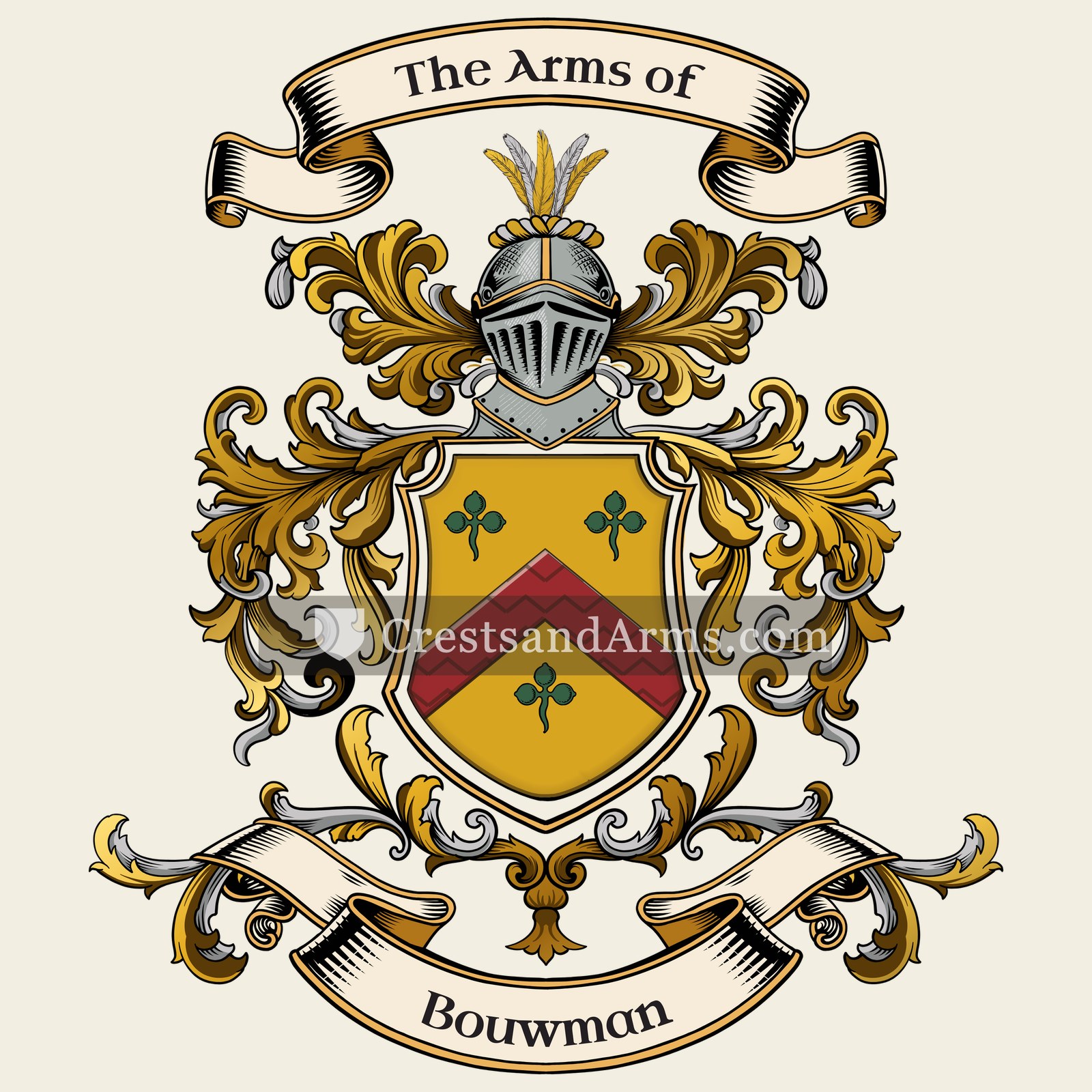
The Bouwman arms were recorded in Harlem, c. 1815.
This is where the arms were entered in the register. Families often moved to other parts of the country, so the same name can turn up in more than one region.
Region
Harlem
Town
Harlem
First recorded
1815
Granting Authority for the Bouwman Arms
Hoge Raad van Adel
Photograph made by me · CC BY-SA 3.0
The body that granted and recorded arms in Netherlands in this period.
William I of the Netherlands
Sovereign of the period
William I of the Netherlands
1815–1840
Reigning in Netherlands when the Bouwman arms are first recorded.
How Arms Worked in Netherlands
In the Netherlands, coats of arms were often used by noble families and those who held specific public offices. These arms were passed down through the generations to legitimate descendants. Younger branches of a family usually kept the original design without needing to add special marks. This system ensured that the family identity remained clear and consistent over many years.
Granting authority
The Hoge Raad van Adel is the official body that regulates and manages noble titles and coats of arms in the Netherlands.
How they got arms
Families typically obtained their coats of arms through official royal grants or by proving their long-standing historical use of the symbols.
Where arms were recorded
Coats of arms are officially recorded in the registers held by the Hoge Raad van Adel, which began its work in 1814.
The family's standing
Recorded among the armigerous families of Netherlands.
Origin & History of the Bouwman Family in Netherlands
The surname Bouwman is a classic occupational name that originated in the Low Countries, specifically within the Dutch-speaking regions of Europe. The name is derived from the Middle Dutch word "bouman," which translates directly to farmer or tiller of the soil. During the medieval period, surnames were often adopted to describe a person’s primary trade, and since agriculture was the backbone of the economy, this name became quite common among rural families. By the time the family was established in Harlem in 1815, the name had been passed down through generations as a proud link to their ancestral roots in land cultivation. As the family settled into the urban environment of Harlem, they carried this historical connection to the land with them, marking their transition from traditional farming life to the evolving social structure of the nineteenth century.
Bouwman Meaning & Related Branches
Root word
Bouwman
Derived from the Middle Dutch word bouwen meaning to cultivate or build.
This name
BouwmanAn occupational surname referring to a farmer, peasant, or someone who cultivates land.
also spelled
Bouwmans
Bowman
Bouwmann
Related arms
Bowmanvariant spelling
Documented Sources
J. B. Rietstap, Armorial Général, Gouda: G. B. van Goor Zonen, 1884–87
Debrabandere, Frans. Woordenboek van de familienamen in België en Noord-Frankrijk. 2003
Meertens, P.J. De betekenis van de Nederlandse familienamen. 1995


 chevronProtection, and faithful service completed
 trefoilPerpetuity, and the Trinity
 chevronProtection, and faithful service completed
 trefoilPerpetuity, and the Trinity