Map of Italy showing where the Bove arms are recorded
The Bove arms were recorded in Trévise, c. 1775.
This is where the arms were entered in the register. Families often moved to other parts of the country, so the same name can turn up in more than one region.
The body that granted and recorded arms in Italy in this period.
Alvise Giovanni Mocenigo
Sovereign of the period
Alvise Giovanni Mocenigo
1763–1778
Reigning in Italy when the Bove arms are first recorded.
How Arms Worked in Italy
In the Italian states, coats of arms were often used by noble families to show their status and history. These symbols were passed down through the generations to all legitimate male descendants. Younger branches of a family usually kept the original design but sometimes added small changes to distinguish their specific line from the main branch.
Granting authority
Various local rulers and city governments controlled the use of coats of arms across the different Italian states.
How they got arms
Families often assumed their own arms or received them as official grants from local lords, popes, or city councils.
Where arms were recorded
Arms were recorded in local city archives or private family books rather than in one single national register.
The family's standing
Recorded among the armigerous families of Italy.
Origin & History of the Bove Family in Italy
The family name Bove finds its roots in the linguistic landscape of medieval Italy, where it likely originated as a descriptive nickname. In the Italian language, the word *bove* refers to an ox, a term often used in historical records to denote someone who possessed great physical strength or a steady, hardworking nature. By the time the family established a documented presence in the city of Treviso in 1775, the name had already been integrated into the social fabric of the Veneto region for generations. During this era, families in northern Italy were often tied to specific trades or land management, and the Bove name frequently appeared in local administrative registers that tracked property ownership and civic duties. As the family grew within Treviso, they became part of the local urban identity, contributing to the agricultural and commercial life that defined the region during the late eighteenth century.
Coat of Arms & Family Crest Details
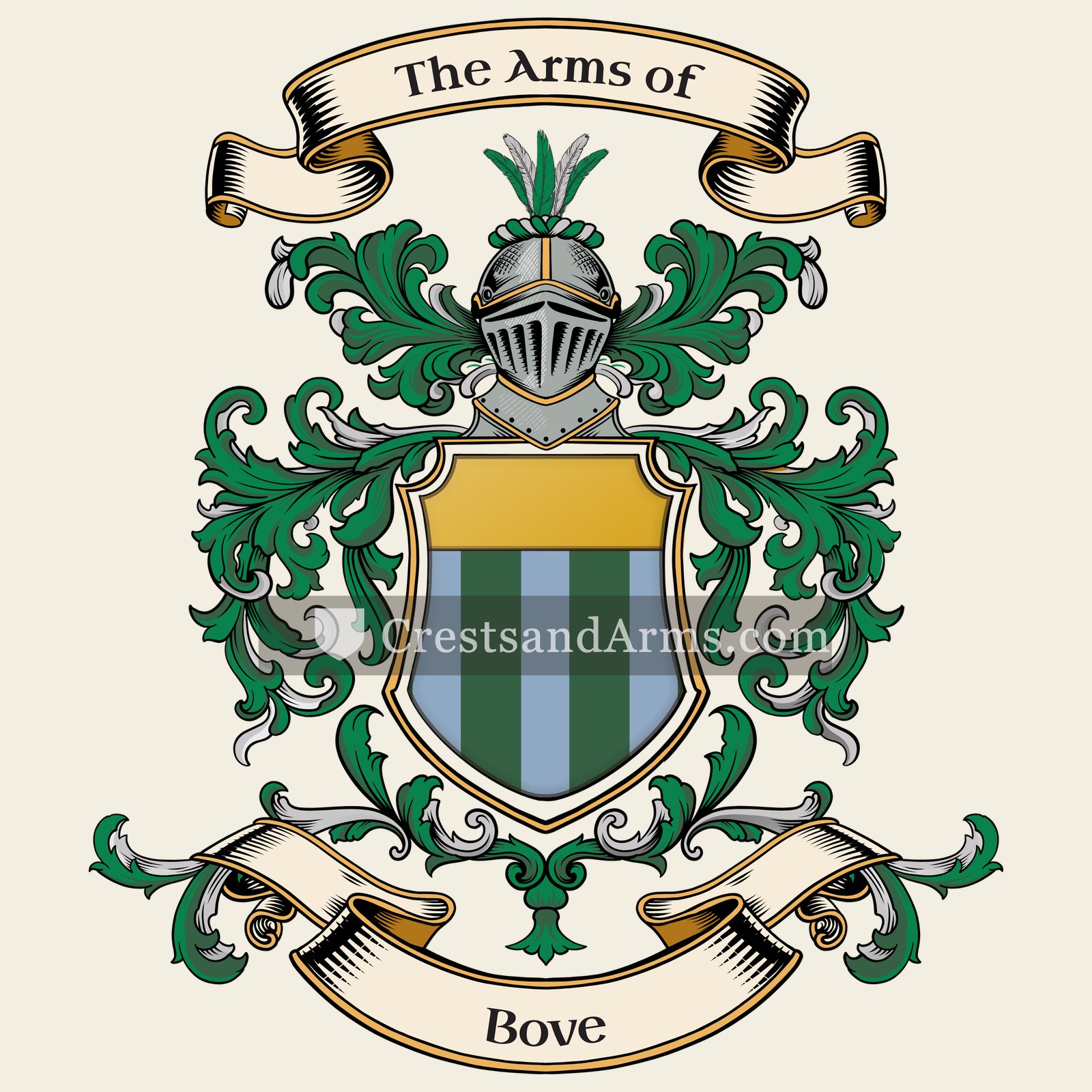
Symbols on this shield
paleMilitary strength, and a fortified defence
vairProtection, and the winter fur
chiefAuthority, wisdom and dominion
Colours
Green (Vert)Means: Hope
VairMeans: Protection
Gold (Or)Means: Generosity
Historical info
Source
J. B. Rietstap, Armorial Général, Gouda: G. B. van Goor Zonen, 1884–87
Blazon (the actual original written record)
“De sin. à trois pals de vair; au chef d'or.”
ChampagneChampagne, c. 1663
Digital archive packCoat of arms PNG, gold border print PDF, vector SVG and the certificate of authenticity. Sent to your email in minutes.
Map of France showing where the Bove arms are recorded
The Bove arms were recorded in Champagne, c. 1663.
Champagne made its money at its great trade fairs, where merchants from across Europe met. Wealth of that kind bought land, and land brought arms, so the region carries a lot of names.
This is where the arms were entered in the register. Families often moved to other parts of the country, so the same name can turn up in more than one region.
The body that granted and recorded arms in France in this period.
Louis XIV of France
Sovereign of the period
Louis XIV of France
1643–1715
Reigning in Italy when the Bove arms are first recorded.
How Arms Worked in France
In France, a coat of arms was a mark of honor that passed down through the male line to all legitimate descendants. Families often used the same shield without changes to show their shared heritage. If a branch wanted to stand out, they could add a small mark to their shield to show their specific place in the family tree.
Granting authority
The Juge d'armes de France acted as the official authority that regulated and verified coats of arms across the country.
How they got arms
Families typically inherited their arms from ancestors, though they could also receive them through royal grants or by proving their noble status.
Where arms were recorded
Coats of arms were officially recorded in the Armorial Général de France, which began its main collection in the year 1696.
The family's standing
Recorded among the armigerous families of Champagne.
Origin & History of the Bove Family in France
The family name Bove has deep roots in the historical province of Champagne, where records confirm members of the family were living as early as 1663. During this period, the Champagne region was a vital center for agriculture and trade, and families like the Boves were often tied to the land or local craft guilds. The name itself is thought to be derived from the Latin word bos, which means ox, suggesting that the earliest ancestors may have been farmers or cattle herders. As the family established themselves in the region, they became part of the social fabric of rural French life, navigating the challenges of the seventeenth century. Over time, the family name spread from these small village communities, reflecting the broader movement of people across the French countryside during the transition into the modern era.
Bove Meaning & Related Branches
Root word
Bos
Latin term for an ox or a head of cattle.
This name
BoveAn occupational or descriptive surname referring to a herdsman or a person with ox-like traits.
also spelled
Bovet
Bovée
Bovay
Documented Sources
J. B. Rietstap, Armorial Général, Gouda: G. B. van Goor Zonen, 1884–87
Caffarelli, Enzo and Marcato, Carla. I cognomi d'Italia: Dizionario storico ed etimologico. 2008
De Felice, Emidio. Dizionario dei cognomi italiani. 1978
Archivio di Stato di Treviso, Stato civile della Restaurazione
Digital archive packCoat of arms PNG, gold border print PDF, vector SVG and the certificate of authenticity. Sent to your email in minutes.


 bullValour and generosity
 mulletThe third son, and a divine quality from above
 bullValour and generosity
 mulletThe third son, and a divine quality from above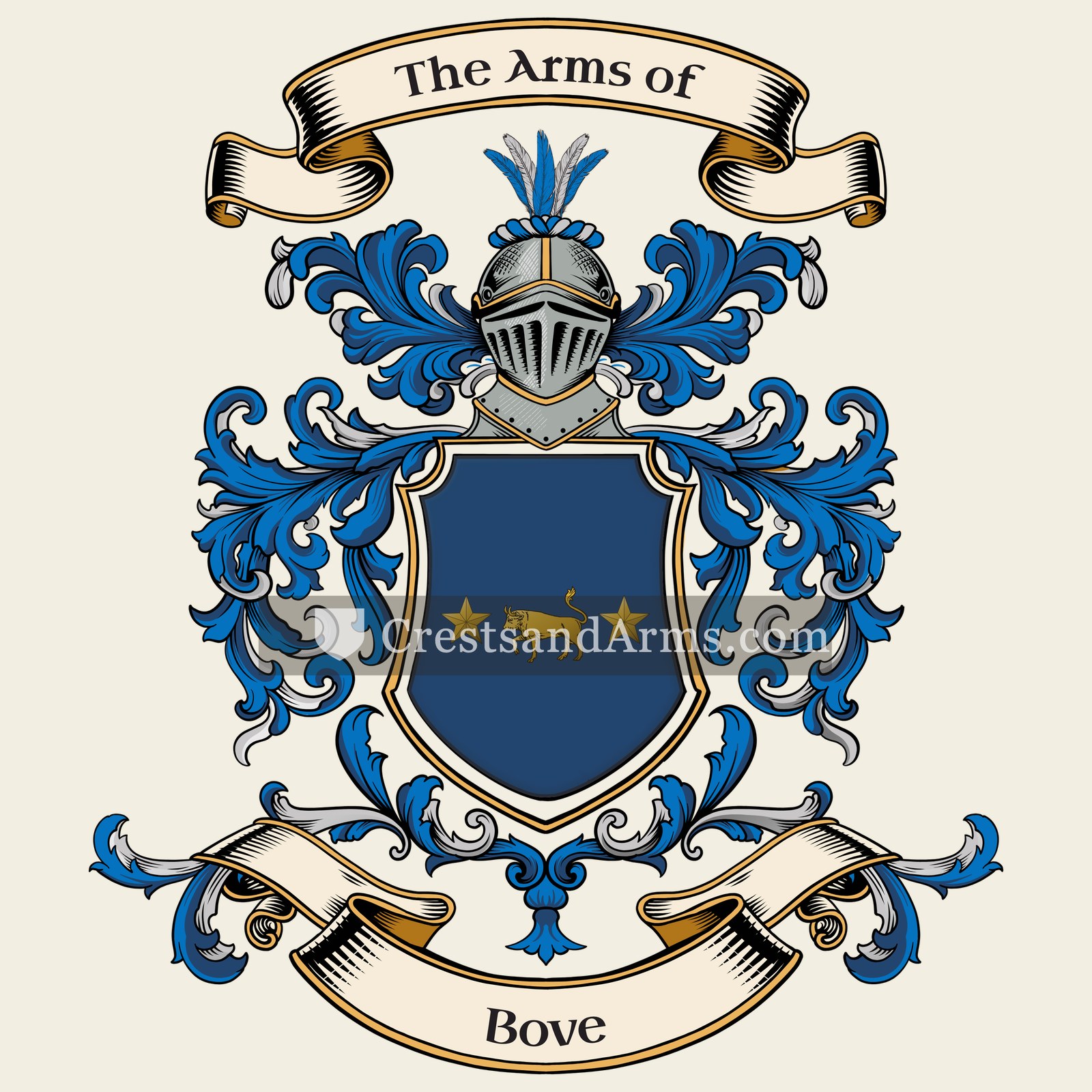


 paleMilitary strength, and a fortified defence
 chiefAuthority, wisdom and dominion