Map of France showing where the Bovet arms are recorded
The Bovet arms were recorded in Dauphine, c. 1663.
Dauphine lay in the mountains of south-eastern France, a country of small estates and scattered valleys. Its gentry were many and mostly modest, and even a small landholding was enough to justify arms.
This is where the arms were entered in the register. Families often moved to other parts of the country, so the same name can turn up in more than one region.
The body that granted and recorded arms in France in this period.
Louis XIV of France
Sovereign of the period
Louis XIV of France
1643–1715
Reigning in France when the Bovet arms are first recorded.
How Arms Worked in France
In France, a coat of arms was a mark of honor that passed down through the male line to all legitimate descendants. Families often used the same shield without changes to show their shared heritage. If a branch wanted to stand out, they could add a small mark to their shield to show their specific place in the family tree.
Granting authority
The Juge d'armes de France acted as the official authority that regulated and verified coats of arms across the country.
How they got arms
Families typically inherited their arms from ancestors, though they could also receive them through royal grants or by proving their noble status.
Where arms were recorded
Coats of arms were officially recorded in the Armorial Général de France, which began its main collection in the year 1696.
The family's standing
Recorded among the armigerous families of Dauphine.
Origin & History of the Bovet Family in France
The Bovet family name finds its historical roots in the rugged landscape of the Dauphiné region in southeastern France. By the year 1663, records confirm that members of the family were well-established in this mountainous area, which served as a gateway between the French kingdom and the Italian states. The name itself is likely derived from the Old French word "bove," which referred to a stable or an ox stall, suggesting that the family’s earliest ancestors were likely involved in agriculture or livestock management. As inhabitants of the Dauphiné, the Bovets lived in a province known for its unique legal customs and its role as a frontier territory. This geographic position often meant that families in the region had to be resilient and adaptable to the changing political climate of the seventeenth century. Over time, the family transitioned from these rural beginnings into various roles within the local community, helping to shape the social fabric of the province during the transition into the modern era.
Coat of Arms & Family Crest Details
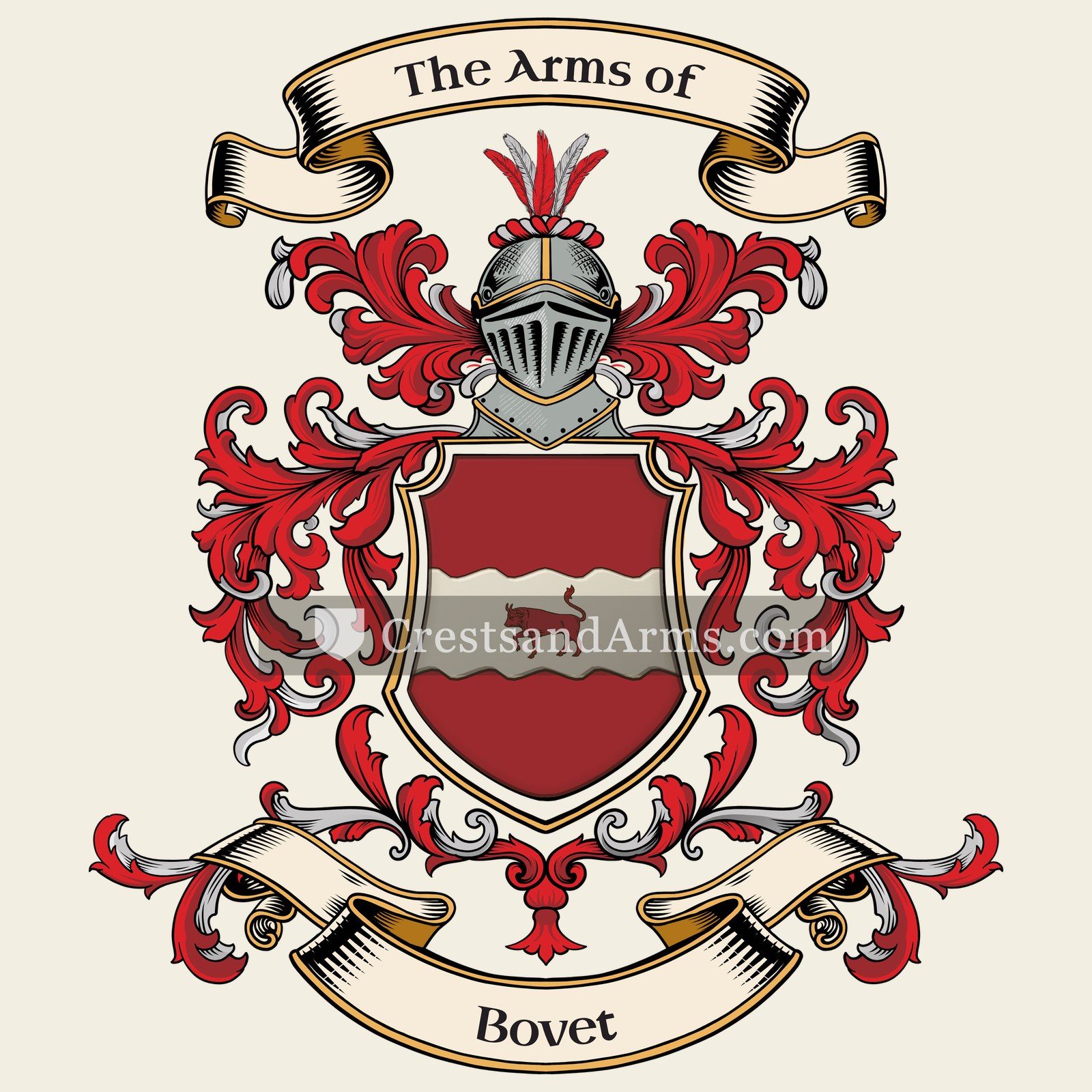
Symbols on this shield
fessThe military belt, and readiness to serve
bullValour and generosity
Colours
Red (Gules)Means: Military strength
Silver (Argent)Means: Peace and sincerity
Historical info
Source
J. B. Rietstap, Armorial Général, Gouda: G. B. van Goor Zonen, 1884–87
Blazon (the actual original written record)
“De gu. à la fasce ondée d'arg., soutenant un boeuf pass. du même.”
SwitzerlandNeufchâtel, c. 1745
Digital archive packCoat of arms PNG, gold border print PDF, vector SVG and the certificate of authenticity. Sent to your email in minutes.
Map of Switzerland showing where the Bovet arms are recorded
The Bovet arms were recorded in Neufchâtel, c. 1745.
This is where the arms were entered in the register. Families often moved to other parts of the country, so the same name can turn up in more than one region.
The body that granted and recorded arms in Switzerland in this period.
How Arms Worked in Switzerland
In Switzerland, coats of arms were not restricted to the nobility and were often adopted by common citizens and families. These symbols were passed down through generations to show family identity. When branches of a family grew, they often changed small details of the design to distinguish their own line from the original group.
Granting authority
Cantonal and civic authorities managed the use of coats of arms within their specific regions and local jurisdictions.
How they got arms
Families typically assumed their own coats of arms based on local custom rather than receiving them from a central monarch.
Where arms were recorded
Arms were recorded in various cantonal and civic registers starting from the fourteenth century throughout the Swiss region.
The family's standing
Recorded among the armigerous families of Switzerland.
Origin & History of the Bovet Family in Switzerland
The family name Bovet has deep roots in the Swiss region of Neuchâtel, where members of the family were well established by the year 1745. The name is believed to originate from the Old French word "bovet," which was a term used to describe a young ox or a small bull. In the agricultural society of the Jura Mountains, such names were often given to families who worked as farmers or cattle herders. By the mid-18th century, the Bovet family had become integrated into the local community, participating in the trade and craftsmanship that defined the Neuchâtel region. Their presence in official records from this era suggests they were active members of the local population who contributed to the development of the area through their work and social ties. Over time, the family name became a permanent fixture in the history of the canton, reflecting the broader patterns of settlement and labor in the Swiss landscape.
Bovet Meaning & Related Branches
Root word
bove
Old French term for an ox or a bull.
This name
BovetA topographic name for someone who lived near a stable or pasture.
also spelled
Bove
Bovay
Bovett
Related arms
Bovevariant spelling
Documented Sources
J. B. Rietstap, Armorial Général, Gouda: G. B. van Goor Zonen, 1884–87
Borel d'Hauterive, André-François-Joseph, Annuaire de la noblesse de France et des maisons souveraines de l'Europe, 1855
Chorier, Nicolas, Histoire générale de Dauphiné, 1661
Moréri, Louis, Le Grand Dictionnaire historique, ou le mélange curieux de l'histoire sacrée et profane, 1759
Archives départementales de l'Isère, Série E (Familles et seigneuries)
Archives nationales de France, Série G (Clergé séculier et paroisses)
Digital archive packCoat of arms PNG, gold border print PDF, vector SVG and the certificate of authenticity. Sent to your email in minutes.


 bullValour and generosity
 bullValour and generosity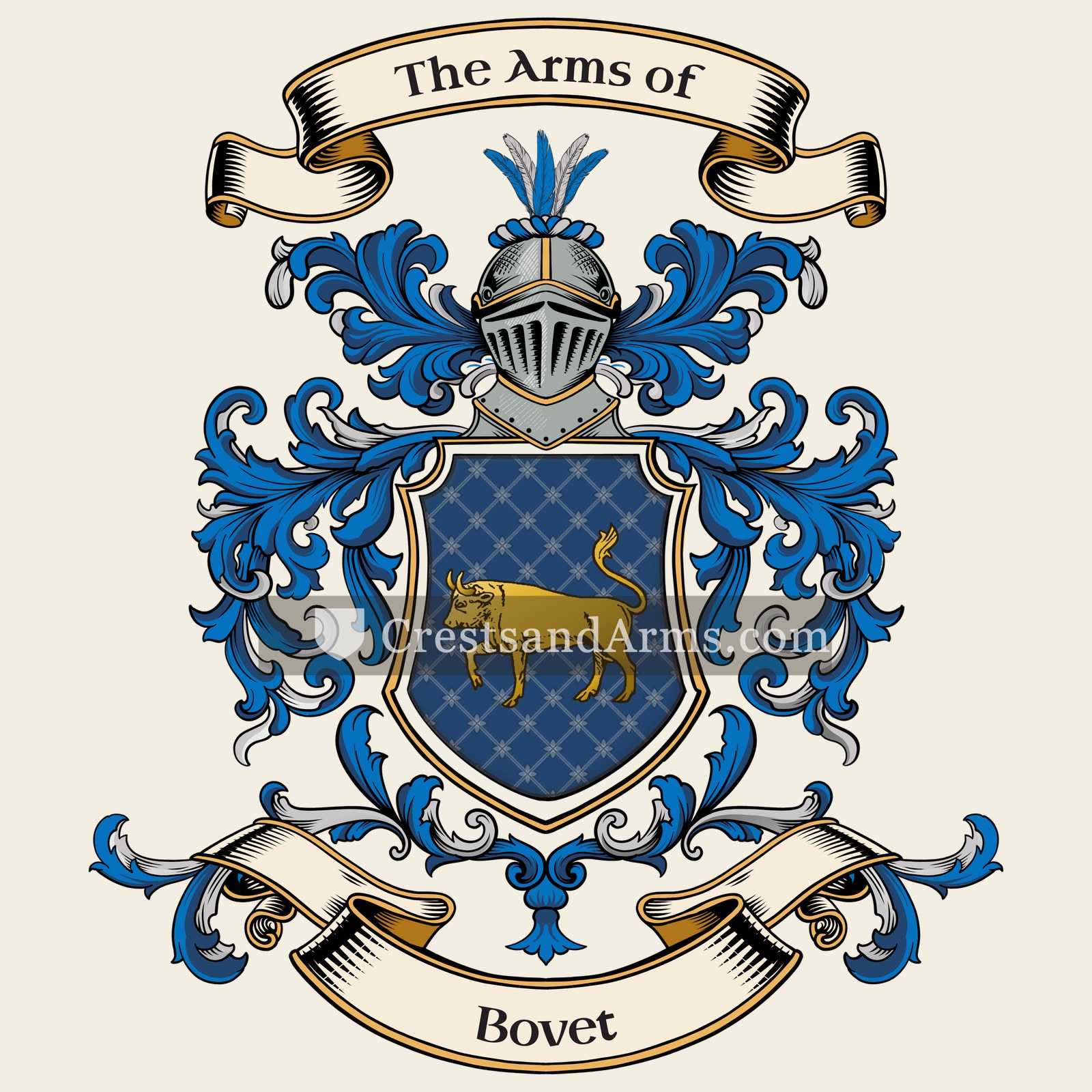


 fessThe military belt, and readiness to serve