Map of England showing where the Bowen arms are recorded
The Bowen arms were recorded in Oxfordshire, c. 1620.
This is where the arms were entered in the register. Families often moved to other parts of the country, so the same name can turn up in more than one region.
The body that granted and recorded arms in England in this period.
James VI and I
Sovereign of the period
James VI and I
1603–1625
Reigning in England when the Bowen arms are first recorded.
How Arms Worked in England
English heraldry allowed arms to be shared by all legitimate descendants of the original owner. These symbols were treated as personal property that moved through the generations to all children. While the eldest son kept the original design, other family members could use the same shield without needing to change it or register their own unique versions.
Granting authority
The College of Arms in London has regulated the use of coats of arms throughout England and Wales since 1484.
How they got arms
Families typically obtained their coats of arms through a formal grant from the Crown or by proving their ancient right to them.
Where arms were recorded
All official coats of arms are recorded in the registers kept at the College of Arms, which date back to the fifteenth century.
The family's standing
Recorded among the armigerous families of Oxfordshire.
Origin & History of the Bowen Family in England
The surname Bowen has deep roots in the British Isles, primarily originating as a patronymic name derived from the Welsh phrase "ap Owain," which translates to "son of Owain." While the name is strongly associated with the rugged landscapes of Wales, families bearing the name began to migrate eastward into England as early as the medieval period. By the year 1620, historical records confirm that members of the Bowen family had established a notable presence in Oxfordshire. During this era, families often moved to follow new economic opportunities or to seek land in the fertile English countryside. As these individuals settled into local communities, the spelling of their name gradually transitioned from its Welsh origins to the standardized English form we recognize today. This migration reflects a broader trend of families moving across regional borders, blending their cultural heritage with the evolving social structures of seventeenth-century England.
Meaning of the Bowen family crest colors & symbols
Symbols on this shield
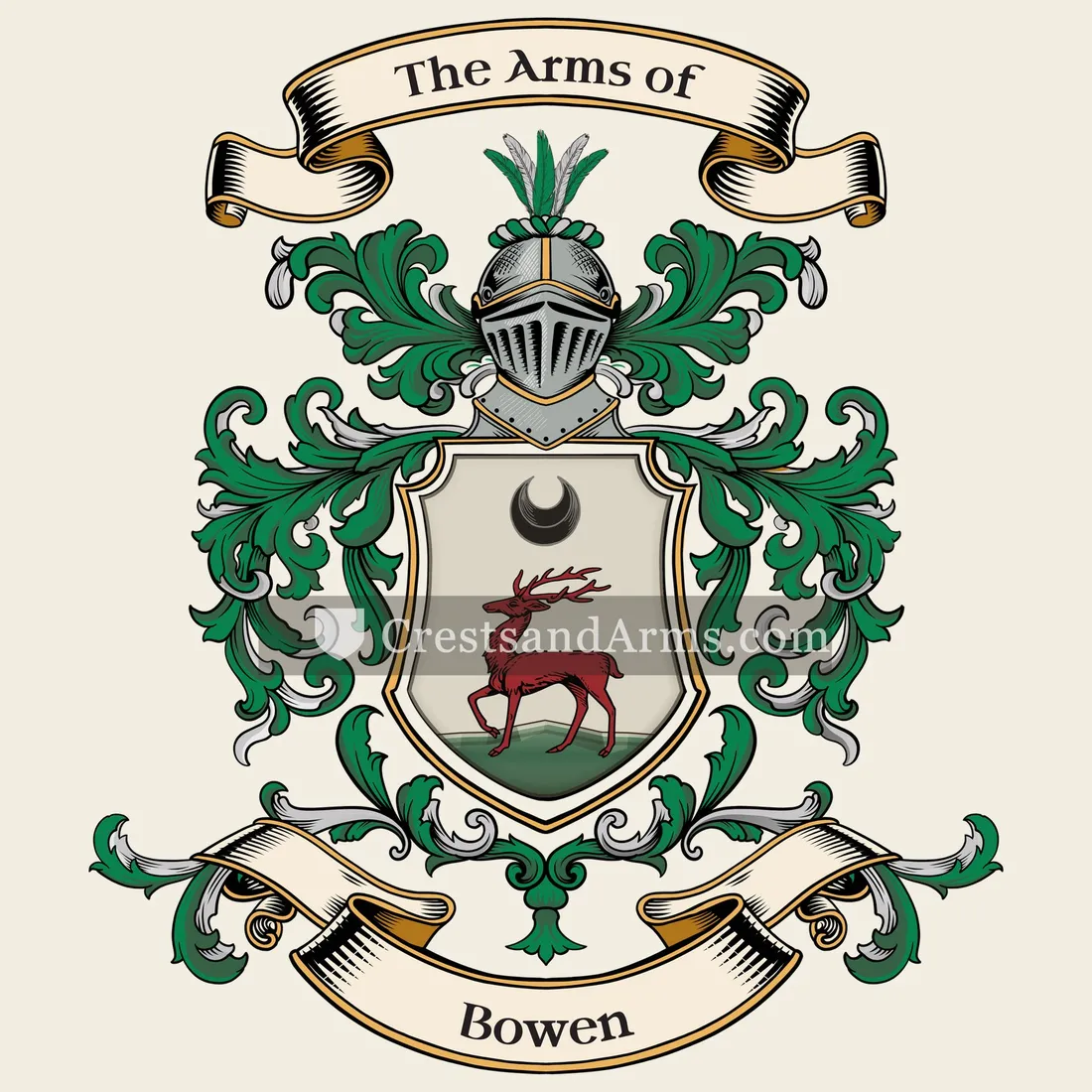
mountThe ground held, and steadfastness upon it
stagPeace and harmony, and one who will not fight unprovoked
crescentHonour by the sovereign, and the second son
Colours
Silver (Argent)Means: Peace and sincerity
Green (Vert)Means: Hope
Red (Gules)Means: Military strength
Black (Sable)Means: Constancy
Historical info
Source
Sir Bernard Burke, The General Armory of England, Scotland, Ireland and Wales, London: Harrison & Sons, 1884
Blazon (the actual original written record)
“Ar. on a mount vert a stag lodged gu. attired and unguled or, in the mouth a trefoil slipped of the second, in dexter chief a crescent sa”
MeathJohn Bowen · Meath, c. 1645
Digital archive packCoat of arms PNG, gold border print PDF, vector SVG and the certificate of authenticity. Sent to your email in minutes.
Map of Ireland showing where the Bowen arms are recorded
The Bowen arms were recorded in Meath, c. 1645.
Meath was the best farmland in Ireland and the old seat of its high kings. Norman families took it early and held it, and land of that quality kept the same families on it for centuries.
This is where the arms were entered in the register. Families often moved to other parts of the country, so the same name can turn up in more than one region.
The body that granted and recorded arms in Ireland in this period.
Charles I of England
Sovereign of the period
Charles I of England
1625–1649
Reigning in England when the Bowen arms are first recorded.
How Arms Worked in Ireland
The Ulster King of Arms granted coats of arms to individuals who proved their social standing and good character. These symbols were typically inherited by all legitimate descendants of the original holder. If a family branch wanted a unique look, they could apply for a specific change to their design through the office to ensure their identity remained distinct.
Granting authority
The Ulster King of Arms acted as the official body that regulated and issued all coats of arms throughout Ireland.
How they got arms
Families obtained their arms through formal grants issued by the office after proving their eligibility and paying the required fees.
Where arms were recorded
All official grants were recorded in the registers held by the Ulster King of Arms starting from the year 1552.
The family's standing
Recorded among the armigerous families of Meath.
Origin & History of the Bowen Family in Ireland
The history of the Bowen family in Ireland is deeply connected to the political landscape of the seventeenth century. While the name itself has Welsh roots, the family established a notable presence in County Meath by 1645. During this period, Ireland was undergoing significant upheaval due to the Irish Confederate Wars. The Bowens were part of a group of families who moved into the region during a time of shifting land ownership and colonial settlement. By securing a foothold in Meath, they became part of the local landed class that navigated the complex social and legal changes of the era. Their early records in the mid-1600s reflect the broader movement of families who settled in the Irish midlands and integrated into the administrative life of the county.
Meaning of the Bowen family crest colors & symbols
Symbols on this shield
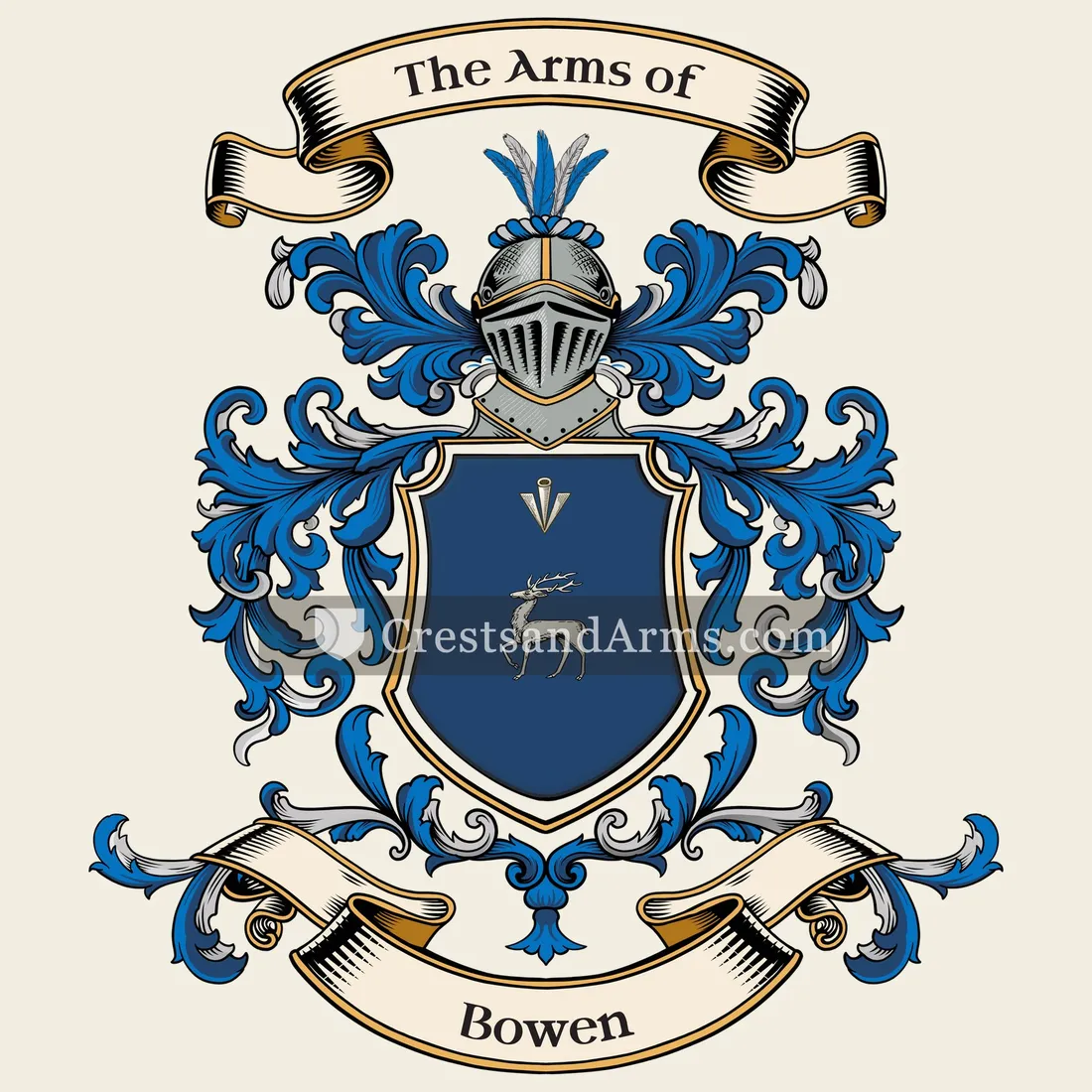
stagPeace and harmony, and one who will not fight unprovoked
arrowReadiness for battle, and affliction endured
Colours
Blue (Azure)Means: Loyalty and truth
Silver (Argent)Means: Peace and sincerity
Historical info
Source
Sir Bernard Burke, The General Armory of England, Scotland, Ireland and Wales, London: Harrison & Sons, 1884
Blazon (the actual original written record)
“Az. a stag ar. with an arrow stuck in the back and attired or”
GlamorganKittle Hill · Glamorgan, c. 1647
Digital archive packCoat of arms PNG, gold border print PDF, vector SVG and the certificate of authenticity. Sent to your email in minutes.
Map of Wales showing where the Bowen arms are recorded
The Bowen arms were recorded in Glamorgan, c. 1647.
Glamorgan was the richest part of Wales, with good coastal farmland and Norman castles along it. The families who held those castles kept their land for centuries, and long holding brought recorded arms.
This is where the arms were entered in the register. Families often moved to other parts of the country, so the same name can turn up in more than one region.
The body that granted and recorded arms in Wales in this period.
Charles I of England
Sovereign of the period
Charles I of England
1625–1649
Reigning in England when the Bowen arms are first recorded.
How Arms Worked in Wales
English heraldry allowed arms to be shared by all legitimate descendants of the original owner. These symbols were treated as personal property that moved through the generations to all children. While the eldest son kept the original design, other family members could use the same shield without needing to change it or register their own unique versions.
Granting authority
The College of Arms in London has regulated the use of coats of arms throughout England and Wales since 1484.
How they got arms
Families typically obtained their coats of arms through a formal grant from the Crown or by proving their ancient right to them.
Where arms were recorded
All official coats of arms are recorded in the registers kept at the College of Arms, which date back to the fifteenth century.
The family's standing
Recorded among the armigerous families of Glamorgan.
Origin & History of the Bowen Family in Wales
The surname Bowen is a classic example of a Welsh patronymic name, which means it was originally formed from a father’s given name. It evolved from the phrase "ap Owain," which translates to "son of Owain." Over many generations of spoken Welsh, the "ap" prefix gradually merged with the name Owain to create the single word Bowen. By the mid-seventeenth century, families bearing this name were well-established in the county of Glamorgan. Records from 1647 confirm that members of the Bowen family were active participants in the local community during this era. At that time, families in South Wales were transitioning from traditional naming customs to the use of fixed surnames that could be passed down to children. This shift helped families maintain a consistent identity as they managed land, trade, and local affairs in the growing towns of Glamorgan.
Bowen Meaning & Related Branches
Root word
ab Owain
A Welsh patronymic phrase meaning son of Owain.
This name
BowenDerived from the Welsh personal name Owain, which is traditionally interpreted as noble born or well born.
also spelled
Bowan
Bowin
Related arms
Benendenrecorded with Bowen, same area
Cheversrecorded with Bowen, same area
Dufferecorded with Bowen, same area
Flemingrecorded with Bowen, same area
Documented Sources
Sir Bernard Burke, The General Armory of England, Scotland, Ireland and Wales, London: Harrison & Sons, 1884
Bardsley, Charles Wareing, A Dictionary of English and Welsh Surnames, 1901


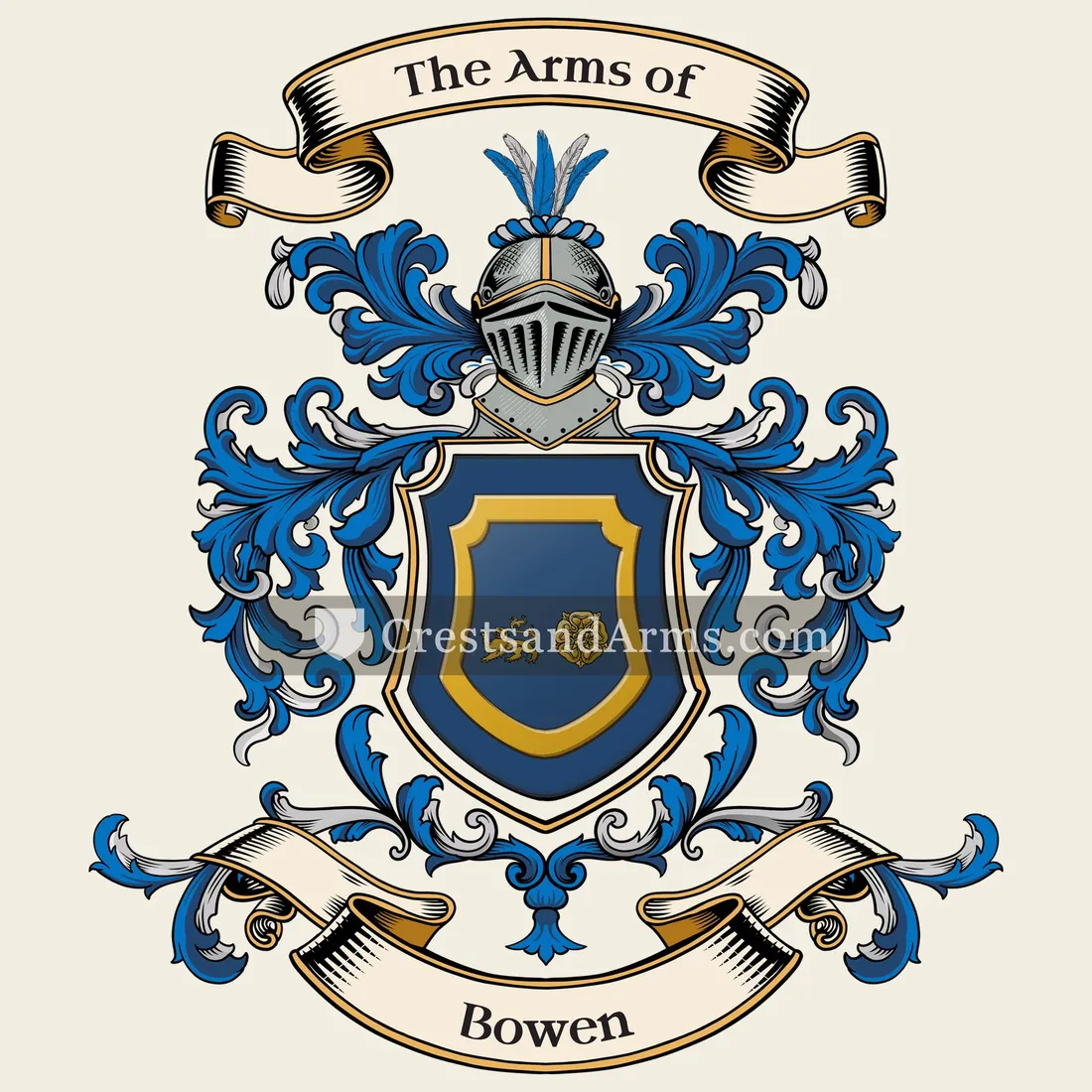
 orlePreservation, and protection in battle
 lionCourage, strength and royalty
 roseThe seventh son, and beauty with grace
 orlePreservation, and protection in battle
 lionCourage, strength and royalty
 roseThe seventh son, and beauty with grace


 mountThe ground held, and steadfastness upon it
 stagPeace and harmony, and one who will not fight unprovoked
 crescentHonour by the sovereign, and the second son


 arrowReadiness for battle, and affliction endured