A record of documented arms, meaning and origin, researched for the Bower family lines. Documented in 2 countries.
Reg. 9280 · English, A–C
Meaning of the Bower family crest colors & symbols
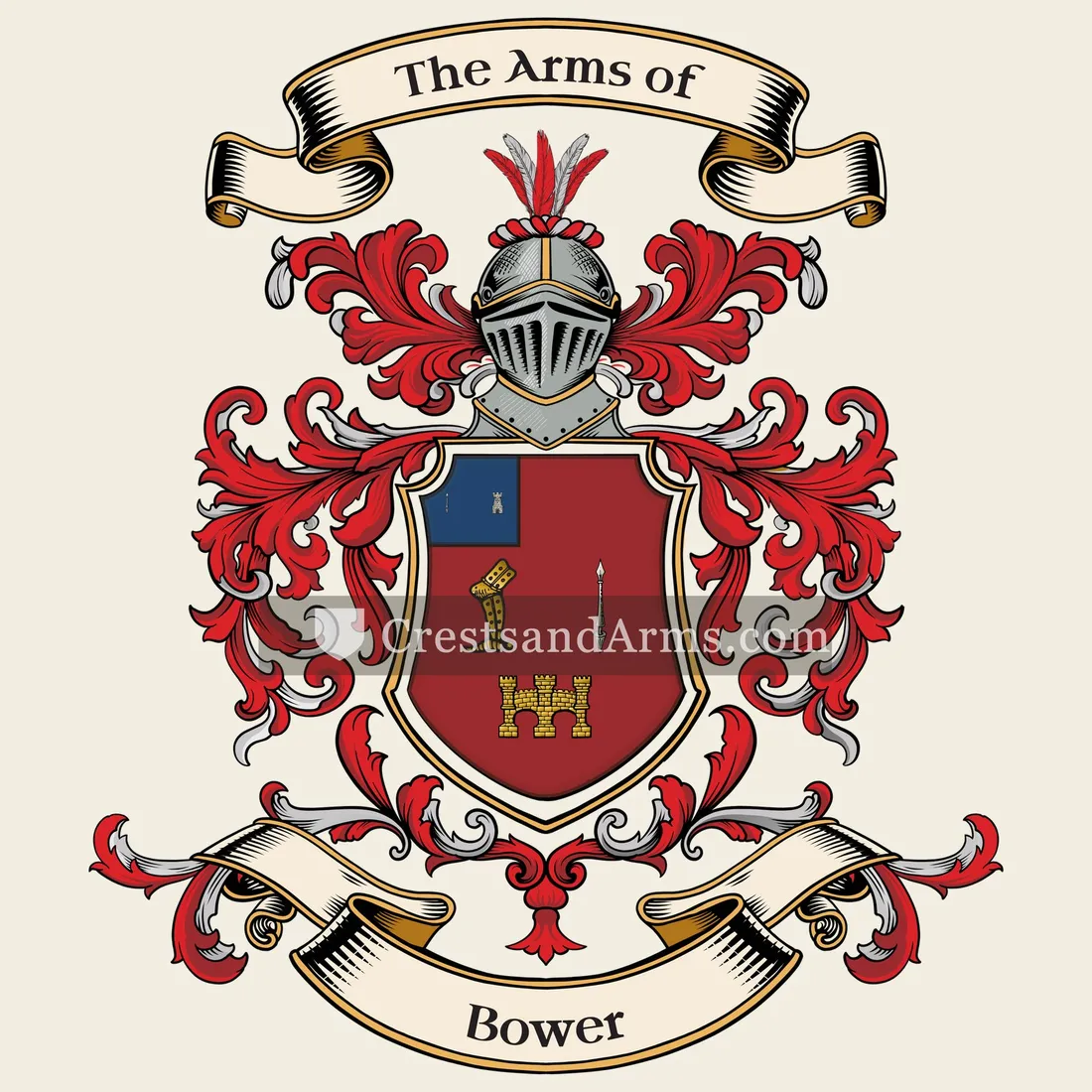
Symbols on this shield
cantonA mark of honour granted by the sovereign
lanceKnightly service and the tilt
legStrength and swiftness
towerGrandeur and solidity, and a stronghold defended
bridgeOne who joins what was divided
Colours
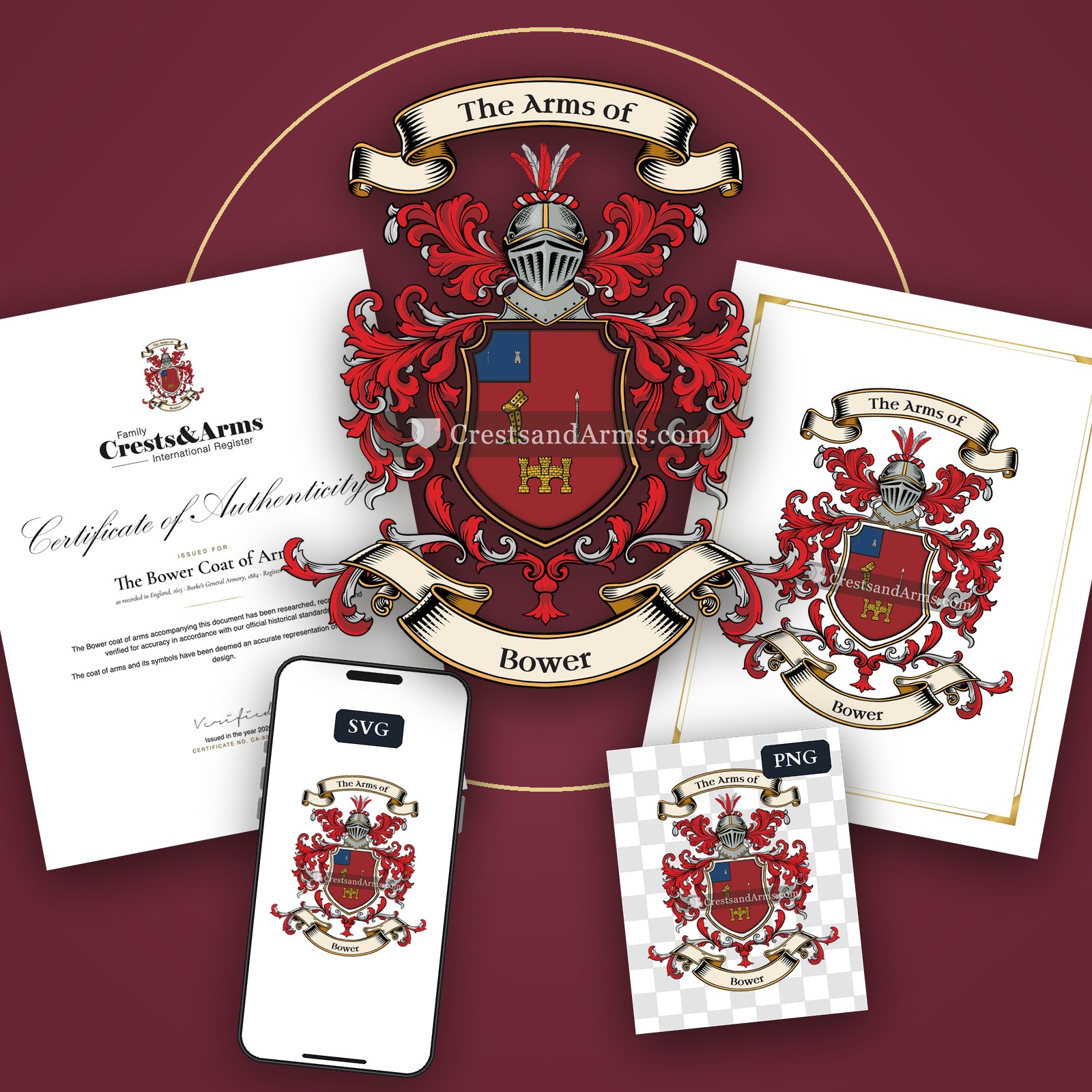
Red (Gules)Means: Military strength
Blue (Azure)Means: Loyalty and truth
Gold (Or)Means: Generosity
Historical info
Source
Sir Bernard Burke, The General Armory of England, Scotland, Ireland and Wales, London: Harrison & Sons, 1884
Blazon (the actual original written record)
“Gu. a human leg couped at the thigh or, vulned and transfixed by a spear broken chevronwise the point downwards to the sinister ppr. on a canton az. surmounted by the dexter half of the spear the arch of a bridge embattled of the third thereon a castle triple-towered of the second”
DurhamOxenfield · Durham, c. 1615
Digital archive packCoat of arms PNG, gold border print PDF, vector SVG and the certificate of authenticity. Sent to your email in minutes.
Map of England showing where the Bower arms are recorded
The Bower arms were recorded in Durham, c. 1615.
Durham was governed by its bishop rather than the crown for most of its history, with its own courts and its own landed class. That separate world produced a tight group of families, nearly all of whom held arms.
This is where the arms were entered in the register. Families often moved to other parts of the country, so the same name can turn up in more than one region.
The body that granted and recorded arms in England in this period.
James VI and I
Sovereign of the period
James VI and I
1603–1625
Reigning in England when the Bower arms are first recorded.
How Arms Worked in England
English heraldry allowed arms to be shared by all legitimate descendants of the original owner. These symbols were treated as personal property that moved through the generations to all children. While the eldest son kept the original design, other family members could use the same shield without needing to change it or register their own unique versions.
Granting authority
The College of Arms in London has regulated the use of coats of arms throughout England and Wales since 1484.
How they got arms
Families typically obtained their coats of arms through a formal grant from the Crown or by proving their ancient right to them.
Where arms were recorded
All official coats of arms are recorded in the registers kept at the College of Arms, which date back to the fifteenth century.
The family's standing
Recorded among the armigerous families of Durham.
Origin & History of the Bower Family in England
The surname Bower is an occupational name that originated in medieval England, specifically referring to a person who made bows or lived in a small cottage known as a bower. By the early 17th century, the family had established a notable presence in the northern county of Durham. Records from 1615 confirm that members of the Bower family were living in this region during a time of significant social and economic transition. As the family settled into the local community, they became part of the fabric of northern English life, likely participating in the agricultural and trade activities common to the area. Their presence in Durham reflects the broader movement of families who rooted themselves in specific English counties, helping to shape the local history and development of their respective parishes over several generations.
Meaning of the Bower family crest colors & symbols
Symbols on this shield
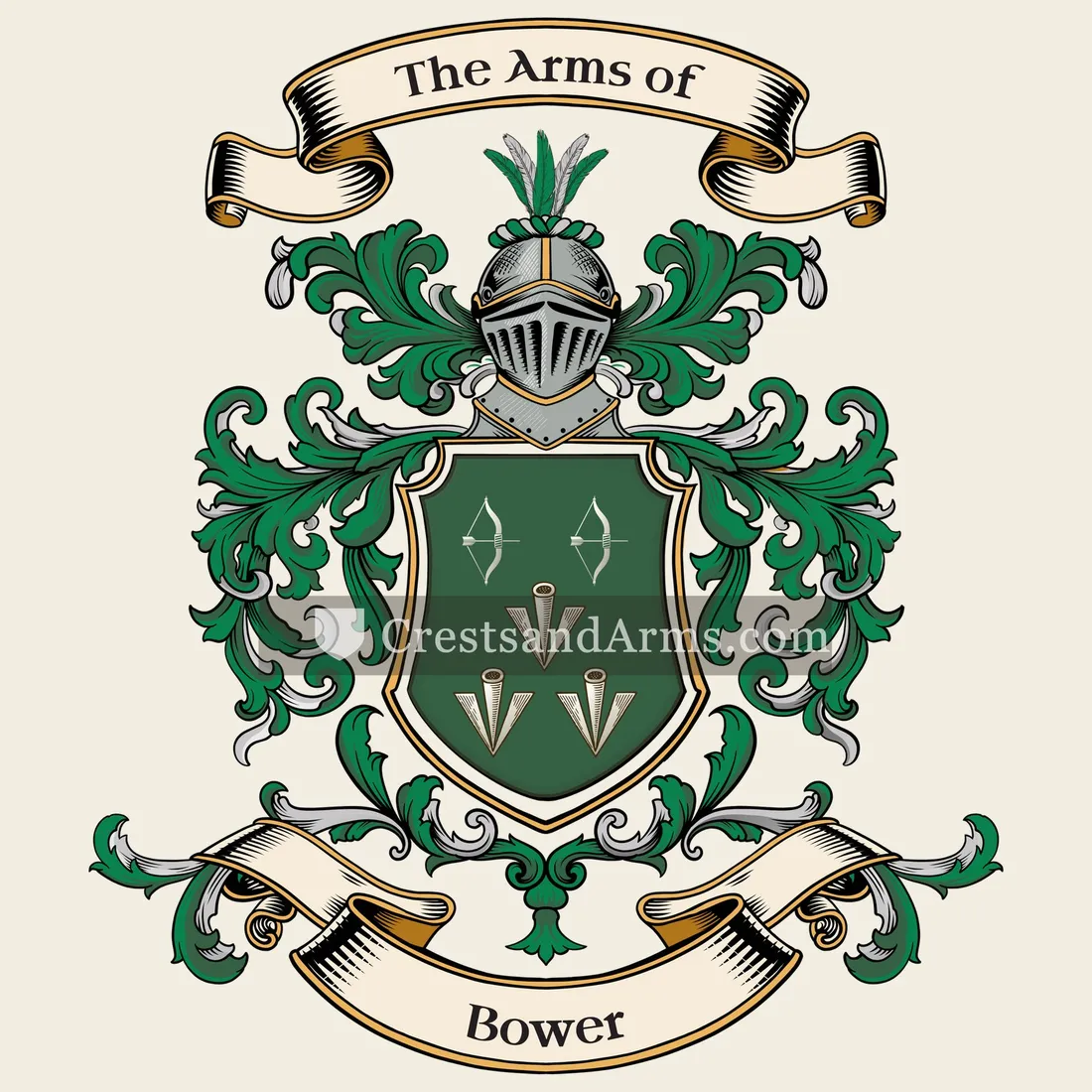
bowReadiness, and the strength held in reserve
arrowReadiness for battle, and affliction endured
Colours
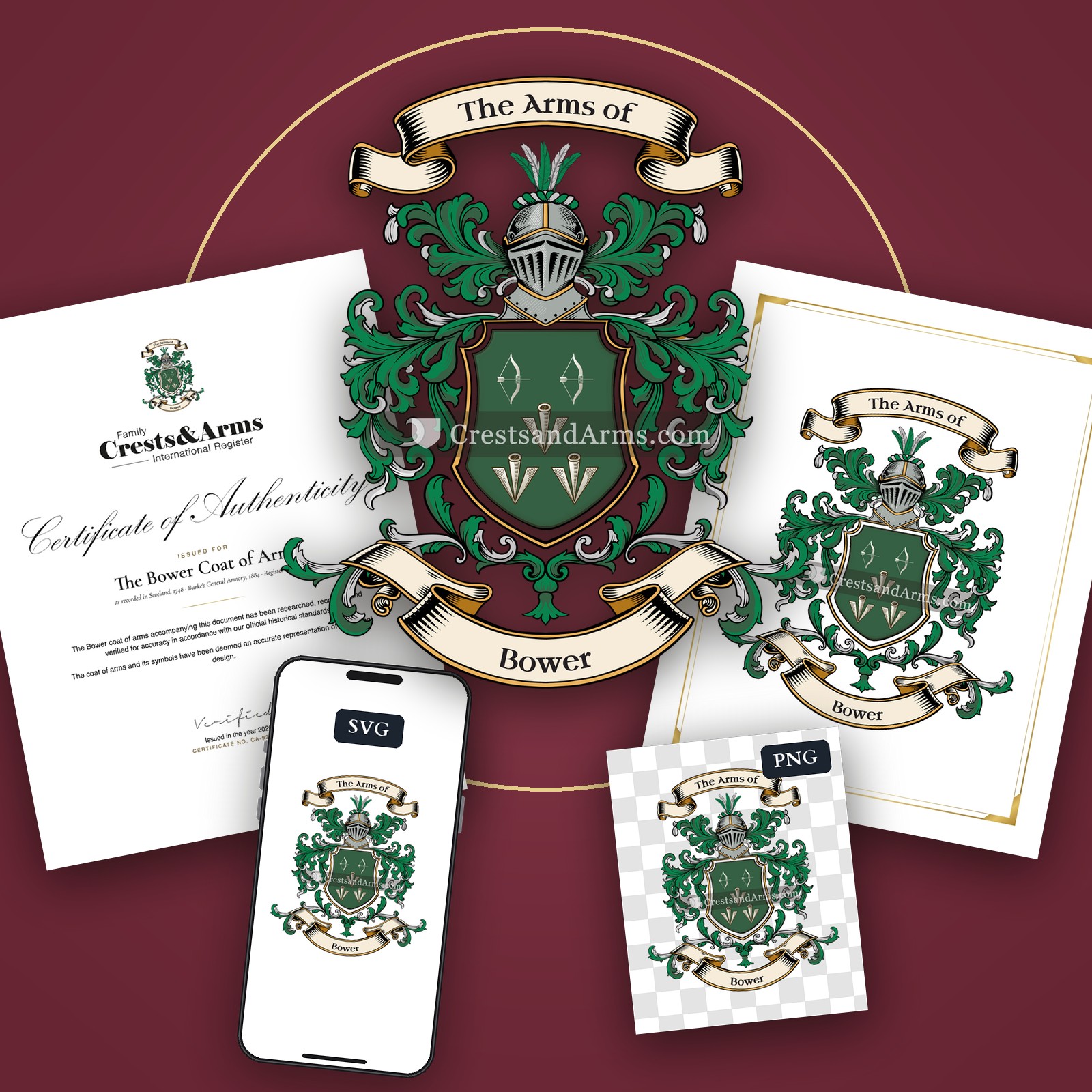
Green (Vert)Means: Hope
Silver (Argent)Means: Peace and sincerity
Historical info
Source
Sir Bernard Burke, The General Armory of England, Scotland, Ireland and Wales, London: Harrison & Sons, 1884
Blazon (the actual original written record)
“Vert two bows in full bend paleways ppr. stringed ar. betw. three sheaves of arrows, two in chief and one in base of the second”
ScotlandKinnettles, c. 1748
Digital archive packCoat of arms PNG, gold border print PDF, vector SVG and the certificate of authenticity. Sent to your email in minutes.
Map of Scotland showing where the Bower arms are recorded
The Bower arms were recorded in Kinnettles, c. 1748.
Arms such as these were typically recorded in Edinburgh.
Edinburgh was the seat of Scotland's government, its courts and its heralds. Families with business there settled nearby, and being close to where arms were recorded is exactly why so many of them appear.
This is where the arms were entered in the register. Families often moved to other parts of the country, so the same name can turn up in more than one region.
The body that granted and recorded arms in Scotland in this period.
George II of Great Britain
Sovereign of the period
George II of Great Britain
1727–1760
Reigning in England when the Bower arms are first recorded.
How Arms Worked in Scotland
Scottish heraldry is unique because it treats a coat of arms as a piece of personal property protected by law. Only one person can own a specific design at any given time. When a family grows, the head keeps the original shield while other relatives must apply for their own distinct version with slight changes to prove their specific identity.
Granting authority
The Court of the Lord Lyon acts as the official body that regulates and controls all heraldic matters throughout Scotland.
How they got arms
Individuals obtain a legal right to their arms through a formal petition process that confirms their identity and family connection.
Where arms were recorded
All valid coats of arms are officially entered into the Public Register of All Arms and Bearings starting from 1672.
The family's standing
Recorded among the armigerous families of Scotland.
Origin & History of the Bower Family in Scotland
The surname Bower is rooted in the occupational history of medieval Britain, as it originally described a person who made bows or worked as a chamberlain in a noble household. By the time the name became established in Scotland, it was closely tied to the development of urban centers and trade. Records confirm that members of the Bower family were well-established in Edinburgh by 1748, where they participated in the city’s growing professional and merchant classes. During this era, Edinburgh was a hub of intellectual and economic activity, and families like the Bowers contributed to the city’s expansion as it transitioned into the modern age. These early residents were part of the fabric of Scottish society, living through a period of significant cultural change as the nation moved toward the Industrial Revolution. Their presence in the capital suggests they were integrated into the local economy and were active participants in the daily life of a developing Scottish metropolis.
Bower Meaning & Related Branches
Root word
bur
Old English term for a small dwelling, cottage, or inner chamber.
This name
BowerAn occupational name for a builder or a dweller in a cottage.
also spelled
Bowyer
Boure
Related arms
Bowrevariant spelling
Bowyervariant spelling
Halfordrecorded with Bower, same area
Otterrecorded with Bower, same area
Documented Sources
Sir Bernard Burke, The General Armory of England, Scotland, Ireland and Wales, London: Harrison & Sons, 1884
Bardsley, Charles Wareing, A Dictionary of English and Welsh Surnames, 1901
Reaney, P.H., A Dictionary of British Surnames, 1958
Durham County Record Office, Durham Bishopric Estates Records, 1615
Digital archive packCoat of arms PNG, gold border print PDF, vector SVG and the certificate of authenticity. Sent to your email in minutes.


 cantonA mark of honour granted by the sovereign
 lanceKnightly service and the tilt
 legStrength and swiftness
 towerGrandeur and solidity, and a stronghold defended
 bridgeOne who joins what was divided
 cantonA mark of honour granted by the sovereign
 lanceKnightly service and the tilt
 legStrength and swiftness
 towerGrandeur and solidity, and a stronghold defended
 bridgeOne who joins what was divided


 bowReadiness, and the strength held in reserve
 arrowReadiness for battle, and affliction endured