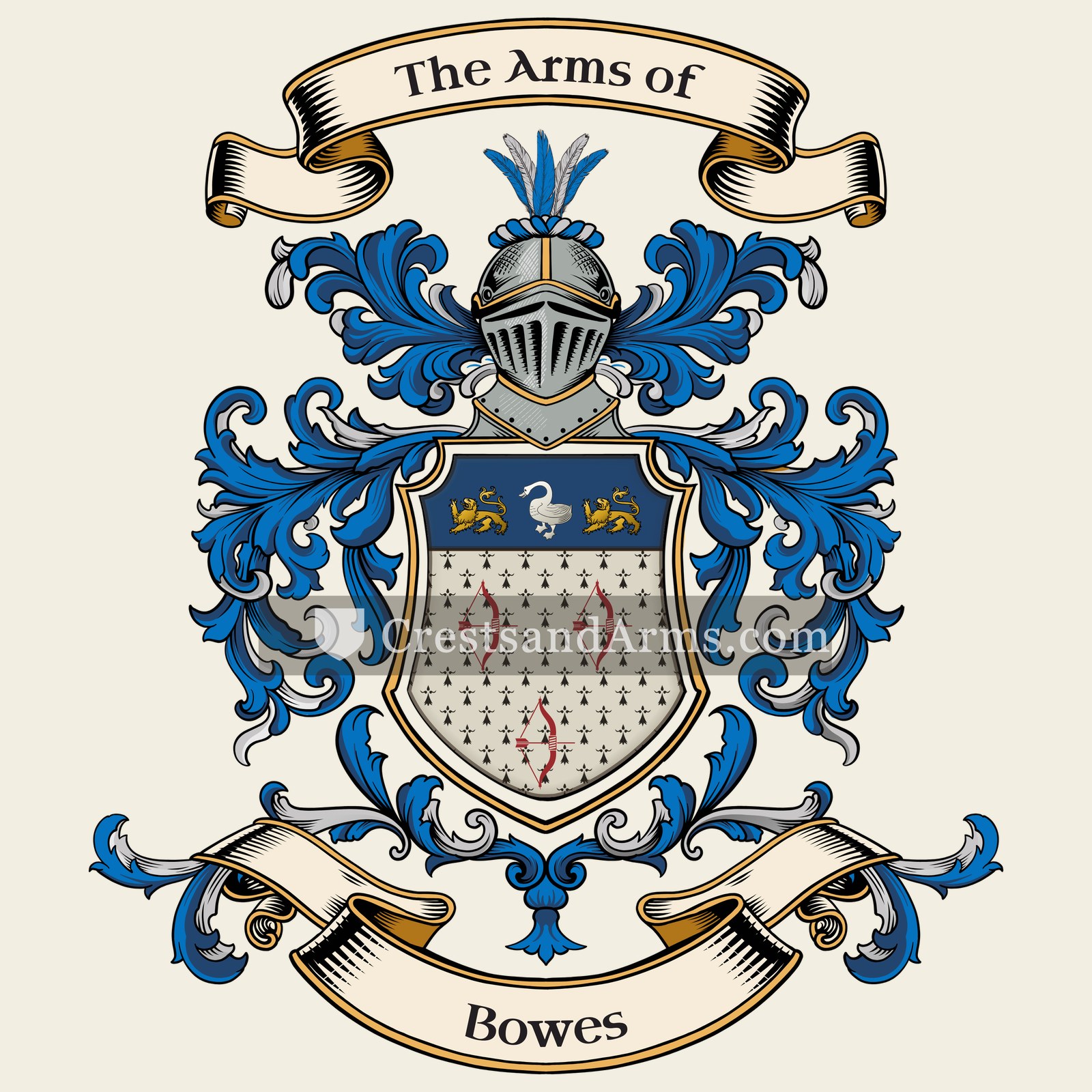
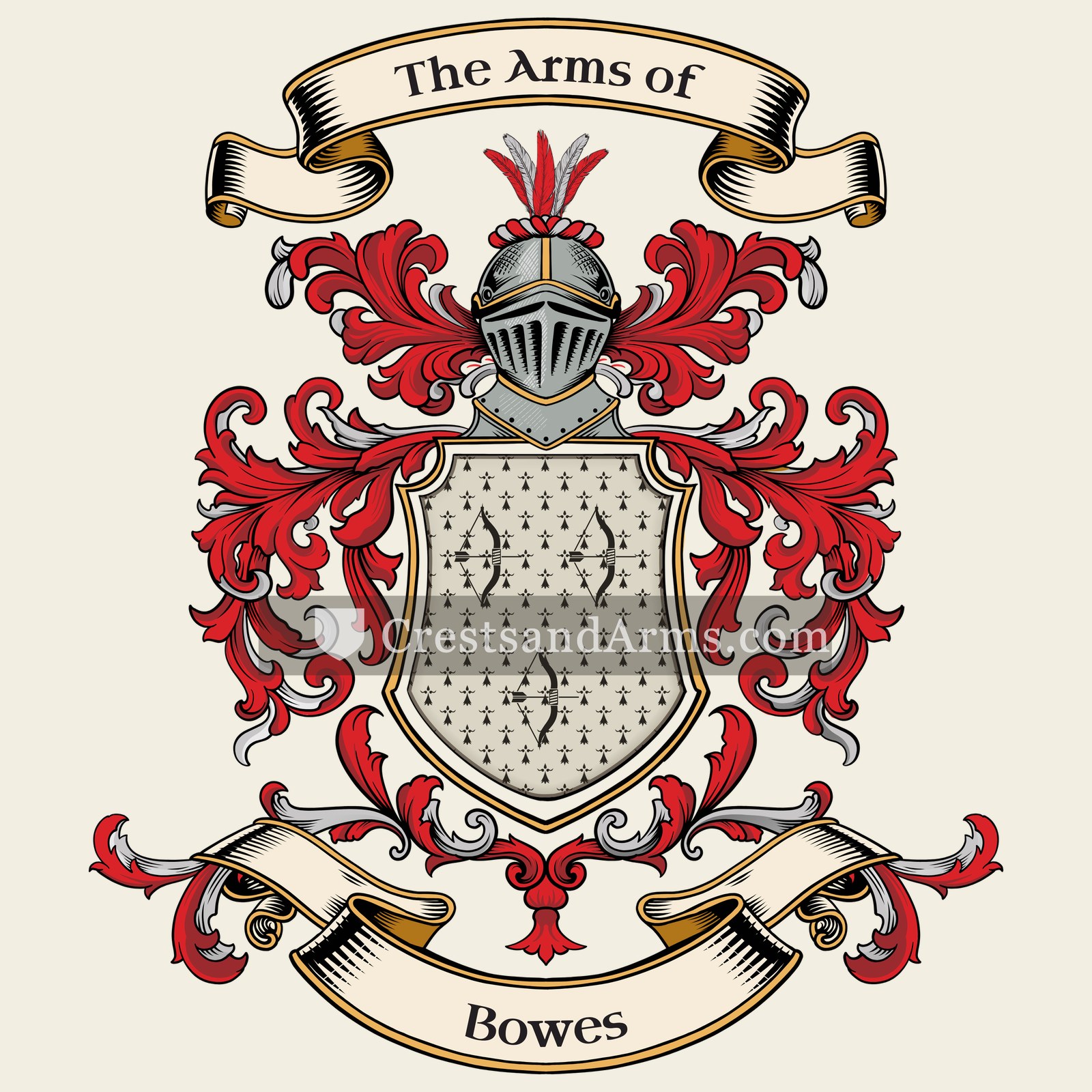
A record of documented arms, meaning and origin, researched for the Bowes family lines. Documented in 3 countries.
Reg. 5829 · Britain, A–C
Coat of Arms & Family Crest Details
Symbols on this shield
bowReadiness, and the strength held in reserve
Colours
ErmineMeans: Dignity
Black (Sable)Means: Constancy
Historical info
Source
J. B. Rietstap, Armorial Général, Gouda: G. B. van Goor Zonen, 1884–87
Blazon (the actual original written record)
“D'herm. à trois arcs de sa., en pals, rangés en fasce. C.: un lion iss. de gu., arm. et lamp. d'azur, tenant un faisceau de cinq flèches au nat., les pointes en bas. T.: deux archers, hab. de sin., coll. de gu. au rabat du même, ceints d'or, le haut-de-chausses du même, les souliers de sa., portant sur le dos un carquois rempli de flèches, et tenant chacun un arc de gu.”
Britainc. 1700
Digital archive packCoat of arms PNG, gold border print PDF, vector SVG and the certificate of authenticity. Sent to your email in minutes.
Map of Britain showing where the Bowes arms are recorded
The Bowes arms were recorded in Britain, c. 1700.
Arms such as these were typically recorded in Kent.
Kent sits between London and the short crossing to Europe, and the trade passing through made it wealthy. Merchant families bought land with that money, and it was landowners who took coats of arms.
This is where the arms were entered in the register. Families often moved to other parts of the country, so the same name can turn up in more than one region.
The body that granted and recorded arms in Britain in this period.
William III of England
Sovereign of the period
William III of England
1694–1702
Reigning in Britain when the Bowes arms are first recorded.
How Arms Worked in Britain
English heraldry allowed arms to be shared by all legitimate descendants of the original owner. These symbols were treated as personal property that moved through the generations to all children. While the eldest son kept the original design, other family members could use the same shield without needing to change it or register their own unique versions.
Granting authority
The College of Arms in London has regulated the use of coats of arms throughout England and Wales since 1484.
How they got arms
Families typically obtained their coats of arms through a formal grant from the Crown or by proving their ancient right to them.
Where arms were recorded
All official coats of arms are recorded in the registers kept at the College of Arms, which date back to the fifteenth century.
The family's standing
Recorded among the armigerous families of Britain.
Origin & History of the Bowes Family in Britain
The surname Bowes is a locational name that originated in northern England, specifically derived from the town of Bowes in the North Riding of Yorkshire. The name itself is thought to come from the plural form of the Old French word "boue," which refers to a muddy or marshy area. While the family name became well-established in the northern counties during the medieval period, members of the family eventually migrated across Britain for trade, military service, and land ownership. By the year 1700, records confirm that branches of the family had settled in Kent. This movement reflects the broader trend of families relocating from their ancestral northern roots toward the growing economic centers of the south during the seventeenth and eighteenth centuries. As they moved, the family integrated into the local communities of Kent, leaving behind a trail of parish records and legal documents that trace their presence in the region.
Coat of Arms & Family Crest Details
Symbols on this shield
chiefAuthority, wisdom and dominion
swanGrace, light and the poet's art
bowReadiness, and the strength held in reserve
lionCourage, strength and royalty
Colours
ErmineMeans: Dignity
Blue (Azure)Means: Loyalty and truth
Silver (Argent)Means: Peace and sincerity
Red (Gules)Means: Military strength
Gold (Or)Means: Generosity
Historical info
Source
Sir Bernard Burke, The General Armory of England, Scotland, Ireland and Wales, London: Harrison & Sons, 1884
Blazon (the actual original written record)
“Erm. three bows in pale gu. on a chief az. a swan ar. holding in the beak a dish with a covered cup in it, betw. two leopards' heads or”
EnglandLondon, c. 1545
Digital archive packCoat of arms PNG, gold border print PDF, vector SVG and the certificate of authenticity. Sent to your email in minutes.
Map of England showing where the Bowes arms are recorded
The Bowes arms were recorded in London, c. 1545.
This is where the arms were entered in the register. Families often moved to other parts of the country, so the same name can turn up in more than one region.
The body that granted and recorded arms in England in this period.
Henry VIII of England
Sovereign of the period
Henry VIII of England
1509–1547
Reigning in Britain when the Bowes arms are first recorded.
How Arms Worked in England
English heraldry allowed arms to be shared by all legitimate descendants of the original owner. These symbols were treated as personal property that moved through the generations to all children. While the eldest son kept the original design, other family members could use the same shield without needing to change it or register their own unique versions.
Granting authority
The College of Arms in London has regulated the use of coats of arms throughout England and Wales since 1484.
How they got arms
Families typically obtained their coats of arms through a formal grant from the Crown or by proving their ancient right to them.
Where arms were recorded
All official coats of arms are recorded in the registers kept at the College of Arms, which date back to the fifteenth century.
The family's standing
Recorded among the armigerous families of England.
Origin & History of the Bowes Family in England
The surname Bowes originates from the northern regions of England, specifically deriving from the Old French word "boues," which refers to the muddy or marshy ground near a settlement. By the middle of the sixteenth century, the family had established a notable presence in London, where they became influential figures in the city’s civic and mercantile life. Records from 1545 show that members of the Bowes family were already deeply integrated into the capital’s social structure, often serving in positions of local government or as successful tradesmen. This transition from their northern roots to the bustling environment of London allowed the family to expand their influence through trade and political service. Their history reflects the broader movement of families during the Tudor period who sought new opportunities in the growing urban center of the English capital.
Coat of Arms & Family Crest Details
Symbols on this shield
bowReadiness, and the strength held in reserve
Colours
ErmineMeans: Dignity
Black (Sable)Means: Constancy
Historical info
Source
Sir Bernard Burke, The General Armory of England, Scotland, Ireland and Wales, London: Harrison & Sons, 1884
Blazon (the actual original written record)
“Erm. three bows bent and stringed in pale sa”
MeathClonlyon · Meath, c. 1645
Digital archive packCoat of arms PNG, gold border print PDF, vector SVG and the certificate of authenticity. Sent to your email in minutes.
Map of Ireland showing where the Bowes arms are recorded
The Bowes arms were recorded in Meath, c. 1645.
Meath was the best farmland in Ireland and the old seat of its high kings. Norman families took it early and held it, and land of that quality kept the same families on it for centuries.
This is where the arms were entered in the register. Families often moved to other parts of the country, so the same name can turn up in more than one region.
The body that granted and recorded arms in Ireland in this period.
Charles I of England
Sovereign of the period
Charles I of England
1625–1649
Reigning in Britain when the Bowes arms are first recorded.
How Arms Worked in Ireland
The Ulster King of Arms granted coats of arms to individuals who proved their social standing and good character. These symbols were typically inherited by all legitimate descendants of the original holder. If a family branch wanted a unique look, they could apply for a specific change to their design through the office to ensure their identity remained distinct.
Granting authority
The Ulster King of Arms acted as the official body that regulated and issued all coats of arms throughout Ireland.
How they got arms
Families obtained their arms through formal grants issued by the office after proving their eligibility and paying the required fees.
Where arms were recorded
All official grants were recorded in the registers held by the Ulster King of Arms starting from the year 1552.
The family's standing
Recorded among the armigerous families of Meath.
Origin & History of the Bowes Family in Ireland
The Bowes family name in Ireland is deeply connected to the historical landscape of County Meath, where members of the family were firmly established by 1645. While the name itself has roots that stretch back to medieval England, its presence in Ireland during the mid-seventeenth century suggests the family was part of the complex migrations and land settlements that defined that era. During this time, Meath was a central region for political and social change, and families like the Bowes often navigated the shifting ownership of land and the influence of local governance. By settling in this fertile part of the country, the family integrated into the local community and became part of the long-term history of the region. Their presence in the records of the 1640s highlights how the family established a foothold in Ireland during a period of significant national upheaval, eventually becoming a lasting part of the Irish genealogical landscape.
Bowes Meaning & Related Branches
Root word
boga
Old Norse term referring to a bow or a curved arch.
This name
BowesA topographic name for someone who lived near a curved arch or a bow-shaped river bend.
also spelled
Bowez
Bowis
Bowz
Related arms
Astleysame arms
Bowssame arms
Lowesimilar arms
Bowze, or Bouzevariant spelling
Documented Sources
J. B. Rietstap, Armorial Général, Gouda: G. B. van Goor Zonen, 1884–87
Reaney, P.H., A Dictionary of English Surnames, 1958
Lower, Mark Antony, Patronymica Britannica: A Dictionary of the Family Names of the United Kingdom, 1860
The National Archives, Probate Records of the Prerogative Court of Canterbury, 1700
Kent History and Library Centre, Parish Registers of Kent, 1700
Digital archive packCoat of arms PNG, gold border print PDF, vector SVG and the certificate of authenticity. Sent to your email in minutes.


 bowReadiness, and the strength held in reserve
 bowReadiness, and the strength held in reserve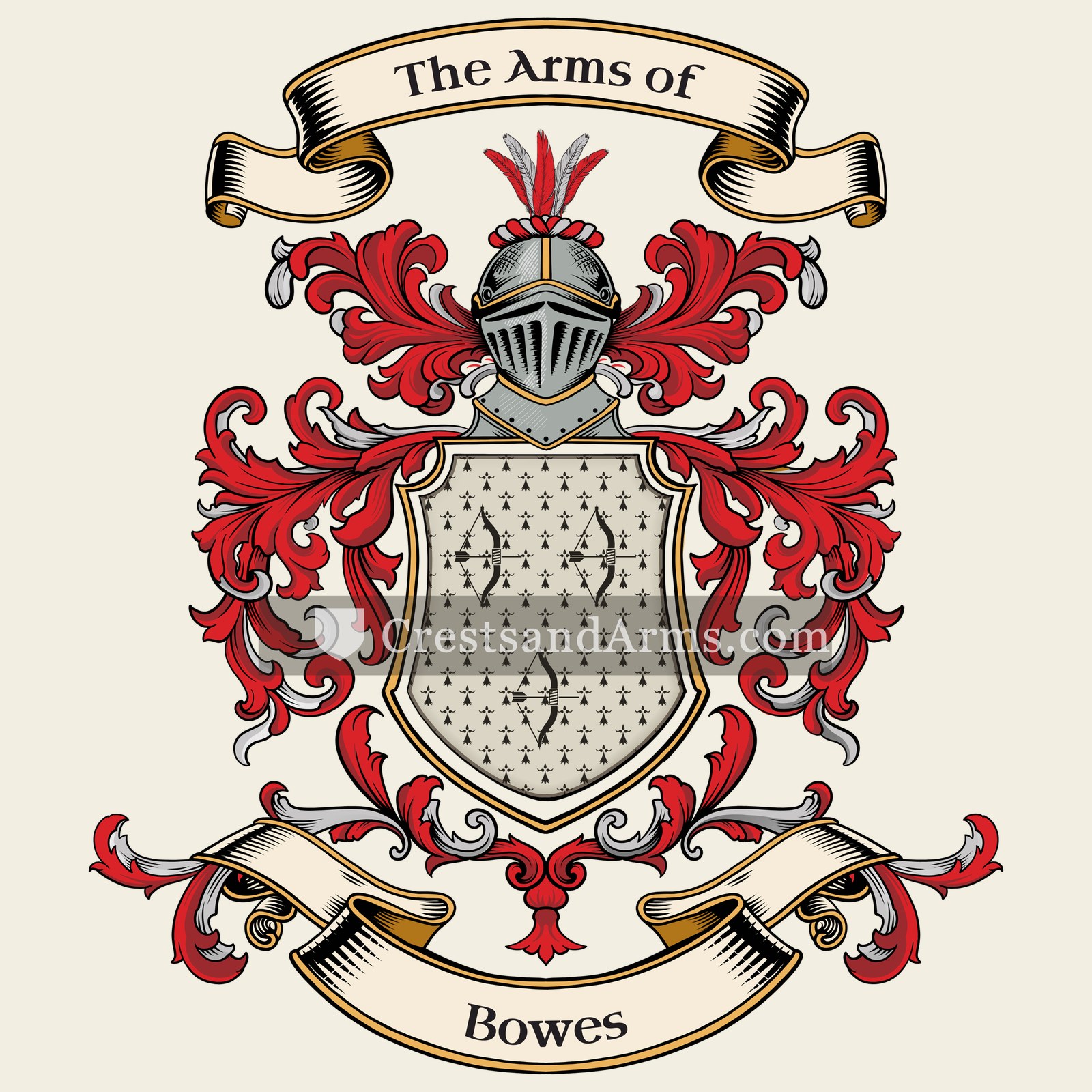


 chiefAuthority, wisdom and dominion
 swanGrace, light and the poet's art
 lionCourage, strength and royalty