A record of documented arms, meaning and origin, researched for the Bowick family lines. Documented in 3 countries.
Reg. 4517 · German, A–C
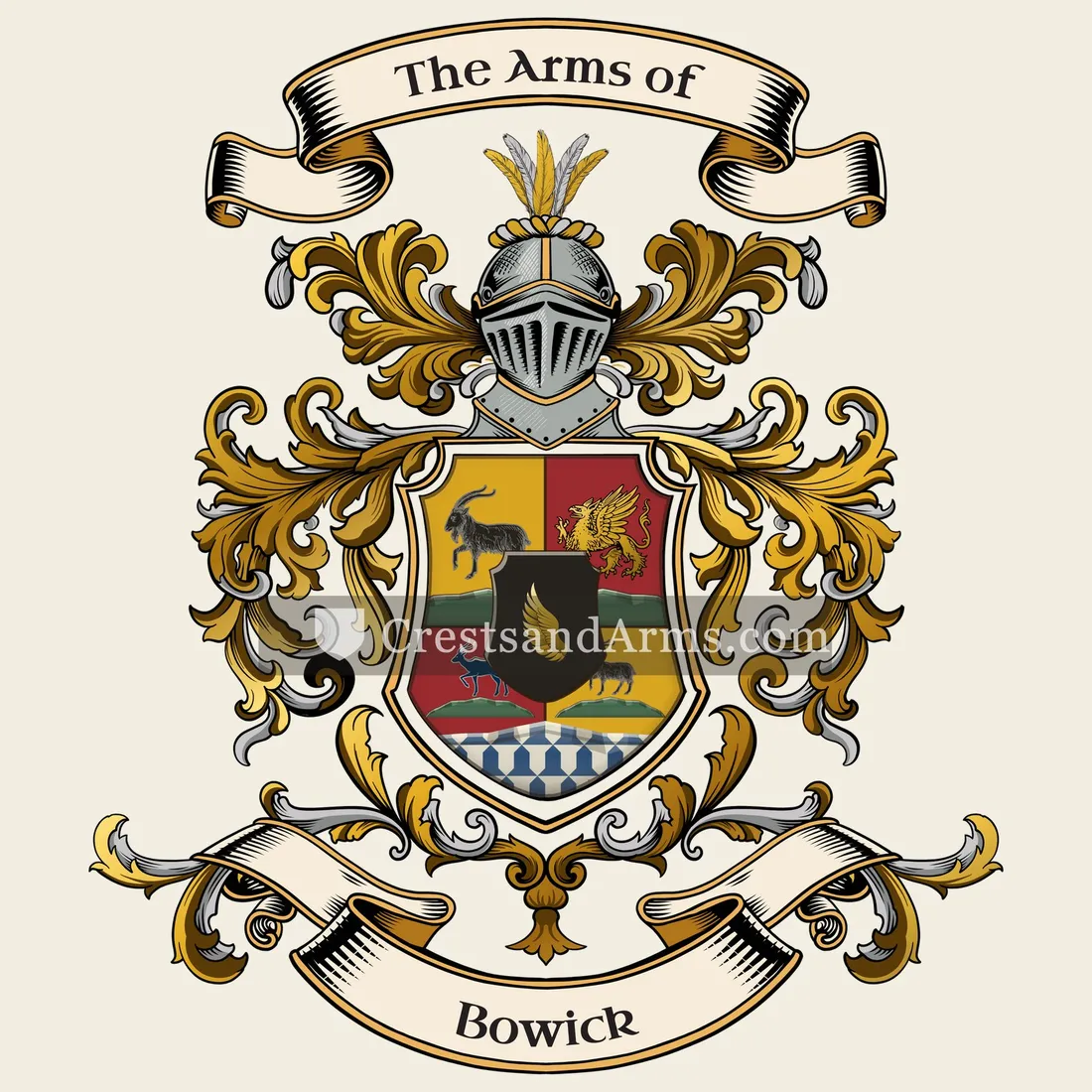
Meaning of the Bowick family crest colors & symbols
Symbols on this shield
mountThe ground held, and steadfastness upon it
wingSwiftness, and protection under a raised wing
goatOne who wins by diplomacy rather than force
griffinValour and vigilance, guarding great treasure
antelopeHarmony, polity and peace
Colours
Gold (Or)Means: Generosity
Red (Gules)Means: Military strength
Black (Sable)Means: Constancy
Green (Vert)Means: Hope
Historical info
Source
J. B. Rietstap, Armorial Général, Gouda: G. B. van Goor Zonen, 1884–87
Blazon (the actual original written record)
“Ec.: aux 1 et 4 d'or au bouc sautant de sa., soutenu d'une colline de sin., le bouc du 1 cont.; au 2 de gu. au griffon d'or, soutenu d'un tertre de sin. et tenant de ses pattes une flèche d'arg. en pal.; au 3 d'arg. à un chamois sautant et cont. au nat., soutenu d'une colline de sin. Sur le tout de sa. au vol d'or. Deux cq. cour. C.: 1° une tête et col de bouc cont. de sa., tenant entre ses dents une feuille de chène d'or; l. d'or et de sa.; 2° un vol à l'antique d'or, ch. d'une bande de gu., surch. du griffon du 2; l. d'arg. et de gu.”
BavariaBavaria, c. 1731
Digital archive packCoat of arms PNG, gold border print PDF, vector SVG and the certificate of authenticity. Sent to your email in minutes.
Map of Germany showing where the Bowick arms are recorded
The Bowick arms were recorded in Bavaria, c. 1731.
Bavaria was a country of old landed families and walled market towns. Estates passed down the same line for centuries, and both the landowners and the leading townsmen kept arms, which is why so many Bavarian names sit in the registers.
This is where the arms were entered in the register. Families often moved to other parts of the country, so the same name can turn up in more than one region.
The body that granted and recorded arms in Germany in this period.
Charles VI, Holy Roman Emperor
Sovereign of the period
Charles VI, Holy Roman Emperor
1711–1740
Reigning in Germany when the Bowick arms are first recorded.
How Arms Worked in Germany
In the Holy Roman Empire, coats of arms were often granted to individuals by the Emperor or his representatives. These arms were then passed down through the generations to all legitimate descendants of the original holder. Younger branches of a family usually kept the same shield design without needing to change it, as the arms belonged to the entire lineage.
Granting authority
The Holy Roman Emperor held the sole power to grant new coats of arms throughout his vast imperial territories.
How they got arms
Families typically obtained their coats of arms through a formal imperial grant or by proving their noble status to the authorities.
Where arms were recorded
These grants were officially recorded in the Imperial Chancery registers, which began keeping formal records of such honors during the Middle Ages.
The family's standing
Recorded among the armigerous families of Bavaria.
Origin & History of the Bowick Family in Germany
The family name Bowick finds its roots in the historical landscape of Bavaria, where records confirm the presence of family members as early as 1731. During this period, the region was part of the Holy Roman Empire and was defined by a complex social structure centered on agricultural life and local trade. Families with names like Bowick often lived in small, rural communities where their identity was closely tied to the specific geography of their village or the nature of their daily work. As members of the Bavarian population, these early ancestors lived through a time of significant religious and political transition that shaped the culture of Southern Germany. By examining these early records, we see a family that was integrated into the local economy and social fabric of the eighteenth-century German countryside.
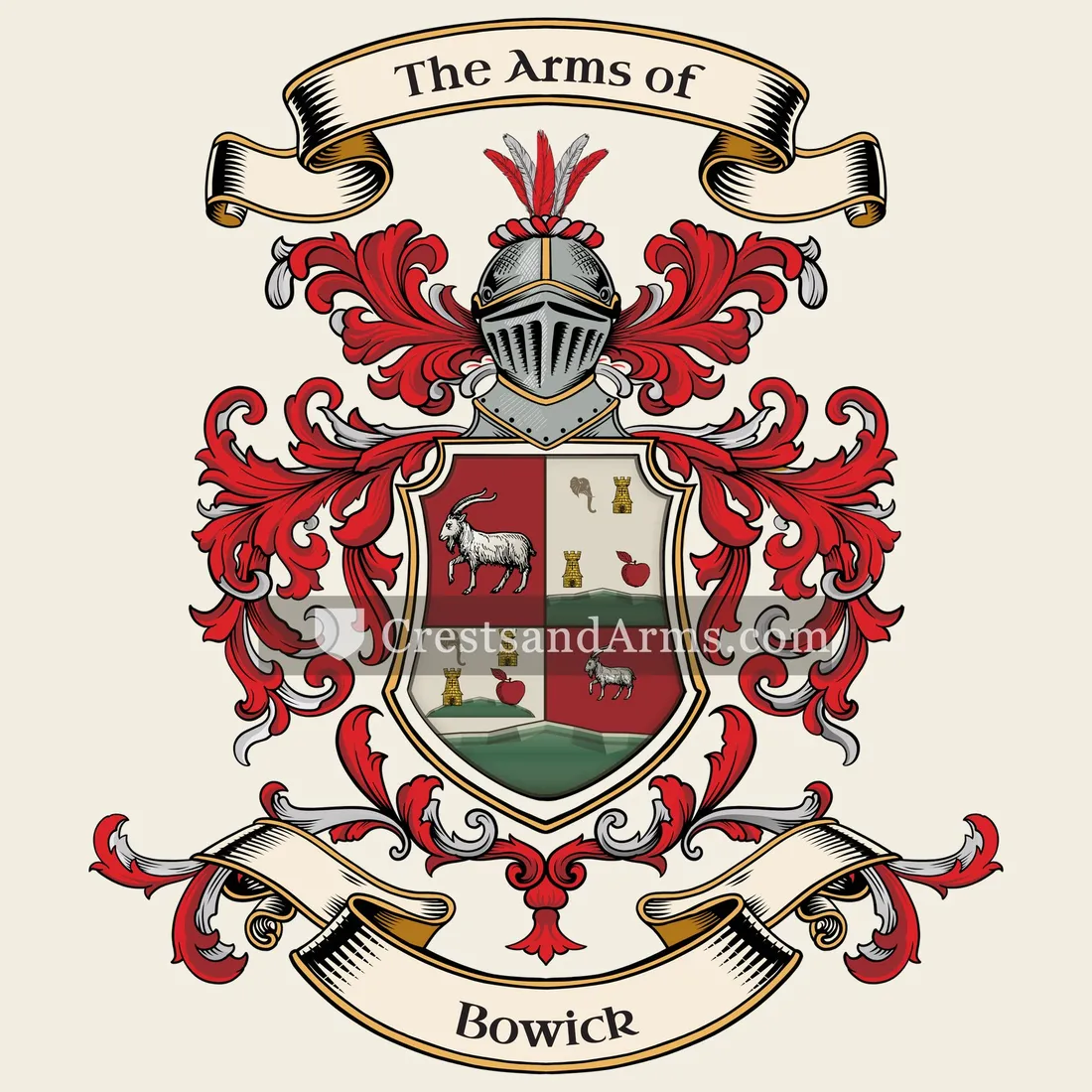
Meaning of the Bowick family crest colors & symbols
Symbols on this shield
mountThe ground held, and steadfastness upon it
goatOne who wins by diplomacy rather than force
elephantGreat strength, wit and ambition
towerGrandeur and solidity, and a stronghold defended
applePeace, plenty and long-standing settlement
Colours
Red (Gules)Means: Military strength
Silver (Argent)Means: Peace and sincerity
Green (Vert)Means: Hope
Gold (Or)Means: Generosity
Historical info
Source
J. B. Rietstap, Armorial Général, Gouda: G. B. van Goor Zonen, 1884–87
Blazon (the actual original written record)
“Ec.: aux 1 et 4 de gu. à un bouc ramp. d'arg., accorné d'or, onglé de sa.; aux 2 et 3 d'arg. à un éléphant au nat., posé sur un tertre de sin., portant deux tours d'or essorées d'azur, avec une pomme de grenade de gu. entre ces deux tours. Deux cq. cour. C.: 1° le bouc, iss. et cont.; 2° un homme iss., hab. d'or, coiffé d'un chapeau à la matelotte de sa., tenant de sa main dextre la pomme de grenade et de sa sen. une des tours de l'éléphant. L. d'arg. et de gu.”
AlsaceAlsace, c. 1532
Digital archive packCoat of arms PNG, gold border print PDF, vector SVG and the certificate of authenticity. Sent to your email in minutes.
Map of France showing where the Bowick arms are recorded
The Bowick arms were recorded in Alsace, c. 1532.
Alsace lay between France and the German lands and belonged to both at different times. Its families held small estates and served whichever side ruled, and men who served in arms carried arms of their own.
This is where the arms were entered in the register. Families often moved to other parts of the country, so the same name can turn up in more than one region.
The body that granted and recorded arms in France in this period.
Francis I of France
Sovereign of the period
Francis I of France
1515–1547
Reigning in Germany when the Bowick arms are first recorded.
How Arms Worked in France
In France, a coat of arms was a mark of honor that passed down through the male line to all legitimate descendants. Families often used the same shield without changes to show their shared heritage. If a branch wanted to stand out, they could add a small mark to their shield to show their specific place in the family tree.
Granting authority
The Juge d'armes de France acted as the official authority that regulated and verified coats of arms across the country.
How they got arms
Families typically inherited their arms from ancestors, though they could also receive them through royal grants or by proving their noble status.
Where arms were recorded
Coats of arms were officially recorded in the Armorial Général de France, which began its main collection in the year 1696.
The family's standing
Recorded among the armigerous families of Alsace.
Origin & History of the Bowick Family in France
The history of the Bowick family in France is deeply tied to the complex cultural landscape of the Alsace region during the sixteenth century. By 1532, records confirm that members of the family were established in this area, which served as a vital crossroads between Germanic and French influences. During this period, Alsace was part of the Holy Roman Empire, yet it maintained strong social and economic connections to the surrounding French territories. The family likely lived through a time of significant religious and political transition, as the ideas of the Reformation began to reshape local communities. Living in such a strategic borderland meant that the family name was shaped by the constant movement of people, trade, and ideas across the Rhine River. This environment required families to be highly adaptable, often navigating multiple languages and shifting regional loyalties as they built their lives in the towns and rural estates of the Alsatian countryside.
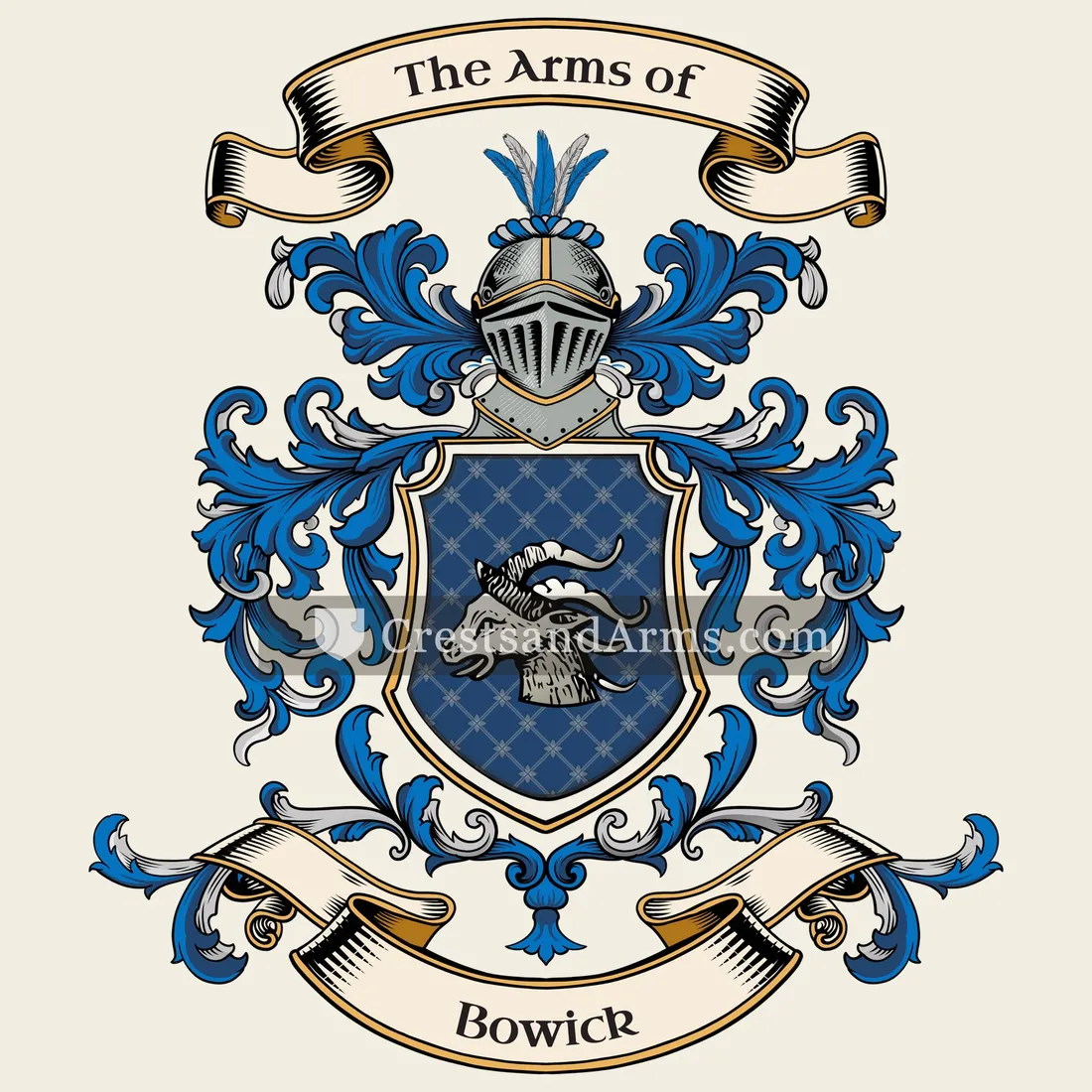
Meaning of the Bowick family crest colors & symbols
Symbols on this shield
goats headWisdom, and one who wins by policy rather than force
Colours
Blue (Azure)Means: Loyalty and truth
Silver (Argent)Means: Peace and sincerity
Historical info
Source
J. B. Rietstap, Armorial Général, Gouda: G. B. van Goor Zonen, 1884–87
Blazon (the actual original written record)
“D'azur à une tête et col de bouc (sans cornes) d'arg. C.: le meuble de l'écu, entre deux prob., coupées alt d'arg. et d'azur.”
Swedenc. 1532
Digital archive packCoat of arms PNG, gold border print PDF, vector SVG and the certificate of authenticity. Sent to your email in minutes.
Map of Sweden showing where the Bowick arms are recorded
The Bowick arms were recorded in Sweden, c. 1532.
Arms such as these were typically recorded in Stockholm.
Stockholm held the Swedish court and the House of Nobility, where every noble family's arms were entered and kept. Families ennobled for service registered there, which is why so many are recorded around the city.
This is where the arms were entered in the register. Families often moved to other parts of the country, so the same name can turn up in more than one region.
The body that granted and recorded arms in Sweden in this period.
Gustav I of Sweden
Sovereign of the period
Gustav I of Sweden
1523–1560
Reigning in Germany when the Bowick arms are first recorded.
How Arms Worked in Sweden
In Sweden, a coat of arms belonged to a noble family as a whole rather than just one individual. These arms were passed down through the generations to all legitimate descendants. Younger branches of the family used the same shield without needing to change it. This system ensured that the entire lineage shared the same identity and status under the law.
Granting authority
The Riddarhuset, or House of Nobility, regulated all noble coats of arms in Sweden under royal authority.
How they got arms
Families received their coats of arms through royal grants of nobility which were then officially registered with the House.
Where arms were recorded
Coats of arms were officially recorded in the Swedish House of Nobility register starting in the year 1626.
The family's standing
Recorded among the armigerous families of Sweden.
Origin & History of the Bowick Family in Sweden
The history of the Bowick name in Sweden begins in the bustling urban environment of sixteenth-century Stockholm. By 1532, members of the family were already established within the city, a time when Stockholm was rapidly evolving as a center of trade and political power under the reign of King Gustav Vasa. During this era, families with names like Bowick often integrated into the growing merchant class or the administrative circles that supported the newly independent Swedish state. Because surnames were not yet strictly standardized in Sweden, the presence of the Bowick name in city records suggests that the family held a recognizable status or a specific trade that required them to be documented by local authorities. Over the following decades, these early residents helped shape the social fabric of the capital as they navigated the transition from the medieval period into the early modern age of the Swedish Empire.
Bowick Meaning & Related Branches
Root word
Buowic
Derived from Old High German words for dwelling and battle.
This name
BowickA topographic name for someone living near a fortified settlement or farmstead.
also spelled
Bocke
Beck
Bek
Bok
Boke
Documented Sources
J. B. Rietstap, Armorial Général, Gouda: G. B. van Goor Zonen, 1884–87


 mountThe ground held, and steadfastness upon it
 wingSwiftness, and protection under a raised wing
 goatOne who wins by diplomacy rather than force
 griffinValour and vigilance, guarding great treasure
 antelopeHarmony, polity and peace
 mountThe ground held, and steadfastness upon it
 wingSwiftness, and protection under a raised wing
 goatOne who wins by diplomacy rather than force
 griffinValour and vigilance, guarding great treasure
 antelopeHarmony, polity and peace


 elephantGreat strength, wit and ambition
 towerGrandeur and solidity, and a stronghold defended
 applePeace, plenty and long-standing settlement


 goats headWisdom, and one who wins by policy rather than force