A record of documented arms, meaning and origin, researched for the Bowyer family lines. Documented in 3 countries.
Reg. 1143 · Britain, A–C
Coat of Arms & Family Crest Details
Symbols on this shield
cross symbolChristian faith and service
cantonA mark of honour granted by the sovereign
lionCourage, strength and royalty
wheatsheafPlenty, and the harvest of one's own labour
Colours
Silver (Argent)Means: Peace and sincerity
Blue (Azure)Means: Loyalty and truth
Red (Gules)Means: Military strength
Gold (Or)Means: Generosity
Historical info
Source
J. B. Rietstap, Armorial Général, Gouda: G. B. van Goor Zonen, 1884–87
Blazon (the actual original written record)
“D'arg. au lion de gu., acc. de trois croix recr. du même; au canton d'azur, ch. d'une gerbe d'or. C.: une tour triplement donjonnée de gu., posée sur un mont de sin. et supp. un dragon iss. d'or.”
Britainc. 1700
Digital archive packCoat of arms PNG, gold border print PDF, vector SVG and the certificate of authenticity. Sent to your email in minutes.
Map of Britain showing where the Bowyer arms are recorded
The Bowyer arms were recorded in Britain, c. 1700.
Arms such as these were typically recorded in Kent.
Kent sits between London and the short crossing to Europe, and the trade passing through made it wealthy. Merchant families bought land with that money, and it was landowners who took coats of arms.
This is where the arms were entered in the register. Families often moved to other parts of the country, so the same name can turn up in more than one region.
The body that granted and recorded arms in Britain in this period.
William III of England
Sovereign of the period
William III of England
1694–1702
Reigning in Britain when the Bowyer arms are first recorded.
How Arms Worked in Britain
English heraldry allowed arms to be shared by all legitimate descendants of the original owner. These symbols were treated as personal property that moved through the generations to all children. While the eldest son kept the original design, other family members could use the same shield without needing to change it or register their own unique versions.
Granting authority
The College of Arms in London has regulated the use of coats of arms throughout England and Wales since 1484.
How they got arms
Families typically obtained their coats of arms through a formal grant from the Crown or by proving their ancient right to them.
Where arms were recorded
All official coats of arms are recorded in the registers kept at the College of Arms, which date back to the fifteenth century.
The family's standing
Recorded among the armigerous families of Britain.
Origin & History of the Bowyer Family in Britain
The surname Bowyer is an occupational name that originated in medieval Britain to describe a person who crafted bows for hunting and warfare. As longbows were essential tools for both survival and national defense during the Middle Ages, these craftsmen held a respected position within their local communities. By the time the family established a documented presence in Kent around 1700, the name had transitioned from a description of a trade into a hereditary family identifier. Many families with this name lived in rural areas where the skills of woodcraft and archery were passed down through generations. Over the centuries, the Bowyers became deeply integrated into the social and economic fabric of the English countryside, moving from the specialized workshops of the medieval era to the agricultural and mercantile life of the eighteenth century.
Coat of Arms & Family Crest Details
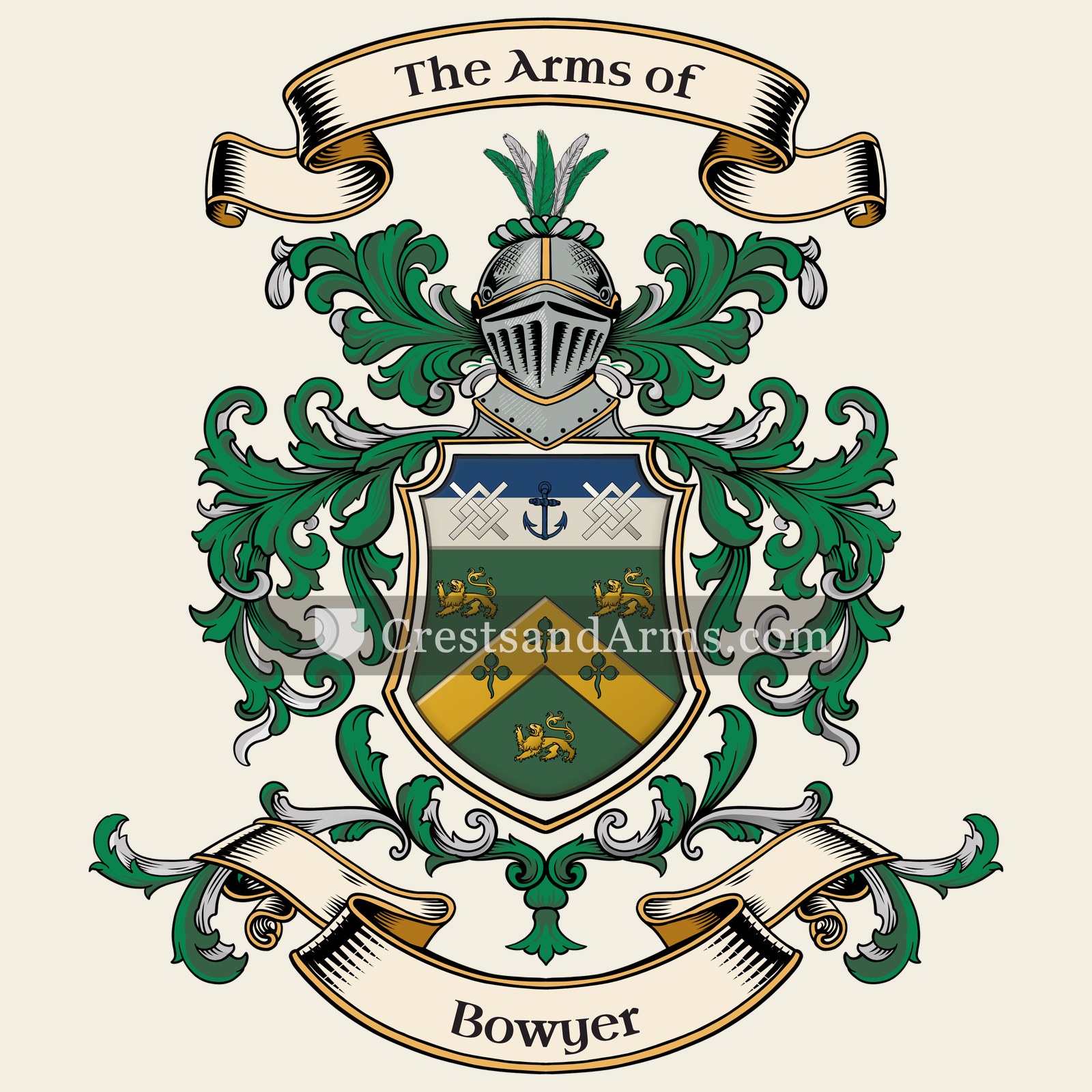
Symbols on this shield
chevronProtection, and faithful service completed
chiefAuthority, wisdom and dominion
anchorHope, and steadfastness in trouble
lionCourage, strength and royalty
trefoilPerpetuity, and the Trinity
fretPersuasion, and the net that holds
Colours
Green (Vert)Means: Hope
Gold (Or)Means: Generosity
Silver (Argent)Means: Peace and sincerity
Blue (Azure)Means: Loyalty and truth
Historical info
Source
Sir Bernard Burke, The General Armory of England, Scotland, Ireland and Wales, London: Harrison & Sons, 1884
Blazon (the actual original written record)
“Vert on a chev. betw. three lions' heads erased or, as many trefoils, slipped, of the field; on a chief barry wavy az. and ar. an anchor betw. two frets of the second”
EnglandLondon, c. 1543
Digital archive packCoat of arms PNG, gold border print PDF, vector SVG and the certificate of authenticity. Sent to your email in minutes.
Map of England showing where the Bowyer arms are recorded
The Bowyer arms were recorded in London, c. 1543.
This is where the arms were entered in the register. Families often moved to other parts of the country, so the same name can turn up in more than one region.
The body that granted and recorded arms in England in this period.
Henry VIII of England
Sovereign of the period
Henry VIII of England
1509–1547
Reigning in Britain when the Bowyer arms are first recorded.
How Arms Worked in England
English heraldry allowed arms to be shared by all legitimate descendants of the original owner. These symbols were treated as personal property that moved through the generations to all children. While the eldest son kept the original design, other family members could use the same shield without needing to change it or register their own unique versions.
Granting authority
The College of Arms in London has regulated the use of coats of arms throughout England and Wales since 1484.
How they got arms
Families typically obtained their coats of arms through a formal grant from the Crown or by proving their ancient right to them.
Where arms were recorded
All official coats of arms are recorded in the registers kept at the College of Arms, which date back to the fifteenth century.
The family's standing
Recorded among the armigerous families of England.
Origin & History of the Bowyer Family in England
The surname Bowyer is an occupational name that originated in medieval England to describe a person who crafted bows for hunting and warfare. As archery was a vital skill for both survival and national defense, these craftsmen held a respected position within their local communities. By the time records confirm the presence of the Bowyer family in London in 1543, the name had already transitioned from a simple job description into a hereditary family title. During this period, London was a rapidly growing center of trade and industry, and families like the Bowyers often integrated into the city’s guild system to maintain their professional standing. Their early history reflects the broader shift in English society where surnames became essential for tracking property, legal identity, and family lineage across generations.
Coat of Arms & Family Crest Details
Symbols on this shield
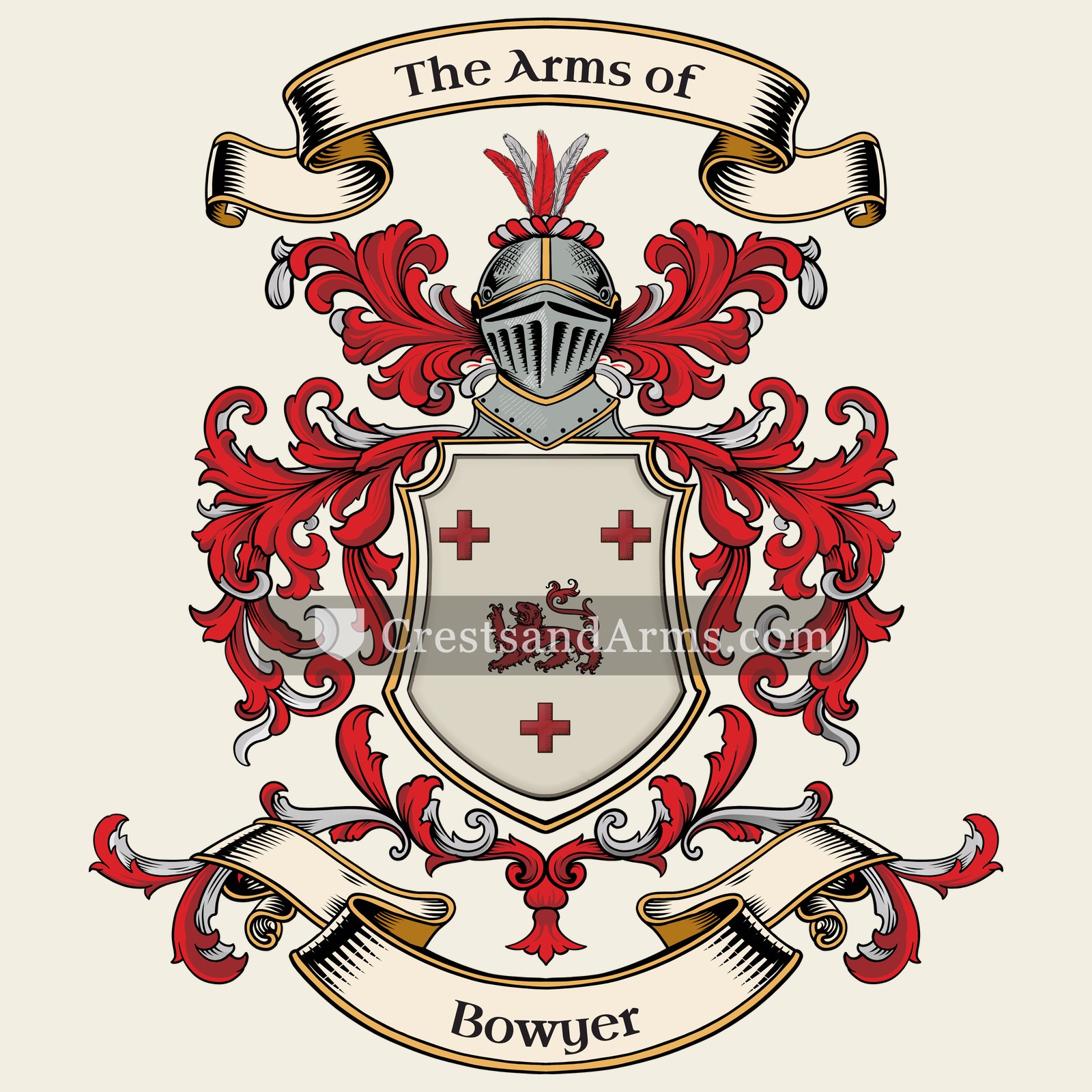
cross symbolChristian faith and service
lionCourage, strength and royalty
Colours
Silver (Argent)Means: Peace and sincerity
Red (Gules)Means: Military strength
Historical info
Source
Sir Bernard Burke, The General Armory of England, Scotland, Ireland and Wales, London: Harrison & Sons, 1884
Blazon (the actual original written record)
“Ar. a lion ramp. betw. three crosses crosslet fitchée gu”
Irelandc. 1678
Digital archive packCoat of arms PNG, gold border print PDF, vector SVG and the certificate of authenticity. Sent to your email in minutes.
Map of Ireland showing where the Bowyer arms are recorded
The Bowyer arms were recorded in Ireland, c. 1678.
Arms such as these were typically recorded in Dublin.
Dublin was the seat of government in Ireland and the place where grants were sought and recorded. Families with business at the castle or the courts settled nearby, and settling there put their arms on record.
This is where the arms were entered in the register. Families often moved to other parts of the country, so the same name can turn up in more than one region.
The body that granted and recorded arms in Ireland in this period.
Charles II of England
Sovereign of the period
Charles II of England
1660–1685
Reigning in Britain when the Bowyer arms are first recorded.
How Arms Worked in Ireland
The Ulster King of Arms granted coats of arms to individuals who proved their social standing and good character. These symbols were typically inherited by all legitimate descendants of the original holder. If a family branch wanted a unique look, they could apply for a specific change to their design through the office to ensure their identity remained distinct.
Granting authority
The Ulster King of Arms acted as the official body that regulated and issued all coats of arms throughout Ireland.
How they got arms
Families obtained their arms through formal grants issued by the office after proving their eligibility and paying the required fees.
Where arms were recorded
All official grants were recorded in the registers held by the Ulster King of Arms starting from the year 1552.
The family's standing
Recorded among the armigerous families of Ireland.
Origin & History of the Bowyer Family in Ireland
The surname Bowyer originates from the medieval occupation of a maker of bows, and it arrived in Ireland as part of the broader patterns of migration and trade during the seventeenth century. By 1678, records confirm that members of the Bowyer family were firmly established in Dublin, a city that served as a vital hub for administration and commerce at the time. These early settlers were likely drawn to the capital by the opportunities available in the growing urban economy, where their craft or professional skills could be applied in a rapidly developing society. As they integrated into the local community, the family became part of the diverse social fabric of Dublin, contributing to the city's growth during a period of significant political and cultural transition. Their presence in the official records of the late 1600s highlights how families with English or continental roots helped shape the professional landscape of Ireland’s capital during this era.
Bowyer Meaning & Related Branches
Root word
boga
Old English term for a bow or arch.
This name
BowyerAn occupational surname for a maker or seller of bows and arrows.
also spelled
Boyer
Bowier
Bowiar
Bowyear
Related arms
Boyaresimilar arms
Levettsimilar arms
Peaksimilar arms
Bowiervariant spelling
Documented Sources
J. B. Rietstap, Armorial Général, Gouda: G. B. van Goor Zonen, 1884–87
Bardsley, Charles Wareing, A Dictionary of English and Welsh Surnames, 1901
Reaney, Percy Hide, A Dictionary of British Surnames, 1958
The National Archives, Probate Records of the Prerogative Court of Canterbury, 1700
Kent History and Library Centre, Parish Registers of Kent, 1700
Digital archive packCoat of arms PNG, gold border print PDF, vector SVG and the certificate of authenticity. Sent to your email in minutes.


 cross symbolChristian faith and service
 cantonA mark of honour granted by the sovereign
 lionCourage, strength and royalty
 wheatsheafPlenty, and the harvest of one's own labour
 cross symbolChristian faith and service
 cantonA mark of honour granted by the sovereign
 lionCourage, strength and royalty
 wheatsheafPlenty, and the harvest of one's own labour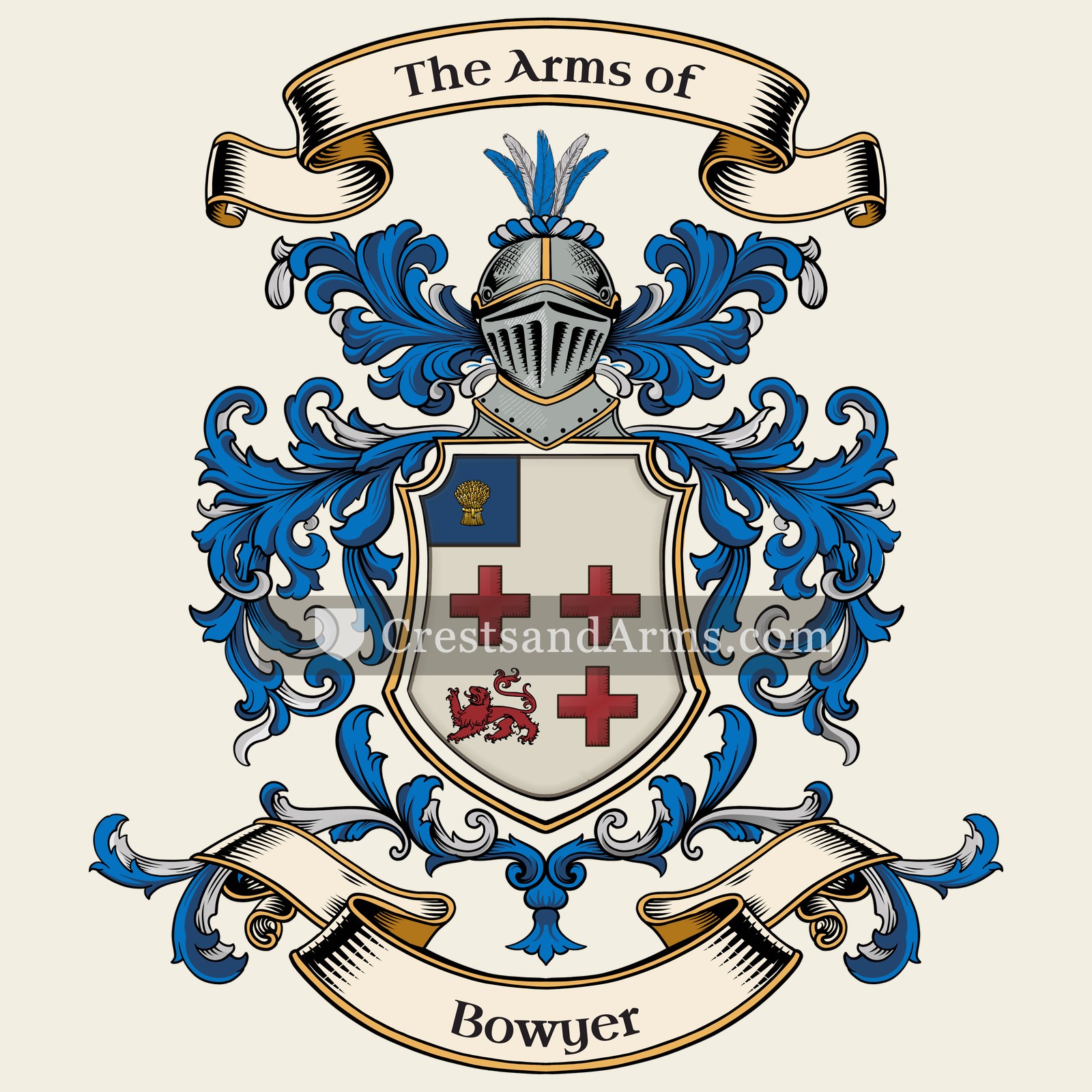


 chevronProtection, and faithful service completed
 chiefAuthority, wisdom and dominion
 anchorHope, and steadfastness in trouble
 trefoilPerpetuity, and the Trinity
 fretPersuasion, and the net that holds