Map of France showing where the Boyar arms are recorded
The Boyar arms were recorded in Lorraine, c. 1477.
Lorraine sat on the border between France and the German lands, and border country bred soldiers. Families here held small estates and served in arms, and a fighting man was exactly the sort who carried a shield of his own.
This is where the arms were entered in the register. Families often moved to other parts of the country, so the same name can turn up in more than one region.
The body that granted and recorded arms in France in this period.
Louis XI of France
Sovereign of the period
Louis XI of France
1461–1483
Reigning in France when the Boyar arms are first recorded.
How Arms Worked in France
In France, a coat of arms was a mark of honor that passed down through the male line to all legitimate descendants. Families often used the same shield without changes to show their shared heritage. If a branch wanted to stand out, they could add a small mark to their shield to show their specific place in the family tree.
Granting authority
The Juge d'armes de France acted as the official authority that regulated and verified coats of arms across the country.
How they got arms
Families typically inherited their arms from ancestors, though they could also receive them through royal grants or by proving their noble status.
Where arms were recorded
Coats of arms were officially recorded in the Armorial Général de France, which began its main collection in the year 1696.
The family's standing
Recorded among the armigerous families of Lorraine.
Origin & History of the Boyar Family in France
The history of the Boyar family in France is deeply rooted in the turbulent landscape of the late fifteenth century, specifically within the region of Lorraine. By 1477, the area was a focal point of European conflict, most notably during the Battle of Nancy, which saw the defeat of Charles the Bold, the Duke of Burgundy. Historical records suggest that families like the Boyars were established in this borderland during a time when the Duchy of Lorraine was struggling to maintain its independence between the powerful kingdoms of France and the Holy Roman Empire. The name likely functioned as a descriptor of social status or professional duty, reflecting the complex administrative and military roles required of those living in such a strategic territory. As the region transitioned through these shifts in power, the Boyar family became part of the local fabric, surviving the pressures of war and political instability that defined the late Middle Ages in eastern France.
Coat of Arms & Family Crest Details
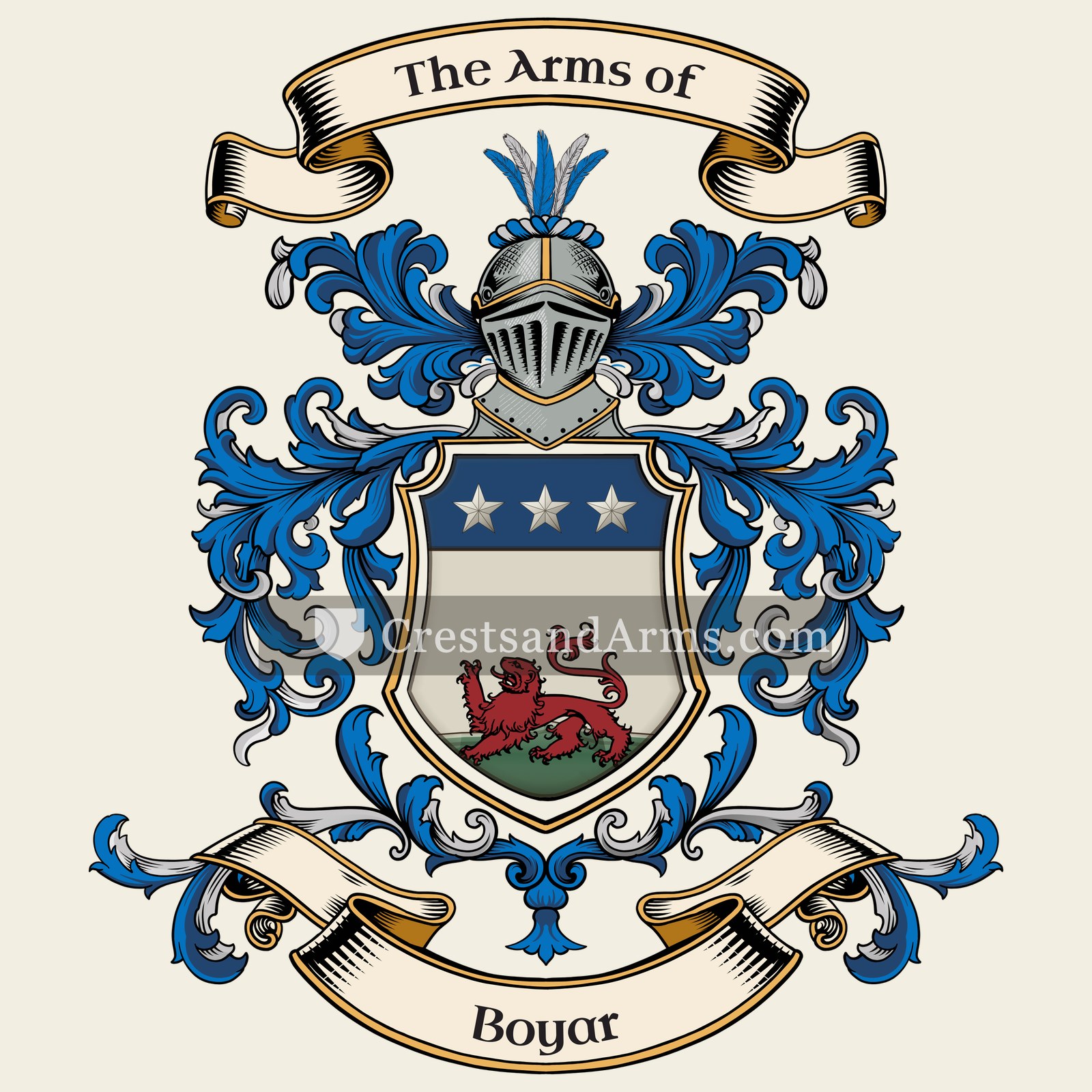
Symbols on this shield
mountThe ground held, and steadfastness upon it
chiefAuthority, wisdom and dominion
lionCourage, strength and royalty
mulletThe third son, and a divine quality from above
Colours
Silver (Argent)Means: Peace and sincerity
Blue (Azure)Means: Loyalty and truth
Green (Vert)Means: Hope
Red (Gules)Means: Military strength
Historical info
Source
J. B. Rietstap, Armorial Général, Gouda: G. B. van Goor Zonen, 1884–87
Blazon (the actual original written record)
“D'arg. au lion léopardé de gu., pass. sur une terrasse de sin.; au chef d'azur, ch. de trois étoiles (5) du champ.”
SwitzerlandNeufchâtel, c. 1745
Digital archive packCoat of arms PNG, gold border print PDF, vector SVG and the certificate of authenticity. Sent to your email in minutes.
Map of Switzerland showing where the Boyar arms are recorded
The Boyar arms were recorded in Neufchâtel, c. 1745.
This is where the arms were entered in the register. Families often moved to other parts of the country, so the same name can turn up in more than one region.
The body that granted and recorded arms in Switzerland in this period.
How Arms Worked in Switzerland
In Switzerland, coats of arms were not restricted to the nobility and were often adopted by common citizens and families. These symbols were passed down through generations to show family identity. When branches of a family grew, they often changed small details of the design to distinguish their own line from the original group.
Granting authority
Cantonal and civic authorities managed the use of coats of arms within their specific regions and local jurisdictions.
How they got arms
Families typically assumed their own coats of arms based on local custom rather than receiving them from a central monarch.
Where arms were recorded
Arms were recorded in various cantonal and civic registers starting from the fourteenth century throughout the Swiss region.
The family's standing
Recorded among the armigerous families of Switzerland.
Origin & History of the Boyar Family in Switzerland
The history of the Boyar family in Switzerland is rooted in the region of Neuchâtel, where records confirm their presence by the year 1745. During the eighteenth century, Neuchâtel was a unique principality that maintained a complex political relationship with the Prussian monarchy while operating under its own local customs and legal systems. Families like the Boyars often integrated into the local economy through skilled trades or agricultural work, which were the primary drivers of life in the Jura Mountains and the lakeside villages. As the family established themselves in this area, they became part of a society that valued meticulous record-keeping, particularly regarding church baptisms and civil registrations. This environment allowed the family to maintain a distinct identity as they navigated the social shifts of the Enlightenment era. By settling in this specific Swiss canton, the early members of the Boyar family contributed to the cultural fabric of a region known for its blend of French linguistic traditions and independent political spirit.
Related Branches & Arms
Root word
Boiar
A Slavic term denoting a member of the highest rank of nobility.
This name
BoyarRefers to a person of high social standing or a nobleman within feudal society.
also spelled
Boyier
Boyar
Boyay
Documented Sources
J. B. Rietstap, Armorial Général, Gouda: G. B. van Goor Zonen, 1884–87
Barthélemy, Édouard de. Histoire de la ville de Nancy. 1860
Schneider, Jean. La ville de Metz aux XIIIe et XIVe siècles. 1950
Archives départementales de Meurthe-et-Moselle, Série B: Cours et juridictions
Digital archive packCoat of arms PNG, gold border print PDF, vector SVG and the certificate of authenticity. Sent to your email in minutes.


 chiefAuthority, wisdom and dominion
 greyhoundCourage, vigilance and loyalty
 chiefAuthority, wisdom and dominion
 greyhoundCourage, vigilance and loyalty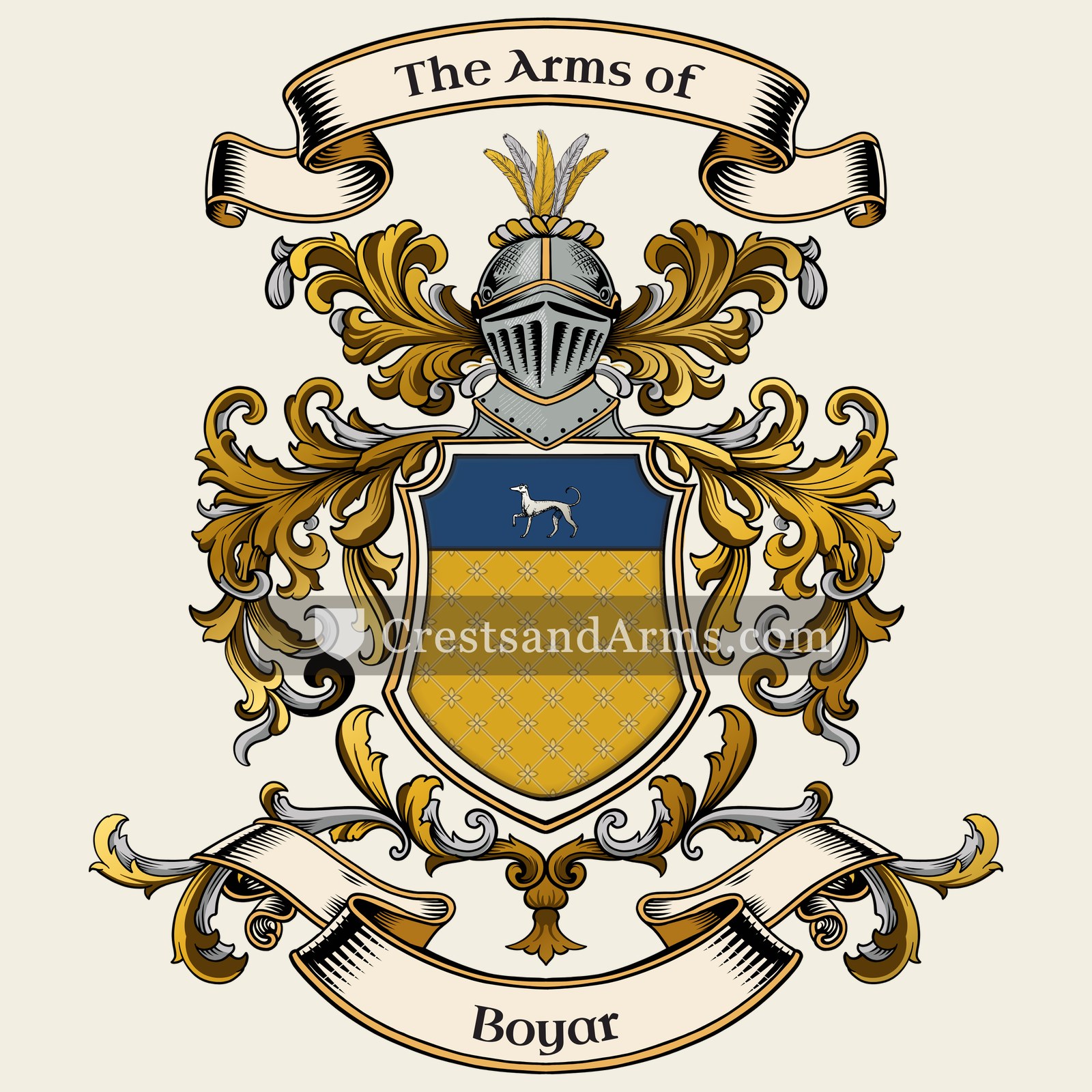


 mountThe ground held, and steadfastness upon it
 lionCourage, strength and royalty
 mulletThe third son, and a divine quality from above