A record of documented arms, meaning and origin, researched for the Boyden family lines. Documented in 3 countries.
Reg. 2927 · German, A–C
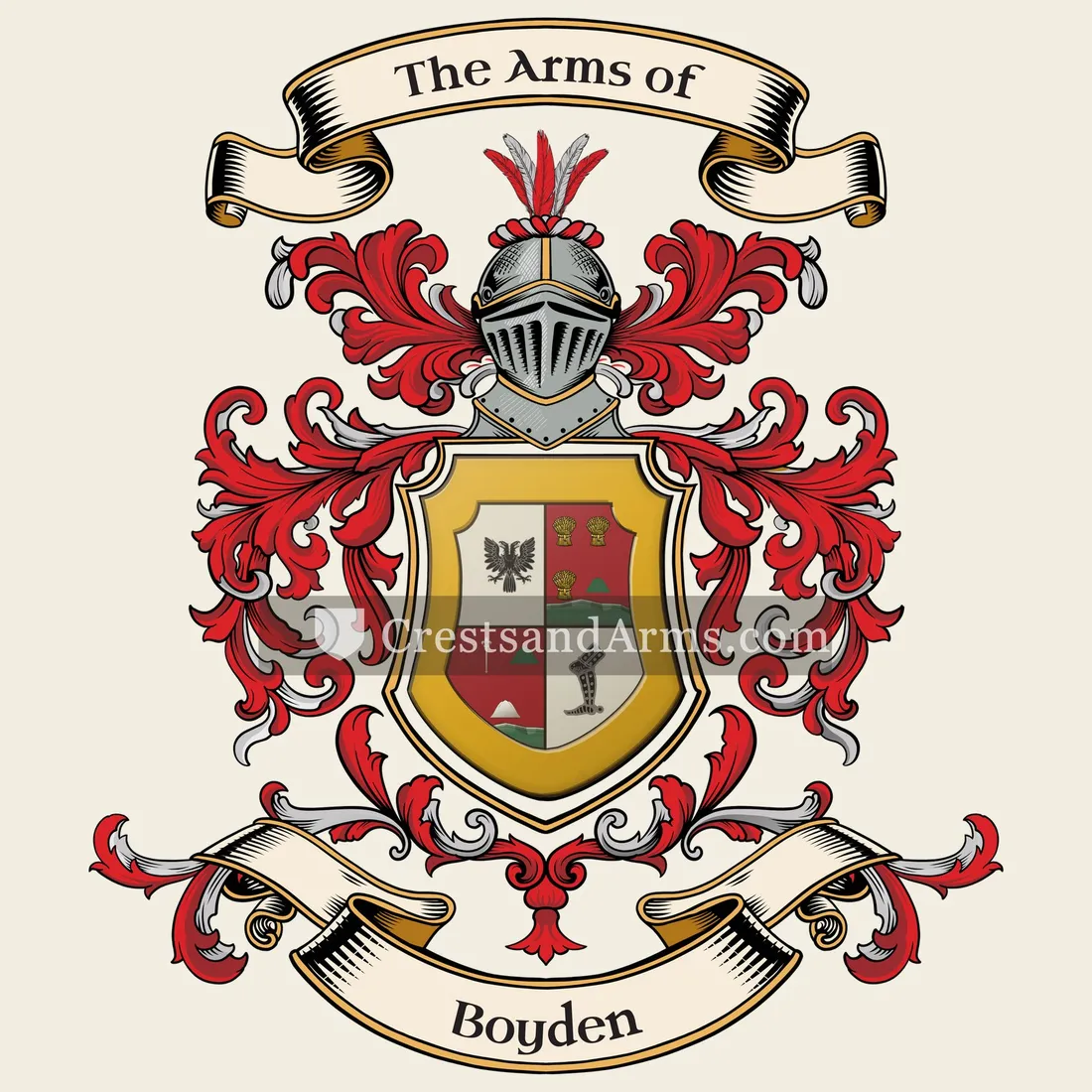
Meaning of the Boyden family crest colors & symbols
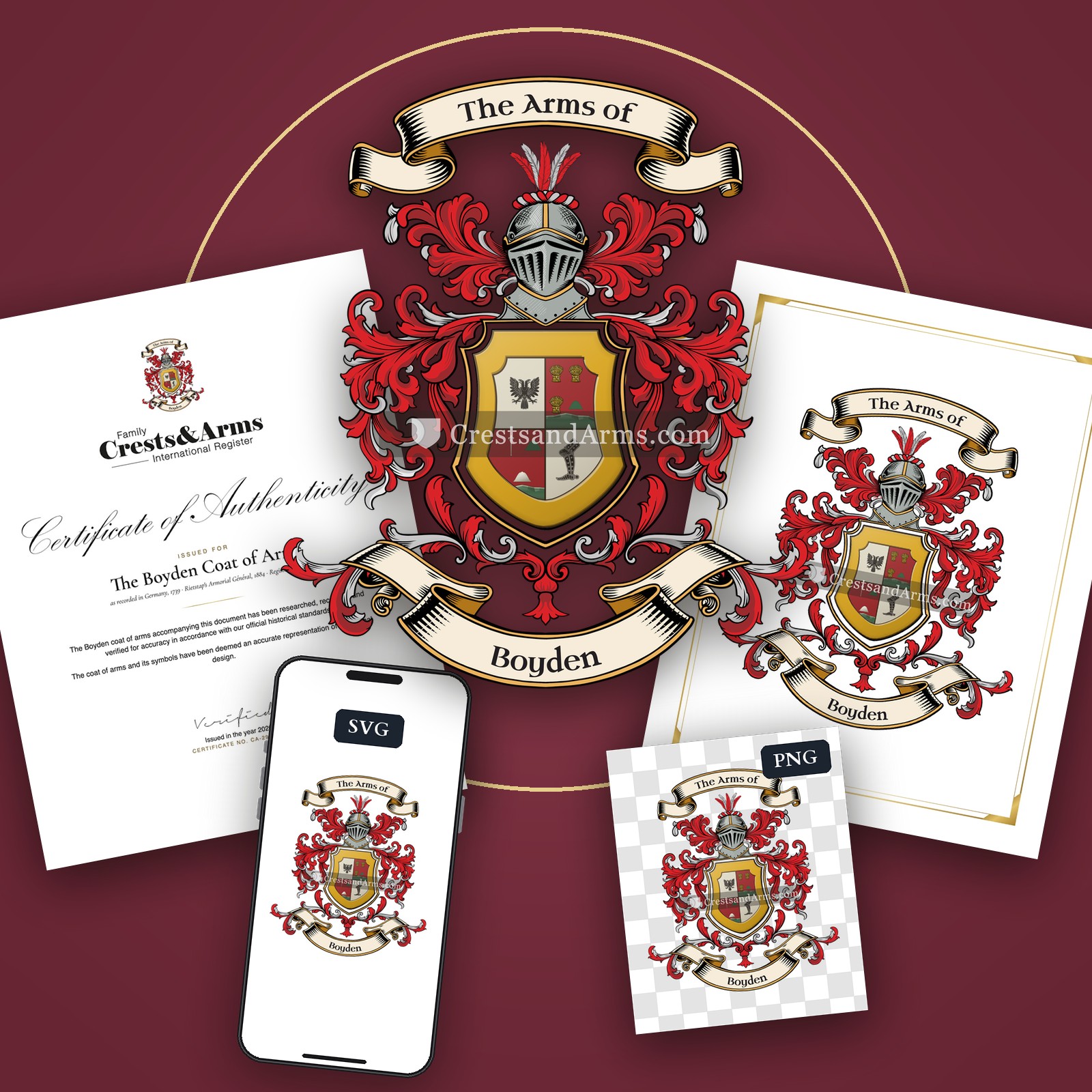
Symbols on this shield
mountThe ground held, and steadfastness upon it
eagleNobility, strength and a keen mind
wheatsheafPlenty, and the harvest of one's own labour
batonAuthority and office held under the crown
legStrength and swiftness
Colours
Silver (Argent)Means: Peace and sincerity
Red (Gules)Means: Military strength
Gold (Or)Means: Generosity
Green (Vert)Means: Hope
Black (Sable)Means: Constancy
Historical info
Source
J. B. Rietstap, Armorial Général, Gouda: G. B. van Goor Zonen, 1884–87
Blazon (the actual original written record)
“Ec.: au 1 d'arg. à la tête de l'aigle de Prusse; au 2 de gu. à trois épis d'or, tigés et feuillés de sin., rangés sur un tertre du même; au 3 d'azur à un messager au nat., tenant un bâton, pass. sur une terrasse de sin. soutenue d'un rocher d'arg.; au 4 d'arg. à un membre d'aigle de sa., la patte d'or. L'écu bordé d'or. C.: une étoile (8) d'or, entre un vol de l'aigle de Prusse. L.: à dextre d'or et de sa., à sen. d'or et de gu.”
Germanyc. 1739
Digital archive packCoat of arms PNG, gold border print PDF, vector SVG and the certificate of authenticity. Sent to your email in minutes.
Map of Germany showing where the Boyden arms are recorded
The Boyden arms were recorded in Germany, c. 1739.
Arms such as these were typically recorded in Bavaria.
Bavaria was a country of old landed families and walled market towns. Estates passed down the same line for centuries, and both the landowners and the leading townsmen kept arms, which is why so many Bavarian names sit in the registers.
This is where the arms were entered in the register. Families often moved to other parts of the country, so the same name can turn up in more than one region.
The body that granted and recorded arms in Germany in this period.
Charles VI, Holy Roman Emperor
Sovereign of the period
Charles VI, Holy Roman Emperor
1711–1740
Reigning in Germany when the Boyden arms are first recorded.
How Arms Worked in Germany
In the Holy Roman Empire, coats of arms were often granted to individuals by the Emperor or his representatives. These arms were then passed down through the generations to all legitimate descendants of the original holder. Younger branches of a family usually kept the same shield design without needing to change it, as the arms belonged to the entire lineage.
Granting authority
The Holy Roman Emperor held the sole power to grant new coats of arms throughout his vast imperial territories.
How they got arms
Families typically obtained their coats of arms through a formal imperial grant or by proving their noble status to the authorities.
Where arms were recorded
These grants were officially recorded in the Imperial Chancery registers, which began keeping formal records of such honors during the Middle Ages.
The family's standing
Recorded among the armigerous families of Germany.
Origin & History of the Boyden Family in Germany
The Boyden family name has deep roots in the historical landscape of Bavaria, where records confirm the presence of family members as early as 1739. During this period, the region was part of the Holy Roman Empire and was defined by a society centered on agriculture and local craftsmanship. Families like the Boydens often lived in small, tight-knit village communities where their surname likely evolved from a descriptive nickname or a reference to a specific geographic location. As the eighteenth century progressed, the family would have navigated the complex social structures of the Bavarian electorate, likely working as farmers or skilled tradespeople who contributed to the local economy. This era was a time of significant transition, and the Boyden family history reflects the broader movement of people who helped shape the cultural identity of southern Germany through their daily labor and community involvement.
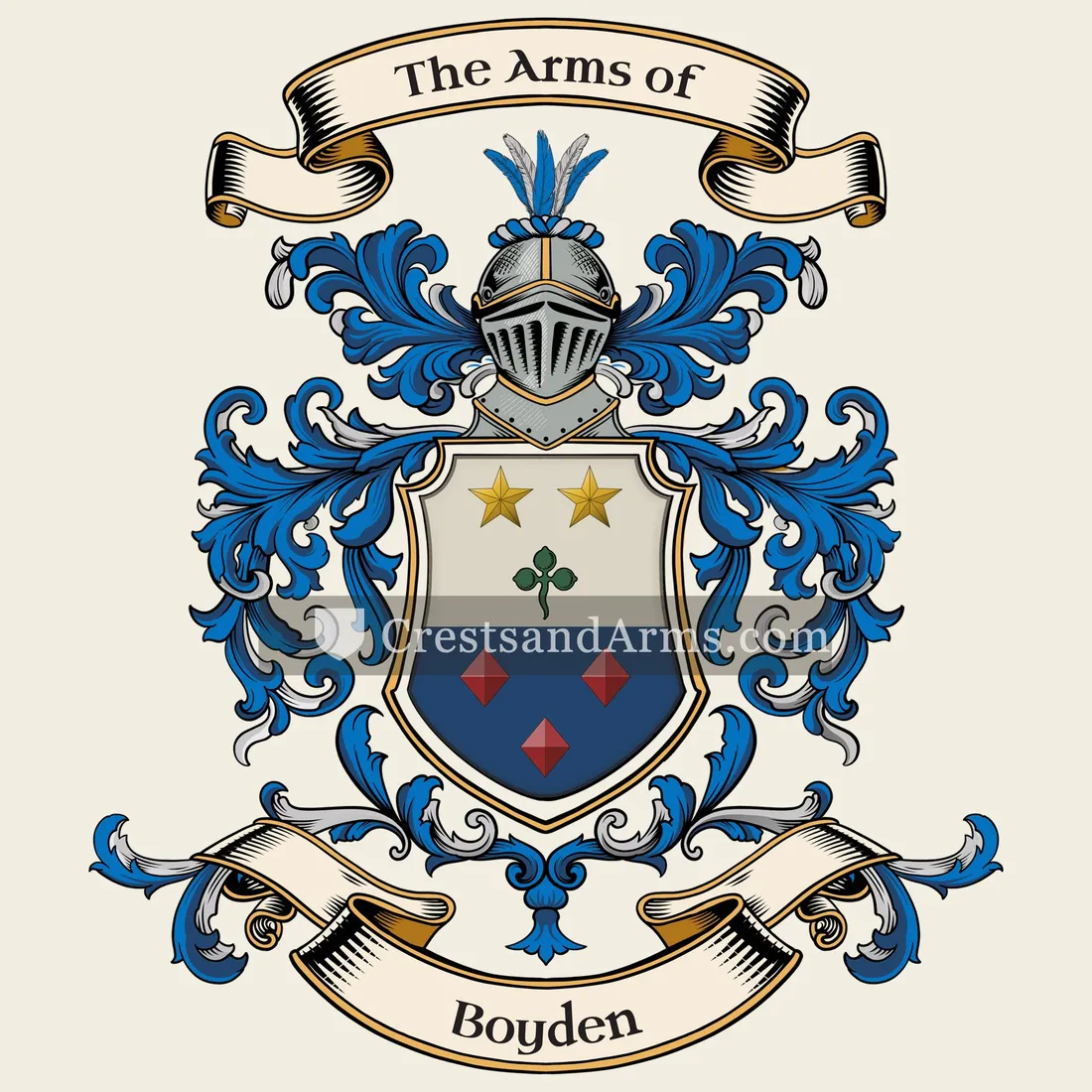
Meaning of the Boyden family crest colors & symbols
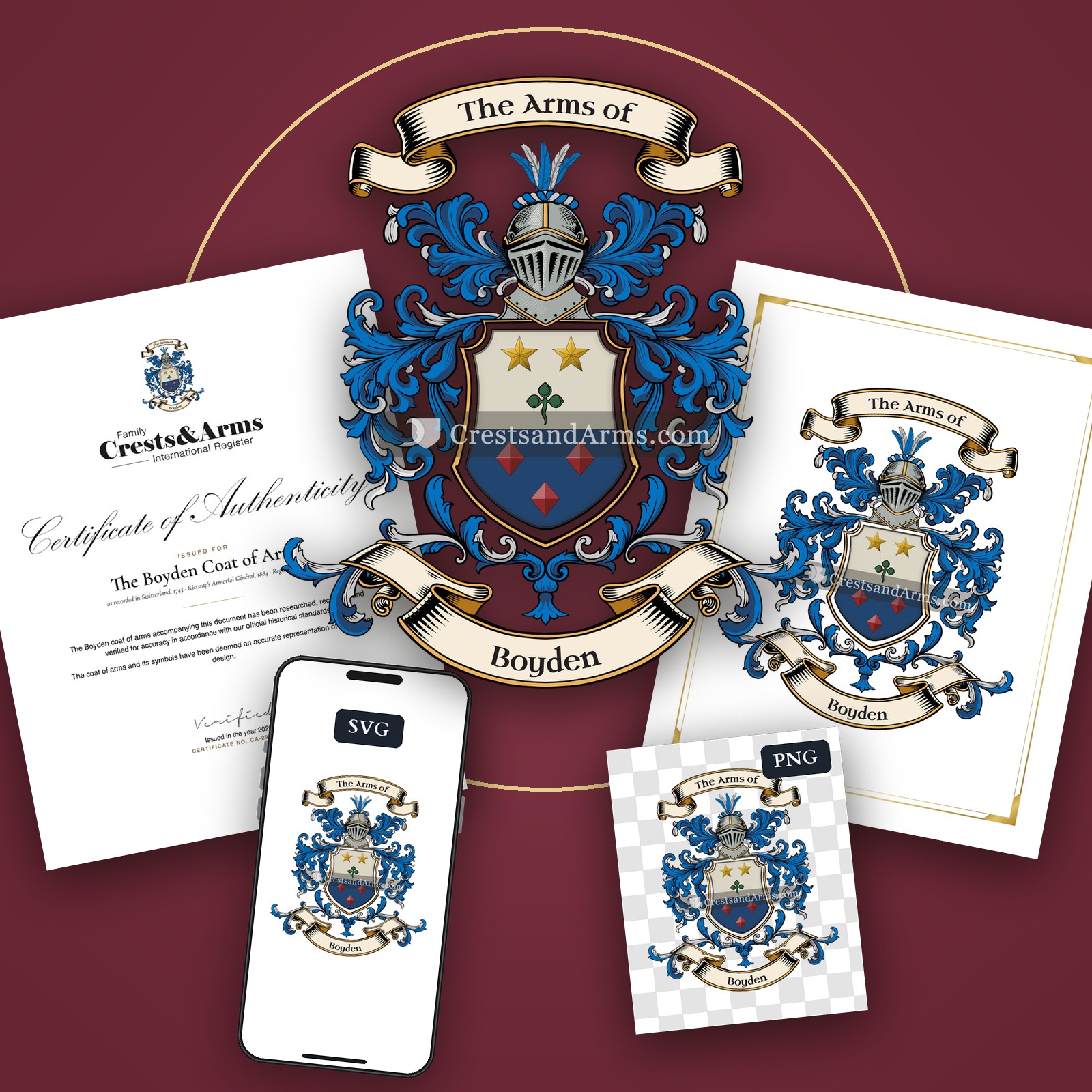
Symbols on this shield
trefoilPerpetuity, and the Trinity
mulletThe third son, and a divine quality from above
lozengeHonour and nobility, and the arms of a woman
Colours
Silver (Argent)Means: Peace and sincerity
Blue (Azure)Means: Loyalty and truth
Green (Vert)Means: Hope
Gold (Or)Means: Generosity
Red (Gules)Means: Military strength
Historical info
Source
J. B. Rietstap, Armorial Général, Gouda: G. B. van Goor Zonen, 1884–87
Blazon (the actual original written record)
“Coupé: au 1 d'arg. à un trèfle de sin., accosté de deux étoiles (5) d'or; au 2 d'azur à trois losanges de gu. taillées à quatre facettes, rangées en fasce et touchant les bords.”
Switzerlandc. 1745
Digital archive packCoat of arms PNG, gold border print PDF, vector SVG and the certificate of authenticity. Sent to your email in minutes.
Map of Switzerland showing where the Boyden arms are recorded
The Boyden arms were recorded in Switzerland, c. 1745.
Arms such as these were typically recorded in Bern.
Bern was the largest of the Swiss cantons and ran itself, with its own council and its own courts. Its governing families held office for generations, and office of that kind carried a shield with it.
This is where the arms were entered in the register. Families often moved to other parts of the country, so the same name can turn up in more than one region.
The body that granted and recorded arms in Switzerland in this period.
How Arms Worked in Switzerland
In Switzerland, coats of arms were not restricted to the nobility and were often adopted by common citizens and families. These symbols were passed down through generations to show family identity. When branches of a family grew, they often changed small details of the design to distinguish their own line from the original group.
Granting authority
Cantonal and civic authorities managed the use of coats of arms within their specific regions and local jurisdictions.
How they got arms
Families typically assumed their own coats of arms based on local custom rather than receiving them from a central monarch.
Where arms were recorded
Arms were recorded in various cantonal and civic registers starting from the fourteenth century throughout the Swiss region.
The family's standing
Recorded among the armigerous families of Switzerland.
Origin & History of the Boyden Family in Switzerland
The history of the Boyden name in Switzerland is deeply rooted in the social and administrative landscape of the eighteenth century, particularly within the city-state of Bern. By 1745, records indicate that members of the family were established residents of this region, which was then a powerful center of political and economic influence. During this period, families in Bern were often categorized by their professional guilds or their contributions to the city’s civic life. As the Boyden name appeared in local registries, it likely reflected a family integrated into the structured society of the Swiss Confederation. These early ancestors lived through a time of significant transition in Switzerland, where local citizenship and residency were strictly documented to manage the growing urban population. Their presence in Bern suggests that the family was part of the foundational fabric of the city, participating in the daily commerce and community governance that defined the era.
Meaning of the Boyden family crest colors & symbols
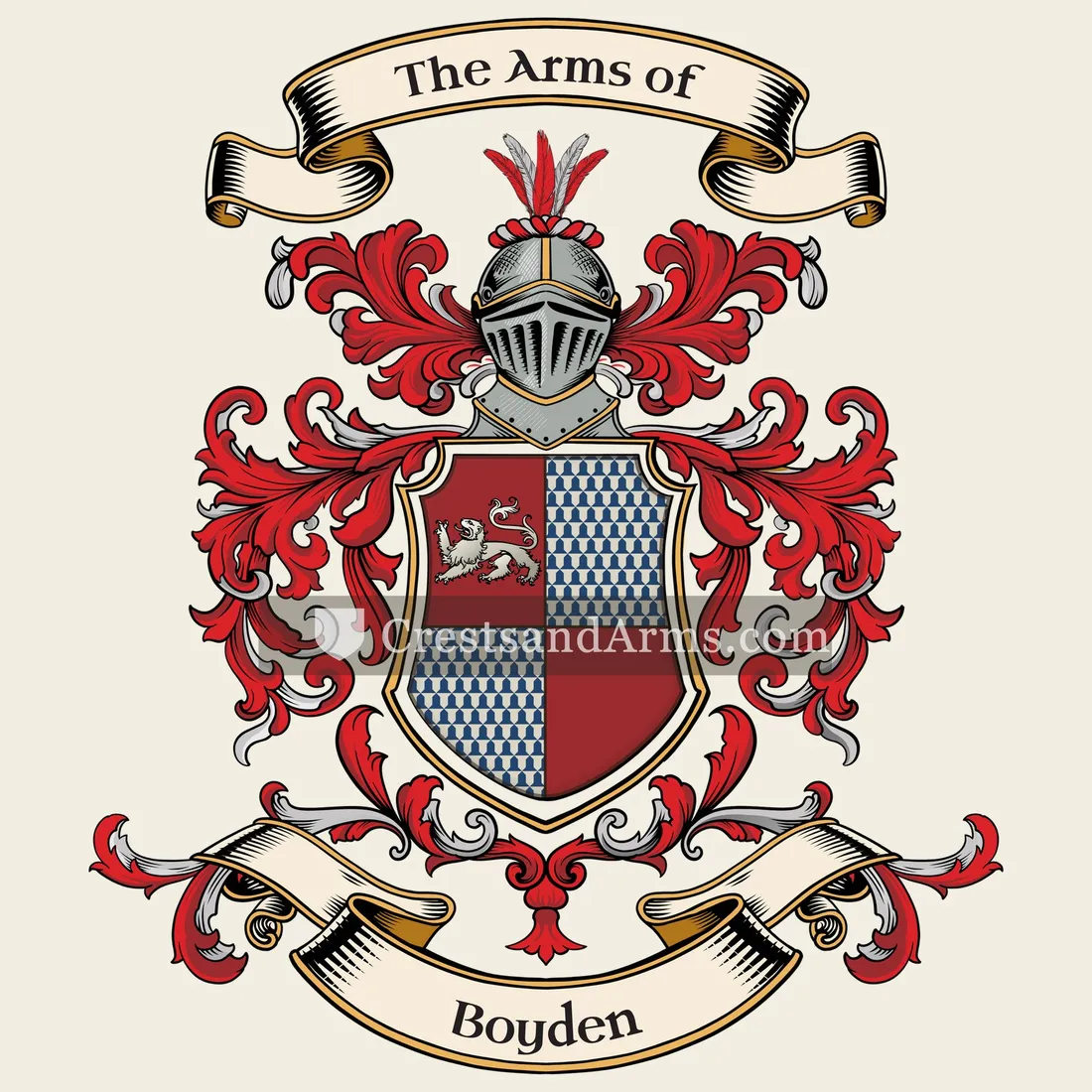
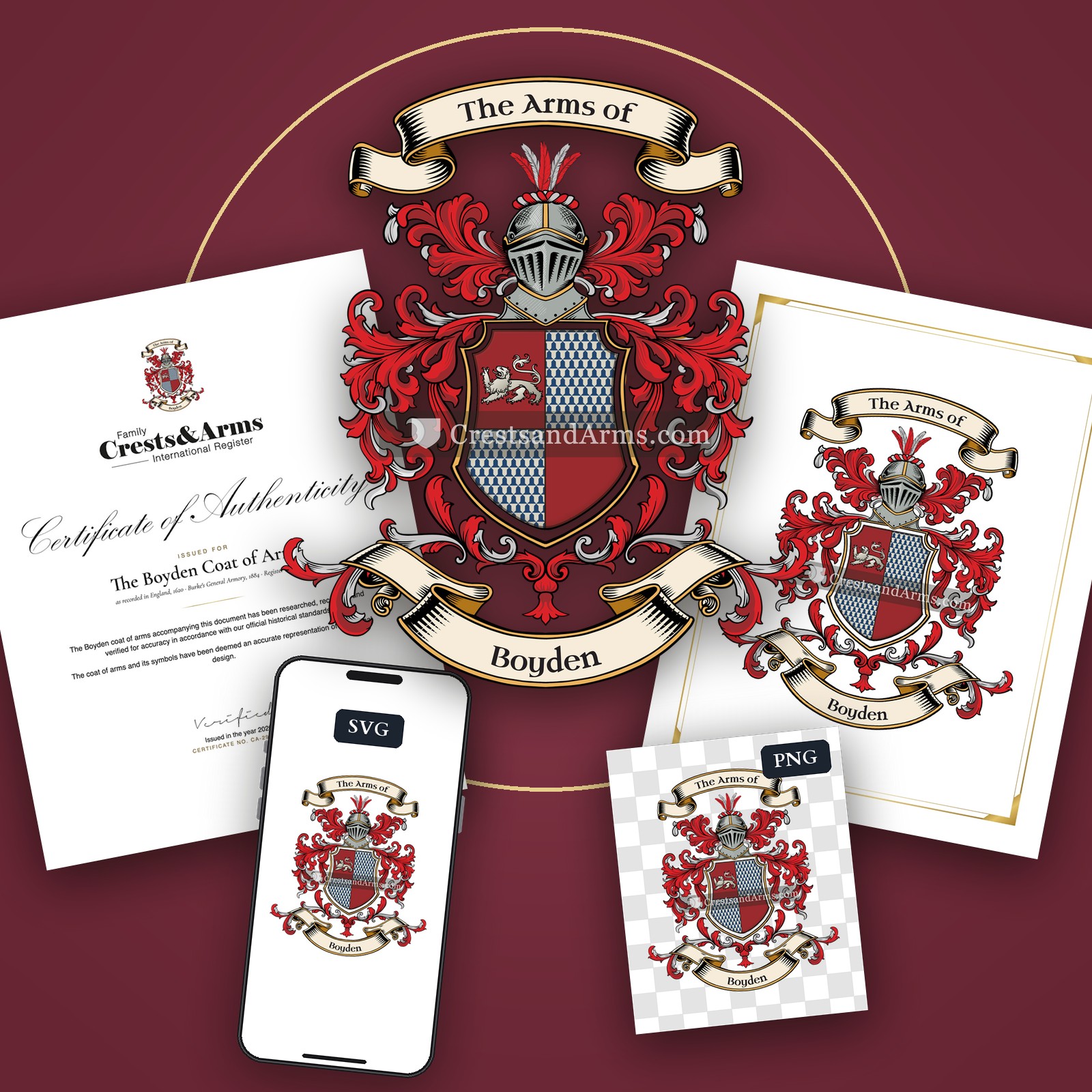
Symbols on this shield
vairProtection, and the winter fur
lionCourage, strength and royalty
Colours
Red (Gules)Means: Military strength
VairMeans: Protection
Silver (Argent)Means: Peace and sincerity
Historical info
Source
Sir Bernard Burke, The General Armory of England, Scotland, Ireland and Wales, London: Harrison & Sons, 1884
Blazon (the actual original written record)
“Quarterly gu. and vair, in the first quarter a lion pass. ar”
LancasterWorsley · Lancaster, c. 1620
Digital archive packCoat of arms PNG, gold border print PDF, vector SVG and the certificate of authenticity. Sent to your email in minutes.
Map of England showing where the Boyden arms are recorded
The Boyden arms were recorded in Lancaster, c. 1620.
Lancashire was divided among a great many small landed families, more than most northern counties. Estates were passed down whole rather than split up, so the same names hold the same ground for centuries in the records.
This is where the arms were entered in the register. Families often moved to other parts of the country, so the same name can turn up in more than one region.
The body that granted and recorded arms in England in this period.
James VI and I
Sovereign of the period
James VI and I
1603–1625
Reigning in Germany when the Boyden arms are first recorded.
How Arms Worked in England
English heraldry allowed arms to be shared by all legitimate descendants of the original owner. These symbols were treated as personal property that moved through the generations to all children. While the eldest son kept the original design, other family members could use the same shield without needing to change it or register their own unique versions.
Granting authority
The College of Arms in London has regulated the use of coats of arms throughout England and Wales since 1484.
How they got arms
Families typically obtained their coats of arms through a formal grant from the Crown or by proving their ancient right to them.
Where arms were recorded
All official coats of arms are recorded in the registers kept at the College of Arms, which date back to the fifteenth century.
The family's standing
Recorded among the armigerous families of Lancaster.
Origin & History of the Boyden Family in England
The surname Boyden has deep roots in the English landscape, with historical records placing the family in the county of Lancaster as early as the seventeenth century. The name is generally considered to be of locative or topographical origin, likely derived from the Old English words for a dwelling or a specific valley. During the early 1600s, families bearing this name were part of the social fabric of Northern England, living through a period of significant religious and political transition. As the family established itself in Lancaster, they were part of a growing class of yeoman farmers and tradespeople who helped shape the local economy of the region. By 1620, the Boyden name was already well-integrated into the local parish records, which served as the primary way for officials to track births, marriages, and deaths within the community. This period of history reflects a time when families were beginning to move more freely across the English countryside, yet they remained deeply connected to the specific towns where their ancestors had first settled.
Boyden Meaning & Related Branches
Root word
Bode
Derived from the Old High German word for messenger or herald.
This name
BoydenA patronymic surname indicating descent from a messenger or a person serving as an envoy.
also spelled
Boddin
Bodenh
Bodenn
Bodin
Bodyn
Documented Sources
J. B. Rietstap, Armorial Général, Gouda: G. B. van Goor Zonen, 1884–87


 mountThe ground held, and steadfastness upon it
 eagleNobility, strength and a keen mind
 wheatsheafPlenty, and the harvest of one's own labour
 batonAuthority and office held under the crown
 legStrength and swiftness
 mountThe ground held, and steadfastness upon it
 eagleNobility, strength and a keen mind
 wheatsheafPlenty, and the harvest of one's own labour
 batonAuthority and office held under the crown
 legStrength and swiftness


 trefoilPerpetuity, and the Trinity
 mulletThe third son, and a divine quality from above
 lozengeHonour and nobility, and the arms of a woman

 lionCourage, strength and royalty